Home
» New Trends
»
The Business of Carbon Capture: Engineering Choices and Tradeoffs on the Road to Net Zero
The Business of Carbon Capture: Engineering Choices and Tradeoffs on the Road to Net Zero
Carbon capture is becoming a real infrastructure business, but it is not a single technology and it is not a universal substitute for cutting emissions at the source. The commercial opportunity sits across an interconnected chain: separating carbon dioxide, conditioning and compressing it, moving it, using it or injecting it underground, and proving that the claimed climate benefit is real.
That distinction matters more in 2026 because the market is moving from one-off demonstration projects toward shared transport and storage networks. The International Energy Agency reported in March 2026 that more than 30 carbon capture, utilization, and storage projects had reached final investment decisions during the previous two years, while investment exceeded $5 billion in 2025. At the same time, Norway's Longship project entered operation in 2025, creating a full capture-to-storage value chain that can also serve industrial customers outside Norway. These developments do not make every carbon capture project economical, but they make the business model more concrete than it was a few years ago. See the IEA's 2026 financing analysis and the Norwegian government's Longship update.
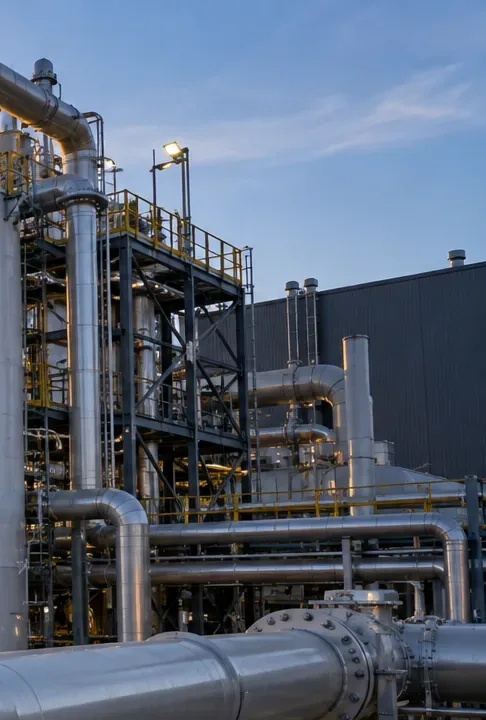
Stainless-steel process towers and large-diameter piping show the kind of industrial infrastructure needed to separate, compress, and move captured carbon dioxide.
The first business decision: what problem are you actually trying to solve?
A cement company, a natural gas processor, a direct air capture developer, and a CO2 storage operator may all be described as being in the carbon capture business, yet their economics are fundamentally different. The right engineering choice depends on the carbon source, the concentration of CO2, the availability of low-carbon energy, proximity to transport and storage, local regulation, and who is willing to carry long-term performance and liability risk.
Option
Best fit
Main advantage
Main tradeoff
Point-source capture
Cement, chemicals, refining, hydrogen, steel, power, and other large emitters
Prevents a portion of a concentrated emission stream from reaching the atmosphere
Adds equipment, energy use, operating cost, and dependence on transport or storage
Direct air capture
Carbon removal where durable storage and low-carbon energy are available
Removes CO2 already dispersed in the atmosphere and offers more siting flexibility
Air contains very little CO2, so separation is energy- and equipment-intensive
Geologic storage
Projects seeking durable isolation of large CO2 volumes
Can provide long-duration storage at scale
Requires suitable geology, permitting, monitoring, financial assurance, and long-term stewardship
CO2 utilization
Projects with a nearby market for products that use captured CO2
May add product revenue and reduce transport distance
Climate value varies by product lifetime and lifecycle emissions; not all uses are permanent storage
Shared hub model
Industrial clusters with multiple emitters near common transport and storage
Spreads infrastructure costs across customers
Creates coordination, volume, scheduling, and counterparty risks
Why the CO2 source changes the economics
One of the most important and most verifiable cost drivers is CO2 concentration. Separating carbon dioxide from a high-purity industrial stream is generally easier than extracting it from a dilute exhaust stream. U.S. Department of Energy technical material notes that high-concentration streams such as ethanol fermentation may need little more than dehydration and compression, while dilute flue gases require larger separation equipment and more energy. DOE also notes that capture systems for dilute streams tend to have higher capital and operating requirements. The underlying engineering reason is simple: more non-CO2 gas must be processed for each ton of CO2 recovered. See the DOE carbon capture technical assessment.
When point-source capture is the stronger choice
Point-source capture is usually the more practical starting point when a facility has a large, steady emission stream, especially if the stream is already relatively rich in CO2. It can also make sense in hard-to-abate industries where some emissions come from the chemistry of the production process rather than only from fuel combustion. Cement is the classic example: replacing the heat source does not eliminate the process CO2 released when limestone is converted into clinker.
The tradeoff is that a capture unit does not operate in isolation. Solvent regeneration, compressors, pumps, cooling systems, water treatment, maintenance, and downtime all affect the host plant. An operator should therefore compare the full cost per ton avoided, not merely the capture percentage or the nameplate cost of the capture island. A system that captures a high share of stack CO2 but causes large upstream energy emissions can deliver a smaller net benefit than the headline rate suggests.
When direct air capture may be justified
Direct air capture, or DAC, solves a different problem. Instead of preventing a new emission at a stack, it removes CO2 from ambient air. That makes it relevant for durable carbon removal, especially where residual emissions cannot yet be eliminated. It also offers more geographic flexibility because the plant does not have to sit beside a smokestack.
The penalty is dilution: atmospheric CO2 is far less concentrated than industrial exhaust. That means moving large volumes of air and regenerating capture materials, which makes energy source, heat integration, climate, and storage access central to project economics. A DAC project powered by high-emission energy would undermine its purpose, so developers need to evaluate the full lifecycle rather than the capture equipment alone. The U.S. Department of Energy's Regional Direct Air Capture Hubs program illustrates the scale at which governments are trying to demonstrate integrated DAC, infrastructure, and permanent storage.
Capture technology is only one engineering choice
Commercial carbon capture can use chemical solvents, physical solvents, sorbents, membranes, cryogenic separation, or combinations of these methods. There is no single winner across all gas streams.
Chemical absorption can work well with low-concentration flue gas, but solvent regeneration requires heat and the plant must manage degradation, corrosion, and chemical consumption.
Physical solvents and membranes become more attractive when CO2 partial pressure and concentration are higher. Modular membrane systems can simplify construction, but separation performance can fall for low-pressure, dilute streams.
Solid sorbents can reduce liquid handling and may offer attractive heat-integration pathways, but cyclic durability, mass transfer, and scale-up are key engineering questions.
Process-integrated capture may be preferable to a retrofit when a plant is new or undergoing major redesign, because the entire process can be optimized around capture rather than adding equipment after the fact.
For an existing industrial asset, retrofitability may matter more than theoretical efficiency. Space, steam availability, cooling-water capacity, tie-in windows, and the cost of production outages can dominate a project that looks attractive on a laboratory flowsheet.
Transport and storage can decide whether capture has a business case
Captured CO2 has little value if there is nowhere reliable to send it. The IEA describes pipelines, ships, rail, and trucks as transport options, with the appropriate choice depending on project scale, geography, and network maturity. A single small source may prefer truck or ship logistics during an early phase, while a large cluster with stable volumes can justify dedicated pipeline infrastructure. See the IEA overview of CCUS transport and storage.
The hub model is increasingly important because shared infrastructure can turn transport and storage from a bespoke cost into a service. Norway's Northern Lights system is a useful real-world example: liquefied CO2 is moved by ship to a receiving terminal before injection beneath the seabed. The Norwegian government states that phase one has 1.5 million metric tons per year of storage capacity and that an approved second phase is intended to raise capacity to more than 5 million tons per year. That model can serve emitters that do not own a reservoir or pipeline network.
For customers, however, outsourcing transport and storage replaces engineering risk with contractual risk. A capture plant can be technically ready but unable to operate if the ship, pipeline, injection well, or storage permit is delayed. Contracts therefore need to address minimum volumes, temporary outages, quality specifications, pressure and moisture limits, take-or-pay obligations, force majeure, and who pays when one part of the chain is unavailable.
Permanent storage has a regulatory cost—and that is part of the product
Geologic storage is not simply pumping CO2 underground. In the United States, EPA Class VI requirements for geologic sequestration include site characterization, modeling of the CO2 plume and pressure front, well construction standards, testing and monitoring, emergency plans, financial responsibility, post-injection care, and closure requirements. EPA states that these rules are designed to protect underground sources of drinking water throughout the project lifecycle. See the EPA Class VI program.
That regulatory burden raises development cost and lead time, but it also creates part of the commercial value of a storage service: customers are paying not just for pore space, but for characterized geology, permitted wells, measurement, monitoring, verification, operational discipline, and long-term compliance.
Storage versus utilization: do not treat every ton the same
Using captured CO2 in a product can create revenue, but the climate outcome depends on what happens next. CO2 mineralized into certain building materials can be durably bound; CO2 converted into a fuel may later return to the atmosphere when the fuel is used. The useful business question is therefore not “Can we sell the CO2?” but “How much CO2 is permanently isolated or credibly displaced over the full lifecycle, and what is that worth?”
U.S. tax rules reflect this distinction. IRS guidance requires lifecycle analysis for certain utilization claims under Section 45Q, and the amount considered utilized is tied to carbon oxide demonstrated to be permanently isolated or displaced based on that analysis. The IRS also requires annual documentation and contractual information for parties involved in disposal, injection, or utilization. See the current IRS Instructions for Form 8933.
Policy can change the project ranking
Carbon capture projects often have a gap between the cost of building and operating the system and the direct market value of the captured CO2. Tax credits, contracts for difference, carbon prices, regulated emission limits, grants, and public infrastructure can close that gap, but they also introduce policy risk.
United States: tax-credit economics
Section 45Q is one of the most important U.S. mechanisms because it places a value on qualifying captured carbon oxide. The rules have continued to evolve. IRS instructions revised in December 2025 note that Public Law 119-21 standardized the base credit amount for facilities or equipment placed in service after July 4, 2025, while DAC continues to have separate statutory treatment. Projects may also face prevailing-wage, apprenticeship, registration, transferability, documentation, and measurement requirements. Because the final value depends on project dates and eligibility, developers should model the tax structure with current IRS guidance rather than relying on an old headline dollar figure. The IRS maintains a dedicated 45Q carbon oxide sequestration credit page.
Europe: building storage as infrastructure
The European Union is attacking a different bottleneck: storage availability. Under the Net-Zero Industry Act, the EU has a target of at least 50 million metric tons per year of CO2 injection capacity by 2030. In a May 2026 progress update, the European Commission reported three storage sites already permitted and seven more in permitting, while noting that further projects are still needed to reach the target. See the European Commission's 2030 carbon storage target.
For industrial companies, this matters because a regional storage market can reduce the need for every emitter to develop its own reservoir. For storage developers, it creates a potential infrastructure business built around injection capacity, transport links, and long-term monitoring.
How to choose a carbon capture strategy by need
If you operate a high-purity CO2 source
Start with the simplest separation pathway and focus due diligence on compression, dehydration, transport, and storage access. Ethanol, ammonia, and some hydrogen or natural gas processing streams can be materially easier to capture than dilute combustion exhaust. The project may succeed or fail based more on logistics and contracting than on separator technology.
If you operate cement, lime, steel, or another hard-to-abate plant
Compare capture against process redesign, electrification, alternative feedstocks, and fuel switching rather than assuming capture is automatically required. If unavoidable process emissions remain, carbon capture can become especially valuable. Prioritize heat integration, retrofit space, outage planning, and access to a shared CO2 network.
If you are developing a new power plant
Model the complete system, including fuel, capture energy, compression, cooling, capacity factor, transport, storage fees, and residual emissions. A power project with capture competes not only with an unabated plant but also with renewables, storage, nuclear power, demand response, grid expansion, and other low-carbon options. The answer will vary by grid and region.
If your objective is carbon removal
DAC or biogenic CO2 capture with durable storage may fit the objective better than ordinary fossil point-source capture because they can remove atmospheric carbon on a net basis when lifecycle emissions are sufficiently low. The critical checks are low-carbon energy, verified storage, monitoring, and credible accounting.
If you are an infrastructure investor
Transport and storage hubs can resemble other regulated or contracted infrastructure businesses: high upfront capital, long asset lives, and revenue tied to throughput commitments. Favor clusters with multiple credible emitters, diversified contracts, expandable storage, and clear permitting. Be cautious where the investment case depends on one customer or one unproven capture project reaching full volume on schedule.
The business case is a chain, not a capture percentage
The strongest carbon capture projects align five things at once: a technically favorable CO2 source, reliable low-carbon energy and utilities, a bankable transport route, permitted and monitored storage or credible utilization, and a policy or customer value high enough to pay for the full chain.
That is why there is no universally “best” carbon capture technology. A high-purity industrial stream next to a storage hub can be compelling with relatively conventional engineering. A dilute source hundreds of miles from storage may be expensive even with an efficient solvent. DAC may be strategically valuable for removals while remaining much more demanding than point-source separation. Utilization can create revenue but must be evaluated product by product for durability and lifecycle emissions.
The practical recommendation is to make decisions in that order: first identify which emissions truly need capture, then characterize the gas stream, then secure transport and storage, and only after that optimize the capture technology and financing structure. Carbon capture can support deep decarbonization and carbon removal, but calling the destination a “zero-emission future” should not obscure the engineering reality: residual emissions, energy use, upstream impacts, leakage risk, and lifecycle accounting still matter. The business succeeds when those constraints are measured and priced rather than ignored.