Home
» New Trends
»
Predictive Logistics: Where Big Data and AI Actually Improve Cross-Border Supply Chains
Predictive Logistics: Where Big Data and AI Actually Improve Cross-Border Supply Chains
The most important point is simple: predictive logistics creates value only when a forecast can change a real operating decision before a delay, border hold, missed connection, or inventory shortage happens. The AI model is not the product. The useful product is an earlier, better decision about routing, documentation, capacity, inventory, or customer commitments.
That distinction matters more in 2026 because the data environment for cross-border trade is becoming more structured and machine-readable. The World Bank's 2025 Logistics Performance Indicators 2.0 shifted from perception-based surveys toward shipment-level operational data from maritime, aviation, and postal networks. In the European Union, the Commission says that as of June 1, 2026, consignments entering EU territory by any mode should have a valid Entry Summary Declaration, or ENS, submitted through the relevant advance cargo information process. The EU's broader customs reform, politically agreed on March 26, 2026, also points toward a shared data architecture and AI-assisted risk analysis. Those developments make predictive logistics more practical, but they do not make it automatic.
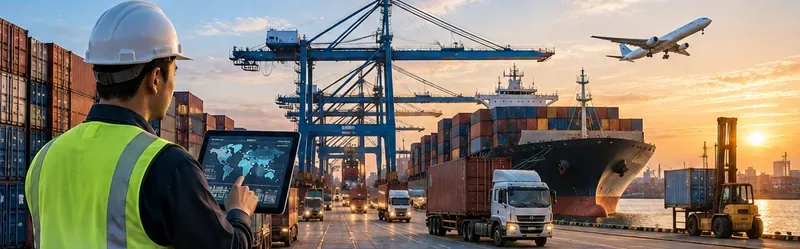
A cross-border shipment can generate signals from ocean, road, air, port, and customs processes; predictive logistics is useful when those signals arrive early enough to change the next decision.
The bottom line: prediction matters only if you can act on it
Predictive logistics combines historical records with current operational data to estimate what is likely to happen next. Common targets include estimated arrival times, port dwell, customs-processing risk, missed transshipment connections, demand changes, inventory exposure, and route disruption. Machine learning can improve these estimates when the underlying data is sufficiently consistent and representative.
For a cross-border operator, the practical question is not “Do we need AI?” It is “Which decisions are currently made too late because we lack a reliable early signal?” If the answer is “none,” a predictive platform may add complexity without much benefit. If teams repeatedly discover problems only after a container misses a connection, an ENS filing is rejected, or stock has already run short, prediction may be worth pursuing.
The latest World Bank Logistics Performance Indicators 2.0 is useful context because it measures logistics with actual shipment-level operational data and emphasizes connectivity, speed, and reliability. The World Bank notes that its 2023–24 data still show substantial time penalties and unpredictability around transshipment, borders, ports, and inland checkpoints. Those are exactly the kinds of points where predictive analytics can support earlier intervention.
What can predictive logistics actually forecast?
The most valuable use cases usually sit close to an operational choice. A forecast that cannot trigger an action is mostly a reporting feature.
Use case
Useful inputs
Action the forecast can trigger
Best fit
ETA and delay prediction
Carrier milestones, vessel or flight status, port calls, terminal events, road conditions, historical transit times
Shipment status plus business value, lateness risk, customer priority, product shelf life
Focus staff on the small set of exceptions that need human intervention
Operations teams overwhelmed by alerts
Why is cross-border prediction harder than domestic logistics?
International movements cross more organizational and regulatory boundaries. One shipment may touch a supplier, forwarder, carrier, terminal, port community system, customs broker, customs authority, inspection agency, drayage provider, rail operator, warehouse, and customer. Each party may record events differently and at a different time.
The WTO's Trade Facilitation Agreement encourages pre-arrival processing, electronic documents, international standards, and Single Window systems. Those provisions matter for predictive logistics because models work better when data arrives before the physical shipment and uses consistent definitions.
The World Customs Organization has pursued the same interoperability problem through the WCO Data Model, which provides standardized data definitions and electronic messages for cross-border regulatory processes. WCO Data Model version 4.2.0, released in July 2025, added standardized data sets for areas including customs bonds and certificates of origin. Standardization is not glamorous, but it is one of the foundations that makes cross-border analytics dependable.
A concrete example: predicting a late import before it reaches the border
Consider a hypothetical electronics importer moving containers from an Asian port to a distribution center in Germany through a major European seaport. The company promises customers delivery windows but historically learns about trouble from carrier emails after a schedule has already slipped.
A predictive workflow could combine booked vessel schedules, actual departure events, port-call updates, transshipment history, terminal congestion signals, inland transport capacity, and customs filing status. The model might estimate that one container has a high probability of arriving two days later than the original plan. That prediction is only useful if the importer can do something with it.
If the goods are high priority, the team may reserve an earlier inland slot or protect scarce warehouse labor for the revised arrival window.
If the shipment depends on a tight transshipment, the forwarder may evaluate an alternate connection while options still exist.
If customs data is incomplete, the broker may correct the filing before arrival rather than discovering the issue at the border.
If inventory is adequate, the business may simply update the customer promise and avoid unnecessary expediting.
The same prediction can therefore lead to different actions depending on product value, customer commitment, inventory coverage, and available alternatives. That is why predictive logistics should be linked to business rules and human decision rights rather than deployed as a stand-alone score.
How are customs systems becoming more predictive?
Customs agencies are also moving toward earlier, data-driven risk assessment. The European Commission's Import Control System 2 requires advance safety and security data and uses that information for pre-loading or pre-arrival risk analysis. The Commission warns that incomplete or inaccurate ENS data can lead to rejected filings, additional information requests, and processing delays. For logistics teams, the lesson is direct: prediction quality depends on master-data and filing quality, not just on the model.
The Commission's EU Customs Reform page says the politically agreed reform will move toward a centralized customs data architecture in which machine learning, AI, and human intervention support supply-chain visibility and risk management. The current roadmap states that the EU Customs Data Hub is intended to open first for e-commerce consignments in 2028, followed by broader participation later. Companies trading with the EU should treat that as a reason to improve data readiness now, not as a reason to assume future customs decisions will become fully automated.
Outside Europe, WCO case material shows how customs organizations are already using large-scale analytics. A 2024 WCO account of China Customs' data-driven risk management describes the use of multi-source data, standardized datasets, and machine-learning models to score customs risk in real time. The useful takeaway for commercial logistics is not the specific national system; it is that data quality, common identifiers, and consistent event histories come before effective AI.
Ports and shipping are becoming easier to connect digitally
Ocean logistics is especially dependent on port and regulatory events. Since January 1, 2024, the International Maritime Organization has required Member States to use a Maritime Single Window for electronic exchange of information related to ship arrival, stay, and departure. The IMO also promotes common data definitions through its reference data model so that different systems can exchange information with shared meaning.
Trade documents are also becoming more digital. In 2026, UNECE published a final business-requirements specification for electronic bills of lading, also published as ISO 5909:2026. Digital documents do not automatically create predictive logistics, but they reduce the need to extract critical data from disconnected paper workflows and make structured event data easier to reuse.
What data is worth integrating first?
More data is not always better. Start with data that answers a specific decision question. A practical sequence is usually:
Shipment identity: purchase order, shipment, container, bill of lading, airway bill, package, and product identifiers.
Operational context: capacity, congestion, weather, service schedules, cutoff times, and warehouse constraints.
Business impact: margin, customer priority, inventory coverage, production dependence, shelf life, or penalty exposure.
If identifiers do not reconcile across systems, predictive models will spend their effort learning from broken joins and duplicate records. In many projects, fixing event definitions and reference data produces more value than adding a more sophisticated algorithm.
When is predictive logistics a good fit?
It is most attractive when three conditions are true. First, the business repeats similar logistics decisions often enough to learn from history. Second, there is enough lead time between the prediction and the event to take corrective action. Third, the operator has real alternatives—another departure, carrier, route, inventory source, clearance action, or customer commitment.
It is less compelling when shipments are extremely rare, data is mostly manual and inconsistent, or the organization has no operational flexibility. Predicting a delay six hours before it happens is not useful if the only alternate sailing closed two days earlier.
Companies should also distinguish between a forecast and a recommendation. A model may correctly predict an 80% chance of delay, but the best response depends on cost, urgency, risk tolerance, and contractual obligations. That layer often needs optimization logic or a human decision.
Where can AI fail?
Cross-border models face several predictable failure modes:
Data drift: carrier schedules, customs procedures, routing patterns, and lead times change over time.
Missing events: a shipment may look delayed because a partner stopped sending updates rather than because the cargo stopped moving.
Biased history: a model trained mostly on stable periods may underperform during strikes, extreme weather, conflict, sanctions changes, or sudden capacity shortages.
Identifier mismatch: the same shipment may have different references across ERP, TMS, broker, and carrier systems.
False precision: a single ETA timestamp can hide a wide uncertainty range. For planning, a probability distribution or risk band may be more honest.
Automation without accountability: AI should not silently overwrite customs data, compliance decisions, or customer commitments without appropriate controls.
A strong system therefore reports confidence, logs the data used, monitors error over time, and has a human override path for high-impact decisions.
How should you measure whether it is working?
Do not judge success by model accuracy alone. Measure whether operations improved. Useful metrics include:
Metric
Why it matters
ETA error by lane and mode
Shows whether arrival forecasts are materially better than carrier schedules or simple historical averages
On-time delivery and promise accuracy
Tests whether customers receive more reliable commitments
Customs hold or filing-exception rate
Shows whether early data-quality checks reduce avoidable border friction
Tests whether exception management is focusing people on fewer, higher-value cases
Prediction lead time
Measures how early a useful alert arrives, not merely whether it was technically correct
A model that predicts a delay accurately but only after the rebooking window has closed is not operationally successful. A slightly less accurate model that gives a usable warning two days earlier may be more valuable.
What should a first implementation look like?
Start narrow. Pick one corridor, one mode, and one decision. For example: predict whether ocean imports on a high-volume Asia-to-Europe lane will miss the planned warehouse appointment. Establish a simple baseline, such as the carrier ETA or a historical median, and compare the predictive model against it.
Then connect the output to an explicit action rule: if the probability of missing the appointment exceeds a threshold and inventory coverage is below a defined level, create an exception for the planner. Keep a human in the loop while the model is new. Track false alarms, missed disruptions, and whether planners actually use the alert.
Only after that loop works should the organization add more lanes, more data sources, and more automation. This sequence reduces the risk of building an impressive control tower that produces dashboards but few better decisions.
The practical conclusion
Predictive logistics is becoming more feasible because cross-border trade is producing more standardized, pre-arrival, and shipment-level data. The World Bank's 2025 LPI 2.0, the WCO Data Model, mandatory Maritime Single Windows, EU ICS2, electronic trade-document standards, and the EU's data-driven customs reform all point in the same direction: global logistics is becoming more measurable and more digitally connected.
But AI does not remove the hard parts of supply chains. It does not create missing carrier events, fix poor commodity data, guarantee customs release, or manufacture a backup route. Its value comes from turning reliable data into an earlier signal and then connecting that signal to a decision the business is prepared to make. For companies with repeatable international flows, meaningful alternatives, and disciplined data, that can make cross-border supply chains more reliable. For organizations without those foundations, improving data quality and process design should come first.