Home
» New Trends
»
Where to Study Smart City Planning: 7 Urban Engineering and Planning Degrees Worth Comparing
Where to Study Smart City Planning: 7 Urban Engineering and Planning Degrees Worth Comparing
The hardest part of choosing a smart city planning degree is that the programs rarely use the same name. One university may call it urban data science, another spatial development, another sustainable urban planning, and another city planning. That makes it easy to compare school brands instead of the skills you actually need.
The practical fix is to start with the job you want, then work backward to the curriculum. If your goal is to build mobility models, digital twins, sensor systems, or data-driven city services, you need stronger computing, GIS, statistics, and infrastructure coursework. If you want to become a planner who shapes land use, housing, public space, or climate policy, you need planning law, governance, economics, design, and stakeholder engagement. Many smart city careers sit between those two ends.
The programs below were checked against official university pages in September 2026. They are not presented as a numerical ranking. They are strong, distinctive options worth comparing because they cover different combinations of urban engineering, spatial science, data, planning, design, infrastructure, and policy. Program structures, fees, and admissions rules can change, so always verify the intake you plan to apply for.
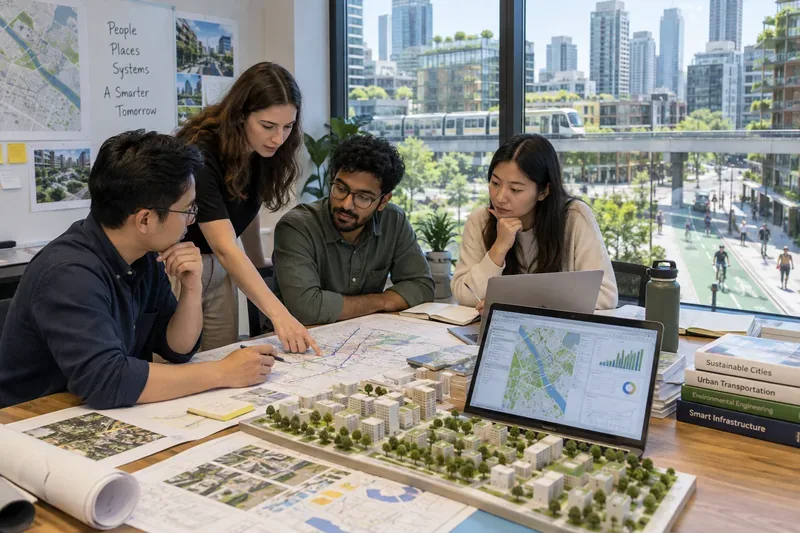
Graduate students compare transit routes, spatial data, and neighborhood design around a physical city model—an example of how smart city planning combines analytics, infrastructure, policy, and urban design.
Start with the outcome: what kind of smart city professional do you want to become?
Before comparing universities, write down the type of problems you want to solve. “Smart city planning” can mean at least four different career directions.
Urban data and analytics: GIS, remote sensing, machine learning, spatial statistics, urban sensing, visualization, and data governance.
Infrastructure and mobility: transport systems, network infrastructure, energy, resilience, traffic planning, and public works.
Urban planning and design: land use, public space, housing, urban form, development control, and participatory planning.
Urban policy and delivery: governance, economics, real estate, public finance, regulation, and implementation.
A good degree does not need to cover all four equally. In fact, the strongest choice is often the program that is intentionally deep in the two areas closest to your target role.
Seven smart city planning degrees worth comparing
University and degree
Best fit
Published structure
NYU Tandon — M.S. in Urban Data Science
Urban analytics, machine learning, civic data, city operations
2 years, 36 credits
UCL — Urban Spatial Science MSc
GIS, spatial modeling, coding, remote sensing, smart city policy
1 calendar year full-time
ETH Zurich — MSc Spatial Development and Infrastructure Systems
Transport, infrastructure networks, spatial development
2 years, 120 ECTS
KTH — MSc Sustainable Urban Planning and Design
Sustainable planning, urban design, resilience, transport
High-density Asian urbanism, planning practice, data-informed policy
2 years / four semesters
Aalto — Urban Studies and Planning in Real Estate Economics, M.Sc. (Technology)
Urban development, real estate systems, planning, engineering context
2 years, 120 ECTS
1. NYU Tandon: M.S. in Urban Data Science
NYU’s Center for Urban Science + Progress is one of the clearest choices for applicants who want the “smart” part of smart cities to be genuinely technical. The current program is the M.S. in Urban Data Science, a two-year, 36-credit degree that combines data science, policy, and emerging technology.
The required curriculum includes applied data science, machine learning for cities, urban science and policy methodologies, data governance, ethics and privacy, and a two-semester capstone. NYU also describes New York City as a living laboratory and highlights projects involving energy efficiency, flood risk, pedestrian safety, and city partners.
Choose it if: you want to work as an urban data scientist, civic technologist, geospatial analyst, urban AI specialist, or analytics-focused consultant. Applicants without a technical background should pay close attention to the recommended preparation in calculus, programming, probability, statistics, GIS, and computer science.
2. UCL: Urban Spatial Science MSc
UCL’s Urban Spatial Science MSc is a strong match for students who want spatial analytics to sit at the center of their urban training. UCL describes the degree as data-centric and lists programming, spatial analysis, data visualization, statistical and simulation modeling, machine learning, and remote sensing among its methods.
The program also offers optional pathways aligned with research themes including Big Data, Smart Cities and Urban Policy, Modelling and Simulation, and Data Visualisation. That matters because it lets you combine technical urban science with a more critical understanding of policy and the limits of technology-led solutions.
Choose it if: you want an intensive one-year master’s focused on geospatial and computational approaches to cities, especially if you already have some quantitative confidence and want to become stronger in coding and urban analytics.
3. ETH Zurich: MSc Spatial Development and Infrastructure Systems
For applicants who think of smart cities primarily as connected physical systems, ETH Zurich’s MSc in Spatial Development and Infrastructure Systems deserves close attention. The program is 120 ECTS over two years and sits within ETH’s architecture and civil engineering area.
Students can focus on Spatial and Landscape Development, Transport Systems and Behaviour, or Network Infrastructure. ETH frames the program around sustainable spatial and infrastructure development, planning complexity, scarce resources, natural hazards, and the management of built systems.
Choose it if: your target career is closer to transport planning, infrastructure strategy, network systems, spatial development, or engineering-led urban resilience than to community planning or architectural urban design. ETH lists qualifying backgrounds including architecture, civil and environmental engineering, geography, geomatics, spatial planning, and transport-related fields.
4. KTH Royal Institute of Technology: MSc Sustainable Urban Planning and Design
KTH’s MSc Sustainable Urban Planning and Design is a two-year, 120-ECTS program that blends planning, design, environmental analysis, and applied projects. Its three profiles are Urban Planning and Design, Urban and Regional Planning, and Environment and Planning.
KTH’s published curriculum includes topics such as urban economics, governance, sustainable mobility, resilience, environmental assessment, urban and regional analysis, and project-based planning. The university also specifically mentions tools such as GIS, scenario planning, strategic environmental assessment, and participatory methods.
Choose it if: you want a broad planning education with a sustainability and design orientation, but still want quantitative and systems tools available. As of the current KTH page, the next application round for studies starting in August 2027 opens October 16, 2026 and closes January 15, 2027.
5. MIT: Master in City Planning
MIT’s Master in City Planning is a professional planning degree rather than an engineering degree, but it belongs on a smart city shortlist because its specialization options include Urban Science and Mobility alongside city design, environmental planning, housing and community development, and international development.
The program is designed around planning practice, policy analysis, institutional intervention, workshops, studios, and real-world problem solving. MIT also notes that entering students with substantial prior knowledge in areas such as data management, spatial analysis, design, qualitative research, or quantitative reasoning may be able to test out of certain requirements.
Choose it if: you want technology and data to support planning rather than define your entire degree. It is particularly relevant for people aiming at public-sector strategy, mobility, planning consulting, urban policy, or interdisciplinary leadership.
6. National University of Singapore: Master of Urban Planning
NUS’s Master of Urban Planning is a strong option for students who want to study high-density urban development in an Asian context. NUS describes Singapore and other Asian cities as laboratories for planning ideas involving density, ecological sensitivity, data science, and social policy.
The full-time program is structured over two years and four semesters. Its value is not that it turns planning into a pure technology discipline, but that it places digital change alongside land use, social equity, climate pressures, governance, and the realities of rapidly urbanizing regions.
Choose it if: you want to work in Asian cities, high-density development, government planning, urban consultancy, or policy-heavy smart city projects. NUS currently states that applications for its August 2027 intake run from October 1, 2026 through February 28, 2027.
7. Aalto University: Urban Studies and Planning in Real Estate Economics, M.Sc. (Technology)
Its curriculum mixes urban planning with real estate markets, land and housing policy, valuation, development, institutions, and sustainability. Aalto also runs the broader Urban Studies and Planning program jointly with the University of Helsinki, giving students an interdisciplinary setting rather than a narrowly technical one.
Choose it if: you are interested in how smart and sustainable districts actually get financed, developed, governed, and delivered. It is especially relevant for careers in urban development, real estate strategy, land policy, consulting, and public-sector development.
How to narrow the list from seven programs to two or three
Once you have a long list, compare the curriculum before comparing prestige. A smart city degree should give you evidence that it teaches the methods your target role uses.
First, check the technical core
If you want a data-heavy role, look for required courses in programming, statistics, GIS, spatial analysis, machine learning, remote sensing, databases, or simulation. NYU and UCL are the clearest data-first options in this list. ETH becomes especially attractive when your technical interest is infrastructure and transport systems rather than software or data science alone.
Next, check whether planning is treated as more than technology
Cities are political, financial, social, and physical systems. A program that teaches sensors but ignores governance will leave a gap; a program that teaches policy but gives you no analytical tools may leave a different gap. Look for coursework in land use, housing, transport, economics, equity, climate resilience, law, public participation, and implementation.
Then, check the format of practical work
Capstones, studios, field projects, and collaborations with city agencies are often more revealing than course titles. They show whether you will practice turning analysis into decisions. NYU emphasizes partner-based capstones, MIT uses workshops and studios, KTH uses substantial project work, and NUS integrates a multi-semester professional planning structure.
Finally, check admissions fit and professional recognition
Some programs welcome broad academic backgrounds; others expect previous planning, engineering, design, statistics, economics, or GIS preparation. If professional planner accreditation matters in the country where you intend to work, verify it with the relevant national planning body. Do not assume that a technically impressive “smart city” degree automatically satisfies local licensing or professional membership requirements.
Which degree is the best fit for common smart city career goals?
Urban data scientist or civic AI specialist: start with NYU Urban Data Science or UCL Urban Spatial Science.
Transport and infrastructure planner: start with ETH Spatial Development and Infrastructure Systems; also examine KTH and MIT mobility offerings.
Sustainable urban planner or urban designer: start with KTH, NUS, or MIT depending on the region and the balance you want between design, policy, and analysis.
Urban development and real estate strategist: Aalto stands out for explicitly combining planning with real estate economics.
Public-sector smart city leader: favor programs that balance technology with governance, finance, implementation, and stakeholder work rather than choosing the most technical curriculum by default.
Self-check: is a program actually right for you?
Before submitting an application, open the official curriculum and answer these questions. If you cannot answer at least five of the seven with a clear “yes,” keep comparing.
Can I name the specific job or problem area this degree prepares me for?
Does the required curriculum teach at least two hard skills I will use in that role?
Does it also cover governance, economics, design, equity, or implementation—not just technology?
Will I complete a studio, capstone, thesis, or real-world project that can become portfolio evidence?
Do my current academic background and prerequisites match the admissions expectations?
Can I justify the total time and cost relative to the careers I am targeting?
If I need planner accreditation or another professional credential, have I verified that separately?
If the answers are strong, you have moved beyond choosing a “smart city” label and toward choosing a degree that fits the work you actually want to do. That is the better way to compare urban engineering and planning programs: by the systems you want to understand, the tools you want to master, and the kinds of city decisions you want to influence.