Home
» New Trends
»
Where to Study UAV Engineering in 2026: 8 Aerospace Programs to Shortlist
Where to Study UAV Engineering in 2026: 8 Aerospace Programs to Shortlist
For students applying in 2026, one meaningful change is that autonomous flight is moving closer to the core of mainstream aerospace education. MIT AeroAstro’s current undergraduate requirements now list 16.85, Design and Testing of Autonomous Vehicles, as an autonomy capstone option. Students design, implement, deploy, and test software architectures for autonomous flying systems rather than treating drones as an extracurricular side project. The important takeaway is not that every leading school now offers a degree called “UAV Engineering.” Most still do not.
A better way to choose where to study unmanned aerial vehicles is to decide which part of the UAV stack you want to own: aircraft design, flight dynamics and control, autonomy and perception, mission operations, or airspace integration. The programs below are not presented as a universal ranking. They are a shortlist built from current university program, curriculum, laboratory, and facility pages, with the tradeoffs made explicit.
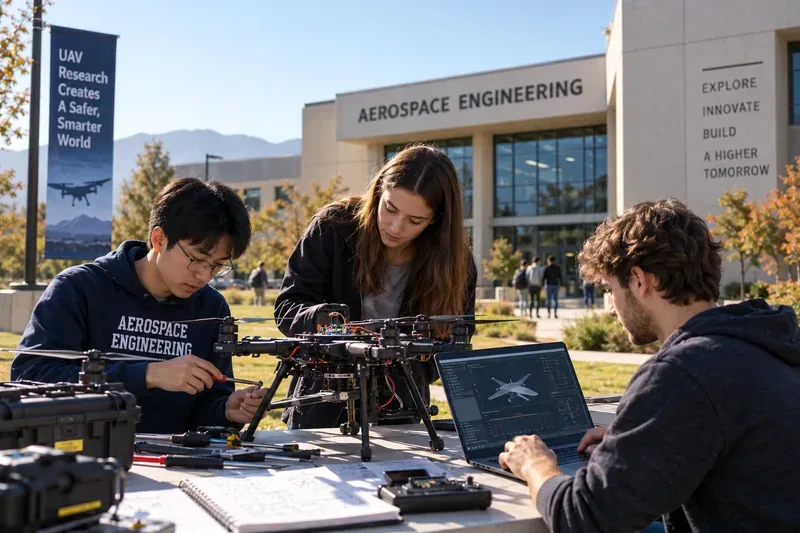
Students work around a multirotor UAV with exposed avionics, hand tools, notes, and a telemetry laptop, illustrating the mix of hardware, controls, software, and flight-test work that a strong UAV engineering pathway should make accessible.
First, clear up the biggest misconception: UAV engineering is not one standardized degree
Verified: Among the universities reviewed here, UAV study appears under several different academic structures. Embry-Riddle offers a dedicated bachelor’s program in uncrewed and autonomous systems. MIT, Purdue, Georgia Tech, Virginia Tech, and TU Delft place much of the relevant work inside broader aerospace curricula, controls, autonomy, robotics, or research labs. CU Boulder offers a graduate aerospace focus area in autonomous systems, while Cranfield offers a specialized master’s centered on autonomous vehicle dynamics and control.
What depends on your goal: A degree with “uncrewed” in its title may give you more direct exposure to mission planning, operations, regulation, and data workflows. A traditional aerospace engineering degree may give you more depth in aerodynamics, structures, propulsion, flight mechanics, and vehicle design. A controls or robotics path may be the stronger choice if your target job is autonomy software, perception, planning, or estimation.
Action: Before comparing university names, write down the job you want in one sentence—for example, “I want to design small fixed-wing UAVs,” “I want to build autonomous navigation software,” or “I want to integrate drones safely into civil airspace.” Use that sentence as your filter.
Shortlist by fit, not by a single league table
Program
Verified UAV/autonomy signal
Strong fit if you want
Main tradeoff
Embry-Riddle Aeronautical University
Dedicated B.S. in Uncrewed and Autonomous Systems; mission planning, remote piloting, ATC procedures, data collection and processing
A direct undergraduate UAS pathway with operational context
Less equivalent to a classical aerospace engineering degree if your priority is deep airframe or propulsion design
MIT AeroAstro
Autonomy capstone 16.85 plus autonomous systems research and multiple related labs
Research-intensive autonomy, planning, controls, and safety-critical systems
No dedicated UAV degree; access to specific labs depends on courses, research openings, and faculty
Purdue Aeronautics and Astronautics
Autonomy and Control is an undergraduate disciplinary choice; Purdue UAS Research and Test Facility supports indoor drone autonomy testing
Aerospace fundamentals plus serious UAS experimentation
You must deliberately build the UAV specialization through electives, projects, and research
CU Boulder Aerospace
Graduate Autonomous Systems focus includes robotics, AI, unmanned systems, formal methods, estimation, and control
Graduate work in autonomous systems, multi-vehicle control, and UAS research
The strongest UAV-specific evidence is at graduate level rather than a dedicated undergraduate major
Georgia Tech Aerospace Engineering
Core controls and flight dynamics, a Robotics and Autonomy option course, and the Aerial Robotics and Experimental Autonomy Lab
Controls, rotorcraft, aerial robotics, and end-to-end experimental work
Autonomy is one pathway within a broad BSAE, not the whole degree
TU Delft Aerospace Engineering
MAVLab, Autonomous Flight of Micro Air Vehicles course, and current research in perception, control, and autonomous drone navigation
Micro air vehicles, lightweight autonomy, bio-inspired navigation, and aerial robotics
MSc track placement and course availability can vary by intake
Cranfield University
MSc in Autonomous Vehicle Dynamics and Control with UAS dynamics, modeling, guidance, navigation, sensor fusion, AI, and a drone laboratory
A focused postgraduate route into autonomous aerial vehicles
It is a master’s route, so it is not a first degree for most applicants
Virginia Tech Aerospace and Ocean Engineering
Dynamics, Control and Estimation track, a large netted Drone Park, and UAS integration research infrastructure
Hands-on flight testing, controls, and airspace-integration exposure
No standalone UAV engineering major
1. Embry-Riddle: the most direct undergraduate route on this list
Verified: Embry-Riddle currently lists a B.S. in Uncrewed and Autonomous Systems. The official program page says the curriculum covers mission planning and execution, remote piloting, air traffic control procedures, data collection, and data processing, while drawing from aeronautical science, computer science, engineering, GIS, and UAS coursework. It also identifies the program as recognized through the FAA UAS Collegiate Training Initiative.
Tradeoff: This is attractive when you want a degree that is explicitly about uncrewed systems and operations. It is not the same academic product as a conventional B.S. in aerospace engineering with heavy requirements in structures, compressible flow, propulsion, and high-level vehicle design. If your long-term goal is to become an airframe aerodynamicist or propulsion engineer, compare the engineering content course by course before choosing the UAS title.
Action: Download the current plan of study and mark every course that develops mathematics, dynamics, controls, programming, electronics, and aircraft design. If those columns look too light for your career target, compare Embry-Riddle’s UAS route against a traditional aerospace degree plus UAS electives.
2. MIT AeroAstro: strong for autonomy research rather than a UAV-branded degree
Verified: MIT AeroAstro’s current undergraduate requirements include the 16.85 autonomy capstone, with prerequisites tied to robotics and real-time systems or autonomy. MIT also maintains an Autonomous Systems & Decision-Making research area spanning guidance, navigation, estimation, control, robotics, and airborne communications. Affiliated groups include the Aerospace Controls Lab, Reliable Autonomous Systems Lab, and other robotics and autonomy groups.
Tradeoff: MIT is compelling if you want deep theory, algorithms, safety-critical autonomy, and research. It is not a “drone school” in the narrow sense. Your UAV experience may depend heavily on which classes you take, which lab you join, and whether a faculty group has a project that matches your interests.
Action: Do not evaluate MIT only from the degree name. Read the current capstone calendar and the project pages of two or three autonomy labs. Ask yourself whether the research problems—planning, control, verification, perception, multi-vehicle systems—match the work you want to do after graduation.
3. Purdue: a strong balance of aerospace fundamentals and UAS test infrastructure
Verified: Purdue’s B.S. in Aeronautical and Astronautical Engineering is a conventional, ABET-accredited aerospace degree, and its undergraduate academics page lists Autonomy and Control among the disciplines students commonly choose for depth. Purdue also operates the Purdue UAS Research and Test Facility, an indoor facility designed for drone autonomy and control research, including motion capture and protected flight testing.
Tradeoff: The degree gives you broad aerospace foundations, which is a strength if you want to design the complete aircraft. The cost is that UAV specialization is not automatic. Two Purdue students can graduate from the same major with very different exposure to autonomy depending on electives, research, and senior design choices.
Action: Build a sample four-year plan before applying. Include an autonomy/control emphasis, one UAS research experience, and a senior design project that can plausibly involve unmanned aircraft. If you cannot find a realistic path to all three, ask the department how undergraduates access PURT and UAS research groups.
4. CU Boulder: especially attractive for graduate autonomous systems
Verified: The University of Colorado Boulder offers an Autonomous Systems focus area within aerospace graduate study. The published focus includes robotics, human-robot interaction, artificial intelligence, unmanned systems, formal methods, estimation, and control. Listed electives include multi-object filtering and cooperative control of multi-vehicle systems.
Tradeoff: CU Boulder is a particularly clear match for an M.S. or Ph.D. applicant who already has engineering fundamentals and wants to specialize in autonomy. For an undergraduate choosing a first degree, the public evidence is less about a dedicated UAV curriculum and more about the broader aerospace pipeline and research environment.
Action: Graduate applicants should identify at least two faculty members whose current work overlaps with their proposed thesis topic. Undergraduates should ask what formal pathways exist to enter autonomous-systems labs before senior year rather than assuming lab access from the department’s research reputation.
5. Georgia Tech: good if you want controls, rotorcraft, and experimental autonomy
Verified: Georgia Tech’s B.S. in Aerospace Engineering includes system dynamics and control, aircraft and spacecraft flight dynamics, a control systems laboratory, and design sequences that can include fixed-wing aircraft or rotorcraft. Its current options list includes Robotics and Autonomy. The Aerial Robotics and Experimental Autonomy Lab works on vehicle design, guidance and control, estimation, simulation, and flight testing using ground and aerial robotic vehicles.
Tradeoff: This is a broad aerospace engineering degree. That is useful if you want to understand the vehicle as a system, but students interested in UAV autonomy need to actively select the right options, labs, and projects instead of expecting a prepackaged drone specialization.
Action: Compare the Aircraft Flight Dynamics, Controls, and rotorcraft design pathways with the lab projects you would actually like to join. If your interests are primarily machine learning and perception, also check how easily aerospace students can take relevant computing and robotics courses.
6. TU Delft: a standout option for micro air vehicles and autonomous flight research
Verified: TU Delft’s Micro Air Vehicle Laboratory is part of the Control and Simulation section of the Faculty of Aerospace Engineering. The lab’s official pages describe work on autonomous flight, collision avoidance, lightweight perception, control, and micro-to-nano air vehicles. The lab also lists the MSc course AE4317 Autonomous Flight of Micro Air Vehicles, where students study autonomous flight methods and apply them to quadrotor obstacle avoidance.
A current 2026-2027 planning page also states that TU Delft’s Aerospace Engineering MSc uses a track placement procedure, with capacity constraints possible for some tracks. That is a practical detail applicants should not ignore.
Tradeoff: TU Delft is exceptionally relevant if your interests are small aerial robots, vision-based navigation, efficient onboard autonomy, or bio-inspired flight. If your goal is large-UAS certification, production engineering, or operational regulation, a different program may provide a more direct route.
Action: Check the exact MSc track and profile that gives access to MAVLab courses for your intake year. Do not assume that being admitted to Aerospace Engineering automatically guarantees a place in every track or laboratory.
7. Cranfield: one of the clearest specialized postgraduate UAV curricula
Verified: Cranfield University currently offers an MSc in Autonomous Vehicle Dynamics and Control. Its published curriculum includes UAS dynamics and control, UAS modeling and simulation, sensor fusion, autonomous vehicle control, guidance and navigation, aerial communications, and artificial intelligence for autonomous systems. The program also describes a drone laboratory and a group project built around autonomous vehicle design and operation.
Tradeoff: This is a focused postgraduate program, making it attractive for students who already have a bachelor’s in engineering, physics, mathematics, or a related discipline. It is not a replacement for an undergraduate engineering foundation. Cranfield also notes that modules can change, so applicants should verify the exact module set for their entry year.
Action: If you already hold an engineering bachelor’s and want to pivot into UAS quickly, compare Cranfield’s module list directly against the job descriptions you are targeting. Look for overlap in modeling, embedded implementation, sensor fusion, control, and guidance rather than judging the program by its title alone.
8. Virginia Tech: strong flight-test infrastructure and UAS integration exposure
Verified: Virginia Tech’s aerospace major offers a Dynamics, Control and Estimation track. The university also operates a large netted Drone Park for student and research flight activity. Virginia Tech’s research facilities page identifies its Mid-Atlantic Aviation Partnership as working on UAS integration and FAA-related standards activity.
Tradeoff: Like Purdue and Georgia Tech, Virginia Tech does not package these assets into a standalone UAV engineering degree. The opportunity is therefore highly dependent on how proactively you combine aerospace coursework, controls electives, research, and flight testing.
Action: Ask the department two concrete questions before applying: how often aerospace undergraduates use the Drone Park for course or research projects, and which faculty currently supervise UAV-focused work in controls, sensing, or airspace integration.
What should you study inside a UAV engineering pathway?
A strong UAV education is broader than learning to fly a quadcopter. For engineering roles, look for a curriculum that gives you enough depth across the system to understand why the vehicle behaves the way it does and enough specialization to become useful in one technical area.
Vehicle fundamentals: aerodynamics, flight mechanics, structures, propulsion or electric power systems.
Dynamics and control: state-space methods, feedback control, nonlinear dynamics, robust or adaptive control.
Autonomy: planning, decision-making, obstacle avoidance, multi-agent coordination, verification, and safety.
Perception and computing: computer vision, machine learning, embedded systems, real-time software, and onboard compute constraints.
Systems engineering: requirements, integration, testing, reliability, human factors, communications, and verification.
Operations and regulation: particularly important if you want to run UAS missions, build operational products, or work on civil airspace integration.
Action: Score each university from 0 to 2 on those seven categories: 0 for no clear evidence, 1 for coursework only, and 2 for coursework plus hands-on laboratory or project access. The resulting profile is more useful than a generic university ranking.
Another misconception: pilot certification is not the same as engineering education
Verified: In the United States, the FAA says a Remote Pilot Certificate is required to act as remote pilot in command for operations under Part 107. That credential demonstrates knowledge of operating rules and procedures. It does not replace coursework in aerodynamics, controls, autonomy, structures, embedded systems, or vehicle design. See the FAA’s current Remote Pilot guidance.
What depends on context: Operational credentials can be valuable if your degree includes field testing or if you want to work in flight operations. They may matter much less for a student focused on simulation, control theory, perception research, or airframe design.
Action: Treat flight certification as an operational skill, not as proof of engineering depth. If a program advertises pilot training prominently, check whether it also provides the mathematics, programming, controls, and design work your intended engineering role requires.
What public university pages cannot tell you
Several important factors remain unknown until you contact the department. A laboratory page proves that the lab exists; it does not prove that every undergraduate can join it. A course catalog proves that a course is approved; it does not guarantee it will run in your semester. A research theme proves faculty interest; it does not guarantee a thesis supervisor will have space when you arrive.
Before paying an application fee or accepting an offer, ask for current answers to these questions:
Which UAV or autonomy courses are scheduled for my actual entry year?
Can first- and second-year students join UAV labs, or is access mostly for seniors and graduate students?
How many students typically get hands-on flight-test roles rather than simulation-only projects?
Which faculty are accepting undergraduate researchers, master’s theses, or Ph.D. students now?
Can aerospace students take robotics, computer vision, machine learning, and embedded-systems electives without delaying graduation?
What flight facilities can students use, and what approvals or certifications are required?
For international students, do export-control, security, or citizenship restrictions affect specific research projects?
Which program is the right fit?
If you want the most direct undergraduate degree centered on uncrewed systems and operations, Embry-Riddle deserves a close look. If you want a broad aerospace engineering foundation and then want to specialize through controls, autonomy, and research, Purdue, Georgia Tech, Virginia Tech, and MIT are stronger examples of that model. For graduate-level autonomous systems inside aerospace, CU Boulder is especially clear. TU Delft is highly compelling for micro air vehicles, perception, and autonomous flight, while Cranfield offers one of the most explicit taught master’s curricula focused on autonomous vehicle dynamics and control.
The right choice therefore depends less on which university has the most famous aerospace name and more on whether you can build the exact combination of vehicle physics, autonomy, software, facilities, and project access that your intended UAV role demands.
Final action: Shortlist three programs, then create a one-page comparison using only official curriculum and laboratory pages. List the exact courses you would take, the lab you would try to join, the UAV project you could realistically complete, and the technical job you expect that pathway to prepare you for. If you cannot fill in all four fields, you do not yet know enough about that program to make a decision.