Home
» New Trends
»
From Sci-Fi to Reality: How Brain-Computer Interfaces Are Restoring Speech and Movement
From Sci-Fi to Reality: How Brain-Computer Interfaces Are Restoring Speech and Movement
The most important answer is this: brain-computer interfaces (BCIs) are no longer only science-fiction concepts. In carefully controlled clinical research, they have already helped some people with severe paralysis turn attempted speech into text or synthetic voice, control computers, move a paralyzed hand, and even stand and walk using a brain-to-spinal-cord “digital bridge.” But these results do not mean BCIs are a general cure for paralysis. Most of the highest-performing systems are still investigational, involve implanted electrodes, and have been demonstrated in small numbers of participants.
That distinction matters. The practical question is not simply “Can a BCI restore speech or mobility?” It is “Which function is being restored, for which condition, with what type of interface, and how much surgery, training, hardware, and clinical support are required?”
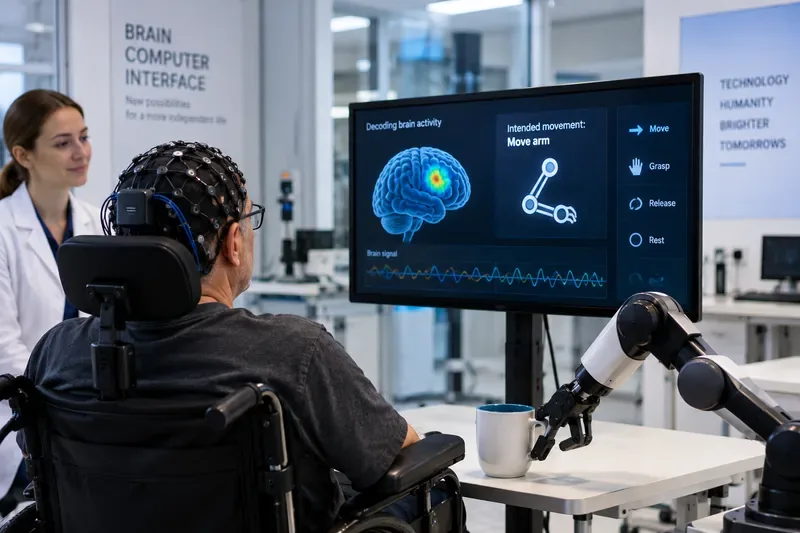
A rehabilitation-lab scene illustrates the core BCI idea: neural activity is measured, decoded into an intended action, and used to control an assistive output such as a robotic arm.
What BCIs can restore today—and what “restore” really means
A brain-computer interface is a system that measures neural activity and converts it into commands for a computer, speech synthesizer, robotic device, muscle stimulator, spinal stimulator, or another output. In many paralysis applications, the goal is to bypass a damaged pathway rather than repair every injured nerve.
For speech, the BCI may decode neural patterns produced when a person attempts to speak and turn them into text or audible words. For movement, it may decode an intention such as “close my hand” or “take a step,” then send that command to a robotic limb, electrically stimulated muscles, or the spinal cord.
Goal
What the BCI decodes
Typical output
Current maturity
Speech and communication
Attempted speech or related motor-cortex activity
Text, synthesized voice, computer input
Strong research results; still investigational
Computer access
Attempted hand or cursor movement, or attempted speech
Mouse, keyboard, tablet or PC control
Demonstrated in long-term home research use
Hand and arm function
Movement intention
Muscle stimulation, powered orthosis or robotic device
First-in-human and small clinical studies
Standing and walking
Intended leg movements
Spinal-cord stimulation patterns
Proof-of-concept clinical research
The 2026 milestone: speech BCI use moved into the home
One of the clearest signs that BCI technology is moving beyond short laboratory demonstrations came in June 2026. A Nature Medicine study of long-term independent intracortical BCI use reported that a man with severe dysarthria and paralysis from amyotrophic lateral sclerosis (ALS) used a brain-to-text and cursor-control system at home for more than 3,800 hours over 19 months.
The participant communicated 183,060 sentences—nearly two million words—at an average rate of 56 words per minute. In prompted testing, attempted speech was decoded with 99.2% word accuracy using a 125,000-word vocabulary. He also used the system to control a personal computer, send messages and email, browse the web, participate in calls, and continue working.
Why is this important? Earlier BCI results could be technically impressive yet still depend heavily on researchers, frequent recalibration, or laboratory equipment. Long-duration home use tests a different requirement: whether the system remains useful when it becomes part of ordinary daily life.
Who might this type of system fit? Research programs generally target people with severe motor impairment who retain the brain activity associated with attempted speech or movement but cannot reliably express it through muscles. ALS, high spinal-cord injury, and brainstem stroke are examples that appear in current trials. Eligibility is highly specific, however, and only a research team can determine whether a particular person meets surgical and clinical criteria.
Speech BCIs are becoming faster and more natural
Restoring communication is not only about producing correct words. A conversation also needs low delay, enough vocabulary, and a voice that is usable for long periods.
In 2025, researchers reported a streaming brain-to-voice neuroprosthesis for a participant with severe paralysis and anarthria. Instead of waiting for an entire sentence before generating output, the system decoded neural activity in 80-millisecond increments and synthesized continuous speech. That approach addresses a practical weakness of earlier systems: pauses long enough to make natural dialogue awkward.
This does not mean a BCI literally reads unrestricted thoughts. High-performing speech systems are generally trained to decode neural activity associated with attempted speech or specific speech-related tasks. Their performance depends on the implant location, signal quality, training data, decoder design, and the participant’s condition.
Text, voice, and typing are different solutions
A person who cannot speak may not need the same output as someone who cannot move a hand. A speech BCI can generate text for a screen, synthesize a voice, or act as keyboard input. Motor BCIs can also provide communication by decoding intended finger or handwriting movements. The best interface therefore depends on what neural signals remain reliable and what the user wants to accomplish.
For someone whose highest priority is conversation, direct speech decoding may offer a more natural communication path. For someone who wants broad digital access, a combination of speech input and cursor control may be more useful because it supports email, browsing, work applications, and messaging rather than speech alone.
Mobility restoration works by reconnecting intention to action
Movement BCIs follow the same basic principle as speech systems: record an intention, decode it, then route it to an output that can act on the world. The output may be a robotic arm, a powered brace, electrical stimulation of the user’s muscles, or stimulation of the spinal cord below an injury.
A landmark 2023 brain–spine interface study in Nature created a wireless digital bridge between cortical signals and epidural spinal-cord stimulation. In one participant with chronic tetraplegia, the system enabled voluntary control of standing and walking, including stairs and more complex terrain. The interface remained stable over a year, including home use.
The result is important, but the condition attached to it is equally important: this was an intensive, implanted system evaluated in a single participant who had a particular injury profile and prior experience with spinal stimulation. It should be read as proof that a digital bridge can work—not as evidence that the same setup will restore walking for every person with spinal-cord injury.
A newer approach is targeting the user’s own hand—and sensation
In July 2026, another Nature Medicine first-in-human study described a “double neural bypass” for a participant with chronic, complete tetraplegia. The system combined an intracortical BCI with spinal and cortical neuromodulation.
The assistive side decoded intended hand movements and drove neuromuscular electrical stimulation and a powered hand orthosis. Sensors on the hand also provided information that could be returned to the brain through stimulation of the somatosensory cortex. The participant completed functional tasks including drinking from a cup, self-feeding, and handling delicate objects.
That study also explored a therapeutic goal rather than only an assistive one: repeated stimulation was designed to promote neuroplasticity, and some improvements in elbow flexion and wrist sensation persisted when stimulation was no longer active. Those findings are encouraging, but they come from one participant and need replication in larger studies before they can define expected outcomes.
What makes an implanted BCI different from a noninvasive one?
Many consumer demonstrations use electroencephalography (EEG), which records electrical activity from electrodes on the scalp. EEG avoids brain surgery, but the skull and surrounding tissue blur the signals before they reach the sensors. Implanted interfaces can record much closer to the neurons or cortical surface, often providing richer signals for rapid speech or fine motor control.
The trade-off is risk. Implantation can require neurosurgery, and long-term systems must address infection, hardware reliability, signal stability, device maintenance, and what happens if components fail or need replacement. The U.S. Food and Drug Administration has published specific guidance for implanted BCI devices used in paralysis or amputation research, including nonclinical testing and clinical-study considerations.
How to judge whether a BCI result is relevant to a real patient
BCI headlines often compress very different technologies into one category. A useful way to interpret a new result is to check five conditions:
Condition and injury level: ALS, stroke, and spinal-cord injury can leave different neural pathways intact.
Implant type: scalp EEG, cortical-surface electrodes, and intracortical arrays do not provide the same signal quality or carry the same risks.
Output: controlling a cursor is not the same clinical task as moving the user’s own muscles or generating fluent voice.
Study size: a dramatic result in one participant establishes feasibility, not a population-wide success rate.
Where the system was used: independent home use is a stronger test of practicality than a short supervised laboratory session.
If a person is considering participation in BCI research, the most useful next step is to review active studies rather than assume a commercial device is available. The BrainGate2 feasibility study record on ClinicalTrials.gov, for example, lists recruiting sites and eligibility information for people with tetraplegia. Separate speech-focused BrainGate studies are also recruiting participants under defined criteria.
What BCIs still cannot promise
BCIs do not regenerate a severed spinal cord simply by reading brain activity, and they do not guarantee restoration of normal speech or walking. Performance can change with neural signal quality, disease progression, electrode stability, training, fatigue, hardware, and the algorithm used to decode signals.
There is also a difference between assistive restoration and biological recovery. An assistive BCI may work only while the system is on, much like a powered prosthesis. Some newer studies pair BCIs with stimulation designed to promote neuroplasticity, but persistent recovery remains an active research question and cannot be assumed from every interface.
Another limitation is access. The systems behind the strongest recent results require specialized neurosurgery, engineering support, calibration, computing hardware, and long-term clinical follow-up. Current research is aimed at making those systems more stable, easier to operate, and less dependent on expert intervention.
Why the field feels different now
The science-fiction version of a BCI is often a device that instantly translates any thought into action. Real BCIs are narrower—but increasingly useful. The major shift is that researchers are solving practical bottlenecks one by one: vocabulary size, decoding accuracy, latency, long-term stability, sensory feedback, independent home operation, and control of the user’s own body.
As of September 2026, the evidence supports a measured conclusion. BCIs have already restored meaningful functions for individual research participants: fluent communication, computer access, voluntary hand actions, standing, and walking. The newest systems are beginning to operate for months or years rather than minutes or hours. Yet the technology remains experimental, and the results are highly dependent on diagnosis, anatomy, implant strategy, rehabilitation, and study design.
The next frontier is therefore not simply “better mind reading.” It is turning highly specialized neural interfaces into durable medical systems that are safe, dependable, maintainable, and useful enough to justify their risks. That is the step that will determine whether today’s remarkable demonstrations become tomorrow’s routine assistive care.