Home
» New Trends
»
UAV Engineering for Logistics: The Architecture Choices Transforming Drone Delivery
UAV Engineering for Logistics: The Architecture Choices Transforming Drone Delivery
Modern logistics drones are not simply small aircraft with a package attached. A useful delivery system is an integrated architecture: airframe, propulsion, energy storage, flight computers, sensors, communications, detect-and-avoid capability, payload handling, ground infrastructure, fleet software, and regulatory procedures all have to work together.
That is why the first question in UAV engineering should not be “Which drone has the longest range?” It should be “What delivery problem are we designing the entire system to solve?” A pharmacy moving lightweight prescriptions across a suburb, a hospital transferring medical samples between sites, and a retailer sending groceries to homes may all require different aircraft, delivery mechanisms, reserve margins, infrastructure, and operating approvals.
As of September 13, 2026, drone logistics is already commercial in multiple markets, but large-scale routine operations remain shaped by aviation rules. In the United States, the Federal Aviation Administration (FAA) still distinguishes ordinary Part 107 operations from the more complex certification path used for compensated package delivery beyond visual line of sight. In Europe, higher-risk operations generally move into EASA's “specific” category and use a risk-based authorization process.
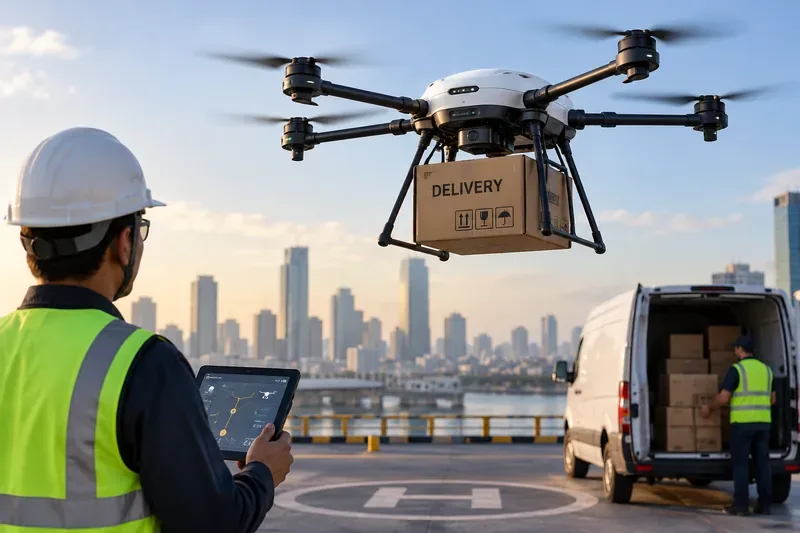
A logistics drone is only one part of the delivery architecture. Ground handling, fleet monitoring, payload transfer, charging, routing, and conventional vehicles may all operate as one network.
What exactly needs to be moved?
Payload definition comes before airframe selection. The engineering team needs to know the package mass, dimensions, center of gravity, fragility, temperature requirements, hazardous-material status, loading method, and expected delivery volume.
A two-pound meal and an eight-pound grocery order create different structural and energy requirements even if both travel the same distance. A compact parcel can sit close to the aircraft's center of mass, while a bulky package can add aerodynamic drag or force a wider landing gear configuration. Temperature-sensitive medicine may require insulation or active monitoring. Dangerous goods introduce additional regulatory and containment requirements.
The payload also determines whether the aircraft should land, lower the package on a tether, release it by parachute in a controlled zone, or transfer it at a dock. Each mechanism changes the vehicle's mass, complexity, failure modes, and required ground footprint.
Decision rule: define the payload envelope first, including the heaviest and largest routine package you realistically expect to carry. Designing around an occasional oversized order can make every ordinary flight less efficient.
Which airframe architecture fits the route?
Three broad configurations dominate small logistics UAV discussions: multirotor, fixed-wing, and hybrid vertical-takeoff-and-landing (VTOL).
Hover consumes substantial power and limits practical range
Short urban or campus missions with tight delivery zones
Fixed-wing
Efficient forward flight and longer range
Cannot hover and needs a launch/recovery strategy
Longer corridors, rural routes, hub-to-hub transport
Hybrid VTOL
Vertical takeoff plus more efficient wing-borne cruise
More propulsion, control, transition, and maintenance complexity
Routes that need both compact endpoints and meaningful cruise range
Current commercial systems illustrate why architecture follows the mission. Wing says its delivery aircraft uses separate vertical-lift motors for takeoff, landing, and delivery plus separate cruise propulsion for efficient forward flight. Its current technology page describes up to a 12-mile round trip for the standard delivery system and centralized oversight rather than manual control of each flight. See Wing's official technology overview.
Zipline uses a different system architecture. Its current Platform 2 fact sheet describes an aircraft designed to fly up to 24 miles and carry up to 8 pounds, with docking and charging infrastructure plus a tethered “Delivery Zip” that descends from the aircraft for the final handoff. These are manufacturer-reported specifications, not universal performance benchmarks. See Zipline's official fact sheet.
Decision rule: if the route spends most of its time in forward flight but still needs vertical operations at each end, hybrid VTOL can justify its added complexity. If the route is very short and precise hovering dominates the mission, a simpler multirotor may be more practical.
Why is payload-range-energy more important than headline flight time?
Battery endurance is often quoted as if it were a fixed property. In logistics, it is a mission variable. Energy demand changes with payload mass, wind, temperature, hover time, climb, routing constraints, battery age, reserve policy, and the delivery maneuver itself.
A logistics design therefore works backward from the mission energy budget. Engineers estimate the energy required for launch, climb, cruise, maneuvering, delivery, return flight, contingency routing, and the required reserve. Only then can the system determine whether the selected battery and propulsion architecture provide acceptable margin.
Higher battery capacity is not free. A larger battery adds mass, which increases energy consumption and may require larger motors, stronger structure, or more lift area. That feedback loop is one reason efficient cruise architectures matter as routes get longer.
Decision rule: evaluate usable payload at the required range with realistic reserve and weather margins. Maximum empty-aircraft endurance is much less useful for logistics planning.
Does the drone need to land at the customer?
Not necessarily. In fact, avoiding a landing can simplify some parts of the customer interaction while complicating others.
A landing vehicle needs a clear, stable area and must manage people, pets, debris, uneven terrain, and possible contact with the aircraft. A tethered system can keep the main aircraft higher while lowering only the package. Wing's official description says its aircraft hovers above the delivery zone and lowers the order on a tether; Zipline's Platform 2 similarly keeps the main aircraft aloft while a separate delivery unit descends.
The tradeoff is that tether systems need their own sensing, control, winch or deployment hardware, obstacle logic, and recovery procedures. They also add mass and introduce additional failure modes.
Decision rule: choose the delivery mechanism as part of aircraft architecture, not as a late accessory. The last 30 feet can be harder to engineer safely than the preceding several miles.
How much autonomy does scalable logistics require?
A demonstration can be flown by one remote pilot watching one aircraft. A logistics network cannot scale economically if every aircraft requires continuous stick-and-throttle control.
Modern delivery architectures increasingly automate route generation, preflight checks, launch, navigation, contingency behavior, delivery, return, and fleet coordination. Human operators move toward supervisory roles: monitoring system health, weather, airspace constraints, exceptions, and multiple aircraft.
That does not mean “autonomous” equals “unsupervised.” Aviation systems need clearly defined responsibilities, alerting, contingency procedures, logging, and safe behavior when sensors or communication links fail.
Wing, for example, says pilots oversee multiple flights from central locations and that individual flights do not require continuous human control. The engineering implication is important: fleet supervision software and operational procedures become safety-critical parts of the system, not just back-office applications.
What do detect-and-avoid and command-and-control actually do?
Detect-and-avoid (DAA) is the capability to identify potential conflicts with other aircraft or hazards and take appropriate action. Command and control (C2) is the communications path used to manage the unmanned aircraft and exchange operational information.
NASA's UAS-in-the-National-Airspace-System research has specifically addressed DAA, C2, communications, navigation, surveillance, human systems integration, and standards needed for broader UAS operations. See NASA's UAS integration research overview.
A robust logistics architecture also needs contingency logic for degraded positioning, lost communications, unexpected obstacles, weather changes, low energy state, and unavailable landing or delivery zones. The safe response may be to hold, return, divert, land at a predefined alternate location, or terminate a mission according to the approved operating concept.
Decision rule: do not evaluate autonomy only by navigation accuracy. Ask what the system does when the expected data are wrong or unavailable.
How does UAS Traffic Management change the architecture?
UAS Traffic Management (UTM) is an information-based ecosystem for coordinating low-altitude drone operations. The FAA describes UTM as complementary to conventional air traffic services and identifies functions including flight planning, authorization, surveillance, and conflict management, particularly for operations beyond visual line of sight (BVLOS).
This matters because a dense delivery network needs more than each drone independently avoiding obstacles. Operators may need to share intended flight areas, receive airspace constraints, coordinate strategically with other operators, and react to changes in the operating environment.
The FAA says it has begun issuing Letters of Acceptance to UTM service providers supporting commercial BVLOS operations with strategic deconfliction services. See the FAA UAS Traffic Management overview.
Decision rule: if the business model depends on dense multi-operator BVLOS traffic, interoperability and traffic-management services belong in the system requirements from day one.
What ground infrastructure is really required?
The answer depends on how much labor the network can tolerate. At low volume, a worker can load a package and manually connect a battery charger. At high volume, those small tasks can become the bottleneck.
A scalable site may need:
Automated or quick-turn charging
Battery health monitoring
Weather sensing
Secure package staging
Automated loading or simplified handoff fixtures
Aircraft health checks and maintenance tracking
Network connectivity and backup communications
Clear launch, recovery, or hover zones
Interfaces to warehouse, restaurant, pharmacy, or order-management software
Wing publicly emphasizes minimal on-site infrastructure, remote operations, APIs, and automated aircraft health checks. Zipline emphasizes docks, charging, loading portals, and integration with third-party inventory and ordering systems. The designs differ, but the lesson is the same: the ground architecture determines how much human handling each delivery requires.
Decision rule: measure labor minutes per completed delivery, not just aircraft flight time. An efficient drone can still support an inefficient logistics process.
What regulatory path should be designed for from the start?
Regulation is not a paperwork layer added after engineering. It changes aircraft mass, redundancy, containment, communications, operations manuals, maintenance, training, and the evidence needed to show an acceptable level of safety.
In the United States, Part 107 covers many small UAS operations below 55 pounds. The FAA's current Part 107 overview still requires the remote pilot or visual observer to keep the drone within unaided visual line of sight unless separate authorization applies. See FAA Part 107 guidance.
For small-package delivery where an operator carries another party's property for compensation beyond visual line of sight, the FAA states that Part 135 is the regulatory path. The FAA's package-delivery page also explains that operators need certification, airspace authorization, delivery infrastructure, and appropriate safety documentation. See FAA Package Delivery by Drone guidance.
As checked on September 13, 2026, the FAA still describes the broader BVLOS framework as proposed rather than a generally implemented final rule, and its UTM field-test material says operations continue under existing regulations until a BVLOS final rule is implemented. See the FAA BVLOS rule page.
Registered drones in the United States are also generally subject to Remote ID requirements. Remote ID broadcasts identification and location information and is part of the FAA's foundation for more complex UAS integration. See the FAA Remote ID overview.
In the European Union, EASA categorizes operations by risk. Operations that do not fit the lower-risk “open” category commonly require authorization in the “specific” category using a risk assessment. EASA's June 2026 consolidated rules incorporate SORA 2.5, the current Specific Operations Risk Assessment framework. See EASA's June 2026 Easy Access Rules for UAS and EASA's SORA guidance.
When does drone delivery make operational sense?
Drones are strongest when the package is relatively light, time has high value, road routes are slow or indirect, the origin has enough shipment density, and the delivery radius fits the aircraft's real mission envelope.
Medical logistics is a natural example because minutes can matter and many items are small. Retail and food delivery can also fit when order mass is modest and customers are located within a dense service area. Conversely, heavy orders, low shipment density, difficult weather, complex apartment access, or frequent exceptions can favor conventional vehicles.
The correct comparison is rarely “one drone versus one van.” A mature network can be multimodal. Vans can move bulk inventory between hubs while drones handle urgent or lightweight last-mile orders. Wing explicitly describes an “Aircraft Library” approach with different aircraft sizes for different payload needs, reflecting the same principle used by ground logistics: one vehicle size does not optimize every shipment.
Which engineering mistakes derail logistics projects?
Optimizing the aircraft while ignoring the network
A few extra miles of theoretical range may matter less than poor package loading, long charging downtime, low order density, or a delivery area that rejects many addresses.
Using maximum payload and maximum range at the same time
Those specifications are often separate boundaries, not one simultaneous operating point. A credible design needs a payload-versus-range curve under representative conditions.
Treating BVLOS as a software feature
BVLOS is an operational and regulatory condition involving aircraft reliability, airspace risk, DAA or other mitigation, C2, procedures, maintenance, operator responsibilities, and authorization.
Assuming GPS alone solves navigation
GNSS is valuable but can be degraded, blocked, spoofed, or temporarily unreliable. Safety architecture should define what happens when positioning confidence falls below an acceptable threshold.
Ignoring noise and community acceptance
Even a technically safe network can face deployment friction if repeated flights disturb neighborhoods or if delivery zones create privacy or nuisance concerns. The FAA notes that aircraft noise remains a major public interest in environmental reviews of aviation activity.
Measuring success only by delivery speed
A ten-minute flight is not a ten-minute logistics process if loading, dispatch, charging, maintenance, and exception handling add substantial delay and labor.
What should a serious pilot program measure?
A useful pilot should test the whole service, not just prove that the aircraft can fly the route. Track:
Successful deliveries as a percentage of dispatched missions
Payload distribution, not just average payload
End-to-end order-to-delivery time
Energy used per completed delivery
Weather-related cancellations and diversions
Aircraft availability and maintenance hours
Charging or battery-turnaround time
Human labor minutes per order
Communication or navigation degradations
Delivery-zone rejection rate
Customer retrieval failures
Noise and community complaints
Safety events and precautionary landings
Cost per successful delivery at realistic utilization
These measurements expose where the bottleneck really lives. It may be battery endurance, but it can just as easily be packing time, charging capacity, weather limits, dispatch software, or customer delivery-zone availability.
The architecture shift transforming logistics
The most important change in UAV engineering is the move from designing a flying robot to designing an automated logistics system. Modern delivery architectures combine efficient airframes, precise vertical operations, autonomous routing, remote fleet supervision, DAA and C2, intelligent payload handling, charging, docks, APIs, and traffic-management services.
That systems approach is what makes drone logistics potentially scalable. The aircraft still matters enormously, but it is no longer the whole product.
Before committing to a platform, answer the operational questions in order: What are you carrying? How far? Under what weather and reserve assumptions? Does the aircraft need to hover? How will the package reach the customer? How is it loaded and recharged? What happens when communications fail? What approvals are required? How does the service connect to the existing warehouse or ordering system?
Once those answers are explicit, the right UAV architecture becomes much easier to evaluate—and the project moves from a compelling flight demonstration toward a logistics network that can actually operate.