Home
» New Trends
»
Where Should You Study Energy Storage Engineering? Top Battery Tech Programs for 2026
Where Should You Study Energy Storage Engineering? Top Battery Tech Programs for 2026
If you want to work on batteries, the first decision is not “Which university ranks highest?” It is “Which part of the battery value chain do I want to engineer?” Cell chemistry, electrode materials, manufacturing, battery management systems, pack design, vehicle integration, recycling, and grid-scale storage require overlapping but different training.
That is why the strongest choice depends on your target role. A chemistry-heavy student aiming for next-generation cathodes may need a very different program from a mechanical engineer who wants to design thermal systems for EV battery packs. The U.S. Department of Energy’s National Blueprint for Lithium Batteries treats the battery workforce as spanning research, manufacturing, supply chains, and end-of-life systems, which is a useful way to think about your own education.
This guide compares programs using official university information available in September 2026. It is not a numerical ranking. Program names, tuition, admissions rules, and course offerings can change, so use the linked university pages as the final authority before applying.
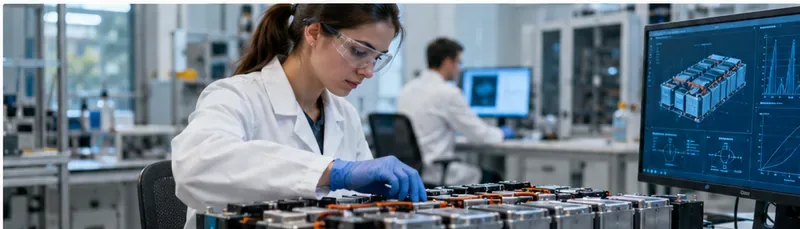
Hands-on battery education can range from cell and materials research to module testing, diagnostics, modeling, and system integration.
Do you need a degree literally called “battery engineering”?
No. A dedicated battery degree is attractive because it forces the curriculum to connect electrochemistry, cells, packs, testing, safety, manufacturing, and applications. But many excellent battery researchers and engineers train through materials science, chemical engineering, mechanical engineering, electrical engineering, or nanoengineering.
The better question is whether the program lets you build the skill stack required for the job you want. For example:
Battery materials and electrochemistry: prioritize thermodynamics, kinetics, ion transport, materials characterization, synthesis, interfaces, and electrochemical testing.
Cell manufacturing: look for electrode processing, slurry/coating knowledge, dry-room or pilot-line experience, quality control, formation, scale-up, and manufacturing engineering.
Battery management systems (BMS): prioritize circuits, estimation, controls, embedded systems, modeling, machine learning, state-of-charge and state-of-health estimation.
Pack and EV integration: look for thermal management, mechanical design, power electronics, controls, safety, durability, and vehicle systems.
Grid storage: add power systems, energy markets, optimization, degradation economics, system sizing, and renewable integration.
Research or PhD preparation: thesis access, active battery faculty, characterization facilities, and sustained lab work matter more than a polished professional degree title.
Which programs are the strongest direct battery degrees?
RWTH Aachen University — Battery Systems Engineering and Battery Science and Technology in Engineering
Best fit: students who want a degree centered on the battery value chain rather than a general engineering degree with a few battery electives.
RWTH Aachen now offers two closely coordinated battery-focused master’s routes. The English-taught M.Sc. Battery Systems Engineering is a two-year, 120-ECTS program delivered through RWTH International Academy. Its published curriculum covers battery modeling, electrical testing, post-mortem analysis, aging, system design, large-scale storage, and recycling.
RWTH also runs the public M.Sc. Battery Science and Technology in Engineering. The program is strongly research-oriented and includes battery testing laboratories, advanced production technology, battery diagnostics, stationary applications, recycling, and battery modeling. Its official curriculum also lists an elective in battery modeling and machine learning.
One of RWTH’s main advantages is research infrastructure around the Center for Ageing, Reliability and Lifetime Prediction of Electrochemical and Power Electronic Systems (CARL). If you want to understand degradation, lifetime prediction, BMS, pack hardware, or the transition from cell measurements to system engineering, RWTH is one of the most directly aligned options in this list.
Watch before applying: the public and private routes have different admissions and fee structures. For the 2026/27 intake, RWTH International Academy lists €24,000 in course fees for Battery Systems Engineering, while the public program has restricted admission. Verify the current cycle rather than assuming these figures remain unchanged.
Uppsala University — Master’s Programme in Battery Technology and Energy Storage
Best fit: students who want a dedicated battery degree with a choice between materials depth and cell/system applications.
The curriculum begins with materials chemistry, analysis, electrochemistry, energy storage, and electrification, then moves into rechargeable battery technology, production, testing, modeling, applications, sustainability, life-cycle analysis, and recycling. Students can build toward two broad profiles: battery materials or battery cells and systems. A 30-credit master’s thesis occupies the final semester and can be carried out with a university research group or company.
Uppsala is especially attractive if you want access to the Ångström Advanced Battery Centre, which the university describes as one of Europe’s largest battery education and research environments. The program also explicitly includes industrial visits, guest lectures, and connections across the battery value chain.
Choose Uppsala over a generic materials degree if: you already know batteries are your field and want the curriculum to stay centered on energy storage from chemistry through integration.
What if you want EV battery packs and automotive electrification?
University of Warwick WMG — MSc Sustainable Automotive Electrification
Best fit: engineers targeting EV battery systems, electrified powertrains, pack integration, and industry-facing automotive work.
Warwick’s MSc Sustainable Automotive Electrification is a 12-month full-time program for 2026 entry. It is broader than a battery-only degree, which is a strength if you want to understand how batteries interact with the rest of an electric vehicle.
WMG’s Energy Innovation Centre supports battery research from materials and electrochemistry through application integration and recycling. Its Battery Systems Group describes research spanning the value chain and emphasizes industrial application.
If your goal is electrode discovery, a materials-centered program may be more appropriate. If your goal is to work on how cells become safe, durable vehicle systems, Warwick deserves a serious look.
Which programs are strongest if you want battery materials without locking into a battery-only degree?
Carnegie Mellon University — M.S. in Materials Science / Materials Science and Engineering, Energy Materials and Systems
Best fit: students who want a broader materials degree while building a concentrated battery and electrochemical-energy curriculum.
Carnegie Mellon’s graduate materials programs offer an Energy Materials and Systems focus area. Published course options include Energy Storage Materials and Systems, Materials for Energy Storage, Materials for Future Energy Systems, and Electrochemical Decarbonization Technologies.
CMU gives you two useful choices. The coursework-based M.S. in Materials Science and Engineering can be completed quickly, while the research M.S. in Materials Science adds a substantial individual research project and final report.
This distinction matters. If you are aiming for battery-industry engineering roles and already have research experience, a coursework route may be efficient. If you want a PhD or advanced R&D role, the research route can provide stronger evidence that you can formulate and execute an experimental problem.
UC Berkeley — MEng Materials Science and Engineering, Chemical and Electrochemical Materials
Best fit: students interested in electrochemistry, energy-storage materials, and technology development in a broad materials-engineering environment.
UC Berkeley’s Master of Engineering in Materials Science and Engineering includes a Chemical and Electrochemical Materials area. The published technical-elective list includes Fuel Cells, Batteries and Chemical Sensors alongside thermodynamics, transport, surfaces, and materials processing.
Berkeley also has a strong electrochemistry research ecosystem through the Center for Electrochemical Science, Engineering and Technology (CESET). Its research areas include battery science, solid electrolytes, electrochemical interfaces, computational materials, and machine learning for materials discovery.
Important distinction: this is not a dedicated “battery engineering” degree. It is a flexible materials pathway in an environment with substantial electrochemistry and battery research. That makes it attractive if you want options beyond batteries as your interests evolve.
UC San Diego — M.S. in NanoEngineering
Best fit: students interested in nanoscale materials, interfaces, and energy-storage research.
The UC San Diego M.S. in NanoEngineering offers a focus area in Nanotechnologies for Energy and the Environment. The department’s graduate catalog specifically identifies nanotechnologies for energy conversion and storage as a major research focus.
Students can choose a thesis plan involving faculty research or a coursework-focused plan culminating in a comprehensive examination. That flexibility is valuable: a thesis path better suits students aiming for battery R&D or doctoral study, while the coursework option can fit professionals who want broader nanoengineering training.
Where should you look if your priority is research rather than a named battery program?
Georgia Institute of Technology — M.S./Ph.D. in Materials Science and Engineering
Best fit: students who want to join an active battery-materials research group and value advisor fit more than degree branding.
Georgia Tech’s Materials Science and Engineering research portfolio explicitly includes energy storage and harvesting. Its graduate course listings include Materials for Energy Storage and Conversion, and current faculty work spans lithium-ion, sodium-ion, solid-state batteries, interfaces, and advanced characterization.
This is the kind of program where the correct question is not “Does the diploma say battery?” but “Which faculty member is working on the chemistry, interface, model, or manufacturing problem I want to study?” For a PhD applicant, that advisor-level match can matter more than a prepackaged specialization.
MIT — graduate engineering pathways in electrochemical energy storage
Best fit: research-driven students who want deep electrochemical fundamentals and are comfortable building a battery pathway through Mechanical Engineering, Chemical Engineering, or Materials Science rather than entering a named battery master’s.
MIT offers graduate-level subjects such as Electrochemical Energy Conversion and Storage, covering thermodynamics, kinetics, transport, materials, lithium batteries, electrochemical testing, and energy devices. Research groups such as the Brushett Research Group work on electrochemical energy storage and conversion, including redox-flow batteries for grid storage.
MIT is therefore better understood as a research ecosystem than as a battery-professional-degree option. If you need a tightly prescribed battery curriculum, RWTH or Uppsala is more direct. If you want to pursue fundamental electrochemistry under a specific research group, MIT can be a stronger fit.
How do these programs compare?
Program
Best for
Battery specificity
Hands-on / research route
RWTH Aachen — Battery Systems Engineering / Battery Science and Technology in Engineering
EV packs, vehicle integration, industrial battery systems
Medium-high
Energy Innovation Centre and automotive research facilities
Carnegie Mellon — M.S. Materials, Energy Materials and Systems
Energy-storage materials with broad materials training
Medium
Coursework or research M.S. route
UC Berkeley — MEng MSE, Chemical and Electrochemical Materials
Electrochemistry, battery materials, broad technology development
Medium
CESET ecosystem; professional MEng structure
UC San Diego — M.S. NanoEngineering
Nanoscale materials and energy-storage research
Medium
Thesis or comprehensive-exam plan
Georgia Tech — M.S./Ph.D. Materials Science and Engineering
Research in next-generation battery materials and interfaces
Research-dependent
Strong faculty-led research pathway
MIT — engineering graduate pathways
Fundamental electrochemistry and advanced energy-storage R&D
Research-dependent
Graduate electrochemistry courses and specialized research groups
Should you choose the program with the biggest battery lab?
Not automatically. Facilities matter only if students at your degree level can actually use them. Before applying, ask questions that are more specific than “Do you have a battery lab?”
Can master’s students fabricate cells, or is equipment reserved for PhD researchers and staff?
Is there access to gloveboxes, cyclers, impedance spectroscopy, thermal testing, microscopy, abuse testing, and post-mortem analysis?
Does the program teach how measurements translate into engineering decisions?
Can students work on pilot-scale electrode or cell manufacturing?
Are thesis projects available with faculty who are accepting new students?
Can students work with industry or national laboratories?
A smaller program that gives you sustained access to a real project can be more valuable than a famous facility you only see during a tour.
What courses should a serious battery curriculum include?
A strong energy-storage engineering program should cover enough of the following areas for your chosen role:
electrochemistry and electrochemical thermodynamics;
transport phenomena and reaction kinetics;
battery materials and interfaces;
cell design and characterization;
degradation, aging, and lifetime prediction;
battery safety and thermal behavior;
manufacturing and quality control;
battery modeling and parameter estimation;
BMS, sensing, state estimation, and controls;
pack design, thermal management, and power electronics;
recycling, life-cycle assessment, and critical materials;
stationary storage, grid integration, and techno-economics where relevant.
If a program advertises “energy storage” but your transcript would contain only one battery elective, it may not provide the specialization you expect.
Is a one-year professional master’s enough?
It can be—if your goal is industry and you already have a strong engineering foundation. A concentrated professional master’s can quickly add battery systems, electrification, or materials knowledge. Warwick’s one-year format is an example of this type of decision.
For research-intensive roles, however, time in the lab is difficult to replace. A two-year program with a substantial thesis can give you experience designing experiments, dealing with failed cells, analyzing noisy data, and defending a technical conclusion. Those skills are especially important if you plan to pursue a PhD or advanced R&D position.
What should international students check before applying?
First, check whether your bachelor’s degree satisfies the program’s chemistry, physics, mathematics, or engineering prerequisites. Battery programs are interdisciplinary, but that does not mean they accept every background without preparation.
Second, compare the total cost of attendance, not only tuition. Dedicated programs vary widely: some are public university programs with restricted places, while others are professional programs with additional fees. Housing, health insurance, visas, and local living costs can change the real comparison substantially.
Third, check application timing directly on the current admissions page. Some pages in this article describe Autumn 2026 cohorts; by the time you read this, you may be applying for 2027 or later.
Finally, review internship and work-authorization rules for your destination country. A program with excellent industry links is less useful if your visa status prevents you from taking the placement you expected.
Which program should you choose for each career goal?
If you want the shortest practical shortlist, start here:
Dedicated battery engineering: RWTH Aachen or Uppsala.
EV battery packs and automotive integration: Warwick WMG or RWTH Aachen.
Battery materials with a broad materials degree: Carnegie Mellon or UC Berkeley.
Nanoscale energy-storage materials: UC San Diego.
PhD-oriented battery materials research: Georgia Tech, UC Berkeley, UC San Diego, Carnegie Mellon, or MIT, depending on advisor fit.
Fundamental electrochemistry and grid-storage research: MIT is particularly attractive when the specific research group matches your interests.
Do not treat this as an ordered ranking. A student who wants BMS development should not choose a chemistry-dominant lab simply because the university is more famous. Likewise, a student who wants to invent solid electrolytes should not prioritize an automotive systems curriculum with limited materials research.
What should you do before submitting an application?
Build a one-page comparison sheet for every school you are considering. Write down the degree name, required courses, battery electives, faculty you would actually want to work with, laboratory access, thesis options, industry projects, total estimated cost, and the jobs the curriculum prepares you to do.
Then read at least two recent papers or project pages from the faculty or center you hope to join. If you cannot explain why their work interests you, the program may not be the right research fit.
For professional programs, reverse the process: find five battery jobs you would realistically apply for after graduation and list their recurring skill requirements. Compare those requirements with the curriculum. The best program is the one that closes your most important skill gaps while giving you evidence—projects, laboratory work, a thesis, or industry experience—that you can actually perform the work.
The bottom line
Energy storage engineering is too broad for a single universal “best university.” The strongest choice depends on whether you want to work at the material, cell, manufacturing, pack, control, vehicle, or grid level.
For students who want a degree explicitly built around batteries, RWTH Aachen and Uppsala stand out because their curricula span multiple layers of the battery value chain. Warwick is compelling for automotive electrification. Carnegie Mellon, Berkeley, UC San Diego, and Georgia Tech offer flexible materials-centered routes with substantial battery research. MIT is a strong research-first option for students who care more about electrochemical depth and advisor fit than a battery-specific degree title.
The safest way to choose is to ignore the headline prestige for a moment and inspect the curriculum, laboratory access, faculty projects, and career outcomes that match the work you actually want to do. In battery technology, specialization is not a minor detail—it determines what problems you will be trained to solve.