Home
» New Trends
»
Autonomous Systems at Scale: How Smart Automation Is Reshaping Factories
Autonomous Systems at Scale: How Smart Automation Is Reshaping Factories
A factory rarely wakes up one morning and decides it needs “autonomy.” The pressure usually arrives in smaller, more practical forms: a line that stops too often, a quality issue that is detected too late, a changeover that takes too long, material that reaches the wrong workstation, or a maintenance team that spends too much time reacting instead of preventing failures.
Smart automation is changing how manufacturers address those problems, but the term is easy to overstate. A robot arm is not automatically an autonomous system. An AI model is not automatically safe enough to control production. A digital twin is not automatically a faithful copy of a factory. And a highly automated plant is not necessarily a “lights-out” facility with no people.
As of September 2026, the evidence points to a more grounded picture: factories are adding more robotics, sensing, analytics, connected operational technology, digital twins, and AI-assisted decision making, while safety, interoperability, cybersecurity, data quality, and human oversight remain central engineering concerns. The most useful question is therefore not “How autonomous can the factory become?” but “Which decisions can be automated reliably, safely, and economically at scale?”
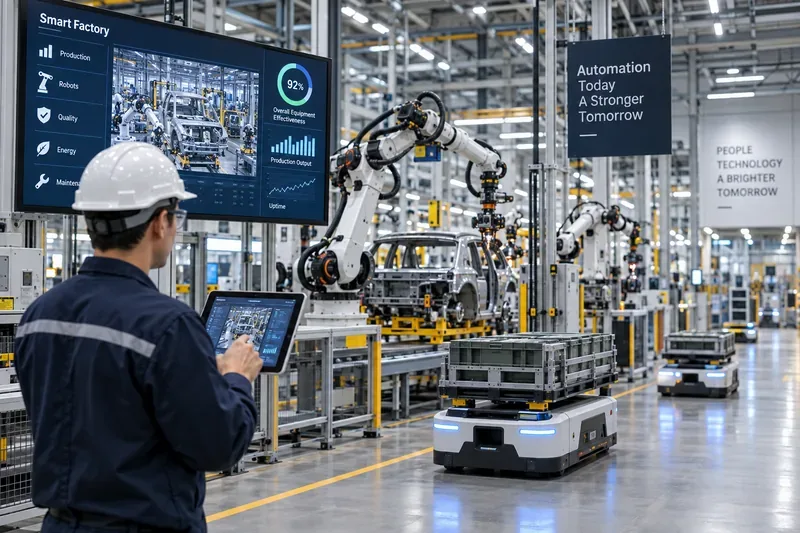
A technician monitors robotic work cells and autonomous mobile robots in a modern factory environment, illustrating how people, machines, material movement, and digital monitoring can operate together.
Verified: industrial automation is expanding at global scale
The scale of robot adoption is not speculative. The International Federation of Robotics reported in its World Robotics 2025 data that 542,000 industrial robots were installed worldwide in 2024. The global operational stock reached about 4.664 million units. Annual installations had exceeded 500,000 units for four consecutive years by that point.
Those numbers verify broad robot adoption, not the prevalence of fully autonomous factories. An industrial robot may repeat a tightly programmed operation for years without making any higher-level production decision on its own.
Useful action: treat global robot statistics as evidence that automation is mainstream, but build your business case from your own cycle time, downtime, scrap, labor constraints, changeover frequency, safety exposure, and product mix.
Misconception: “Autonomous” means a factory without people
What is verified: smart manufacturing includes systems with different levels of autonomy rather than a single end state. NIST describes smart manufacturing systems as adaptive systems with differing levels of autonomy, built on cyber-physical systems and data analytics. Its July 2026 AI and Machine Learning Roadmap for Smart Manufacturing discusses autonomy alongside industrial data, sensing, robotics, digital twins, logistics, and other capabilities.
What depends on context: some processes can run for long periods with little intervention; others need frequent operator judgment, inspection, tooling changes, material handling, exception recovery, or maintenance. Product variability and process risk matter as much as the sophistication of the automation.
What is not known universally: there is no single optimal percentage of “human-free” operation that applies across automotive, electronics, food, pharmaceuticals, heavy industry, or job shops.
Useful action: define autonomy by decision boundary. List which decisions remain manual, which are advisory, which are automatically executed, and which automatically escalate to a person when confidence or operating conditions move outside limits.
Misconception: more robots automatically create a smart factory
What is verified: a smart manufacturing system depends on connected information, controls, data, and performance measurement, not simply on the number of robots. NIST's Smart Manufacturing Systems Design and Analysis Program emphasizes cyber-physical infrastructure, real-time control, analytics, standards, protocols, and system-level performance.
What depends on context: robotizing a stable, repetitive bottleneck can be highly effective. Automating an unstable process can simply make defects, jams, or scheduling mistakes happen faster.
What remains uncertain until measured: the actual gain in throughput, OEE, quality, energy efficiency, or labor productivity from a specific automation project.
Useful action: baseline the process before automating it. Record cycle-time distribution, microstops, first-pass yield, changeover time, manual interventions, maintenance events, and upstream/downstream constraints. Compare the post-deployment system with that baseline rather than with a vendor demo.
Where smart automation is changing factory behavior
1. Machines are becoming easier to observe
Sensors, industrial networks, machine interfaces, and edge systems can expose production states that were previously buried in controllers or maintenance logs. Better visibility is often the first practical step toward autonomy because a system cannot make dependable decisions from data it cannot collect or interpret.
Useful action: start with a shared equipment-state model and consistent timestamps before building advanced analytics. If two systems disagree about whether a machine was producing, idle, blocked, starved, or down, an AI layer will inherit that ambiguity.
2. Maintenance is moving from calendars toward condition and risk
Connected equipment can support condition monitoring, diagnostics, and prognostics. This does not mean every failure is predictable. Wear patterns, sensors, operating regimes, and failure modes vary.
Useful action: choose assets where unplanned downtime is expensive and where there is a measurable precursor to failure. A predictive-maintenance model without a reliable failure label, enough representative data, or a maintenance action tied to its output may create alerts rather than value.
3. Material movement is becoming more dynamic
Autonomous mobile robots and other automated transport systems can move parts between work cells without fixed conveyors. Their value is often greatest where routes, product mix, or workstation demand change frequently.
Useful action: evaluate fleet behavior at system level, not one-robot speed. Include intersection congestion, charging, pickup/drop-off dwell time, blocked aisles, traffic rules, manual forklifts, and recovery from route obstruction.
4. Quality decisions can move closer to the process
Machine vision and AI-assisted inspection can detect visual defects, dimensional deviations, or process signatures quickly. Performance, however, depends on lighting, camera geometry, product variation, labeling quality, defect rarity, and how thresholds are managed over time.
Useful action: track false accepts and false rejects separately. A model that improves headline accuracy can still be unacceptable if it misses a rare critical defect.
5. Production decisions can become more adaptive
At higher maturity, analytics can recommend or execute adjustments to routing, scheduling, process parameters, or resource allocation as conditions change. This is where the phrase “autonomous manufacturing” becomes more meaningful: the system is not only executing a fixed sequence but selecting among allowed responses using current state information.
Useful action: constrain autonomous decisions to an explicitly approved operating envelope. Define what the system may change, how far it may change it, what evidence it needs, and when it must revert or request human approval.
Misconception: AI can simply replace deterministic industrial control
What is verified: NIST's 2026 roadmap says AI and machine learning are enabling advances in smart manufacturing while also identifying critical challenges around industrial big data, data management, integration with heterogeneous sensing and control systems, and trustworthy, explainable, reliable operation in high-stakes industrial environments.
What depends on context: AI can be useful for perception, anomaly detection, forecasting, optimization, recommendation, or constrained control. The acceptable role depends on process safety, latency, model stability, verification requirements, and the consequences of a wrong decision.
What remains unknown: claims that general-purpose AI can safely and economically replace established control architectures across arbitrary factories are not supported by a universal body of evidence.
Useful action: use a layered architecture. Keep deterministic safety functions and hard real-time controls where they are needed, then add AI at clearly defined layers with monitoring, fallbacks, audit logs, and safe degraded modes.
Misconception: a digital twin is just a 3D factory model
What is verified: NIST's work on manufacturing digital twin standards describes digital twins as a broader smart-manufacturing capability involving data, models, interoperability, and trustworthiness. NIST's July 2026 Digital Twins Workshops Summary Report highlights continuing challenges in interoperability, verification, validation, uncertainty quantification, cybersecurity, and workforce readiness.
What depends on context: one twin may support machine health; another may model a work cell; another may simulate line balancing or production schedules. A photorealistic 3D visualization can be useful, but visual fidelity is not the same as decision fidelity.
Useful action: define the question the twin must answer. Then validate the data and model against that decision. If the goal is predicting queue buildup, validate queue and cycle behavior. If the goal is energy optimization, validate the energy model.
Misconception: factory connectivity is a solved commodity problem
What is verified: NIST research on wireless systems for factory automation identifies reliability, latency, network coexistence, spectrum conditions, scalability, and integration with control as engineering challenges.
What depends on context: some telemetry can tolerate delay or packet loss; motion coordination, machine safety, and time-sensitive control may have much tighter requirements.
Useful action: classify communications by consequence. Do not apply the same availability and latency assumptions to dashboards, quality images, mobile-robot traffic, safety signals, and closed-loop control.
Cybersecurity becomes an operational reliability issue
The more decisions depend on connected operational technology, the more a cyber incident can affect physical production. NIST's Guide to Operational Technology Security, SP 800-82 Rev. 3 covers OT threats, vulnerabilities, architectures, and countermeasures. In May 2026, NIST also released an initial public draft of SP 1800-41 focused specifically on responding to and recovering from cyber attacks in manufacturing environments.
What is verified: connectivity creates cybersecurity considerations that can affect operations, safety, and restoration.
What depends on context: the right controls depend on architecture, legacy equipment, remote access, patch constraints, suppliers, safety requirements, and acceptable downtime.
Useful action: rehearse recovery, not just prevention. Know which production states can be restored from trusted backups, how controllers and recipes are validated after an incident, and how operations continue in a degraded mode.
Robot safety is an application problem, not only a robot feature
Marketing language such as “collaborative” can create another misconception: that the robot itself makes the whole application safe. The current international robot-safety standards separate requirements for industrial robots from requirements for integrated robot applications and cells. ISO 10218-1:2025 addresses industrial robots, while ISO 10218-2:2025 addresses integration, commissioning, operation, maintenance, decommissioning, and robot-cell hazards. OSHA's robotics technical guidance likewise treats the robot as part of a larger system that includes end effectors, controls, sensors, power sources, and interfaces.
Useful action: reassess risk when tooling, payload, speed, process, guarding, software, layout, or human interaction changes. Safety validation should follow the actual application, not the original robot brochure.
A practical maturity model for scaling autonomy
Stage
Typical capability
Main question before scaling
Observe
Machines expose consistent state and production data
Can we trust the data and timestamps?
Diagnose
Analytics explain losses, defects, or abnormal behavior
Do alerts correspond to actionable conditions?
Recommend
Software proposes maintenance, routing, scheduling, or parameter changes
Are recommendations measurably better than the current process?
Act within limits
Systems execute approved adjustments automatically
Are boundaries, fallbacks, and escalation rules explicit?
Coordinate
Multiple machines, robots, and logistics systems adapt together
Does local optimization harm line-level performance?
Scale across sites
Architectures, data models, controls, and governance are reused
Can the system remain safe, secure, maintainable, and measurable across different plants?
This progression is not a mandatory industry standard. It is a useful way to separate data visibility from decision autonomy so that a factory does not jump from “we have sensors” to “the system should control itself” without the engineering stages in between.
What is still genuinely uncertain
Universal return on investment
There is no credible single payback period for “smart automation.” ROI changes with utilization, labor market, energy cost, maintenance burden, product life cycle, volume, downtime cost, integration complexity, and the maturity of the starting process.
Useful action: build ROI around one constrained process and include integration, validation, cyber, training, spare parts, model maintenance, and recovery costs.
The long-term boundary between human and machine decisions
Technology is advancing, but the right boundary is not only a technical question. Safety, regulation, economics, workforce skills, quality accountability, and customer requirements also shape it.
Useful action: design roles around exceptions and accountability, not around a prediction that people will disappear from the process.
How quickly autonomous AI control will generalize
AI systems are improving rapidly, but performance in one production environment does not establish reliability across different equipment, materials, plants, or failure modes.
Useful action: demand site-specific validation and change-control procedures before extending an AI-driven control policy to a new line or product.
How to self-check whether automation is actually getting smarter
A factory is not becoming smarter merely because it has more dashboards, sensors, robots, or AI licenses. Look for evidence that the system is making operations more predictable and controllable. A scaled autonomous system should be able to answer these questions clearly:
Which decisions are automated, and which still require a person?
What data is required for each automated decision, and how is that data validated?
What happens when sensors disagree, communications fail, or model confidence drops?
Can the system revert to a safe state without improvisation?
Are safety functions independent of non-safety analytics where required?
Can operators understand why an automated action occurred?
Can maintenance teams diagnose the automation itself?
Are cybersecurity response and recovery procedures tested?
Do line-level results improve, or are individual machines being optimized at the expense of the whole system?
Can the same architecture be maintained across shifts, products, and sites without multiplying custom exceptions?
The most important shift in modern manufacturing is not from manual work to robots. It is from isolated automation to connected systems that can observe conditions, reason within defined limits, coordinate actions, and recover when reality does not match the model. Scaling that capability demands more than AI. It requires good process engineering, trustworthy data, interoperable systems, safety discipline, cyber resilience, and clear human accountability.
That is what makes autonomous systems at scale transformative—and also what keeps the factory from confusing automation with autonomy.