Home
» New Trends
»
Beyond Large Language Models: Why Embodied AI Is the Next Frontier in Tech
Beyond Large Language Models: Why Embodied AI Is the Next Frontier in Tech
Large language models changed computing by making software dramatically better at understanding and generating language. But the next major frontier is not simply a larger chatbot. It is embodied AI: AI that can perceive a physical environment, reason about what is happening, choose an action, execute that action through a robot or other machine, and use feedback to adjust what it does next.
That distinction matters because the physical world does not wait for a perfect answer. A warehouse robot that reaches for a box has to judge distance, avoid people, account for an object slipping in its gripper, and decide whether the pickup actually succeeded. An LLM can describe those steps. An embodied system has to close the loop between understanding and action.
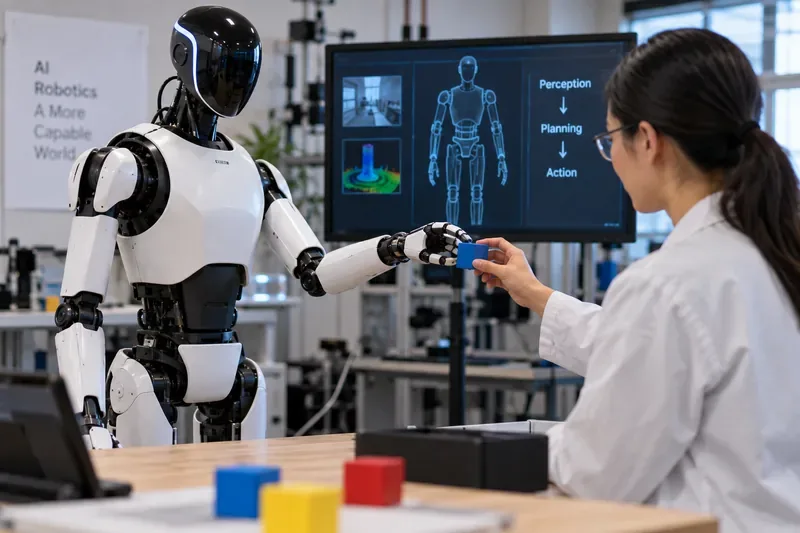
A humanoid robot and researcher interact with a physical object while a lab display shows the perception-to-planning-to-action loop that distinguishes embodied AI from language-only systems.
The short answer: embodied AI connects intelligence to consequences
An LLM primarily operates in an information space: text, code, images, audio, or other digital inputs and outputs. Embodied AI adds a body, sensors, actuators, and a control loop. That can mean a humanoid robot, a mobile manipulator, an autonomous vehicle, a drone, or another machine that must act safely in the real world.
In practice, the strongest systems are not abandoning language models. They are layering new capabilities around them. A high-level model may interpret a goal such as “clear this workbench,” while a vision-language-action model, or VLA, converts visual observations and language instructions into robot actions. Lower-level controllers then handle precise motion, balance, force, and timing.
Google DeepMind’s current robotics work illustrates that split. Its Gemini Robotics family combines embodied reasoning with models that turn visual and language inputs into motor control. The company’s July 2026 Gemini Robotics ER 2 model card describes an embodied-reasoning model designed for spatial, temporal, and physical reasoning. NVIDIA takes a complementary platform approach: Isaac GR00T combines foundation models, data pipelines, simulation, middleware, and robot-side computing for general-purpose humanoid development.
What changes when AI gets a body?
Layer
Main job
What can go wrong
LLM or high-level reasoning
Interpret goals, language, rules, and context
Misunderstands the request or makes an invalid plan
Perception
Estimate objects, people, geometry, motion, and state from sensors
Misses an obstacle, misjudges distance, or loses track of an object
VLA or robot policy
Map observations and instructions to actions
Selects an ineffective or unsafe movement
Low-level control
Execute motion, balance, grip, force, and timing
Slips, overshoots, collides, or destabilizes
Feedback and safety
Detect success, failure, uncertainty, and hazards
Fails to stop, recover, or ask for human help
This is why “just put an LLM in a robot” is not a sufficient engineering strategy. Language reasoning is useful, but useful physical autonomy also requires sensing, real-time control, calibration, physics, safety constraints, and recovery behavior.
Why embodied AI is advancing now
1. Robot learning is getting broader data
Traditional industrial robots are excellent when the environment is tightly controlled and the task barely changes. General-purpose robots need a wider base of experience. The Open X-Embodiment project pooled more than one million real robot trajectories across 22 robot embodiments. Its central finding was that training across different robots can produce useful transfer instead of requiring every machine to learn only from its own isolated dataset.
That does not mean one dataset makes a robot universally capable. It does show why cross-embodiment data matters: experience collected on one platform can help models learn concepts and behaviors that generalize to others.
2. Foundation models are moving from words to actions
A language model predicts tokens. A robot foundation model can be trained to predict actions conditioned on visual observations and language. NVIDIA’s GR00T research, for example, uses mixtures of human video, real robot trajectories, simulated trajectories, and synthetic data. Google DeepMind’s robotics work similarly focuses on combining multimodal reasoning with action execution.
The practical consequence is important. Instead of engineering a separate model from scratch for every pick, place, sort, reach, or handoff task, developers can start from a broader model and adapt it to a specific robot, environment, and workflow.
3. Simulation reduces the cost of physical trial and error
Real-world robot data is expensive because hardware moves slowly compared with software, breaks, wears out, and can create safety risks during training. Simulation therefore acts as a multiplier. NVIDIA’s Isaac Sim supports physics-based simulation, synthetic-data generation, software-in-the-loop testing, and hardware-in-the-loop testing.
Simulation is not a replacement for real validation. The “sim-to-real” gap remains: friction, lighting, flexible materials, sensor noise, people, and mechanical wear can differ from a virtual model. The better use of simulation is to cover many scenarios cheaply, then validate critical behavior on actual hardware.
4. The system can now reason about success, not only issue commands
Embodied intelligence becomes much more useful when a robot can determine whether a step worked. Google DeepMind’s April 2026 Gemini Robotics-ER 1.6 announcement emphasized spatial reasoning, planning, instrument reading, and success detection. Those capabilities matter because physical tasks are full of partial failures: a drawer may be stuck, a bottle may tip over, or a part may be present but not seated correctly.
A robust system therefore needs more than a plan. It needs observation after action and a policy for what to do when reality does not match the plan.
A concrete example: clearing a cluttered workbench
Consider the instruction, “Put the tools in the tray and throw away the packaging.” An LLM can create a reasonable checklist. An embodied AI system has to do much more:
identify which objects are tools and which are trash;
estimate where each object is and whether it is reachable;
choose a safe grasp without crushing or dropping the object;
move around obstacles while staying clear of people;
verify that the object landed in the intended location;
recover if the grasp fails or the scene changes.
This example also shows where embodied AI may be a poor fit. If every object arrives in the same orientation on a fixed conveyor belt, a simpler industrial automation cell may be cheaper, faster, easier to validate, and easier to maintain. Embodied AI earns its complexity when the environment, objects, instructions, or workflows vary enough that rigid automation becomes brittle.
When embodied AI is a strong fit
Embodied AI is most attractive when a task combines physical interaction with meaningful variation. Good candidates include mixed-item logistics, flexible manufacturing, laboratory automation, inspection, service robotics, and environments where humans give natural-language instructions that must be grounded in the surrounding scene.
Four conditions strengthen the case:
Variation is unavoidable. Objects, positions, routes, or goals change often.
The task benefits from perception and judgment. A fixed sequence is not enough.
There is enough economic value to support data collection, integration, and maintenance.
A safe operating envelope can be defined. Human oversight, speed limits, restricted zones, emergency stops, or other safeguards can bound the risk.
When an LLM, conventional software, or classical automation is still better
Embodied AI should not be treated as the default solution for every automation problem. If the work is entirely digital, an LLM or conventional software agent avoids the cost and risk of hardware. If a physical process is repetitive and highly structured, a traditional robot cell may outperform a general-purpose embodied system on cycle time and predictability.
There is also a middle ground. A company can use an LLM for planning or operator assistance while keeping motion execution deterministic. This can be a sensible choice in regulated, safety-critical, or high-throughput settings where open-ended autonomy is not yet worth the trade-off.
The harder problems are no longer only about model intelligence
As embodied AI improves, deployment bottlenecks increasingly move into systems engineering. Developers must synchronize cameras and other sensors, calibrate robot geometry, manage latency, collect representative data, monitor hardware health, establish failure states, and define what happens when confidence is low.
Safety is also fundamentally different from chatbot safety. A bad sentence can mislead a user; a bad motor command can damage equipment or injure someone. That is why model evaluations, physical safeguards, runtime monitoring, and human intervention mechanisms have to work together.
DeepMind’s robotics model cards explicitly document intended uses, limitations, and safety considerations rather than presenting model capability as sufficient evidence for unrestricted deployment. That is a useful pattern for the industry: capability demonstrations should be separated from proof that a system is safe and reliable in a specific workplace.
What to watch next
The most important signal is not whether robots become more human-looking. It is whether the intelligence stack becomes more transferable, more data-efficient, easier to validate, and safer across changing environments.
Several directions are already visible. Cross-embodiment learning aims to reuse experience across different robot bodies. Whole-body models are expanding beyond tabletop manipulation. On-device inference can reduce dependence on network latency for time-sensitive control. Simulation and synthetic data are being used to explore cases that would be expensive or dangerous to reproduce repeatedly in the real world. Multi-robot coordination is also moving from a research idea toward integrated system capability.
None of these developments proves that general-purpose robots are ready for every home or business. The stronger conclusion is narrower and more useful: the frontier of AI is expanding from generating information to acting under physical constraints. That shift introduces new opportunities, but also new requirements for control, validation, safety, and economics.
Bottom line
Large language models remain an important part of the stack because language is a powerful interface for goals, knowledge, and planning. Embodied AI extends that intelligence into environments where success depends on sensing what is actually happening, taking an action, and responding to the result.
For a software-only problem, an LLM may still be the right tool. For a fixed physical process, conventional automation may still win. But when machines must operate in messy, changing environments and translate human intent into reliable physical behavior, embodied AI is becoming the more relevant frontier.