Home
» New Trends
»
Vertiport Infrastructure: What the Airports of the Air Taxi Era Actually Need
Vertiport Infrastructure: What the Airports of the Air Taxi Era Actually Need
The most important rule for vertiport infrastructure is simple: design from the operating model backward, not from an architectural rendering forward. A useful vertiport is not merely a rooftop landing pad. It is a tightly coupled system for aircraft movement, electrical energy, passenger handling, emergency response, surface access, and airspace integration. If any one of those systems is undersized or poorly located, the entire facility can become difficult to operate even if the landing area itself is compliant.
That matters because the air taxi market is still developing, and infrastructure standards continue to evolve. As of September 2026, the U.S. Federal Aviation Administration still lists Engineering Brief 105A, dated December 27, 2024, as its vertiport design guidance. The FAA describes that document as a living standard while more validated VTOL operating data is collected. It is also limited in scope: the FAA's current infrastructure page says EB 105A is specific to pilot-onboard eVTOL aircraft operating in visual meteorological conditions and with a maximum takeoff weight of 12,500 pounds. Planners should therefore treat today's guidance as a design baseline, not a guarantee that one layout will fit every future aircraft or operating concept. See the FAA Engineering Brief 105A and the FAA Advanced Air Mobility Infrastructure page.
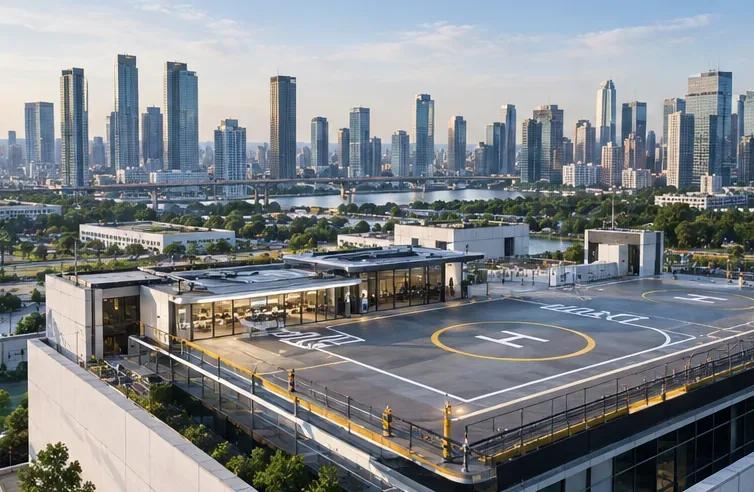
A conceptual urban vertiport showing how landing areas, aircraft stands, terminal space, and access infrastructure may compete for limited rooftop area. Actual dimensions, markings, and equipment depend on the aircraft, operating concept, and local rules.
Start With the Aircraft and Mission, Not the Site Plan
Before drawing a pad, define the aircraft and the trips the facility is supposed to support. A downtown passenger shuttle, an airport connector, a suburban park-and-fly site, and a cargo-only node can require very different infrastructure.
The key inputs include aircraft dimensions and weight, landing and takeoff performance, wheel or skid configuration, charging method, battery cooling needs, expected turnaround time, passenger capacity, baggage handling, approach and departure paths, and whether aircraft will ground-taxi, hover-taxi, or be repositioned by ground equipment. The FAA specifically uses a “Design VTOL” concept because the largest or most demanding aircraft expected at a facility can drive safety-area, parking, and separation requirements.
This is also where a developer should decide what “capacity” means. A facility designed for six movements per hour is a different project from one expected to process several aircraft simultaneously. The number of landing positions alone is not enough. Parking stands, charging dwell time, passenger loading, and sequencing can become the real bottlenecks.
A Vertiport Is Four Infrastructure Systems Working Together
1. Airside geometry and safety
The airside portion includes the touchdown and liftoff area, or TLOF, the final approach and takeoff area, or FATO, the surrounding safety area, approach and departure paths, taxi routes where applicable, and aircraft parking positions. These areas cannot be sized independently because the aircraft's geometry, performance, and downwash affect all of them.
Downwash and outwash deserve special attention. The FAA's EB 105A introduces a downwash/outwash caution area for locations where modeled airflow may reach or exceed approximately 34.5 mph (55.5 km/h). The point is not the number alone; it is the design consequence. People, loose objects, landscaping, signs, service equipment, and nearby vehicles may need to be kept outside affected zones or protected by operating procedures and physical design. Ground surfaces also need to avoid loose debris that could become foreign-object hazards.
European guidance takes a somewhat different design approach. EASA's Prototype Technical Design Specifications for Vertiports, published March 24, 2022, introduced an “obstacle free volume” concept intended to accommodate the vertical segment of VTOL operations and potentially more flexible urban trajectories. It remains important to distinguish this prototype guidance from a universal global standard.
2. Electrical power and aircraft charging
For electric air taxis, the power system can be as important as the concrete. A vertiport may need high-capacity utility service, transformers, switchgear, charging equipment, cable management, cooling, backup power, and possibly on-site energy storage. These systems take space, can add substantial construction lead time, and must be coordinated with the local utility early.
The FAA notes that consensus has not yet been achieved on a single charging class or connection standard for eVTOL aircraft. Charging needs vary with aircraft duty cycle, battery chemistry, cooling architecture, and charging speed. That uncertainty argues for modular electrical rooms, spare conduit, expandable switchgear, and parking layouts that can accept different charger configurations rather than locking a site into one proprietary setup.
A useful reference is the Federal Aviation Administration Vertiport Electrical Infrastructure Study produced by the National Renewable Energy Laboratory. In the aircraft data gathered for that study, peak DC charging power ranged from roughly 300 to 1,000 kW and battery capacities ranged from about 130 kWh to more than 300 kWh. Those figures are not a universal requirement, but they illustrate why a commercial vertiport can impose a much larger electrical load than a conventional passenger terminal alone.
3. Passenger, baggage, and ground transportation flow
The best vertiport location is not necessarily the closest rooftop to a business district. Passengers still need to reach the site, check in, move through any required screening, board safely, and connect to their final destination. A five-minute airborne time saving can disappear if the traveler spends 20 minutes reaching a poorly connected rooftop or waiting for an elevator.
Designers should therefore measure door-to-door performance, not only flight time. Useful sites tend to have direct links to rail, metro, airport terminals, parking, taxis, or high-frequency road transport. Passenger circulation should also remain physically separated from aircraft movement, charging equipment, service vehicles, and hazardous areas.
Accessibility is part of the operating design, not an afterthought. Boarding slopes, vertical circulation, accessible waiting areas, and the handling of mobility devices can influence how much apron and terminal space is required.
4. Emergency response, security, communications, and operations
Vertiports also need emergency access, fire protection planning, incident isolation areas, communications, weather information, lighting, signage, and procedures for abnormal operations. Battery charging and energy storage add hazards that traditional heliports may not have been designed around. EB 105A directs designers to applicable building and fire codes and points to standards including NFPA 418 for heliports and vertiports and NFPA 855 for stationary energy storage systems.
For U.S. projects, infrastructure approval also involves more than meeting a drawing standard. The FAA states that existing requirements for new takeoff and landing facilities apply to AAM infrastructure, including notice under 14 CFR Part 157 and aeronautical review under Part 77 where applicable. Local zoning, building codes, fire codes, land-use approvals, and community processes can be equally decisive.
Which Site Type Fits Which Use Case?
Site type
Where it can work well
Main advantages
Main constraints
Existing airport or heliport
Airport transfers, early commercial service, fleet trials
Existing aviation land, emergency services, airspace procedures, and some passenger infrastructure
May need charging upgrades, new parking, taxiing space, and coordination with existing traffic
Ground-level urban or suburban site
Transit hubs, business districts with available land, suburban feeder routes
Easier structural loading, emergency access, utility construction, and future expansion
Land can be expensive; surface access and noise-sensitive neighbors may limit operations
Rooftop or elevated site
Dense areas where ground land is scarce and demand is strong
Potentially close to trip origins and destinations; fewer ground-level obstructions
Structural capacity, evacuation, fire response, wind, turbulence, elevator capacity, and limited expansion can be difficult
Dedicated greenfield hub
High-throughput networks or future multimodal developments
Layout can be optimized around aircraft flow, charging, parking, and passenger processing
Requires proven demand, major utility service, transport links, and more capital before revenue begins
Why Throughput Often Depends on Parking and Power, Not Pad Count
Consider a hypothetical airport-connector vertiport. Suppose it has one arrival/departure position and three parking stands. If aircraft can land quickly but then occupy a stand for charging, boarding, inspections, or cooling, the parking area may fill before the landing position reaches its theoretical movement capacity. Adding a second landing pad would not solve that bottleneck.
The opposite can also happen. A site may have plenty of stands but only enough electrical capacity to fast-charge one aircraft at a time. In that case, the power system becomes the scheduling constraint. The correct layout therefore comes from an integrated operating simulation: arrival rate, dwell time, charging profile, reserve requirements, passenger processing time, recovery from delays, and abnormal events should all be tested together.
This is one reason the FAA's near-term AAM strategy emphasizes using existing infrastructure where practical. The FAA Advanced Air Mobility page says initial operations are expected to use existing helipads, routes, and air traffic control services where possible. That can reduce the risk of building a large dedicated facility before aircraft utilization and passenger demand are well established.
Rooftop Vertiports Need a Higher Bar Than “The Roof Is Big Enough”
A rooftop can look ideal on a map and still be unsuitable. Structural loading is only the first test. Designers must also consider dynamic aircraft loads, fire access, evacuation paths, protected passenger routes, wind and turbulence around nearby buildings, obstacle clearance, lightning protection, drainage, equipment placement, and the ability to move replacement batteries or heavy maintenance equipment if required.
Vertical circulation is a particularly practical constraint. If all passengers, staff, baggage, and emergency responders share a small elevator core, terminal throughput may be limited long before aircraft capacity is reached. In some projects, a slightly less central ground-level site with direct road or rail access may deliver a faster and more resilient passenger journey.
Community Acceptance Is Part of Infrastructure Design
Airspace safety is primarily a federal aviation responsibility in the United States, but local acceptance can shape whether a site is viable. Noise, visual effects, operating hours, traffic, emergency planning, and compatible land use can all influence approvals and public support. The FAA's AAM implementation materials explicitly include community engagement and environmental impacts such as noise, air quality, visual effects, and wildlife disruption.
That means a developer should not wait until final design to show the community a finished plan. Approach and departure directions, expected daily activity, ground traffic, emergency procedures, and the location of noise-sensitive land uses should be considered during site selection. The best mitigation is often a better site or operating concept, not a late-stage acoustic treatment.
Build in Phases When Demand Is Uncertain
For many markets, the most defensible infrastructure strategy is staged development. An early phase might adapt an existing aviation facility with a compliant landing area, limited parking, temporary or modular charging, and a modest passenger space. A second phase can add dedicated parking stands, larger electrical service, improved passenger processing, and redundancy once actual utilization is known. A high-throughput terminal should come only after the route network, fleet mix, and turnaround assumptions are supported by operating data.
This approach also protects against standards risk. The FAA, EASA, the UK Civil Aviation Authority, and other regulators are still developing or refining frameworks for advanced air mobility. The UK CAA's CAP2538, Considerations for Aerodromes and Vertiports Planning to Operate VTOL Aircraft, for example, is published as jurisdiction-specific guidance rather than a single global template.
How to Tell Whether a Vertiport Concept Is Ready to Advance
A credible concept should survive a few practical checks before major capital is committed:
The design aircraft and expected fleet mix are defined well enough to size landing, safety, parking, and taxi areas.
Approach and departure paths have been reviewed against obstacles, surrounding airspace, and likely community constraints.
Downwash and outwash effects have been evaluated for people, equipment, vehicles, loose objects, and adjacent property.
The electric utility has confirmed what service can be delivered, on what timeline, and what upgrades are required.
Charging dwell time, stand occupancy, passenger processing, and recovery from delays have been modeled together rather than separately.
Emergency response and battery or energy-storage hazards have been incorporated into the site plan.
Passengers can move from street or transit connection to aircraft without crossing active aircraft or service zones.
The site has a realistic path through aviation review, zoning, building, fire, environmental, accessibility, and local approval requirements.
The design can expand or change charger technology without reconstructing the entire facility.
If several of those questions are still unanswered, the project is probably not ready for a fixed architectural solution. The air taxi era may introduce new aircraft, but the infrastructure lesson is familiar: successful transport hubs work because operations, safety, energy, passengers, and the surrounding city are designed as one system. The winning vertiports are likely to be the ones that are flexible enough to start small, safe enough to earn trust, and practical enough to keep aircraft and passengers moving as demand grows.