Home
» New Trends
»
Solid-State and Beyond: How to Choose the Right Next-Generation Energy Storage Technology
Solid-State and Beyond: How to Choose the Right Next-Generation Energy Storage Technology
Energy storage is no longer a single race toward the battery with the highest energy density. It is becoming a portfolio problem: electric vehicles value low mass and fast charging, data centers value power quality and reliability, and electric grids may need anything from seconds of response to multiple days of stored energy. That difference matters because a technology that looks exceptional in one application can be a poor fit in another.
As of September 2026, lithium-ion still sets the commercial baseline, while sodium-ion is entering scale-up, all-solid-state batteries remain in the prototype and pilot-manufacturing phase, and long-duration systems such as flow batteries, thermal storage, pumped hydropower, compressed air and hydrogen are being developed for use cases where compactness matters less than duration and lifetime. The practical question is not “Which chemistry wins?” but “Which trade-offs are acceptable for the job?”
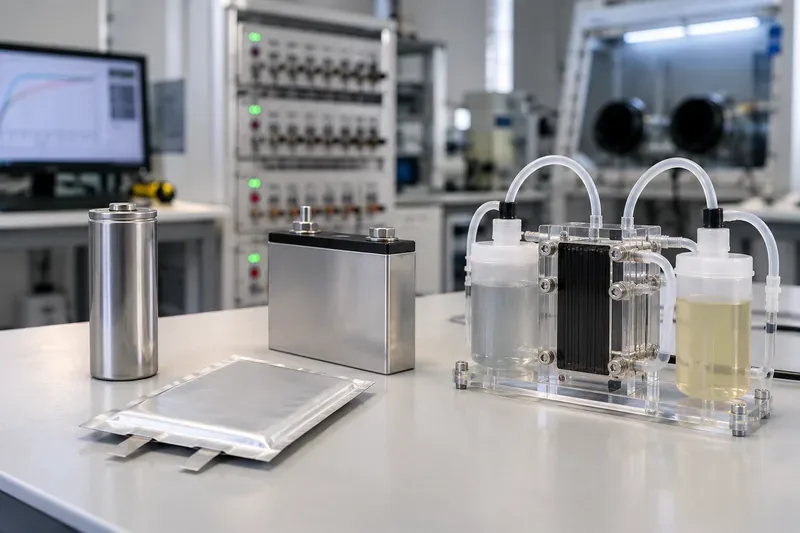
A battery research bench with several cell formats and a small flow-cell test rig, illustrating why next-generation storage spans both compact batteries and stationary systems with very different design priorities.
The market is already splitting by use case
The latest IEA Global EV Outlook 2026 battery analysis shows why a single-winner narrative is misleading. Lithium-ion manufacturing capacity exceeded 4 TWh globally by the end of 2025, and lithium iron phosphate (LFP) accounted for more than 90% of stationary battery storage installations in 2025. Mature manufacturing, established supply chains and proven field experience still carry enormous weight.
At the same time, the IEA identifies sodium-ion as entering the scale-up phase and solid-state as progressing but not yet demonstrated at large scale in real-world applications. For grid storage, the U.S. Department of Energy (DOE) is explicitly pursuing multiple technology families under Storage Innovations 2030, including lithium-ion, flow batteries, sodium batteries, zinc batteries, pumped storage hydropower, compressed-air storage, thermal storage, supercapacitors and hydrogen.
Useful action: define the application first—vehicle, backup power, daily solar shifting, 10-plus-hour grid storage, or multi-day resilience—before comparing chemistries. Otherwise, energy density or headline charging speed can dominate a decision where those metrics are not the real bottleneck.
A practical comparison of the main options
Technology
Where it is strongest
Main advantage
Main trade-off
2026 readiness
Advanced lithium-ion, especially LFP
EVs, home storage, 1–8 hour grid storage
Highly mature manufacturing and falling system cost
Still relies on lithium supply chains; energy density and thermal management remain design constraints
Reduces dependence on lithium and can perform well at low temperature
Lower energy density than leading lithium-ion; supply chain is much smaller
Early commercial scale-up
All-solid-state lithium
Premium EVs, robotics and other space- or weight-sensitive systems
Potential for higher energy density and improved safety characteristics
Manufacturing complexity, pressure requirements, cost and durability at scale
Pilot cells and pre-commercial programs
Lithium-sulfur
Potential future aviation and weight-sensitive transport
Very high theoretical specific energy and abundant sulfur cathode material
Polysulfide transport, lithium-metal stability and cycle-life challenges
Research and development
Redox flow batteries
Stationary, long-duration storage
Energy capacity can be increased by enlarging electrolyte tanks rather than the electrochemical stack
Low volumetric energy density and larger physical footprint
Commercial in selected grid projects, still scaling
Thermal, pumped hydro, compressed air and hydrogen
Long-duration or multi-day storage, especially where site conditions are favorable
Can decouple storage duration from battery-cell manufacturing constraints
Site, infrastructure, conversion-efficiency and permitting constraints vary widely
Ranges from mature to emerging depending on technology
The table is intentionally qualitative. Comparing a laboratory cell to a shipping battery pack, or a four-hour battery to a 100-hour storage plant, can produce meaningless “winner” claims. DOE’s 2024 long-duration energy storage assessment evaluates technologies for 10-hour and longer service because cost and architecture change substantially as duration increases.
Solid-state batteries: the strongest promise, but not the safest assumption
Verified: solid-state batteries replace the liquid electrolyte used in conventional lithium-ion cells with a solid electrolyte. That can enable new cell architectures, including lithium-metal anodes, and may improve energy density. The IEA also notes that the most frequently cited safety and range advantages have not yet been demonstrated at mass-market scale under standardized real-world conditions.
What depends on the design: “solid-state” is not one chemistry. Sulfide, oxide and polymer electrolytes behave differently, and some semi-solid or “almost-solid” designs still use small amounts of liquid. Mechanical pressure, interfacial contact, moisture sensitivity, dendrite control and production yield can all change the final pack-level result.
What is still uncertain: the cost, cycle life, manufacturing yield and pack-level safety performance that will be achieved after true high-volume production. Toyota stated in October 2025 that it was still targeting a 2027–2028 market launch for BEVs with all-solid-state batteries in its all-solid-state battery cathode-material collaboration announcement. QuantumScape opened its Eagle Line in February 2026 to produce cells for customer sampling, testing and product integration, according to its pilot-production announcement. Those are meaningful milestones, but neither one proves broad mass-market economics yet.
Useful action: if you are planning an EV or storage procurement before 2028, treat all-solid-state as an option to monitor rather than the default baseline. Ask for pack-level—not just cell-level—energy density, cycle life, fast-charge performance, operating pressure, warranty terms and independent abuse-test data.
Sodium-ion: a supply-chain hedge, not a universal low-cost replacement
Verified: sodium-ion has moved beyond purely laboratory research. The IEA reports that the latest cells can reach about 175 Wh/kg, versus up to about 205 Wh/kg for current LFP and 265 Wh/kg for NMC, while offering strong low-temperature performance. It also reports that sodium-ion manufacturing capacity is only a little over 1% of lithium-ion capacity today, so scale remains a major constraint.
Commercial activity is accelerating. CATL announced a sodium-ion passenger-vehicle program in February 2026 and unveiled a sodium-ion battery energy storage system in June 2026. The company says the stationary system is commercially ready, with cumulative shipments expected to reach 1 GWh by the end of 2026 and global deliveries planned from June 2027; those dates are manufacturer targets and should be treated as such. See CATL’s June 2026 sodium-ion storage announcement.
Common misconception: sodium is abundant, so sodium-ion batteries must automatically be cheaper than LFP. That conclusion is not yet verified. The IEA notes that lower energy density, a less-developed hard-carbon supply chain and current lithium prices can offset raw-material advantages.
Useful action: compare delivered pack cost per usable kWh, cold-weather performance, cycle life, footprint and supplier bankability. Sodium-ion becomes especially interesting when lithium-price exposure, cold climate or supply-chain diversification matters more than minimum pack volume.
Lithium-sulfur: compelling for weight, difficult for lifetime
Lithium-sulfur remains attractive because sulfur is abundant and the chemistry has very high theoretical specific energy. That makes it particularly interesting for applications where every kilogram matters, such as aviation or long-range unmanned systems.
Verified challenge: sulfur chemistry forms soluble polysulfides that can migrate through the electrolyte, while lithium-metal anodes introduce their own stability issues. Berkeley Lab continues to work on electrolyte designs to suppress those mechanisms, as described in its lithium-sulfur research program. NREL reported in early 2025 that the chemistry has the potential to exceed 500 Wh/kg at cell level but that current performance remains poor enough to require substantial modeling and materials work.
Useful action: treat lithium-sulfur as a high-upside research path for weight-sensitive products, not a drop-in replacement for applications that prioritize thousands of predictable cycles and established service networks.
Flow batteries and long-duration storage: when bigger can be better
For stationary storage, the design objective changes. A utility may have plenty of land but need 10, 24 or 100 hours of energy. In that context, high Wh/kg can matter far less than lifetime, replacement cost, safety, maintenance and the cost of adding another hour of storage.
Flow batteries are a clear example. DOE describes their core advantage as decoupled power and energy: the electrochemical stack determines power, while larger electrolyte tanks increase stored energy. That can be attractive when long duration is more valuable than a compact footprint. The trade-off is that pumps, tanks, balance-of-plant hardware and relatively low energy density make them unsuitable for vehicles and space-constrained applications.
Beyond electrochemical batteries, pumped hydropower, compressed-air storage, thermal storage and bidirectional hydrogen can serve even longer durations under the right conditions. They are not universally better: geography, infrastructure, round-trip losses, permitting and project scale can dominate the economics.
Useful action: for grid projects above 10 hours, run a duration-sensitive model. Compare levelized cost of storage, degradation, expected cycles per year, augmentation or replacement needs, land and interconnection—not just installed cost per kWh.
Three misconceptions that distort next-generation battery decisions
“Solid-state means fireproof.”
That is too broad. Replacing a flammable liquid electrolyte can reduce one hazard, but cell safety still depends on electrodes, interfaces, mechanical design, thermal propagation and pack construction. The IEA explicitly says the expected safety advantages of all-solid-state systems still need real-world demonstration at scale.
Action: ask for independent pack-level thermal propagation, crush, overcharge and fast-charge test results rather than relying on the electrolyte description alone.
“The highest energy density will win the grid.”
Not necessarily. Energy density is crucial in vehicles and aircraft, but fixed grid installations can trade space for lower cost, longer duration or easier maintenance. DOE’s long-duration program spans electrochemical, mechanical, thermal and chemical storage for exactly this reason.
Action: weight energy density lightly unless site footprint is actually a binding constraint.
“One chemistry will replace lithium-ion.”
The evidence points toward segmentation instead. LFP is already dominant in stationary batteries; sodium-ion is gaining a foothold where low-temperature performance or supply diversification matters; solid-state is being positioned first for premium high-performance applications; and long-duration storage may use entirely different architectures.
Action: build a technology shortlist by use case rather than by chemistry brand or media attention.
Which technology should you favor?
For an EV entering production in the next few years: mature lithium-ion remains the lowest-risk baseline. Sodium-ion is worth evaluating for shorter-range or cold-climate designs. Solid-state belongs in the advanced-development roadmap unless a supplier can demonstrate validated pack-level production data.
For premium EVs, robotics or other space-constrained systems after 2027: solid-state deserves close attention because extra energy density and power can justify higher early cost, but supplier qualification will be critical.
For stationary storage of roughly 1–8 hours: LFP remains the practical benchmark in most markets because it combines maturity, scale and proven deployment. Sodium-ion could become a stronger alternative as production expands.
For 10-plus-hour grid storage: compare flow, sodium, zinc, thermal, compressed air, pumped hydro and hydrogen based on site conditions, cycling profile and project life. This is where a battery designed for a car may be the wrong reference point.
For aviation and extreme weight sensitivity: lithium-sulfur and advanced lithium-metal or solid-state systems have compelling theoretical advantages, but qualification, cycle life and manufacturing consistency remain decisive barriers.
The real race is to prove performance at system scale
Next-generation energy storage will be decided less by one laboratory record than by repeatable manufacturing, supply-chain resilience, pack safety, lifetime cost and the ability to finance projects. Solid-state batteries may eventually transform premium mobility. Sodium-ion may diversify the market and improve cold-weather options. Flow, thermal, mechanical and hydrogen systems may take a larger role as power grids demand longer storage durations.
The most durable strategy is therefore technology-neutral but use-case-specific: specify the service first, test claims at system level, and keep enough flexibility to adopt a newer chemistry only when it beats the incumbent on the metrics that actually matter.