Home
» New Trends
»
The Internet of Medical Things (IoMT): How Connected Devices Are Transforming Remote Patient Care
The Internet of Medical Things (IoMT): How Connected Devices Are Transforming Remote Patient Care
The Internet of Medical Things, or IoMT, is moving from a collection of connected gadgets toward a more regulated part of health care infrastructure. Two U.S. developments make that especially clear in 2026. In February, the FDA issued updated final guidance on cybersecurity for medical devices with cyber risk, replacing its June 2025 version and emphasizing resilient device design, labeling, and premarket documentation. In May 2026, CMS updated its public guidance on remote patient monitoring, describing a model in which an internet-connected medical device automatically sends health data to a provider who uses it to manage treatment.
For patients and care teams, the practical message is straightforward: remote care is not transformed simply because a device can connect to the internet. The value comes from the full system—reliable measurement, secure transmission, usable clinical data, and a defined human response when the data changes.
What the Internet of Medical Things actually means
IoMT is the health care branch of the broader Internet of Things. It includes network-connected medical devices, sensors, software, gateways, and clinical systems that collect or exchange health information. A connected blood pressure cuff, glucose monitor, cardiac device, pulse oximeter, smart scale, or home monitoring hub can be part of an IoMT system when its data moves into a care workflow.
IoMT is related to telehealth, but the two terms are not interchangeable. A video visit is telehealth even if no medical sensor is connected. IoMT can operate between visits, sometimes automatically, by collecting measurements and sending them to a clinician-facing system. HHS specifically lists remote patient monitoring devices that collect vital signs as one type of remote health technology. See the HHS privacy and security resource for remote care technologies.
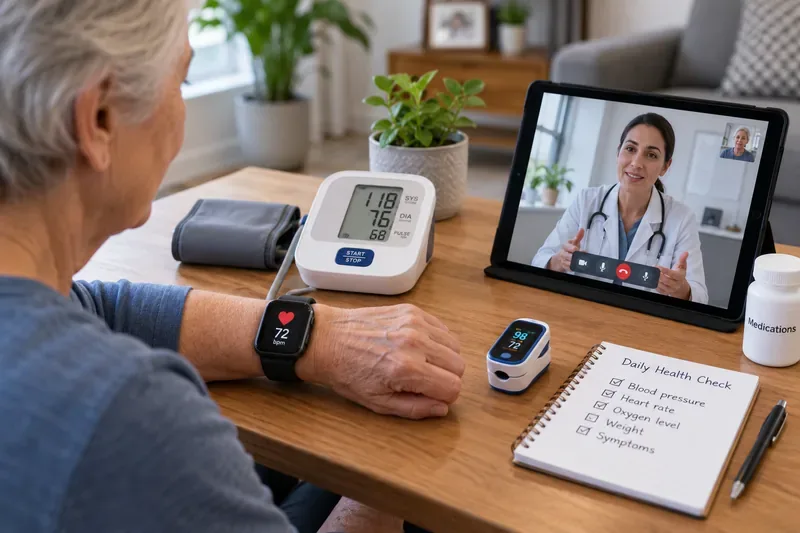
An at-home remote care setup can combine connected vital-sign devices with a clinician review workflow; the clinical value depends on reliable measurements, transmission, and follow-up.
How an IoMT remote-care system works
The exact architecture varies by product, but most remote monitoring programs contain several linked layers. A failure at any one layer can reduce the usefulness of the whole system.
Layer
What it does
Typical concern
Medical device or sensor
Measures a physiologic signal such as blood pressure, glucose, oxygen saturation, weight, or heart rhythm
Measurement quality, calibration, placement, battery life
Connection
Moves data by Bluetooth, Wi-Fi, cellular service, or another supported link
Receives data and may pass it to a vendor platform or clinical system
Account security, software updates, compatibility
Clinical platform
Organizes measurements into trends, alerts, and patient records
Interoperability, duplicate data, alert overload
Care workflow
Defines who reviews data, what thresholds matter, and when to contact the patient
Unclear ownership, slow escalation, staff burden
This last layer is easy to underestimate. A connected scale that uploads a patient's weight every day is not, by itself, a care program. Someone must know whether the change is clinically meaningful, when to verify the reading, and what action is appropriate.
That matters for remote care because connectivity changes the risk profile of a medical device. A device may be clinically useful and still create a security problem if software vulnerabilities expose health information, allow unauthorized control, or interrupt a function on which care depends.
A concrete example came from an FDA safety communication involving certain Contec and Epsimed patient monitors. The FDA said identified vulnerabilities could expose patient data or allow unauthorized control. A 2025 software patch removed networking functionality, which meant affected devices could only be used for local monitoring after the patch. The case does not mean internet-connected monitoring is inherently unsafe; it shows that cybersecurity can directly affect whether a remote-care feature remains available. The details are in the FDA safety communication on the affected patient monitors.
What remote patient monitoring looks like in practice
CMS defines remote patient monitoring as a patient collecting health data with a connected medical device that automatically transmits the data to a provider, who then uses it to treat or manage the patient's condition. Its public page, last modified May 13, 2026, lists connected blood pressure cuffs, weight scales, and pulse oximeters as examples and notes that Medicare coverage can apply to chronic and acute conditions. The current U.S. Medicare criteria are specific to that program and should not be treated as a universal rule for every insurer or country. See the CMS remote patient monitoring guidance.
In a hypertension program, for example, a patient might use a connected cuff at home. The readings flow to the care team's system rather than relying on handwritten notes brought to the next appointment. That can give the clinician a series of measurements across days instead of one office reading. Whether that improves care depends on accurate technique, patient participation, appropriate thresholds, and timely review.
The same pattern can apply to other conditions. A heart-failure program may track weight changes that could warrant follow-up. Diabetes care may use connected glucose data. Respiratory monitoring may use pulse oximetry when clinically appropriate. Some implanted cardiac devices can also support remote monitoring. These are not interchangeable programs: each condition requires its own measurement schedule, interpretation rules, and escalation plan.
Where IoMT can improve remote care
More information between appointments
Traditional outpatient care often relies on periodic snapshots. IoMT can add longitudinal data collected in the patient's normal environment. This can help a care team see trends that would be invisible during a single visit. The benefit is strongest when the measurement is clinically relevant and the team knows what change should trigger action.
Less dependence on manual reporting
Automatic transmission can reduce transcription errors and missing logs. It also lowers the chance that a patient forgets to bring a paper record. NIST's work on medical-device interoperability highlights the value of standards-based communication for reducing transcription errors and moving device-derived information into health systems. See the NIST medical device interoperability program.
More care can happen at home
For people who live far from a clinic, have mobility limitations, or need frequent checks, remote monitoring may reduce some in-person visits. It can also support post-discharge or hospital-at-home models when the clinical program is designed for that level of care. The limitation is important: moving equipment into a home also moves part of the clinical technology stack into an environment that a hospital does not control.
The trade-offs that determine whether IoMT works
Accuracy versus convenience
A convenient wearable is not automatically appropriate for diagnosis or treatment decisions. Consumer wellness devices and regulated medical devices can have different intended uses, validation, and oversight. Care teams should match the device to the decision they plan to make from its data.
More data versus more workload
Continuous or frequent readings can reveal useful trends, but they can also create alert fatigue. A program needs rules for filtering routine variation from changes that require attention. Otherwise, more data can increase workload without improving decisions.
Connectivity versus resilience
Remote monitoring depends on networks, software, credentials, and sometimes cloud services. A temporary internet outage should not create an unsafe situation. Programs need a fallback: instructions for manual readings, a phone contact, local device operation, or an in-person assessment depending on the medical risk.
Integration versus fragmentation
If each device has its own portal, login, data format, and alert system, clinicians can end up managing technology rather than patients. Interoperability—systems exchanging and correctly interpreting data—is therefore a core requirement, not a cosmetic feature.
Home convenience versus home-network risk
NIST's December 2025 work on telehealth and smart-home integration notes that hospital-at-home technology enters networks that health systems do not fully control. It recommends controls such as access management, authentication, monitoring, data security, governance, and network segmentation. See the NIST paper on telehealth smart-home cybersecurity and privacy.
What patients should ask before relying on a connected device
What is being measured, and why? The answer should connect the measurement to a real clinical decision.
Who actually reviews the data? Ask whether readings are monitored continuously, periodically, or only before appointments.
What happens if a reading is abnormal? Know whether an alert goes to a nurse, physician, call center, or only to you.
What should you do if the device or internet connection fails? A backup plan matters most for higher-risk conditions.
How are software and security updates handled? Follow manufacturer and care-team instructions rather than installing unofficial modifications.
Where does the data go? Ask which app, platform, provider, or vendor receives it and how access is controlled.
What health systems should evaluate before scaling IoMT
A useful remote-monitoring program should be judged as a clinical service, not just a technology purchase. The device needs evidence appropriate to its intended use. Patient onboarding should include measurement technique and connectivity support. The data should reach the people responsible for acting on it without forcing them to watch multiple disconnected dashboards.
Security also has to be managed across the product lifecycle. Health systems should know which devices can receive updates, how vulnerabilities are communicated, what happens when a vendor ends support, and whether a compromised device can be isolated without losing essential patient care. Privacy training should cover the realities of home use, shared devices, mobile apps, and remote communication—not only the hospital network.
What IoMT does not solve by itself
IoMT cannot compensate for a poorly chosen measurement, an understaffed care team, an unreliable home connection, or unclear clinical responsibility. It also does not guarantee better outcomes simply because more data are collected. Some patients may find connected monitoring burdensome, while others may benefit from the reassurance and reduced travel. Programs need alternatives for people who lack broadband, smartphones, digital literacy, or a stable home environment.
That is why the strongest IoMT implementations treat technology as one component of care rather than the care itself. The connected device extends observation beyond the clinic; clinicians still need to interpret the signal in the context of symptoms, history, medications, and patient preferences.
The practical outlook
The Internet of Medical Things is transforming remote patient care most convincingly where four conditions come together: a meaningful measurement, a reliable connected device, a secure and interoperable data path, and a clinical workflow that can respond. The 2026 FDA cybersecurity guidance and current CMS remote-monitoring framework both reinforce that connected care is becoming more structured, not less.
For patients, the most useful question is not “Is this device smart?” but “What happens with my data after the device sends it?” For providers, the equivalent question is “What decision will this data improve, and who owns the response?” When those answers are clear, IoMT can make remote care more continuous and actionable. When they are not, connectivity can simply add another layer of complexity.
Sources checked: FDA cybersecurity guidance (February 2026), CMS remote patient monitoring page (modified May 13, 2026), HHS telehealth privacy guidance, NIST medical-device interoperability resources, and NIST telehealth smart-home cybersecurity research. Information reviewed September 13, 2026.