Home
» New Trends
»
Where to Study Logistics and Drone Delivery Management: Best-Fit Degrees for 2026
Where to Study Logistics and Drone Delivery Management: Best-Fit Degrees for 2026
The most important decision is not which school has the word “drone” in its catalog. It is which side of drone delivery you want to manage. If you want to design delivery networks, forecast demand, manage carriers, control inventory, and improve last-mile performance, start with supply chain management or logistics. If you want to run UAS fleets, manage flight safety, airspace, remote pilots, and operational compliance, start with an uncrewed aircraft systems or aviation degree. If you want to build autonomy, detect-and-avoid systems, or the aircraft themselves, an engineering route is usually stronger.
For students who want to bridge both sides, the best path is often a primary degree in one domain plus targeted coursework, certification, internships, or graduate study in the other. That matters because commercial drone delivery is not simply a new transportation mode; it is the intersection of logistics, aviation safety, regulation, data, automation, and operations management.
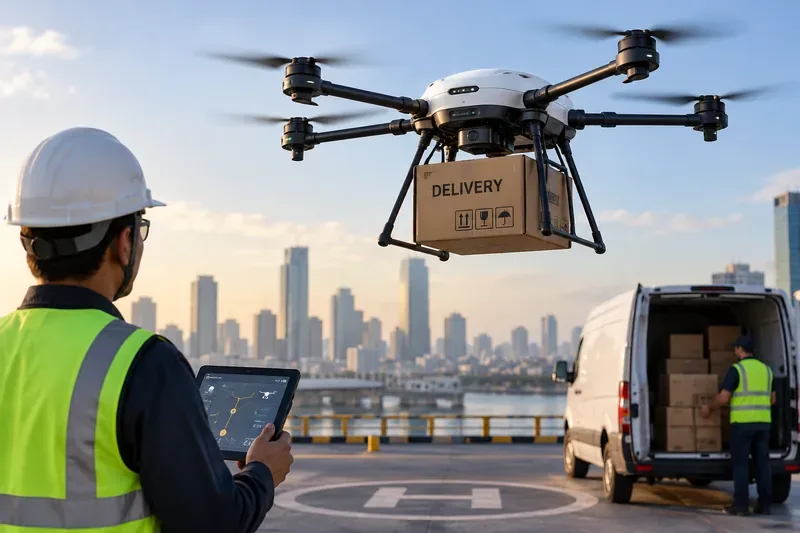
Drone-delivery careers combine aviation operations with the logistics systems that decide what moves, when, and where.
Should you study logistics, supply chain, or drone operations?
Choose the degree that matches the decisions you expect to own. A logistics manager decides how goods move through a network. A supply chain analyst may forecast demand, optimize inventory, or evaluate transport tradeoffs. A UAS operations manager is responsible for safe aircraft operations, mission planning, airspace integration, maintenance coordination, and regulatory procedures. A drone-delivery program manager may need enough fluency in all of these areas to connect aviation operations with business goals.
There is no universally best degree for every drone-delivery role. The practical question is whether you want to optimize the delivery system, operate the aircraft system, or engineer the technology.
Which undergraduate programs are the strongest fits?
The programs below are not presented as an absolute ranking. They are best-fit examples based on current curricula and program structures verified on official university pages in September 2026.
University of North Dakota: B.S. in Aeronautics, Unmanned Aircraft Systems Operations
UND is one of the clearest choices for students who want drone operations to be the center of their undergraduate education. Its 120-credit Unmanned Aircraft Systems Operations B.S. Aero emphasizes UAS operations, National Airspace System integration, safety, aircraft systems, human factors, commercial operations, and mission management. UND also lists a low-altitude UAS commercial applications and operations track, which is particularly relevant to delivery-style operations.
The fit is strongest for students who want to manage flight operations, remote crews, safety systems, or UAS integration. The main limitation is important: UND states that the major requires U.S. citizenship because of export-controlled technology and curriculum. International students should not assume they are eligible for the major, although UND notes that a UAS minor is available to international students.
Embry-Riddle Aeronautical University: B.S. in Uncrewed and Autonomous Systems
Embry-Riddle’s B.S. in Uncrewed and Autonomous Systems is another strong option for students who want an aviation-centered route. The program covers mission planning and execution, remote piloting, air traffic procedures, data collection and processing, regulations, sensors, security, meteorology, and business foundations. Embry-Riddle also identifies the program as AABI-accredited and part of the FAA UAS Collegiate Training Initiative.
This route makes sense if you want to work close to the aircraft and the operating system around it. It is less direct than a supply chain degree for careers centered on procurement, warehouse operations, inventory planning, or global sourcing, so students targeting delivery-network management should deliberately add business, logistics, analytics, or operations coursework.
Arizona State University: B.S. in Supply Chain Management
For students who want to manage the logistics network rather than fly the aircraft, ASU’s 120-credit B.S. in Supply Chain Management is a strong logistics-first option. The curriculum covers logistics, operations management, procurement, planning, execution systems, negotiations, and strategy. ASU also highlights quantitative methods including forecasting, data mining, programming, operations research, optimization, and operations analysis.
That analytical emphasis is especially useful for drone-delivery roles involving demand forecasting, service-area design, fleet utilization, delivery density, inventory placement, and cost-to-serve modeling. ASU lists Tempe, Online, and ASU Local delivery options for the degree. The tradeoff is that a supply chain degree does not by itself teach aviation safety, airspace rules, or UAS operations; those skills must be added separately.
Michigan State University: B.S. in Supply Chain Management
Michigan State’s B.S. in Supply Chain Management is a strong fit for students who want broad operational depth. The official curriculum includes procurement and supply management, manufacturing and service operations management, logistics and transportation management, data analytics in supply chain management, and an integrated or experiential capstone.
That combination is useful for students who expect drone delivery to be one transport mode inside a larger supply chain. A company may use drones only for selected routes while relying on trucks, parcel carriers, warehouses, and traditional fulfillment for the rest. A broad supply chain foundation helps you decide when drone delivery actually makes operational and financial sense rather than treating it as the default solution.
Embry-Riddle: B.S. in Logistics and Supply Chain Management
Embry-Riddle also offers a logistics-first degree within an aviation-focused university. Its B.S. in Logistics and Supply Chain Management covers warehousing, distribution, transportation, inventory management, purchasing, performance metrics, and supply chain technology. The university lists both online and in-person study methods through its Worldwide and Online structure.
This is a particularly practical choice for someone who wants supply chain depth but also values access to an institution with extensive UAS and aviation programs. It does not automatically combine the logistics degree with a drone credential, so students should still check current elective, minor, certificate, and extracurricular options before enrolling.
What are the best graduate options if you already have a bachelor’s degree?
If you already hold a relevant bachelor’s degree, a second undergraduate degree is often unnecessary. Graduate study can be used to fill the missing side of your profile: supply chain engineering for quantitative network design, or UAS study for aviation and autonomous-systems expertise.
Georgia Tech: M.S. in Supply Chain Engineering
Georgia Tech’s M.S. in Supply Chain Engineering is well suited to students who already have a technical, business, or quantitative foundation and want stronger supply chain design and analytics skills. The program focuses on analytical methods, supply chain engineering, enterprise management, and an industry capstone. Georgia Tech states that full-time students can complete it in 12 months, or take up to 16 months if they pursue a full-time summer internship.
This is a good fit for future network-design, optimization, analytics, or technology-program roles in drone-enabled logistics. It is not a UAS pilot or aviation-operations degree, so you would still need drone-specific regulatory and operational training if your job requires direct responsibility for UAS operations.
Embry-Riddle: M.S. in Uncrewed and Autonomous Systems
For working professionals who already understand logistics but need deeper drone expertise, Embry-Riddle’s online M.S. in Uncrewed and Autonomous Systems is a targeted option. The 30-credit program addresses policy, technology, systems management, operational support, and adoption of uncrewed systems. Embry-Riddle says the program includes preparation for an FAA Part 107 credential and a hands-on residency component for professional drone-pilot training.
This route is most relevant to operations leaders, safety professionals, program managers, and technical managers who already have a business or engineering base. If your primary gap is procurement, transportation economics, or global distribution rather than UAS knowledge, a logistics graduate degree may be the better investment.
Embry-Riddle: M.S. in Logistics and Supply Chain Management
Embry-Riddle’s online M.S. in Logistics and Supply Chain Management is the reverse bridge: it is useful for aviation or UAS professionals who need stronger logistics and management skills. The 30-credit program includes transportation, business analytics for operations, procurement, production and material control, global supply chains, and a logistics simulation.
For a remote pilot, aviation manager, or engineer moving into delivery-network leadership, this can be more valuable than another UAS degree because it fills the commercial and operational gap.
Does a degree qualify you to operate a drone-delivery service?
No. A university degree and regulatory authorization are separate things. In the United States, the FAA states that pilots operating under the Small UAS Rule need a Remote Pilot Certificate. The current FAA Remote Pilot Certificate guidance requires first-time applicants to meet eligibility requirements and pass the aeronautical knowledge process described by the agency.
Commercial package delivery can require a much higher level of organizational authorization. The FAA’s Package Delivery by Drone guidance explains that operators conducting small-package delivery under Part 135 must go through the air-carrier certification process and obtain the necessary approvals for their operating concept. The FAA page also states that BVLOS delivery operations currently require an exemption or waiver within that framework.
This distinction matters when choosing a school. A program that teaches you to pass Part 107 can be useful, but Part 107 alone does not turn a graduate into a certified drone-delivery airline. For management careers, you should understand the operator-certification environment even if you are not the person flying the aircraft.
What courses should you look for before applying?
The program title matters less than the actual curriculum. Before choosing a degree, look for enough depth in the subjects that match your target role.
For logistics leadership: transportation management, inventory, procurement, warehousing, network design, forecasting, operations research, supply chain analytics, and global trade.
For UAS operations: National Airspace System operations, aviation safety, UAS law and policy, mission planning, human factors, meteorology, aircraft systems, and operational risk management.
For technical integration: systems engineering, autonomy, controls, sensors, communications, software, cybersecurity, geospatial data, and reliability.
For program management: project management, finance, economics, data analysis, safety management, regulation, and cross-functional capstones.
A student interested in drone delivery should also look for projects that require tradeoffs. For example, when is a drone route faster but more expensive? When does weather make truck delivery more reliable? How does payload affect service radius? How should inventory be positioned if only some orders are drone-eligible? Those are the kinds of decisions employers need managers to make.
How important are hands-on experience and internships?
Very important. Drone delivery is an operational field, so a degree with no exposure to real aircraft, safety procedures, logistics data, or industry projects can leave a gap between theory and practice. UND emphasizes hands-on UAS operations and an established UAS ecosystem. Embry-Riddle emphasizes mission planning, operational training, and aviation facilities. Georgia Tech builds its supply chain master’s around an industry capstone. Michigan State includes an experiential supply chain capstone option.
When comparing programs, ask whether you can work on actual UAS missions, route-planning projects, logistics simulations, warehouse or fulfillment problems, fleet data, or industry-sponsored projects. A smaller number of highly relevant projects can be more valuable than a long list of unrelated electives.
What is the best degree combination for different students?
Your situation
Recommended path
Why
High-school student who wants to run drone flight operations
UAS or aeronautics bachelor’s, then add logistics/business electives
Builds aviation safety and operational credibility first
High-school student who wants to manage delivery networks
Supply chain/logistics bachelor’s, then add Part 107 and UAS coursework
Builds the broader network, cost, inventory, and transport foundation
Engineering student interested in autonomous delivery systems
Aerospace/robotics/systems engineering plus logistics electives or projects
Matches hardware, software, autonomy, and systems-integration work
Supply chain professional moving into drone programs
Graduate UAS study or targeted UAS certificate/training
Fills aviation, safety, and regulatory knowledge gaps without repeating business fundamentals
Drone or aviation professional moving into delivery-network leadership
Graduate logistics/supply chain program
Adds transportation economics, inventory, procurement, analytics, and network design
Supply chain engineering master’s plus UAS industry exposure
Builds optimization and systems-design depth for large-scale delivery networks
What should international students check first?
Start with eligibility, program delivery, and aviation-regulation constraints. UND explicitly states that its UAS Operations B.S. Aero major requires U.S. citizenship, although it offers a UAS minor to international students. Other universities may have different restrictions, and a program’s admission rules are separate from the rules governing commercial drone operations in the country where you plan to work.
If you intend to work in the United States, review the current FAA rules rather than assuming a foreign drone credential transfers automatically. The FAA states on its foreign-operator guidance that it does not currently recognize a foreign remote pilot certificate as a substitute for an FAA Remote Pilot Certificate. Regulations can change, so confirm the applicable rules close to the time you enroll, train, and seek employment.
How should you make the final choice?
Choose the program that solves your biggest skill gap and gives you evidence of applied ability. A logistics degree is usually the better foundation if you want to manage end-to-end delivery performance. A UAS degree is usually better if you want to own flight operations, safety, or airspace integration. Engineering is the right foundation if you want to build the aircraft, autonomy, or supporting systems.
Then strengthen the degree with the other side of the field. A supply chain major can add Part 107, UAS electives, aviation safety, or a drone internship. A UAS major can add transportation, analytics, operations research, procurement, and business coursework. A technical graduate can add logistics projects and learn how cost, inventory, and service-level decisions constrain the aircraft mission.
The best preparation for drone delivery is not a trendy degree title. It is a coherent combination of logistics judgment, aviation or engineering competence, regulatory awareness, data skills, and hands-on experience that matches the job you actually want.