Home
» New Trends
»
The Ethical Boundaries of Brain-Computer Interfaces in Modern Healthcare
The Ethical Boundaries of Brain-Computer Interfaces in Modern Healthcare
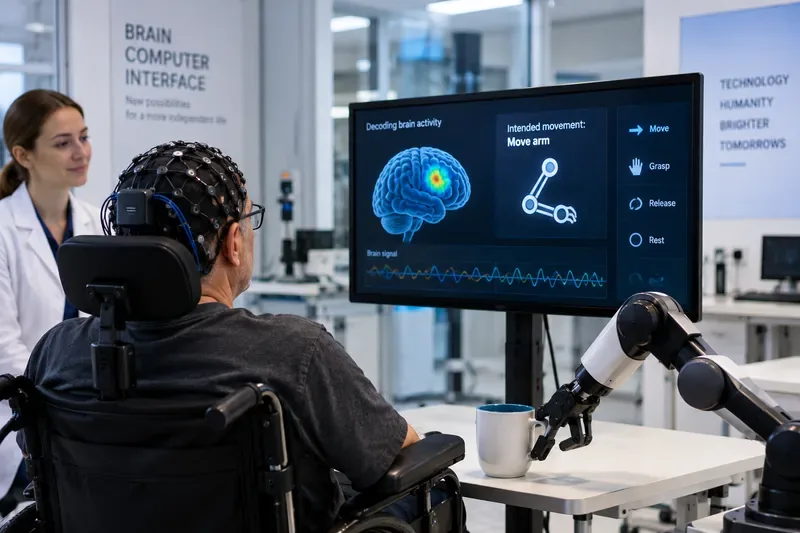
Imagine being offered a brain-computer interface that might help you communicate after paralysis, control a prosthetic device, or regain a degree of independence. The medical promise can be compelling. The difficult part is deciding what should happen before a patient, clinician, hospital, or research team says yes.
A brain-computer interface, or BCI, is a system that measures activity from the nervous system and converts it into information or commands that a computer or device can use. Some BCIs are noninvasive, such as systems based on electroencephalography (EEG), which records electrical activity from the scalp. Others are implanted and place electrodes in or near neural tissue. These approaches can differ greatly in risk, data sensitivity, clinical purpose, and long-term obligations.
The ethical discussion changed materially in 2025. UNESCO adopted the first global normative framework focused specifically on the ethics of neurotechnology, with a certified copy published in 2026. The recommendation emphasizes human dignity, autonomy, privacy, safety, equity, and protection against misuse. It does not replace national law or medical-device regulation, but it gives patients and health organizations a clearer vocabulary for deciding where ethical boundaries should sit. See the UNESCO Recommendation on the Ethics of Neurotechnology.
A clinical BCI decision is not only about whether a device can detect brain signals. Ethical evaluation also includes informed consent, patient safety, privacy, autonomy, cybersecurity, equity, and long-term responsibility.
What You Need to Know Before Judging a BCI
The most important beginner mistake is treating all brain-computer interfaces as one technology. Ethical risk changes with the device, the person, the clinical goal, and the setting.
Start by separating three use cases
Clinical care: a device is used as part of treatment or rehabilitation.
Clinical research: the device is investigational and is being studied for safety or effectiveness.
Enhancement or nonmedical use: the goal is to extend a capability rather than treat or compensate for a medical condition.
The same hardware may raise different ethical questions in each setting. A patient in a research study may face uncertainty about long-term device support. A hospital may have clearer duties around medical records than a consumer neurotechnology company. A nonmedical product may not be covered by the same health privacy rules as care delivered by a regulated provider.
In the United States, the FDA's current implanted-BCI guidance is specifically aimed at devices intended to restore lost motor or sensory capabilities in people with paralysis or amputation. The guidance addresses nonclinical testing and clinical-study considerations for these higher-risk systems. It is useful context, but it is not a universal rulebook for every BCI. Read the FDA guidance on implanted BCI devices.
Boundary 1: Safety Must Come Before Novelty
The first ethical boundary is straightforward: a BCI should not be treated as acceptable merely because it is technically impressive. Medical ethics requires a reasonable relationship between expected benefit and foreseeable risk.
For implanted systems, those risks can include surgery, infection, tissue response, hardware failure, explantation, and uncertain long-term performance. For noninvasive systems, physical risk may be lower, but inaccurate interpretation, poor usability, false expectations, or inappropriate clinical decisions can still cause harm.
NIH's BRAIN Initiative neuroethics framework places safety first and warns that invasive neural devices create an unusually intimate connection between a device and a person. It also calls for caution when moving neurotechnology from research into medical or nonmedical use. See the NIH BRAIN neuroethics guiding principles.
What to prepare: ask for the known risks, unknown risks, realistic alternatives, expected duration of benefit, and what happens if the device stops working. If those answers are vague, the ethical problem is not solved by stronger marketing language.
Boundary 2: Informed Consent Must Be More Than a Signature
Informed consent means a patient understands the purpose, risks, benefits, alternatives, uncertainties, data practices, and practical consequences of a medical intervention before agreeing to it. For BCIs, that standard can be harder to meet because the technology is complex and some participants may have communication or cognitive impairments.
Good consent should separate what is already established from what remains experimental. It should explain whether the patient is receiving clinical care, participating in research, or both. It should also make clear whether the person can withdraw, what withdrawal means for an implanted device, and whether removal is medically possible or financially supported.
A 2026 peer-reviewed guidance paper on investigational implantable neural-device studies identified informed consent, risk-benefit assessment, participant selection, study-team responsibilities, and post-trial duties as recurring ethical issues. The paper is indexed by the U.S. National Library of Medicine at PubMed.
What to look for: a patient should be able to explain the intervention back in plain language, including what is uncertain. If understanding depends on memorizing technical terms, the consent process needs improvement.
Boundary 3: Neural Data Deserves Strong Privacy Protection
Neural data is information derived from the structure, activity, or function of the nervous system. It can include raw signals, processed features, predictions, or outputs from algorithms that classify a user's intended movement or communication.
The phrase mental privacy refers to protection against unwanted access to or inference about a person's internal mental states. This does not mean today's BCIs can read arbitrary thoughts like a transcript. Most systems are designed for narrow tasks and operate under constrained conditions. The ethical concern is that future algorithms may extract more information from stored signals than was originally anticipated.
That creates a practical question: who controls the raw data, processed data, model outputs, and derived inferences? Patients should know whether data is used only for care, reused for research, transferred to collaborators, retained after study completion, or used to train future algorithms.
Privacy protection also depends on who holds the data. In the United States, HIPAA applies to covered entities and their business associates, not every company that may handle health-related information. HHS explains that information sent to an app that is not a HIPAA covered entity or business associate may no longer be protected by HIPAA. See the HHS guidance on health apps and HIPAA.
What to prepare: request a clear data map: what is collected, where it is stored, who can access it, how long it is retained, whether it can be deleted, and whether secondary uses require renewed consent.
Boundary 4: The Patient Must Retain Meaningful Autonomy
Autonomy is the ability to make voluntary, informed decisions about one's own life and care. BCIs can complicate autonomy because they may mediate communication, movement, stimulation, or feedback through software and algorithms.
For example, if a BCI predicts which movement a user intends, a false classification may make the system act differently from what the person wanted. If stimulation changes mood, motivation, or behavior, the line between therapeutic benefit and unwanted influence may become difficult to define.
Ethically responsible design therefore needs more than accuracy. It should provide understandable controls, safe ways to stop or override the system, and methods for distinguishing user intent from algorithmic inference. Clinicians should also ask whether device settings or software updates could materially alter the user's experience without meaningful participation in the decision.
When to change approach: if the system cannot reliably distinguish user intent, produces repeated unexpected actions, or requires the patient to tolerate behavior they do not understand or cannot control, more supervised use or a different intervention may be appropriate.
Boundary 5: Cybersecurity Is a Patient-Safety Issue
A connected BCI may include implanted or wearable hardware, external processors, wireless links, cloud services, mobile applications, and software updates. Each connection adds potential attack surfaces.
For a neural device, cybersecurity is not merely an IT problem. A compromise could affect confidentiality, availability of therapy, or device behavior. In February 2026, the FDA issued updated final guidance on cybersecurity in medical devices, emphasizing resilient design and cybersecurity documentation across the product lifecycle. See the FDA cybersecurity guidance for medical devices.
What to ask: how are software updates delivered, how long will security patches be provided, what happens if the vendor stops supporting the product, and what is the emergency plan if a connected function is unavailable?
Boundary 6: Access and Benefit Should Not Be Limited to the Easiest Patients to Serve
Equity means that the benefits and burdens of healthcare are distributed fairly. BCIs can be expensive to develop and may require specialized surgery, calibration, rehabilitation, data infrastructure, and long-term technical support. That can concentrate access in wealthy health systems or in patients living near major research centers.
Another equity problem is underrepresentation. A model trained on a narrow patient population may not perform equally well across ages, disabilities, languages, socioeconomic settings, or patterns of disease. Accessibility is also broader than hardware: instructions, interfaces, caregiver support, travel requirements, and maintenance costs can all determine who can realistically use a system.
The OECD's current neurotechnology policy work highlights autonomy, privacy, safety, equity, and trust as core concerns in responsible innovation. Its framework also emphasizes governance across the full lifecycle rather than only at product launch. See the OECD neurotechnology policy resources.
What good practice looks like: developers report performance across relevant patient groups, design for accessibility from the beginning, and make long-term costs visible before enrollment or treatment.
Boundary 7: A Trial Cannot End Ethically When the Funding Ends
Post-trial responsibility is especially important for implanted neural devices. A participant may leave a study with hardware still in the body, dependence on a service, or a new capability that requires continued maintenance.
An ethical protocol should address device ownership, technical support, battery replacement if relevant, explantation, software access, data access, management of adverse events, and what happens if the sponsor goes out of business. These issues should be discussed before implantation, not discovered at the end of a trial.
The 2026 ethical guidance for investigational implantable neural-device studies specifically identifies post-trial responsibilities as a major domain that researchers and ethics committees should plan for in advance.
Red flag: a study can explain how a device will be implanted but cannot explain who will support the participant after the formal study period.
Boundary 8: Therapeutic Goals and Enhancement Goals Should Not Be Blurred
A BCI intended to restore communication after paralysis is ethically different from one intended to improve performance in a healthy user. Both may involve similar sensors or algorithms, but the risk-benefit balance is different.
In healthcare, claims should stay tied to a defined clinical purpose and credible evidence. The more a system moves toward enhancement, workplace monitoring, behavioral prediction, or convenience, the less appropriate it is to justify invasive risk by referring to benefits demonstrated in patients with severe disability.
UNESCO's neurotechnology framework is important here because it treats human dignity, mental integrity, and freedom of thought as concerns that extend beyond conventional medical safety.
A Practical Ethical Checklist for Patients, Families, and Clinicians
You do not need to be a neuroscientist to ask the questions that matter. Before joining a study or adopting a BCI in care, work through this checklist.
Question
What a strong answer should include
What is the clinical goal?
A specific function or health outcome, not a broad promise to "unlock the brain."
Is this approved care or research?
A clear explanation of regulatory status, evidence level, and what remains investigational.
What are the main risks?
Known physical, psychological, software, data, and long-term risks plus material uncertainties.
What data is collected?
Raw neural signals, processed features, model outputs, identity data, retention periods, and secondary uses.
Device removal options, continued care, data handling, and costs.
What happens after the study?
Maintenance, security updates, replacement, explantation, and long-term support.
How is fairness evaluated?
Performance across relevant patient groups and accessibility for people with different needs.
Common Mistakes to Avoid
Assuming brain data is automatically more accurate than behavior. Neural signals are noisy and context-dependent, and algorithms can misclassify them.
Equating regulatory review with complete ethical approval. Regulation, clinical ethics, data governance, and institutional oversight address overlapping but different questions.
Using "de-identified" as a complete privacy guarantee. Re-identification risk can change as datasets and algorithms improve.
Discussing implantation without discussing exit. Removal, maintenance, and post-trial support are part of the ethical decision.
Focusing only on hardware safety. Software updates, cybersecurity, model drift, data reuse, and vendor failure can also affect patient welfare.
Overstating what a BCI can infer. Ethical caution is important, but so is avoiding science-fiction claims that today's systems can freely decode a person's private thoughts.
How to Check Whether the Ethical Process Is Working
A good ethical process should produce observable results, not just a signed form or a compliance checklist.
You should be able to verify that the patient understands the intervention, that risks and alternatives are documented, that data flows are known, that access controls and security updates are planned, that device behavior can be stopped or overridden, and that post-trial responsibilities have named owners. The care or research team should also be willing to revisit consent if software, data use, or device capabilities materially change.
If those conditions are not met, the next step is usually not to add more technical language. It is to simplify the intervention, narrow the data collection, strengthen supervision, redesign consent, add independent review, or delay deployment until the unresolved risk is better understood.
Where the Ethical Boundaries Still Remain Unsettled
No single framework currently answers every BCI ethics question. UNESCO's recommendation is a global normative instrument, not a universal statute. FDA guidance has defined scopes and does not cover every noninvasive, consumer, or enhancement use. Privacy protections vary by jurisdiction and by whether data is held by a healthcare provider, research institution, employer, insurer, or technology company.
There are also difficult questions that may not have one correct answer: how much uncertainty is acceptable for a person with no effective alternative treatment, when a neural signal should be treated as medical data versus personal expression, how long a company must support an implanted device, and whether future decoding methods should be allowed to analyze old recordings for purposes that were not foreseeable when the data was collected.
That uncertainty is not a reason to stop BCI research. It is a reason to make boundaries explicit before the technology becomes difficult to change.
Bottom Line
The ethical case for a brain-computer interface in healthcare is strongest when the clinical goal is clear, the evidence is proportionate to the risk, consent is genuinely informed, neural data is tightly governed, the patient retains meaningful control, cybersecurity is maintained throughout the device lifecycle, access is fair, and long-term responsibilities are defined before treatment begins.
The right question is not simply, "Can this BCI work?" It is, "Can it work in a way that protects the person who has to live with it?" That is the boundary modern healthcare should keep in view as neurotechnology moves from laboratory demonstrations toward broader clinical use.