Home
» New Trends
»
AI-Powered Surgical Robotics: Redefining Precision in the Operating Room
AI-Powered Surgical Robotics: Redefining Precision in the Operating Room
AI-powered surgical robotics is redefining precision less by replacing the surgeon than by adding new layers of sensing, data, guidance, and repeatability around the surgeon’s decisions. As of September 2026, the most important distinction is that mainstream robotically assisted surgery remains human-controlled. The U.S. Food and Drug Administration (FDA) explicitly describes current robotically assisted surgical systems as devices in which the surgeon controls the instruments; they do not independently perform the operation. AI is increasingly being added around that human-controlled core, from video analysis and skills analytics to force measurement and product-specific real-time decision support.
To make that distinction concrete, consider a clearly hypothetical example that will run through this article. Imagine a patient, Jordan, scheduled for a minimally invasive urologic procedure at a hospital with a modern robotic platform. The surgeon, Dr. Maya Lee, has extensive training on that system. Jordan, Dr. Lee, and the hospital are fictional, and this scenario is not a clinical result or testimonial. It is simply a way to show where current technology can realistically contribute before, during, and after a procedure.
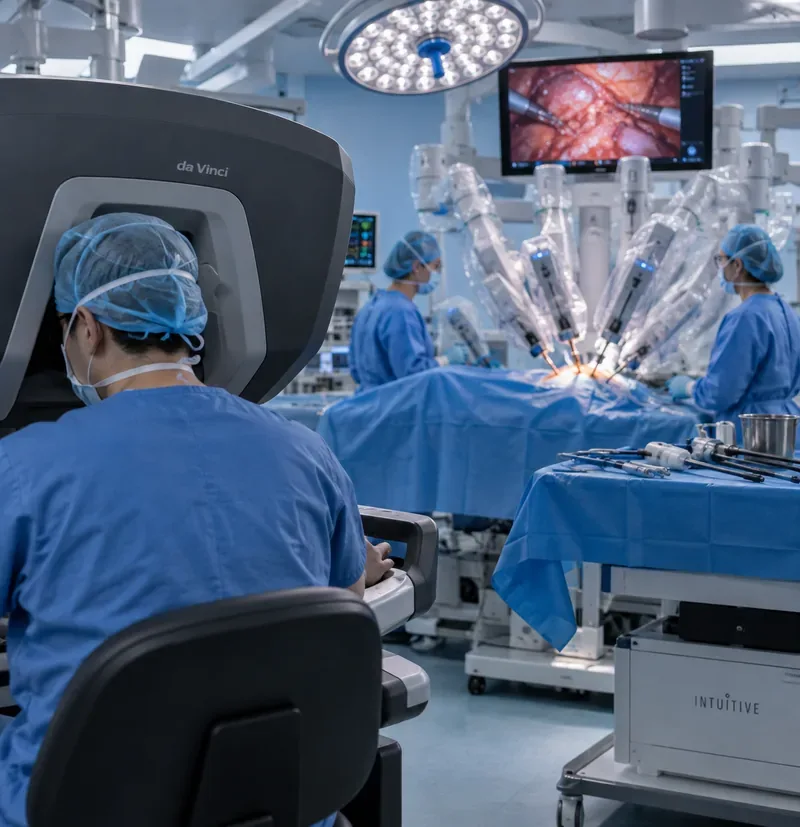
A modern robotic operating-room setup illustrates the division of work that matters most: the surgeon remains responsible for the procedure while robotic hardware, imaging, sensing, and software add layers of control and information.
What does “AI-powered surgical robotics” actually mean today?
The phrase can sound as if an artificial intelligence system is deciding how to operate and then carrying out the surgery on its own. That is not the normal reality of commercial soft-tissue robotic surgery in the United States. The FDA’s computer-assisted surgical systems guidance page says robotically assisted surgical devices allow a surgeon to use computer and software technology to control instruments through small incisions. The agency also states that these devices cannot perform surgery without direct human control.
AI enters the picture in narrower, more practical roles. The FDA maintains an AI-enabled medical device list for products that have met applicable premarket requirements. Within surgical ecosystems, manufacturers are developing tools that analyze video, instrument movement, workflow, and other data streams. Some are used after the operation for training and performance review; others are beginning to support real-time awareness during procedures.
Technology layer
What it can do
Typical 2026 status
Robotic motion control
Translate surgeon hand movements into precise instrument motion, including wristed motion in confined spaces
Established in approved robotically assisted procedures
Advanced visualization
Provide magnified 3D views and digitally processed surgical images
Established
Force sensing and feedback
Measure forces at the instrument and provide tactile or visual information to the surgeon
Available on specific platforms and instruments
AI video and performance analytics
Analyze recorded case video, system data, and instrument movement to identify workflow or skill patterns
Commercially available in selected ecosystems
Real-time AI assistance
Interpret live procedural data and surface narrow, product-specific information during surgery
Emerging; clearance and intended use matter
Autonomous task execution
Plan and perform parts of a surgical task with reduced human input
Mostly research or tightly bounded automation
Fully autonomous soft-tissue surgery
Independently plan and perform an entire human operation
Not routine clinical practice
In the hypothetical case, where does precision begin?
For Jordan’s fictional procedure, precision starts well before any robotic arm moves. The hospital must choose a system cleared for the intended procedure, train the surgical team on that specific model, verify instruments and accessories, and establish contingency plans. FDA guidance stresses that appropriate use and proper training matter because models differ and because robotic systems carry both procedural and device-related risks.
This is an important correction to the idea that the robot itself creates precision. A technically capable system used by an inadequately prepared team is not “precise” in the clinically meaningful sense. Operating-room precision is a system property: surgeon judgment, patient selection, imaging, setup, instrument choice, software behavior, team communication, and device reliability all have to align.
How do modern robots make a surgeon’s movements more controlled?
Current platforms can give surgeons high-definition 3D visualization and computer-mediated control of small, articulated instruments. For example, Intuitive’s FDA-cleared da Vinci 5 platform was announced in March 2024 with updated controllers, vibration and tremor controls, a new 3D display and image-processing architecture, and optional force-sensing instruments. Intuitive’s own da Vinci 5 clearance announcement describes these capabilities and notes that force data can become an additional stream for future analytics.
In the hypothetical case, Dr. Lee still chooses where to dissect, when to stop, how to respond to unexpected anatomy, and whether to convert to another approach. The robot can help translate intentional hand movements into controlled instrument motion, but it does not replace those decisions. That difference is fundamental: mechanical precision is not the same as clinical judgment.
Force sensing adds a new kind of feedback
One limitation of many earlier robotic systems was that surgeons relied heavily on vision rather than feeling tissue forces through the instruments. Newer force-sensing technologies are designed to add information about push, pull, tension, or applied force. That could help a surgeon understand how strongly an instrument is interacting with tissue.
In Jordan’s hypothetical procedure, imagine Dr. Lee retracting tissue in a narrow field. A force indicator or compatible force-feedback instrument may provide another signal alongside the visual image. It does not tell Dr. Lee what the correct maneuver is; it makes an otherwise hidden physical variable more visible or perceptible. That is a good example of how “AI-era” robotics often advances through better sensing and data, not through autonomous decision-making.
Where is AI being used if the robot is still surgeon-controlled?
One of the fastest-moving areas is surgical data analysis. Modern robotic platforms generate video, instrument-position data, force measurements, system events, and workflow information. AI can process those data streams much faster than a person could manually review them.
Intuitive’s My Intuitive+ documentation says its Case Insights product uses AI to evaluate da Vinci system data, kinematic movement, and video to create objective insights for skill development. The company describes features such as automatic video bookmarks, performance trends, and tailored guidance. Those claims should be understood in the context of the product’s intended use and manufacturer documentation; they are not proof that every AI metric improves patient outcomes.
Medtronic has taken a similar ecosystem approach. Its Hugo robotic-assisted surgery platform received FDA clearance for urologic procedures in December 2025, according to the company’s official U.S. clearance announcement. Medtronic says the Hugo system connects with the Touch Surgery ecosystem for training, tele-proctoring, video access, and AI-powered post-operative insights. The company also states in that release that the Touch Surgery ecosystem is not intended to direct surgery or diagnose or treat a disease or condition.
Can AI assist during the operation, not just after it?
Yes, but the useful question is what exact task is cleared or validated? Real-time AI is arriving as narrow capabilities rather than as a general-purpose “copilot” that can manage the whole operation.
In July 2026, Medtronic announced Touch Surgery Aide, a next-generation operating-room compute platform intended to support real-time AI applications. In its official announcement, Medtronic highlighted advanced computing for real-time decision support and an FDA-cleared Instrument Exit Point application. That is a useful sign of where the field is going: specific AI functions that observe the surgical scene and surface tightly defined information while the surgeon remains in charge.
Back in the hypothetical operating room, this means an AI system might identify a relevant instrument state, organize video, or highlight a defined event. It should not be assumed to understand the whole clinical context. Dr. Lee still integrates anatomy, bleeding, patient physiology, operative goals, prior imaging, and unexpected findings.
Does AI make robotic surgery more precise, or just more measurable?
Both are possible, but they are not the same. Robotic hardware can improve how finely motion is controlled. Sensors can make forces measurable. AI can make complex procedural data searchable and interpretable. But a more measurable operation is not automatically a better operation.
The most valuable near-term change may be that precision becomes auditable. If a system can quantify force, instrument trajectories, task duration, video events, or workflow steps, surgeons and hospitals can compare patterns across cases. That opens the door to more objective training and quality improvement. It also creates new responsibilities: metrics must be clinically meaningful, validated across relevant users and populations, and protected against overinterpretation.
For Jordan’s fictional case, an after-action review might show Dr. Lee selected video moments, instrument-motion trends, or force data. Those observations could guide training for the next case. They would not, by themselves, prove that Jordan’s outcome was better because AI was present.
How close are we to autonomous surgery?
The research frontier is more autonomous than routine clinical practice. A frequently cited milestone is the Smart Tissue Autonomous Robot (STAR). In a 2022 Science Robotics study available through the U.S. National Library of Medicine, researchers described autonomous laparoscopic intestinal anastomosis in phantom tissue and in vivo porcine models. The operator selected among generated plans and supervised the system, while the robot executed substantial parts of the suturing task and adapted to tissue motion and deformation.
The study reported greater consistency and accuracy than comparison techniques on several measured suturing criteria. That is an important research result, but its limits are equally important: it was a preclinical animal study of a specific task using a specialized research system. It does not establish that autonomous human surgery is ready for general use.
For the hypothetical Jordan procedure, there is therefore a large difference between “AI helps analyze or guide a narrow step” and “the robot autonomously performs the operation.” The first is increasingly realistic. The second remains a research ambition for most soft-tissue surgery.
What can go wrong when precision becomes software-dependent?
More sensors and software create more capability, but they also create more failure modes. The FDA says it continues to receive medical-device reports involving robotically assisted surgical systems. Reported issues have included component breakage, mechanical problems, and image or display issues. The agency also cautions that adverse-event reports may be incomplete, duplicated, inaccurate, or unverified and do not by themselves prove that a device caused an event.
AI adds additional questions: Was the model trained on cases similar to this one? Does performance change when the camera view is obscured? How does the software handle unfamiliar anatomy or device configurations? Is a confidence score visible? Can the surgeon quickly disregard or disable the feature? Are software updates governed and validated?
The FDA’s digital-health program has increasingly emphasized lifecycle management for AI-enabled device software. Its digital health guidance collection includes guidance on software functions, cybersecurity, and predetermined change control plans for AI-enabled devices. That matters because an AI component can evolve after initial release in ways that traditional fixed-function hardware did not.
What should hospitals measure before calling an AI-robotic program a success?
The strongest evaluation goes beyond a manufacturer demo or a surgeon’s enthusiasm. For a hospital considering an AI-enhanced robotic program, useful questions include:
Clinical fit: Is the system cleared or otherwise authorized for the intended use, procedure, and patient population?
Training: How are surgeons, bedside assistants, nurses, and technicians trained on the exact model and software version?
Workflow reliability: Does the technology reduce friction or add setup time, troubleshooting, and cognitive burden?
Safety performance: What are conversion rates, device-related events, readmissions, reoperations, and procedure-specific complications?
Precision metrics: Are force, motion, video, or task metrics linked to clinically meaningful endpoints rather than vanity scores?
Human factors: Does the interface make the right information visible at the right time without distracting the surgeon?
Data governance: Who owns case video and analytics, how are they secured, and who can use them for training or evaluation?
Cost and access: Does the platform expand useful minimally invasive care enough to justify acquisition, service, instruments, and training?
In Jordan’s hypothetical case, the hospital should not judge the program simply because the operation used a sophisticated robot. A stronger review asks whether the right patient received the right approach, the team was appropriately trained, the system performed as intended, and measurable outcomes justify the added technology.
What does “precision” mean for the next generation of operating rooms?
The next phase of surgical robotics is likely to make precision multidimensional. A surgeon may combine fine mechanical control, high-resolution imaging, measured tissue forces, AI-analyzed video, remote collaboration, simulation, and procedure-specific real-time assistance. The operating room becomes less like a single machine and more like a connected sensing-and-decision environment.
That creates a realistic path toward greater automation without requiring an abrupt jump to a fully autonomous robot. Repetitive or highly structured sub-tasks may become increasingly automated. AI may get better at recognizing anatomy, instrument states, workflow phases, and deviations from expected patterns. Robotic systems may become better at enforcing boundaries, stabilizing motion, or adapting to deforming tissue. Human surgeons can remain responsible for goals, judgment, exceptions, consent, and accountability while machines take on narrowly defined tasks that benefit from consistency.
The bottom line: AI changes the meaning of surgical precision
Return to the hypothetical Jordan case. The most realistic AI-powered operating room is not one in which Dr. Lee presses “start” and watches a robot perform the procedure. It is one in which Dr. Lee operates through a highly capable robotic platform while additional technologies measure forces, process video, surface specific information, record objective data, and support review after the case.
That is already a meaningful redefinition of precision. Precision is no longer only about how steadily an instrument moves. It can include how accurately the team sees, how gently tissue is handled, how consistently a task is performed, how quickly a deviation is recognized, and how effectively experience from one case is converted into learning for the next.
The safest way to understand the field in 2026 is therefore neither “robots are taking over surgery” nor “AI is just marketing.” The evidence points to a more nuanced transition: human-controlled surgical robots are becoming richer in sensors, software, data, and narrowly targeted AI capabilities, while higher levels of autonomy continue to move forward in research. The challenge now is to prove which of those capabilities meaningfully improve patient care, not simply which ones look impressive in the operating room.