Home
» New Trends
»
Scaling CCUS: Can Carbon Capture Truly Reverse Global Emissions?
Scaling CCUS: Can Carbon Capture Truly Reverse Global Emissions?
Updated September 2026: Carbon capture, utilization and storage (CCUS) has moved into a more serious scaling phase, but the gap between momentum and climate impact remains large. The International Energy Agency's March 2026 financing review says more than 30 CCUS projects reached final investment decisions over the previous two years, while investment grew more than fifteenfold from 2020 to exceed $5 billion in 2025. The same report says projects already under construction could nearly double operational capture capacity by 2030. At the same time, global energy-related CO₂ emissions still reached a record of nearly 38.4 billion metric tons in 2025. See the IEA financing assessment and the IEA Global Energy Review 2026 emissions analysis.
That contrast gives the most useful answer to the headline question: CCUS can become a major tool for cutting hard-to-abate emissions and enabling durable carbon removal, but it cannot reverse global emissions by itself. Point-source carbon capture mainly prevents new CO₂ from reaching the atmosphere. Actual reversal requires carbon dioxide removal (CDR) that pulls CO₂ from the air and stores it durably, at a scale larger than the remaining emissions. The quality of the result matters more than the headline nameplate capacity.
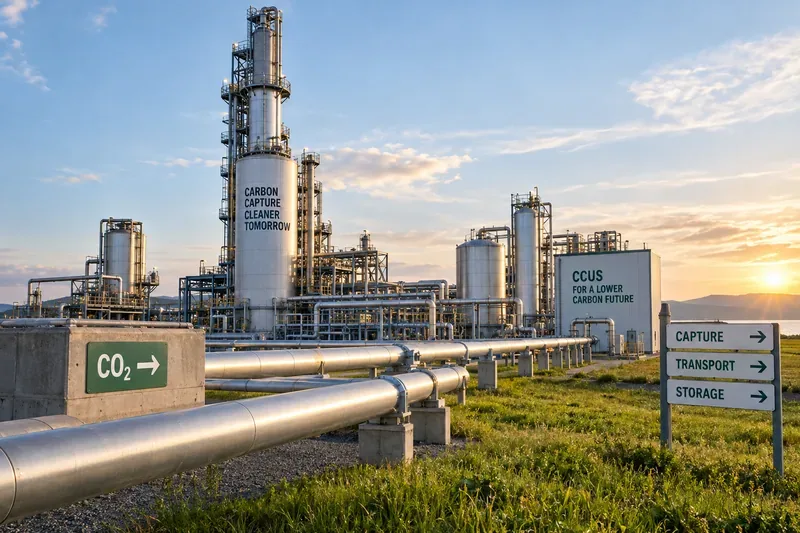
An industrial carbon-capture complex with processing towers and pipelines illustrates the linked capture, transport, and storage infrastructure that must work together for CCUS to deliver measurable climate results.
What Should Successful CCUS Actually Achieve?
Before asking whether CCUS can scale, it helps to separate three different outcomes that are often grouped together. They are not climatically equivalent.
Pathway
What it does
What counts as a high-quality result
Point-source CCS
Captures CO₂ from a cement kiln, hydrogen plant, power plant, or other industrial source before release.
Verified net emissions avoided after accounting for capture energy, transport, upstream emissions, and storage operations.
Carbon utilization
Uses captured CO₂ in fuels, chemicals, concrete, minerals, or other products.
A life-cycle emissions reduction compared with the product it replaces, with special value when carbon remains stored for a long time.
Carbon dioxide removal
Removes CO₂ already in the atmosphere, for example through direct air capture with storage (DACCS) or bioenergy with carbon capture and storage (BECCS).
Durable storage plus a verified life-cycle balance showing more CO₂ removed from the atmosphere than emitted by the full process.
This distinction matters because using CO₂ does not automatically mean avoiding CO₂. The IEA's analysis of carbon utilization emphasizes that climate value depends on the CO₂ source, the energy used, the product displaced, and how long the carbon remains out of the atmosphere. A synthetic fuel may recycle carbon but release it again when burned; mineralized building materials can retain it much longer.
What Changed in 2025 and 2026?
The strongest recent change is not a single breakthrough in capture chemistry. It is the emergence of larger, connected projects with financing, transport networks, and dedicated storage infrastructure. The IEA's March 2026 database update reports that operational or under-construction capture capacity increased by more than 10% compared with the previous annual update. It also notes that the world's first dedicated CO₂ storage hub began operating in Norway and that construction started on new facilities in eight countries. The IEA's March 2026 project update provides the latest high-level snapshot.
There is also a larger financial base. According to the IEA, more than 70 large-scale capture facilities are in operation and more than 9,000 kilometers of CO₂ pipelines now exist. Governments have earmarked more than $50 billion in public support for CCUS over the past three years. These are meaningful signs of industrialization, but they are not proof that all announced projects will be built or that every installed unit will run at its design capture rate.
The IEA CCUS Projects Database, last updated in March 2026, is useful precisely because it distinguishes commissioned, under-construction, and planned projects. That distinction should be preserved whenever deployment claims are evaluated.
Can CCUS Truly Reverse Global Emissions?
Not in the ordinary point-source form. Capturing CO₂ from a smokestack reduces the amount added to the atmosphere, but it does not remove the stock of CO₂ already there. That is emissions avoidance, not reversal.
Reversal becomes possible only when the world reaches net-negative CO₂ emissions: durable removals exceed the residual CO₂ still being emitted. The IPCC states that carbon dioxide removal is unavoidable for counterbalancing hard-to-abate residual emissions if net-zero CO₂ or greenhouse-gas emissions are to be achieved. It also makes an important distinction: sustained net-negative CO₂ emissions are needed if the goal is to make global warming decline rather than merely stabilize. See the IPCC Working Group III Summary for Policymakers and Chapter 3 on mitigation pathways.
Even then, "one ton removed" should not be interpreted too casually. The IPCC notes that land and ocean carbon stores respond to atmospheric CO₂ changes, so part of an imposed removal can be counteracted by CO₂ released from natural sinks. This is one reason climate-quality accounting must focus on durable, net removal rather than simply counting captured molecules.
How Big Is the Scale Gap?
The scale gap is still enormous. The IEA reported just over 50 million metric tons per year of operational capture and storage capacity in the first quarter of 2025. That number is capacity, not verified annual capture, so it should not be treated as actual climate performance. For perspective only, 50 million tons is roughly 0.13% of the 38.4 billion tons of energy-related CO₂ emitted globally in 2025.
The direction is improving: projects under construction could nearly double operational capacity by 2030, and many more projects are planned. But a project pipeline is not the same as commissioned equipment, and commissioned equipment is not the same as verified net CO₂ stored. The most credible scale claims therefore move through four gates: announced, financed, built, and measured in operation.
Where Does CCUS Deliver the Best Results?
1. Cement and other process-emission industries
Cement is a strong use case because part of its CO₂ comes from the chemistry of calcining limestone, not just from fuel combustion. Switching to renewable electricity alone cannot eliminate those process emissions. The IPCC therefore identifies CCS as an important option for deep cement decarbonization alongside material substitution, efficiency, circularity, and new chemistries. See the IPCC industry chapter.
2. Concentrated industrial CO₂ streams
Processes that already produce relatively concentrated CO₂ streams can often capture carbon with less separation work than dilute flue gases or ambient air. The practical result depends on site-specific engineering, energy supply, transport distance, storage availability, and operating hours.
3. Shared hubs rather than isolated projects
Multiple emitters sharing pipelines, shipping terminals, compression equipment, and storage sites can improve asset utilization and reduce duplicated infrastructure. Hubs also create a new risk: if one part of the chain is late, the others can be stranded. A capture plant is not useful if the storage site is unpermitted or the transport network is unavailable.
4. Durable removals for residual emissions
DACCS and BECCS matter most when residual emissions remain after direct reductions. Their climate value depends on low-carbon energy, reliable accounting, durable storage, and sustainable feedstocks in the case of bioenergy. They should be judged by net atmospheric removal, not gross CO₂ handled.
A Practical Scorecard for CCUS Quality
If the goal is climate impact rather than project announcements, the following signals are more useful than nameplate capacity alone.
Metric
Good sign
Warning sign
When to change course
Verified CO₂ stored or avoided
Metered, audited volumes with clear system boundaries.
Claims rely mainly on design capacity or projected future capture.
Recalculate the business and climate case using measured performance.
Capture rate and uptime
High real-world capture performance is sustained across normal operating conditions.
Frequent bypasses, outages, or large gaps between design and annual performance.
Fix process integration or reconsider whether the host plant is a suitable retrofit.
Life-cycle emissions
Capture energy, compression, transport, upstream fuel emissions, and storage operations are included.
The accounting boundary stops at the capture unit.
Compare with electrification, efficiency, fuel switching, or process redesign.
Storage integrity
Site characterization, monitoring, plume tracking, financial responsibility, and closure plans are established.
Storage permits, monitoring plans, or long-term liability remain unresolved.
Do not scale the capture side faster than credible storage can be delivered.
Infrastructure utilization
Transport and storage networks have multiple committed users and realistic ramp-up schedules.
Large pipelines or storage assets depend on speculative future volumes.
Phase capacity or secure anchor customers before expanding.
Cost per net ton
Costs fall as repeat projects standardize engineering and contracts.
Costs are quoted per gross ton captured while net climate impact is much smaller.
Use cost per net ton avoided or removed for technology comparisons.
Durability
CO₂ is geologically stored or retained in a genuinely long-lived product.
Utilization creates a product that releases CO₂ soon after use.
Classify the project as carbon recycling rather than permanent removal.
Storage Is Not a Footnote
For large-scale CCS, storage quality determines whether captured carbon actually stays out of the atmosphere. In the United States, EPA Class VI requirements cover geologic site characterization, well construction, operation, mechanical integrity, monitoring, financial responsibility, plugging, post-injection care, and closure. The EPA's current Class VI overview was updated in August 2026 and provides a useful example of the safeguards required for long-term storage.
Europe is also treating storage as infrastructure rather than an afterthought. The EU Net-Zero Industry Act establishes a target of at least 50 million metric tons per year of CO₂ injection capacity by 2030. The European Commission says permitted and planned sites are growing, especially around the North Sea, but additional projects and faster permitting are still needed to reach the target. See the European Commission's 2030 storage target page.
When Should a Project Choose a Different Decarbonization Route?
CCUS is not automatically the best choice simply because a source emits CO₂. A stronger project-development process asks whether the underlying activity can be changed more directly.
Prefer efficiency or electrification when they can eliminate fuel use at lower cost and with simpler infrastructure.
Prefer material substitution or process redesign when they can avoid the chemical source of emissions rather than capture it afterward.
Delay a capture retrofit when transport and storage will not be ready on a compatible schedule.
Reconsider high-energy capture when the additional power or heat would come from carbon-intensive sources and materially erode the net benefit.
Do not call short-lived utilization a removal when the CO₂ will soon return to the atmosphere.
Revisit the host asset itself when its remaining economic life is too short to justify a long-lived capture system and transport contract.
This is not an argument against CCUS. It is a quality filter. The best deployment puts capture where direct elimination is technically difficult, while using faster and simpler solutions where they are available.
What Would Successful Global Scaling Look Like?
A credible global scale-up would show progress in several dimensions at the same time.
More projects moving from planning to operation. Final investment decisions, construction starts, commissioning, and measured performance should rise—not only announcements.
Storage capacity developing ahead of capture demand. Characterized reservoirs, permits, injection wells, monitoring systems, and liability frameworks need long lead times.
Standardized transport and CO₂ specifications. Shared standards make pipelines, ships, terminals, and storage hubs easier to finance and interconnect.
Replicable business models. The IEA emphasizes stable revenue mechanisms, clear risk allocation, and predictable regulation because CO₂ itself usually has little standalone market value.
Expansion beyond a few early regions. The climate case weakens if infrastructure remains concentrated while emissions growth and industrial expansion occur elsewhere.
Transparent measurement and verification. Investors, regulators, and the public need operating data that distinguishes gross capture from net climate benefit.
The European Commission's industrial carbon management framework illustrates the direction: capture, transport, utilization, and storage are treated as a connected system rather than independent technologies.
What CCUS Cannot Solve on Its Own
CCUS does not eliminate methane leakage from fossil-fuel supply chains, reduce energy demand, replace inefficient equipment, or automatically decarbonize electricity. It also does not make every carbon-containing product climate-neutral. Those issues require separate measures.
Large-scale carbon removal has its own constraints. DAC needs substantial low-carbon energy and storage. BECCS can require land, biomass, transport, and careful sustainability controls. Geological storage requires characterization, monitoring, permitting, and long-term stewardship. The IPCC describes CDR as necessary for net zero, but it also stresses feasibility and sustainability constraints at large scale.
That is why the strongest climate strategy is a portfolio: reduce avoidable emissions first, electrify where practical, expand low-emissions energy, address methane and material demand, deploy CCS for difficult industrial emissions, and reserve durable removal for balancing residual emissions and eventually achieving net-negative CO₂.
The Bottom Line
CCUS can scale enough to matter, and current investment and infrastructure growth are more substantial than they were a few years ago. But "reverse global emissions" is a much higher bar than "capture more carbon."
A successful CCUS system should be judged by verified net tons avoided or durably removed, not by announced project capacity. Point-source CCS can sharply reduce emissions from industries where direct alternatives remain difficult. Carbon dioxide removal can eventually help push global CO₂ emissions below zero. Neither outcome is automatic, and neither removes the need for deep direct emissions cuts.
The decision rule is straightforward: keep scaling CCUS where measured net climate performance is strong, storage is credible, infrastructure is utilized, and alternatives are weaker. Change course when capture adds too much energy or cost, storage cannot be secured, or a simpler technology can eliminate the emissions at the source. That approach gives CCUS the best chance of becoming a durable part of climate mitigation without asking it to do a job that no single technology can do.