Home
» New Trends
»
Managing Aging Populations: Digital Solutions for Better, Safer Elder Care
Managing Aging Populations: Digital Solutions for Better, Safer Elder Care
A familiar elder-care problem often starts small: an older parent misses a follow-up appointment, a family caregiver is unsure whether a blood-pressure reading is urgent, and several clinicians each have only part of the picture. Nothing is necessarily wrong with any one service. The problem is that care is spread across people, places, devices, and schedules that do not naturally stay synchronized.
That coordination challenge is becoming more important as populations age. The World Health Organization (WHO) reported in October 2025 that by 2030, one in six people worldwide will be age 60 or older, and that the global population in this age group is expected to reach 2.1 billion by 2050. WHO also emphasizes that there is no single “typical” older person: needs vary widely, from fully independent living to complex health and long-term-care support. See the WHO Ageing and health fact sheet.
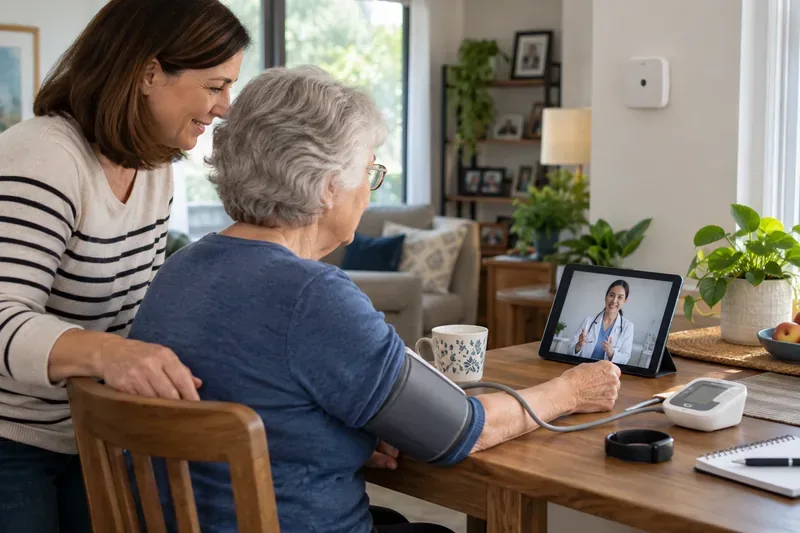
An older adult joins a telehealth visit at home with help from a family caregiver; a connected blood-pressure cuff is ready to share health readings with the care team.
Why elder care becomes harder as populations age
Population aging does not create one problem; it magnifies several existing ones at the same time. Older adults are more likely to live with multiple chronic conditions, changes in mobility, hearing or vision, and functional limitations. Care may involve primary care, specialists, pharmacies, home-care workers, family members, transportation, social services, and emergency services. When those parts do not communicate well, the burden often falls on the older adult or an unpaid caregiver.
Five pressures are especially important:
More complex, long-duration care. The goal is often not a one-time cure but stable function, symptom control, independence, and quality of life over years.
Fragmented information. Medication lists, home observations, specialist notes, and social needs may live in different systems.
Caregiver and workforce constraints. Technology can remove some administrative friction, but it cannot manufacture more time unless workflows are redesigned around it.
Isolation and reduced mobility. Travel to appointments can become difficult, while social isolation can worsen well-being.
Digital exclusion. Poor connectivity, inaccessible interfaces, low digital confidence, language barriers, impaired vision or hearing, and cognitive changes can make a supposedly convenient tool unusable.
Start with the simplest digital fixes
1. Make access easier before adding advanced technology
The first useful digital investment is often not artificial intelligence or a smart-home platform. It is making basic access reliable. That can mean a tablet with a simplified home screen, large text, high-contrast controls, captioning, caregiver proxy access, a single support phone number, or a pre-visit technology check.
For telehealth, the U.S. Department of Health and Human Services advises providers to account for device access, hearing and vision needs, caregiver support, and technology preparation. Its telehealth guidance for older adults is a useful reference even for organizations outside the United States because the usability issues are broadly applicable.
A good rule is simple: if a digital service saves staff time but repeatedly requires a relative to troubleshoot logins, the burden has merely moved elsewhere.
2. Use reminders and communication tools to prevent avoidable coordination failures
Appointment reminders, shared calendars, secure messaging, medication schedules, refill prompts, and caregiver notifications can address everyday breakdowns without requiring a complex clinical system. These tools work best when they are limited to a few high-value actions rather than producing a constant stream of alerts.
Medication reminders deserve particular caution. A reminder can prompt a person to take a medicine, but it does not prove that the medicine was taken correctly, that the prescription remains appropriate, or that two clinicians have not created a conflicting regimen. Medication review still requires qualified clinical judgment.
Move to connected care when simple tools are not enough
3. Use telehealth for the visits that genuinely fit remote care
Video or audio visits can reduce travel, make specialist access easier, and help family caregivers join consultations from different locations. They are particularly useful for many follow-up discussions, behavioral health services, medication reviews, and chronic-condition check-ins. They are less suitable when the clinician needs a hands-on examination, imaging, a procedure, or urgent emergency assessment.
The best model is usually hybrid rather than “digital only.” Telehealth should make in-person care more targeted, not eliminate it. Programs should also keep a fallback route for people who cannot use video reliably.
4. Add remote patient monitoring when home data changes decisions
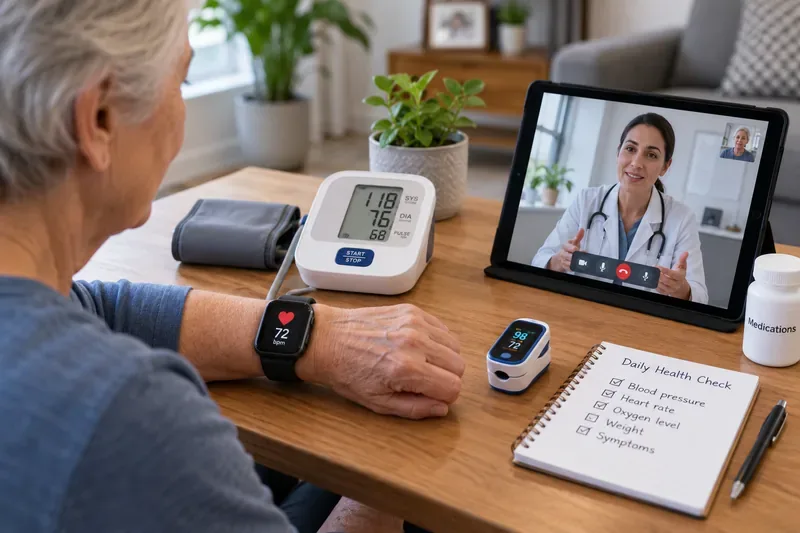
Remote patient monitoring, often shortened to RPM, uses connected devices to collect health data outside a clinic and transmit it to a care team. The U.S. Centers for Medicare & Medicaid Services describes examples such as connected blood-pressure cuffs, weight scales, glucose devices, and pulse oximeters. Its current description is available on the CMS Remote Patient Monitoring page.
RPM is valuable only when the organization knows what it will do with the readings. Before deployment, define who reviews data, which values require action, how quickly someone must respond, what happens after hours, and how false alarms are handled. Otherwise, a dashboard can create alert fatigue without improving care.
Reimbursement, device requirements, and clinical rules differ by country and payer. CMS rules are relevant to U.S. Medicare and should not be assumed to apply elsewhere.
5. Use safety and aging-in-place technology with consent
For people who want to remain at home, digital safety tools may include wearable fall alerts, motion sensors, bed or chair occupancy sensors, door alerts, smart lighting, connected smoke alarms, stove-safety devices, and location support for people at risk of getting lost. The purpose should be to extend independence and reduce response time when something is wrong.
The trade-off is privacy. A family may feel safer with continuous monitoring while the older adult may experience it as surveillance. The least intrusive technology that solves the problem is usually preferable. Organizations should make consent understandable, explain exactly what is collected and who can see it, and offer a way to change preferences later.
Integrate systems instead of stacking more apps
6. Build a shared, person-centered care plan
Once multiple digital tools are in use, the next problem is integration. A telehealth platform, fall sensor, pharmacy app, home-care schedule, and RPM dashboard are not an integrated care system merely because they are all digital.
WHO's 2025 second edition of its Integrated Care for Older People (ICOPE) guidance describes a pathway that includes assessment, more detailed evaluation when needed, a personalized care plan, and ongoing implementation and monitoring. The guidance is designed around person-centered primary and community care rather than around a specific technology vendor. See the WHO ICOPE guidance, second edition.
In practice, that means digital tools should feed a shared view of priorities: what matters to the person, current health risks, functional goals, medication responsibilities, caregiver roles, escalation instructions, and upcoming follow-up. Interoperability matters because staff should not have to copy the same information into several disconnected systems.
7. Add AI only where there is a clear decision or workload problem
Artificial intelligence can help prioritize large alert queues, summarize long clinical records, identify patterns in longitudinal data, support scheduling, translate routine information, or flag people who may need earlier review. These uses are most defensible when AI assists a human decision rather than silently replacing one.
Older adults must be represented in the data used to design and test these systems. WHO's policy brief on ageism in artificial intelligence for health warns that biased data and assumptions can create or amplify age-related discrimination. AI models should therefore be evaluated for performance across relevant age groups, disabilities, languages, and care settings, with human review for consequential decisions.
Do not treat social connection as an optional feature
Digital elder care is often discussed as if it were mainly about clinical data, but social connection is part of health. A 2025 WHO Commission on Social Connection report describes loneliness and social isolation as significant health and well-being concerns and calls for scalable action. The report is available from the WHO Commission on Social Connection.
Technology can help through easy video calling, online community groups, volunteer check-ins, transportation coordination, and caregiver communication. But a video call is not automatically meaningful social connection. Programs should measure whether people actually feel more connected and whether digital contact complements, rather than displaces, valued in-person relationships.
A practical progression from low risk to high complexity
Stage
Primary goal
Typical tools
What must be in place first
Foundation
Make care reachable
Accessible devices, broadband support, caregiver access, help desk
Usability testing and non-digital fallback
Coordination
Reduce missed tasks
Reminders, secure messaging, shared schedules
Clear ownership of each task
Connected care
Bring care into the home
Telehealth, remote monitoring, safety sensors
Escalation rules and staff response capacity
Integrated care
Create one working care picture
Shared care plans, interoperable records, cross-team workflows
Validated data, bias testing, human oversight, monitoring
Privacy, security, and autonomy must be designed in
Health, behavioral, location, and home-sensor data can be highly sensitive. Security therefore needs to be part of the service design, not a feature added after launch. Use strong authentication appropriate to the user's abilities, encrypt sensitive data in transit and at rest where applicable, limit staff access by role, keep audit logs, patch connected devices, and define what happens when a device or account is compromised.
For U.S. organizations subject to HIPAA, HHS provides specific telehealth privacy and security guidance. Other countries and care settings have different legal requirements, so a local legal and regulatory review is still necessary.
How to check whether a digital elder-care program is actually working
The final test is not how many devices were deployed. It is whether life and care are better for older adults and whether the system is more manageable for caregivers and staff. Review the program after a defined pilot period and compare results with a clear baseline.
Access: Are completed appointments increasing, wait times falling, or travel burdens decreasing without excluding people who cannot use digital channels?
Function and safety: Are relevant care goals improving, and are clinically important alerts being acted on within the intended time?
Workload: Has staff time moved from repetitive administration toward useful care, or has the system created more dashboards and alarms?
Caregiver burden: Do family caregivers report fewer coordination problems, or are they now expected to manage devices and troubleshooting?
Equity: Do outcomes remain acceptable across age ranges, disability levels, languages, income groups, and areas with weaker connectivity?
Trust: Do older adults understand what the technology does, who receives their data, and how to opt out or change permissions?
Continuity: When a device fails or a connection drops, is there a safe backup process?
If convenience improves while trust, accessibility, workload, or safety worsens, the solution needs redesign rather than expansion. The strongest digital elder-care programs use technology as infrastructure for person-centered care: they start with a real problem, introduce the least complex tool that can solve it, connect that tool to a human workflow, and measure whether the result supports independence, dignity, and better care.