Home
» New Trends
»
Grid-Scale Battery Storage: Why It Is Becoming Essential to the Renewable Energy Transition
Grid-Scale Battery Storage: Why It Is Becoming Essential to the Renewable Energy Transition
Grid-scale battery storage has moved from a promising add-on to a rapidly expanding part of modern power systems. The clearest recent signal came in 2026. The International Energy Agency reported that 108 gigawatts (GW) of new battery storage capacity were deployed worldwide in 2025, about 40% more than in 2024. In the United States, the U.S. Energy Information Administration reported on August 7, 2026 that utility-scale battery capacity had reached nearly 52 GW by the end of June after operators added 8.3 GW in the first half of the year.
Those numbers matter because the renewable energy transition is no longer only about building more solar panels and wind turbines. As variable generation grows, the harder problem becomes moving electricity from the hours when it is abundant to the hours when people and businesses need it most. Batteries can do that quickly, repeatedly, and with a response time that also makes them useful for many grid-balancing services.
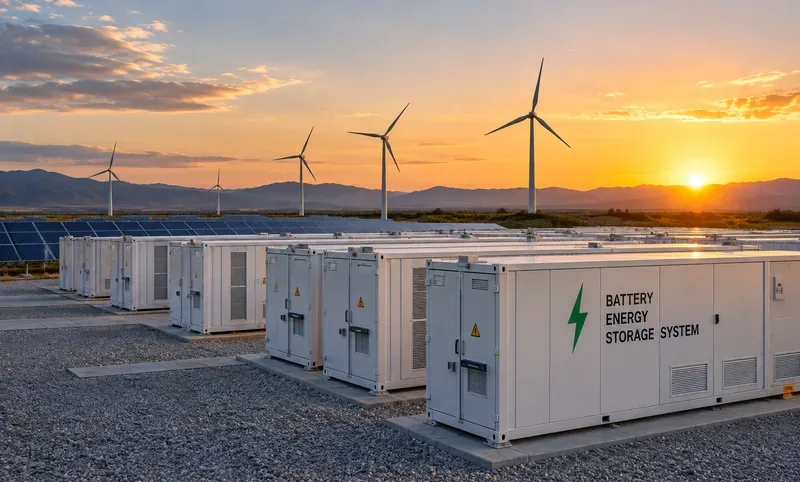
Containerized battery units sit alongside solar arrays and wind turbines, illustrating how storage can shift renewable electricity across hours and provide fast grid support.
What changed by 2026?
The scale-up is now visible in both global and national data. The IEA's Global Energy Review 2026 battery storage analysis says battery storage was the fastest-growing power technology in 2025. It also reports that lithium iron phosphate, or LFP, batteries accounted for around 90% of deployments and that roughly 80% of new battery capacity was utility-scale.
The U.S. trend is similarly striking. According to the EIA's August 2026 update, U.S. utility-scale battery capacity grew at an average annual rate of 70% over the previous three years. Operators also reported plans for another 54 GW to come online over the following two and a half years. Planned projects are not guaranteed to be completed, but the pipeline shows how quickly storage has become part of mainstream grid investment.
At the same time, the transition is creating a stronger need for flexibility. The IEA Electricity Mid-Year Update 2026 expects renewable generation to overtake coal-fired generation globally in 2026. More solar and wind can reduce fuel use and emissions, but their output changes with sunlight and weather. A power system therefore needs resources that can respond when generation and demand do not line up.
Why renewable-heavy grids need storage
A conventional power plant can often choose when to generate, subject to fuel, operating, and technical constraints. Solar and wind are different. A solar farm produces most strongly during daylight, while electricity demand may peak later in the evening. Wind can be abundant overnight and weak during a hot afternoon. The issue is not that renewable electricity is unusable; it is that its timing is partly determined by weather.
Grid-scale batteries address that timing mismatch. They charge when electricity is plentiful or inexpensive and discharge later when the system needs power. This is commonly called energy shifting. By moving electricity across hours, batteries can reduce renewable curtailment, which occurs when available generation cannot be used because demand or grid capacity is insufficient at that moment.
Batteries also respond extremely quickly. That makes them useful for frequency regulation, operating reserves, ramping support, and other services that help keep supply and demand continuously balanced. A single battery project can participate in several of these services, although the exact combination depends on market rules, technical design, warranty constraints, and the operator's strategy.
MW and MWh: the two numbers that explain a battery project
One of the easiest mistakes for newcomers is treating a battery's power rating and energy capacity as the same thing. They answer different questions.
Measure
What it tells you
Simple example
MW (megawatts)
How much power the battery can charge or discharge at one moment
A 100 MW battery can discharge at up to 100 MW if designed and operated that way
MWh (megawatt-hours)
How much electrical energy the battery can store or deliver over time
A 400 MWh battery could theoretically deliver 100 MW for four hours before accounting for operating limits and losses
Duration
Energy capacity divided by power capacity
400 MWh divided by 100 MW equals a four-hour nominal duration
This distinction matters when people ask whether batteries can “back up” renewables. A 100 MW battery with one hour of energy is very different from a 100 MW battery with eight hours of energy. The first may be excellent for short peaks and fast grid services; the second can shift substantially more energy through a long evening.
What grid-scale batteries can do for the power system
Shift solar electricity into the evening
Solar output often peaks before electricity demand does. A battery can charge during a solar-rich period and discharge after sunset. This can raise the usable value of solar generation and reduce the need to curtail production during oversupplied hours.
Respond to sudden imbalances
Because batteries can change output rapidly, they can help system operators respond to short-term mismatches between generation and demand. This does not eliminate the need for other balancing resources, but it adds a highly controllable source of flexibility.
Reduce stress during peak demand
Battery discharge during high-demand periods can reduce the amount of generation or imported power needed at the system peak. In some locations, well-sited storage may also defer certain grid upgrades. Whether it actually does so is a project-specific planning question rather than an automatic benefit.
Help manage congestion
A battery can charge on one side of a congested period and discharge later when the network is less constrained. In some cases, storage can also be placed near constrained parts of the grid. However, batteries cannot create unlimited transmission capacity, and charging itself can worsen congestion if it occurs at the wrong location or time.
Why batteries are important but not literally the only “missing piece”
Calling storage the missing piece of the renewable transition is useful shorthand, but it can become misleading if taken too literally. A reliable low-emissions power system needs a portfolio of resources. Storage is one of them.
Transmission remains essential because electricity still has to move from where it is generated to where it is consumed. In July 2026, the U.S. Department of Energy released its draft National Transmission Needs Study, which identified a pressing need for additional transmission infrastructure as electricity demand grows and regional constraints become more important. Batteries may relieve some local congestion or shift flows across time, but they do not replace the need for a stronger network.
Demand response also matters. Flexible loads can move consumption to periods when electricity is abundant, reducing how much storage is needed. Hydropower, geothermal, nuclear power, flexible thermal generation, interregional transmission, and other firm or dispatchable resources can contribute to reliability as well. The optimal mix varies by region, weather pattern, market design, fuel availability, and the shape of electricity demand.
Why lithium-ion dominates today
Lithium-ion batteries have become the leading technology for grid-scale battery projects because they are commercially mature, modular, fast to deploy, and supported by a large manufacturing base. Within lithium-ion, LFP chemistry has become especially important for stationary storage. The IEA reports that LFP made up around 90% of battery storage deployments in 2025.
Energy density is less critical for a stationary site than for an electric vehicle, where every kilogram and liter matters. That gives grid projects more freedom to use chemistries optimized for cost, cycle life, safety characteristics, and availability rather than maximum energy per unit of mass.
Still, lithium-ion is not the answer for every duration. The IEA's Electricity 2026 flexibility analysis notes that most battery projects still cluster around roughly two hours, while more projects are moving toward four hours or longer. Longer-duration needs may favor different battery designs or entirely different storage technologies.
Where long-duration energy storage fits
The U.S. Department of Energy defines long-duration energy storage (LDES) as storage capable of delivering electricity for 10 hours or more. Its long-duration energy storage program focuses on technologies that can cover needs extending beyond the short daily shifting role commonly served by lithium-ion systems.
That distinction becomes more important as renewable penetration rises. A four-hour battery can be very effective for moving afternoon solar into the evening, but it is not designed to cover every multi-day period of low wind and low solar output. Longer-duration storage, stronger transmission links, flexible demand, and firm generation may all be needed for those events.
In other words, the storage challenge changes with the timescale. Seconds-to-minutes services, hourly energy shifting, overnight balancing, and multi-day reliability are different problems. No single storage duration should be assumed to solve all of them.
Falling costs are helping, but project economics are more complicated than battery prices
Battery pack costs have fallen sharply over the long term. The IEA reports that average lithium-ion battery pack prices fell by about 20% in 2024 and another roughly 8% in 2025. Lower cell and pack costs improve the economics of storage, but they are only part of the installed project cost.
A grid-scale battery project also needs inverters or power-conversion equipment, transformers, controls, thermal management, fire protection, civil works, interconnection equipment, land, engineering, construction, financing, and often future augmentation to compensate for degradation. The National Renewable Energy Laboratory's utility-scale battery storage cost framework separates these system components and models multiple storage durations, which is a useful reminder that a battery project is an integrated power plant rather than simply a box of cells.
Revenue is equally complex. Storage can earn value from energy-price differences, capacity payments, ancillary services, grid contracts, or a combination of these. Revenue stacking can improve economics, but it also makes forecasts sensitive to market rules and competition. As more batteries enter a market, some high-value services can become saturated, pushing developers to rely more on energy shifting or capacity value.
The biggest barriers are increasingly outside the battery container
The technology itself is scaling rapidly, but grid connection and permitting can slow deployment. The IEA's 2026 analysis notes that many utility-scale battery projects face multi-year delays in securing grid connections and approvals. Local concerns, including fire safety, can also affect permitting and project design.
Interconnection matters because a battery is both a load when charging and a generator when discharging. Its impact therefore depends on when and where it charges, not just its maximum discharge rating. Better interconnection studies can reflect that operating behavior rather than treating every project as if it were always charging or discharging at its maximum.
Supply chains are another consideration. Battery deployment depends on manufacturing capacity, critical minerals, power electronics, and qualified integration equipment. The rapid shift toward LFP has reduced reliance on nickel and cobalt for many stationary projects, but concentration in battery manufacturing and materials processing remains a strategic issue.
What should grid planners and energy buyers watch through 2030?
Duration, not just GW. Power capacity can grow quickly while total stored energy remains insufficient for longer reliability needs. MWh and discharge duration deserve as much attention as MW.
Interconnection reform. Faster, more realistic studies can determine whether announced projects actually become operating assets.
Transmission expansion. Storage and transmission often complement each other. A battery can shift power in time; a transmission line moves it across geography.
Market design. Batteries need compensation for the services they provide, whether energy shifting, reserves, capacity, congestion management, or other grid support.
Safety and standards. As projects become larger and more common, siting, emergency response, thermal management, monitoring, and codes become more important to public acceptance and reliable operation.
Long-duration technologies. As solar and wind shares rise, interest will increasingly extend beyond the two-to-four-hour range that dominates many current projects.
The practical conclusion
Grid-scale batteries are becoming essential because renewable energy changes not only where electricity comes from, but also when large amounts of electricity are available. Storage gives the grid a way to separate the timing of generation from the timing of consumption, while also providing fast operational support.
The latest 2026 data show that this is no longer a small demonstration market. Global deployment reached 108 GW in 2025, and U.S. utility-scale battery capacity approached 52 GW by mid-2026. Yet the strongest conclusion is not that batteries can replace every other grid investment. It is that they are becoming a core flexibility resource alongside transmission, demand response, firm generation, and other forms of storage.
For the renewable energy transition, that makes batteries less a single “missing piece” than a new layer of infrastructure that helps many other pieces work together.