Home
» New Trends
»
Cybersecurity in the FinTech Era: Protecting Financial Data Against Modern Threats
Cybersecurity in the FinTech Era: Protecting Financial Data Against Modern Threats
A customer reports a login alert they do not recognize. At the same time, a payment API starts returning errors, the fraud team sees unusual transfers, and a cloud provider posts a service incident. For a modern FinTech company, these are not separate problems. Identity, payments, APIs, mobile apps, vendors, and always-on infrastructure are tightly connected, so one weak control can become a financial-data breach, account takeover, or outage within minutes.
That is the practical cybersecurity problem in the FinTech era: speed and connectivity create customer value, but they also widen the attack surface. The most useful response is not to buy a single “AI security” product or to treat compliance as the finish line. It is to build protection in layers, starting with high-impact basics and moving toward architecture, resilience, and governance.
There are also two verified regulatory changes that matter in 2026. The EU’s Digital Operational Resilience Act, or DORA, has applied since January 17, 2025, bringing a stronger focus on ICT risk management, incident handling, resilience testing, and third-party technology risk for in-scope financial entities. In payments, PCI DSS v4.0.1 is the supported PCI DSS version, and the future-dated v4.x requirements became effective on March 31, 2025. Those changes reinforce a broader point: protecting financial data now includes operational resilience, supplier risk, secure software, and evidence that controls work in practice.
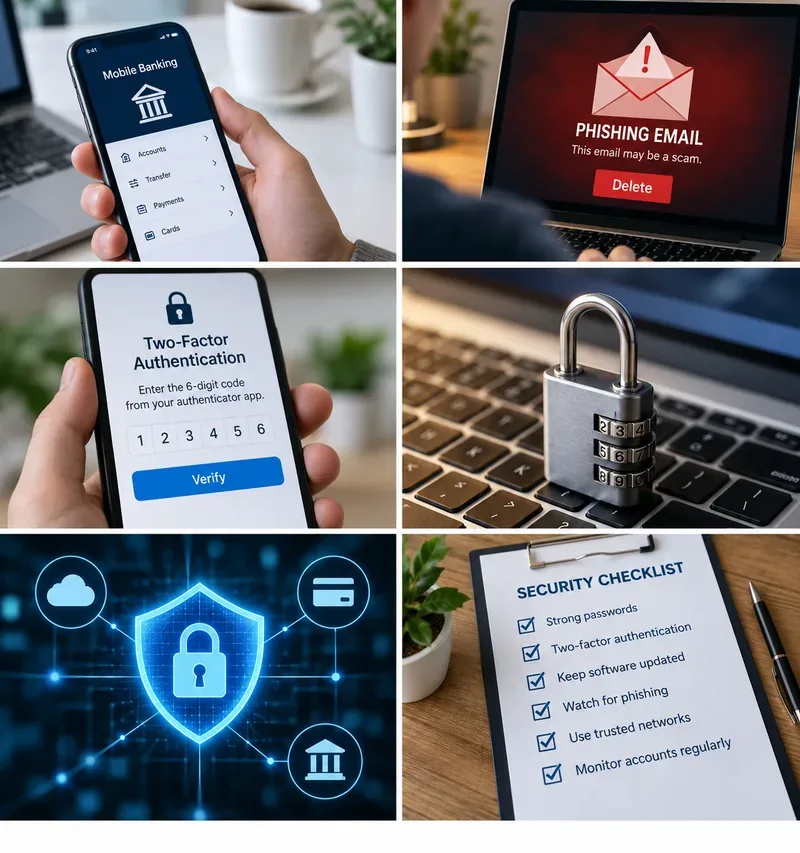
Modern FinTech security depends on layers: safer authentication, phishing resistance, protected devices and networks, and continuous monitoring rather than a single defensive control.
Why FinTech systems attract modern attackers
FinTech combines several characteristics attackers value: money movement, identity data, payment credentials, high transaction velocity, internet-facing APIs, mobile apps, cloud infrastructure, and integrations with banks, processors, KYC vendors, analytics services, and SaaS platforms. A successful compromise can produce immediate financial gain or valuable data for later fraud.
The threat picture is not limited to classic “hackers stealing a database.” The ENISA Threat Landscape 2025 found DDoS to be the dominant incident type across the EU dataset and ransomware to remain among the most impactful threats. ENISA also reported phishing and vulnerability exploitation as leading intrusion access points. Its dedicated finance-sector threat landscape describes significant pressure from DDoS, data-related attacks, ransomware, and financially motivated actors.
For a FinTech operator, that translates into five recurring risk families: stolen identities and account takeover; insecure APIs and applications; ransomware or destructive intrusion; service disruption such as DDoS; and compromise through a third party or software supply chain.
Start with the easiest high-value controls: identity and access
The simplest place to reduce risk is authentication. Password reuse, phishing, stolen session cookies, weak account recovery, and overprivileged internal accounts remain dangerous because they can bypass expensive network defenses.
Require multifactor authentication for employees, administrators, sensitive customer actions, and high-risk account recovery flows. Where practical, move privileged and workforce access toward phishing-resistant methods such as FIDO/WebAuthn. CISA’s MFA guidance explicitly recommends phishing-resistant MFA as the target and identifies FIDO/WebAuthn as the widely available phishing-resistant approach.
MFA alone is not enough. A strong identity layer also includes short-lived sessions for sensitive operations, reauthentication for high-value transfers or profile changes, device and risk signals, rate limits, secure recovery, and least-privilege access for staff and services.
Practical check: Ask whether an attacker who steals a password can reset MFA, add a new beneficiary, create an API key, or change a payout account without a second independent verification. If the answer is yes, the weak point is the transaction and recovery design, not just the login screen.
Reduce the amount of financial data you expose
Encryption is essential, but data minimization is often the stronger first move. Data that is never collected, or is deleted when no longer needed, cannot be stolen from your production database later.
Classify customer and payment data by sensitivity. Separate authentication secrets, cardholder data, identity documents, bank-account information, transaction histories, and internal risk signals. Encrypt sensitive data in transit and at rest using managed key systems, but also restrict who and what can decrypt it. Tokenization can reduce direct exposure of payment data in systems that do not need the original value.
For organizations handling cardholder data, use the current PCI Security Standards Council document library to confirm the applicable PCI DSS v4.0.1 requirements instead of relying on an old checklist. PCI SSC states that v4.0.1 is the supported revision and that the previously future-dated requirements became effective March 31, 2025.
Practical check: Trace one card number or bank-account identifier from customer entry to every database, log, queue, backup, analytics system, support tool, and vendor. If you cannot map where it travels, you cannot confidently protect or delete it.
Secure APIs as if every client is hostile
FinTech products are API-heavy by design. Mobile apps, merchant integrations, open-banking connections, fraud engines, internal microservices, and partner platforms all exchange sensitive data through APIs. That makes authorization errors especially dangerous.
The OWASP API Security Top 10 2023 highlights broken object-level authorization and broken authentication among core API risks. In plain terms, an API must not assume that because a user is authenticated, they are allowed to access any account, transaction, document, or object identifier they can submit.
Enforce authorization server-side on every sensitive object and action. Do not trust account IDs, customer IDs, role values, prices, or transfer limits supplied by the client. Apply schema validation, rate limiting, replay protection where relevant, short-lived credentials, secure secret storage, and strong service-to-service identity. Keep administrative and internal APIs off the public internet unless exposure is truly required.
NIST’s Zero Trust Architecture guidance is useful here because it shifts trust away from network location and toward explicit authentication and authorization of users, devices, services, and resources.
Practical check: In a test environment, change the account or transaction identifier in an authenticated API request. If the server returns another customer’s object, the issue is authorization logic, even if the request used a valid token.
Move from prevention to continuous detection
No preventive control is perfect, especially in financial systems where legitimate activity can resemble fraud. Detection therefore needs to combine cybersecurity telemetry with transaction and identity context.
Centralize logs for authentication, administrator actions, API gateways, cloud control planes, endpoint security, payment flows, secrets access, and high-risk customer events. Correlate events such as a new device, impossible travel, password reset, beneficiary creation, large transfer, API-key creation, and unusual data export.
Detection should not depend on a single static threshold. Use behavioral baselines and risk scoring where they are explainable and tested, but keep deterministic controls for clearly unacceptable actions. Machine learning can help prioritize anomalies; it should not replace audit trails, access controls, or incident response.
Practical check: Choose three attack scenarios—stolen admin credentials, compromised customer account, and leaked service token—and verify that your monitoring creates an actionable alert before material damage occurs.
Harden software delivery and patch management
Fast release cycles are a FinTech advantage, but they can also push vulnerabilities into production quickly. Security needs to be part of the build and deployment process rather than a final penetration test before launch.
Maintain an inventory of internet-facing systems, APIs, libraries, containers, cloud resources, and software dependencies. Scan dependencies and images, protect the CI/CD pipeline, review sensitive code paths, sign or verify build artifacts where appropriate, and rotate credentials that appear in source code or logs. Prioritize vulnerabilities based on exploitability, exposure, privilege, and business impact instead of treating every CVE as equally urgent.
Practical check: Pick a critical library used in a payment service and ask four questions: Where is it deployed? Which version is running? Who owns the service? How quickly can you replace it? If those answers require days of manual searching, the vulnerability-management process is too slow for an always-on financial platform.
Treat third-party risk as part of your own attack surface
A FinTech business may have excellent internal controls and still fail because a KYC provider, payment processor, cloud platform, customer-support tool, analytics SDK, or managed service is compromised or unavailable.
This is one reason DORA matters. The official EUR-Lex DORA summary explains that the regulation addresses ICT risk management, incident reporting, resilience testing, and ICT third-party risk. Not every FinTech company is automatically in scope, so legal applicability depends on entity type, activities, and jurisdiction. The operational lesson is broader: critical suppliers need measurable security and resilience requirements.
Maintain a service dependency map, identify concentration risk, define security obligations in contracts, review vendor access, and plan alternatives for critical services. “The vendor is compliant” should not be the only control. Ask how an outage or compromise would affect your customers and what you can do without that supplier.
Practical check: Simulate the loss of one critical provider for 24 hours. If the team cannot identify affected products, data flows, fallback procedures, and customer communications, third-party resilience is not mature enough.
Build for disruption: ransomware, DDoS, and operational resilience
Financial security is also an availability problem. A service can protect confidentiality and still fail customers if attackers or technical incidents make payments, authentication, or account access unavailable.
Use layered DDoS protection, autoscaling where appropriate, rate controls, protected administrative paths, network segmentation, and tested failover for critical components. Keep offline or logically isolated backups for systems that need recoverability, and test restoration rather than merely checking that backup jobs report success.
Incident-response plans should define who can isolate systems, revoke tokens, disable transfers, contact regulators or partners, preserve evidence, and communicate with customers. Tabletop exercises are valuable because they expose decision gaps before a real crisis.
Practical check: Run a timed exercise in which ransomware affects an internal identity system while a public API is under DDoS pressure. Measure how long it takes to detect, contain, make business decisions, restore critical functions, and communicate externally.
Put governance above the tools
The most difficult level is not technical; it is organizational. Security investments compete with product velocity, customer experience, revenue, and cost. Without governance, teams may buy many controls while leaving the most important risks unresolved.
The NIST Cybersecurity Framework 2.0, published in 2024 and still current in 2026, organizes cybersecurity around six functions: Govern, Identify, Protect, Detect, Respond, and Recover. The addition of Govern is especially relevant to FinTech because cybersecurity should be treated as enterprise risk, not only as an engineering issue.
Define risk owners, approved risk tolerances, security metrics, exception processes, incident escalation, and board or executive reporting. Map regulatory obligations to actual technical controls and evidence. A policy document should be traceable to system configurations, test results, logs, and accountable owners.
What changes when AI enters the threat model?
AI can make social-engineering content faster to produce and can help attackers automate research, but organizations should be careful with dramatic claims about entirely new classes of attacks. The underlying control failures are often familiar: weak identity verification, excessive privilege, insecure recovery, vulnerable software, and poor monitoring.
The safer response is to strengthen verification rather than trying to “detect AI” in every email or call. For high-risk actions, use authenticated channels, independent confirmation, transaction risk controls, and phishing-resistant identity methods. Treat AI-generated messages as another reason not to base trust on writing style, caller confidence, or apparent familiarity.
FinTech cybersecurity: a self-check you can run
Area
Evidence of a healthy control
Warning sign
Identity
Phishing-resistant MFA for privileged access; secure recovery; least privilege
Password plus SMS is the only barrier to critical admin actions
Compliance reports are treated as the security strategy
How to know whether your security program is improving
Do not judge success only by the number of tools deployed or audits passed. Measure outcomes. Can the organization prevent common account-takeover paths? Can it detect suspicious privileged activity quickly? Can it identify where sensitive data lives? Can it patch an exposed critical service within an agreed timeframe? Can it keep core payment functions running during a provider failure? Can it restore systems from clean backups? Can leaders see which risks remain accepted and why?
A mature FinTech security program can answer those questions with evidence, not optimism. The goal is not perfect prevention; that is unrealistic. The goal is to reduce the chance of compromise, limit the blast radius when something goes wrong, detect abuse early, protect financial data throughout its lifecycle, and recover without losing customer trust.