Home
» New Trends
»
CRISPR and Beyond: How Precision Gene Editing Is Becoming Programmable Medicine
CRISPR and Beyond: How Precision Gene Editing Is Becoming Programmable Medicine
Updated September 2026. Imagine a fictional patient named Maya, a 20-year-old living with sickle cell disease and recurrent vaso-occlusive crises. After hearing that a CRISPR therapy is now approved in the United States, she asks a deceptively simple question: “Does gene editing fix the mutation that causes my disease?”
The answer reveals where precision gene editing really stands. Some therapies cut DNA to disable a regulatory switch. Others can change a single DNA letter without making a double-strand break. Newer systems can write small substitutions, insertions, or deletions into DNA. Still other approaches aim to change gene activity or RNA without permanently rewriting the genome. The future of gene editing in medicine is therefore not one technology replacing another; it is a growing toolkit matched to the biology of each disease.
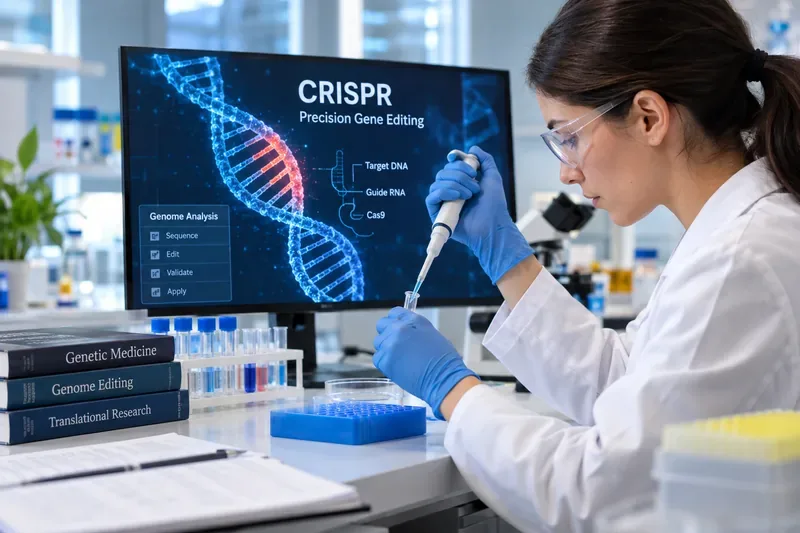
A scientist works at a genome-editing laboratory bench while a CRISPR targeting diagram is displayed nearby, reflecting the combination of molecular design, cell processing, and validation required for precision genetic medicine.
Where CRISPR medicine stands today
Maya’s first surprise would be that the most established CRISPR medicine does not directly repair the sickle-cell mutation in the HBB gene. CASGEVY (exagamglogene autotemcel) edits a regulatory region of the BCL11A gene in a patient’s own blood-forming stem cells. Reducing BCL11A activity in the erythroid lineage raises fetal hemoglobin, which can prevent red blood cells from sickling. The cells are collected, edited outside the body, tested, and returned after myeloablative conditioning. The mechanism is described in the FDA prescribing information for CASGEVY.
CASGEVY was first approved by the U.S. Food and Drug Administration for sickle cell disease in December 2023 and for transfusion-dependent beta-thalassemia in January 2024. In July 2026, the FDA expanded the indications to patients aged 2 years and older with sickle cell disease and recurrent vaso-occlusive crises or transfusion-dependent beta-thalassemia. The current indication is listed on the FDA CASGEVY product page and in the agency’s July 1, 2026 approval announcement.
That is a major milestone, but it also illustrates an important lesson: “precision” does not necessarily mean repairing the original mutation letter-for-letter. A clinically useful edit can instead change a regulatory pathway that compensates for the disease.
The next question is not “Can we edit DNA?” but “What kind of edit is best?”
CRISPR is a broad family of programmable systems. The National Human Genome Research Institute describes CRISPR as a technology adapted from naturally occurring bacterial systems to selectively modify DNA. Its updated definition is available in the NHGRI CRISPR glossary. In medicine, however, the practical choice is more specific: what molecular change is required, in which cell type, with what delivery method, and with what acceptable risk?
Approach
What it does
Main strength
Important limitation
Clinical maturity in 2026
CRISPR nuclease editing
Creates a targeted DNA cut, then relies on cellular repair
Efficient for gene disruption and regulatory edits
Double-strand breaks can produce unintended repair outcomes
Approved therapies exist
Base editing
Chemically converts selected DNA bases without a double-strand break
Well suited to certain single-letter changes or gene inactivation
Editing windows, bystander edits, target compatibility, and delivery constraints
Human clinical studies are underway; no FDA-approved base-editing therapy yet
Prime editing
Uses a nicking enzyme, reverse transcriptase, and prime-editing guide RNA to install a programmed small edit
Can support diverse substitutions plus small insertions and deletions without a double-strand break
More complex machinery, variable efficiency, and difficult delivery
First human clinical data have been published; still investigational
Gene regulation / epigenome editing
Changes gene activity without necessarily changing the DNA sequence
Potentially avoids permanent sequence alteration
Durability, specificity, delivery, and clinical validation remain challenges
Mostly research and early translational development
RNA editing
Changes RNA rather than genomic DNA
Potentially reversible and avoids permanent DNA modification
Effects may be temporary and may require repeat treatment
Early clinical and preclinical development depending on platform
Base editing: changing a letter without cutting both DNA strands
Suppose Maya’s disease were caused by a mutation that could be addressed by a compatible single-base conversion. A base editor could, in principle, be preferable to a nuclease if it can create the needed change while avoiding a double-strand break. Base editors combine a programmable DNA-targeting component with an enzyme that chemically converts one base into another within a defined editing window.
The significance of base editing is no longer purely theoretical. In 2026, a Phase 1 study of VERVE-102 tested an investigational in-vivo adenine base editor designed to inactivate PCSK9 in the liver of adults with heterozygous familial hypercholesterolemia or premature coronary artery disease. The peer-reviewed report included 35 participants across dose cohorts and described dose-dependent reductions in PCSK9 and LDL cholesterol. It remains an early-phase investigational therapy, and the study does not establish long-term population-level safety or clinical benefit. The original report is indexed by the National Library of Medicine at PubMed: In Vivo Base Editing of PCSK9 with VERVE-102 for Hypercholesterolemia, and the trial record is available at ClinicalTrials.gov NCT06164730.
That study matters because it demonstrates another direction for precision medicine: editing cells inside the body rather than collecting them for ex-vivo manufacturing. It also highlights the challenge that increasingly defines the field—delivery. Editing the liver is more tractable than reaching many cell types in the brain, lung, muscle, or other organs. NIH explicitly identifies tissue-targeted delivery as a major bottleneck for CRISPR nucleases, base editors, and prime editors in its TARGETED Genome Editor Delivery Challenge.
Prime editing: a more flexible search-and-replace strategy
Now change the hypothetical again. Imagine Maya instead has a rare inherited disorder caused by a small deletion that cannot be fixed by a simple base conversion. Prime editing is designed for this kind of broader edit. It uses a Cas9 nickase fused to a reverse transcriptase plus a prime-editing guide RNA that both finds the target and encodes the desired change. The system can install many substitutions as well as small insertions and deletions without intentionally generating a DNA double-strand break.
Prime editing has also crossed the boundary from laboratory research into human testing. In a Phase 1/2 study of PM359 for p47phox-deficient chronic granulomatous disease, investigators used prime editing ex vivo to correct a disease-causing deletion in the NCF1 gene in autologous CD34+ hematopoietic stem cells. A peer-reviewed report described the first two treated participants and concluded that the results supported further investigation. This is early evidence, not proof that prime editing is broadly safe, durable, or effective across diseases. The primary publication is available at PubMed: Prime Editing for p47phox-Deficient Chronic Granulomatous Disease, and the ongoing study is registered as ClinicalTrials.gov NCT06559176.
The attraction of prime editing is flexibility. The tradeoff is complexity: the editor is larger, its guide architecture is more demanding, editing efficiency can vary by target, and getting the full system into the right cells remains difficult. Those limitations mean that prime editing should not be described as a universal replacement for conventional CRISPR.
Precision is a systems problem, not just an editor problem
If Maya asked which tool was “most precise,” a responsible answer would require several separate questions. Does the editor modify only the intended locus? Does it create the intended sequence at that locus without extra insertions, deletions, or structural changes? Does it reach only the desired tissue? Are enough target cells edited to produce a medical benefit? Does the effect last? And does the manufacturing process produce a consistent product?
1. Off-target editing
An editor may bind or modify DNA at unintended genomic sites. This risk is not identical across platforms and cannot be reduced to a single laboratory assay. Developers use computational prediction, targeted sequencing, genome-wide assays, and increasingly sophisticated next-generation sequencing strategies to look for unintended changes.
Hitting the correct genomic address is not enough. Nuclease editing can create a mixture of repair outcomes at the intended site. Base editors can sometimes alter additional compatible bases within their editing window. Prime editors can produce incomplete or alternative products. A clinically meaningful safety program therefore measures the exact molecular outcomes, not merely whether the target site was reached.
3. Delivery
Ex-vivo editing gives developers a chance to collect cells, edit them under controlled conditions, characterize the product, and then infuse it back. That approach is powerful for blood and immune cells but can require complex manufacturing and, in some cases, conditioning regimens. In-vivo editing can be simpler for the patient if an editor is delivered directly to an organ, but it shifts more of the control problem into the body: tissue targeting, dose, biodistribution, immune responses, and the duration of editor exposure all matter.
The NIH Somatic Cell Genome Editing program has treated delivery and safety assays as core infrastructure rather than secondary details. Its overview explains the program’s goals of expanding editing tools, developing tissue-specific delivery systems, improving safety and effectiveness assays, and sharing validated resources through the NIH Somatic Cell Genome Editing program.
4. Durability and follow-up
A permanent DNA edit can be a major advantage when the right long-lived cells are modified. It also means that delayed effects matter. For stem-cell therapies, edited cells may persist and produce descendants for years. For in-vivo approaches, durability depends on the targeted tissue and whether edited cells turn over. Long-term monitoring is therefore part of the therapeutic concept, not an afterthought.
What comes after permanent DNA editing?
“Beyond CRISPR” does not only mean more powerful DNA rewriting. For some diseases, the safest useful intervention may be to change gene activity without changing the underlying DNA sequence. CRISPR interference and activation systems can recruit regulatory proteins to decrease or increase transcription. Epigenome editors can alter molecular marks that influence gene expression. RNA editors act on transcripts rather than the genome itself.
These strategies could be valuable when reversibility is desirable or when permanent sequence modification provides little additional benefit. But temporary or regulatory approaches create their own questions: how long does the effect last, how often must treatment be repeated, how precisely is expression controlled, and can the delivery vehicle reach enough cells? In 2026, these approaches span preclinical research and early clinical development rather than forming a single mature therapeutic class.
What the future may look like for a patient like Maya
Return to the hypothetical consultation. Today, Maya’s care team would not choose a treatment simply because it uses the newest editor. They would first ask whether there is an approved therapy for her condition, whether she meets its clinical criteria, what established alternatives exist, what treatment burdens are involved, and what risks come from conditioning, cell collection, immune reactions, or long-term uncertainty.
In the future, the same decision could become more mutation-specific. A nuclease might be preferred when disabling a regulatory element is enough. A base editor might be selected for a compatible single-nucleotide change. A prime editor might be attractive for a small deletion or a substitution outside the reach of base editing. A non-permanent RNA or gene-regulation approach might be preferable when a reversible effect is safer. The editor becomes one component of a treatment architecture rather than the product’s entire identity.
Five developments likely to determine whether gene editing becomes routine medicine
More selective delivery to difficult tissues
Liver-directed lipid nanoparticles have helped make in-vivo editing clinically feasible, but many diseases require access to cells that are harder to reach. Improvements in nonviral nanoparticles, viral vectors, targeting ligands, and cell-specific delivery could determine how quickly editing expands into neurology, muscle disease, pulmonary disease, and other areas.
Better measurement of rare unintended changes
As editors become more precise, safety assessment must become more sensitive. Regulators are already emphasizing sequencing-based evaluation of off-target changes and genome integrity. A future therapy may be judged not only by average editing efficiency but by a detailed map of rare molecular outcomes.
Platform-based development
Many rare diseases differ primarily in the sequence that must be edited. If developers can reuse validated editor components, manufacturing processes, delivery systems, and safety knowledge across related programs, therapies for small patient populations could become more practical. In June 2026, the FDA issued draft guidance on leveraging prior knowledge in genome-editing gene therapy development, reflecting this emerging regulatory direction. The document is draft guidance, not a final standard.
Manufacturing that scales beyond specialized centers
Ex-vivo autologous therapies can involve collection, shipping, individualized manufacturing, quality testing, conditioning, infusion, and prolonged follow-up. Those steps can limit capacity even when the molecular edit works. More automated manufacturing, standardized quality controls, and in-vivo alternatives may matter as much as improvements in editing chemistry.
Governance that keeps pace with capability
Somatic editing of a patient’s non-reproductive cells is fundamentally different from heritable editing intended to affect future generations. The World Health Organization’s recommendations on human genome editing call for robust governance and oversight across somatic, germline, and heritable applications. WHO continues to state that proceeding prematurely with clinical applications of human germline genome editing would be irresponsible; its current overview is available on the WHO human genome editing page.
A practical self-check for any “gene-editing breakthrough”
Maya’s hypothetical story provides a useful way to judge future headlines. Before treating a result as a medical breakthrough, check the following:
Is the therapy approved, or is it investigational? A promising Phase 1 result is not equivalent to regulatory approval.
Was the edit performed ex vivo or in vivo? The delivery and safety questions are different.
What exactly was edited? The therapy may repair a mutation, disrupt a gene, alter a regulatory element, or change gene expression.
How many people were studied and for how long? Small early-phase trials can reveal biological activity but may miss uncommon or delayed risks.
Was the evidence peer reviewed and registered? Look for the original study, ClinicalTrials.gov record, regulator documents, and current product labeling rather than relying on promotional summaries.
What safety measurements were performed? Ask about off-target edits, unintended on-target changes, genome integrity, immune reactions, delivery-related toxicity, and long-term monitoring.
What treatment burden remains? A precise edit can still require stem-cell collection, conditioning, hospitalization, specialized manufacturing, or repeat dosing.
If those questions have clear answers, the claim is easier to place on the spectrum from laboratory concept to established medicine. That distinction will become increasingly important as CRISPR nucleases, base editors, prime editors, and non-permanent gene-control technologies mature at different speeds.
The real future of precision gene editing
The biggest shift is not simply that researchers can edit DNA more accurately than before. It is that genetic medicine is becoming programmable at several layers: DNA sequence, gene regulation, RNA, delivery, and cell manufacturing. CASGEVY has already shown that CRISPR-based editing can become an approved medicine. Base editing has produced human in-vivo clinical data. Prime editing has entered human studies and generated peer-reviewed clinical observations. At the same time, FDA guidance increasingly treats off-target effects, genome integrity, manufacturing, and platform knowledge as central development issues rather than technical footnotes.
For a future patient like Maya, the best outcome may not come from the most sophisticated editor. It will come from the technology that produces the right biological change in the right cells, with enough durability to matter and enough evidence to justify the risk. That is the standard by which “CRISPR and beyond” will ultimately be measured.
This article is for educational purposes and does not provide medical advice. Eligibility for gene-editing therapy or a clinical trial depends on an individual diagnosis, treatment history, health status, local regulatory approval, and specialist evaluation.