Home
» New Trends
»
Blockchain in Global Trade: A Practical Path to Transparency and Traceability
Blockchain in Global Trade: A Practical Path to Transparency and Traceability
A container reaches a port, but the parties involved do not agree on what has happened. The exporter says the latest documents were submitted. The freight forwarder is working from an older version. The buyer cannot verify the product’s chain of custody. A bank is waiting for evidence that another system already holds. No single participant necessarily made a mistake; the deeper problem is that global trade still depends on many organizations maintaining separate records and reconciling them across company and national boundaries.
Blockchain can help with that specific coordination problem. It can provide a shared, tamper-evident history of approved events so authorized participants can verify who recorded what and when. But it is not a cure for poor source data, weak standards, unclear legal rights, or bad process design. The useful question is not “Can we put trade on a blockchain?” It is “Which trade frictions actually need a shared ledger, and what must be fixed first?”
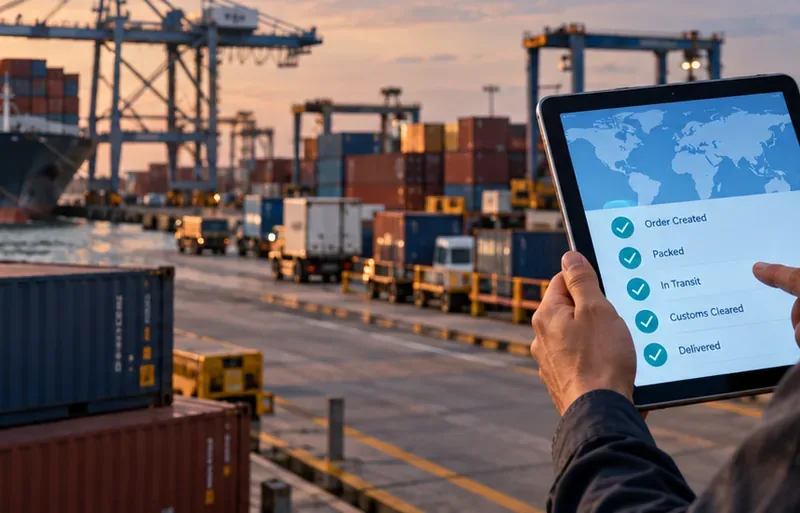
A port worker reviews shipment milestones on a tablet while containers, trucks, cranes, and a cargo vessel illustrate the many handoffs that global trade systems need to reconcile.
Why transparency breaks down in cross-border trade
International shipments move through exporters, carriers, ports, customs agencies, insurers, banks, importers, warehouses, and sometimes certification bodies. Each party may use a different application, identifier, document format, or definition of the same event. That creates four recurring problems: duplicated data entry, inconsistent versions of documents, limited visibility across organizational boundaries, and expensive reconciliation when records conflict.
The World Trade Organization’s digital technologies and trade resources describe blockchain as a distributed ledger that can support verifiable record-keeping for areas such as customs documentation, supply-chain tracking, payments, and contracts. The important feature is shared verification, not cryptocurrency.
NIST describes blockchains as shared ledgers designed to be tamper evident and tamper resistant rather than magically immune to every form of manipulation. Its blockchain technology overview is a useful reminder that the ledger protects the history recorded inside the system; it does not prove that every real-world input was true.
Start with the simplest fix: standardize the data before the ledger
If two trading partners call the same location, shipment, product, or custody event by different identifiers, blockchain only preserves the disagreement more permanently. The first improvement should usually be common identifiers, event definitions, and data-exchange rules.
For supply-chain visibility, GS1 EPCIS and Core Business Vocabulary provide a standardized way to communicate the “what, when, where, why, and how” of events involving products and assets. EPCIS 2.0 also supports sensor information and certification details. A company can use these standards with a conventional database, a data-sharing platform, or a blockchain.
This is an important trade-off: standardization usually delivers value sooner and at lower complexity than deploying a distributed ledger. Blockchain becomes more compelling only when several independent organizations need to share a history but do not want one participant to own the authoritative database.
Digitize the trade document before trying to tokenize it
Paper bills of lading, certificates, and other transferable records create friction because possession, control, authenticity, and transfer can have legal consequences. Replacing paper with a PDF is not always enough. The system must be able to identify the authoritative record, preserve integrity, and establish control where the law requires it.
The legal environment is improving but remains uneven. As of September 2026, the UNCITRAL status page for the Model Law on Electronic Transferable Records (MLETR) lists legislation based on or influenced by MLETR in 13 states and 13 jurisdictions. UNCITRAL also makes clear that local laws can differ from the model, so a technically valid blockchain record does not automatically have the same legal effect everywhere.
Singapore’s TradeTrust framework is one example of an approach designed around interoperable electronic trade documents. IMDA states that the framework can support endorsement, exchange, verification, and title transfer across digital platforms. The lesson is broader than one platform: legal recognition and interoperable document control matter at least as much as the ledger technology underneath.
Where blockchain adds the most value
Trade problem
Best starting point
Blockchain fit
Main trade-off
One company needs a better audit trail
Conventional database with strong access controls and logging
Low
Distributed consensus adds complexity without solving a multi-party trust problem
Partners repeatedly dispute shipment milestones
Shared event model and identity rules
Potentially high
Participants must agree on governance, permissions, and correction procedures
Product provenance or chain of custody
Standards such as EPCIS plus authenticated event capture
Moderate to high
The ledger cannot determine whether a sensor or human entered false data
Electronic bills of lading or other transferable records
Legally recognized electronic-document system
Depends on corridor and platform
Legal recognition, control, and interoperability vary by jurisdiction
Cold-chain or condition monitoring
Trusted sensors, timestamps, identities, and event standards
Moderate
Sensor security and data volume may matter more than ledger design
Automated release, payment, or compliance checks
Stable business rules and high-quality digital evidence
Selective
Exceptions, disputes, and software errors still require human and legal processes
Next, solve governance before adding more technology
A trade blockchain needs answers to questions that a single-company database can postpone: Who may operate a node? Who may write events? Which organizations can view commercially sensitive fields? How is a mistaken record corrected without hiding the original history? Who approves software upgrades? What happens when one member leaves the consortium? How are identities issued and revoked?
For many trade networks, a permissioned model is more practical than a fully public chain because participants need controlled access and defined accountability. That does not remove the need for governance; it makes governance explicit. The WCO/WTO paper on advanced technologies in cross-border trade discusses blockchain alongside IoT, analytics, AI, and machine learning from a customs perspective and highlights implementation challenges as well as potential benefits.
Then connect physical events carefully
Traceability becomes valuable when digital events correspond to what actually happened to physical goods. This is also where blockchain’s limitation becomes most obvious. NIST’s blockchain guidance discusses the “oracle problem”: a ledger can preserve a sensor reading or human declaration, but it may not be able to determine whether the sensor malfunctioned or the person entered false information.
That means a serious traceability design should focus on input assurance. Depending on the use case, that can include authenticated devices, tamper-evident seals, calibrated sensors, controlled scanning procedures, digital signatures, role-based permissions, and exception review. In many cases, it is sensible to keep large or private datasets off-chain while storing hashes, references, signatures, or critical state changes on the ledger. This reduces data exposure and avoids turning the blockchain into a costly document warehouse.
Use smart contracts only after the evidence is reliable
Smart contracts can automate actions when agreed conditions are satisfied, such as releasing a workflow step after a verified document arrives. But automation increases the cost of bad inputs and poorly specified rules. A conventional rules engine may be easier to audit and change when one organization controls the process. Smart contracts are more attractive when multiple independent parties need the same execution logic and no single party should be able to rewrite the outcome unilaterally.
Before automating payment, title transfer, cargo release, or compliance decisions, define exception handling. Real trade includes partial shipments, damaged goods, inspections, amended documents, sanctions screening, force majeure, and disputes. A production system needs an authorized way to pause, override, reverse, or legally resolve those cases without pretending that code alone can settle them.
How to tell whether the system is actually improving trade
A blockchain project should be judged against the process it replaces, not against a technology demo. Capture a baseline before deployment, then compare the same lane, document type, or transaction class after implementation.
Reconciliation time: Are teams spending fewer hours matching conflicting versions of the same shipment or document?
Trace completeness: Can authorized users follow custody and key status events from origin to destination without unexplained gaps?
Document exceptions: Has the rate of duplicate, outdated, or unverifiable documents fallen?
Dispute resolution time: Does a shared event history shorten investigations when parties disagree?
Manual re-entry: Are fewer fields being copied between systems by people?
Partner coverage: Are the organizations responsible for the critical handoffs actually participating, or is the ledger only mirroring one company’s data?
Legal usability: Can the electronic record be relied upon in each relevant jurisdiction and contract, not just displayed in a dashboard?
Total operating cost: Do integration, identity, governance, node operation, support, and audit costs remain justified by the friction removed?
When a blockchain is the wrong answer
If one trusted operator can legitimately maintain the authoritative record, a well-designed centralized database is usually simpler. The same is true when partners will not adopt common identifiers, when most events still arrive on paper, or when the main problem is poor internal process discipline. A distributed ledger cannot compensate for missing participants or inconsistent data semantics.
Blockchain is strongest when three conditions overlap: several independent parties need the same history, they benefit from making unauthorized retroactive changes difficult, and no single participant should control the shared record. If those conditions are absent, interoperability, APIs, digital signatures, and conventional databases may deliver a better result.
The practical end state: shared evidence, not blockchain for its own sake
The most useful vision for blockchain in global trade is not a single worldwide chain containing every document and shipment. It is a set of interoperable systems where participants can exchange standardized data, verify provenance, establish control of electronic trade documents, and preserve critical events in a tamper-evident history when shared governance is necessary.
The path therefore moves from simple to difficult: first fix identifiers and event definitions; then digitize documents; then establish legal validity and governance; then use a shared ledger where reconciliation problems justify it; and only after trustworthy evidence is available should organizations automate higher-stakes actions. That sequence keeps the technology aligned with the business problem and gives teams a clear way to verify whether transparency and traceability are genuinely improving.