Home
» How To
»
How to Wash a The North Face Puffer Jacket Without Ruining the Loft
How to Wash a The North Face Puffer Jacket Without Ruining the Loft
If you are about to wash a The North Face puffer for the first time, the most important thing to know is that “puffer” describes the quilted, insulated style—not one single material. A puffer may contain natural down, synthetic insulation such as THERMOBALL™, or another fill, and the correct cleaning method depends on the exact garment.
As of September 2026, The North Face’s current U.S. product-care guidance still says the care tag inside the garment is the primary instruction source. Its U.S. page recommends professional cleaning by a service that specializes in down for down jackets, while some regional The North Face support pages also describe cautious at-home washing for down and synthetic insulated products. That difference is a good reason not to copy a generic washing routine without first reading your own jacket’s label. See The North Face U.S. Product Care page, The North Face jacket-care guidance, and The North Face synthetic-fill product-care guidance.
First, Know What Kind of Puffer You Have
Down is the soft insulating plumage found beneath the outer feathers of waterfowl. It traps air extremely efficiently, which gives a down jacket its high warmth-to-weight ratio and its characteristic “loft.” Loft means the thickness and springiness of the insulation after it expands. Wet down temporarily collapses and clumps, so drying it thoroughly and breaking up clumps is critical.
Synthetic insulation uses man-made fibers, usually polyester, to trap warm air. Some The North Face puffers use synthetic fills such as THERMOBALL™. The current Men’s THERMOBALL™ Jacket, for example, uses 100% post-consumer recycled polyester insulation, while the 1996 Retro Nuptse uses 700-fill recycled waterfowl down. You can verify those differences on the official THERMOBALL™ Jacket product page and 1996 Retro Nuptse Jacket product page.
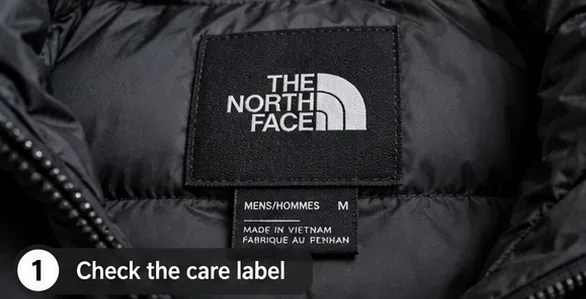
Start with the care label inside your exact jacket. The fill type, wash temperature, drying method, and restrictions on that tag take priority over general advice.
What You Need Before You Start
Your jacket’s care label and, if available, its exact product page or product manual.
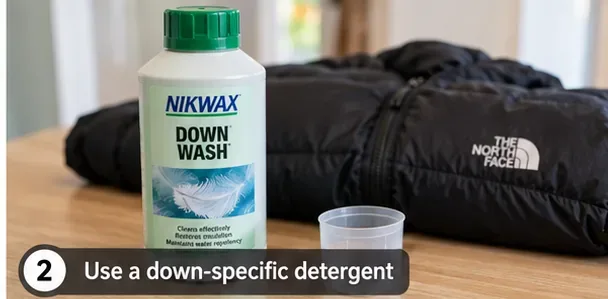
A mild cleaner suitable for the garment. For down, use a down-safe cleaner if the label allows home washing. For synthetic insulation, use the mild detergent specified by the label.
A washing machine only if the care instructions permit machine washing.
A dryer only if the care label permits tumble drying.
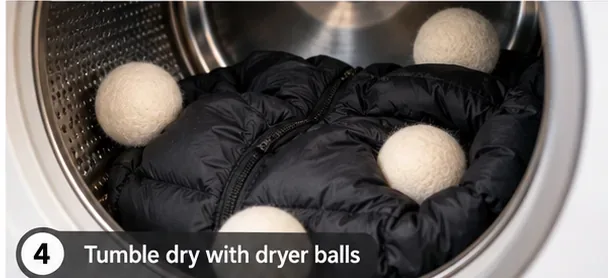
Clean dryer balls or clean tennis balls if the label allows low-heat tumble drying and you need help restoring loft.
Enough time for the jacket to dry completely. Down can take longer than expected.
Avoid improvising with fabric softener, chlorine bleach, harsh cleaners, or high heat. The North Face’s waterproof-jacket guidance specifically warns against fabric softener and chlorine bleach because they can harm technical finishes. Many insulated jackets also have a DWR, or durable water-repellent, finish on the face fabric, so gentle care matters even when the jacket is not fully waterproof. See the official The North Face waterproof-jacket washing guide.
A down-specific wash is shown beside a puffer jacket. Use only the amount and type of cleaner permitted by your jacket’s label; a specific brand is not required unless the manufacturer says so.
How to Wash a The North Face Puffer Jacket
Step 1: Read the Care Label Before Doing Anything Else
Find the sewn-in care tag, usually along an inside seam. Confirm whether the jacket is down or synthetic, whether machine washing is allowed, the maximum wash temperature, whether tumble drying is allowed, and whether there are special instructions for coatings or trims.
If your down jacket’s label is unclear, the conservative choice is to follow The North Face U.S. recommendation and use a professional cleaner that specializes in down products. Do not assume that “professional cleaning” means any ordinary dry cleaner; the service should understand technical down garments.
Step 2: Prepare the Jacket
Empty every pocket. Remove loose items, lift off dried mud with a soft brush, and inspect the shell for tears that could enlarge in the wash. Close the main zipper, pocket zippers, snaps, and hook-and-loop fasteners so they are less likely to catch on the fabric. If the care label says to turn the jacket inside out, do that now.
This is also the time to treat a small dirty area gently rather than scrubbing the entire shell. Avoid stiff brushes and aggressive rubbing, especially on lightweight ripstop fabrics.
Step 3: Use the Right Cleaner and the Gentlest Approved Cycle
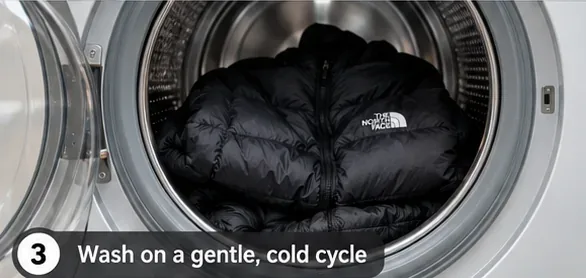
If the care tag allows machine washing, use the temperature and cycle printed on the label. The North Face regional guidance commonly recommends a cool or cold gentle wash for insulated and technical jackets. Use a mild cleaner and do not add fabric softener or bleach.
A puffer jacket sits loosely in a washing-machine drum. When the care label permits machine washing, use the specified gentle cycle and avoid overloading the machine.
Do not wash the jacket with heavy jeans, towels, shoes, or anything with exposed hardware that can abrade the shell. The jacket should have enough room to move rather than being tightly packed into the drum.
Step 4: Rinse Thoroughly
Detergent residue can interfere with loft and technical finishes. If your machine leaves visible suds or the label allows an extra rinse, run an additional rinse cycle. The North Face’s U.S. product-care guidance recommends two rinse cycles for some technical outerwear specifically to remove detergent residue.
Step 5: Dry According to the Label—Low Heat Means Low Heat
Drying is where many first-time mistakes happen. If the label permits tumble drying, use the low-heat setting specified on the tag. The North Face’s regional down-care guidance says that down can be machine dried or laid flat to air dry depending on the garment, and its synthetic-fill guidance says tumble drying with tennis balls can help restore loft when the care instructions allow it.
When the garment label allows tumble drying, low heat plus clean dryer balls or clean tennis balls can help separate insulation and restore loft.
High heat is not a shortcut. It can damage shell fabrics, coatings, seam components, elastic parts, and insulation. If tumble drying is prohibited, follow the approved air-drying method on the label instead.
Step 6: Break Up Down Clumps as the Jacket Dries
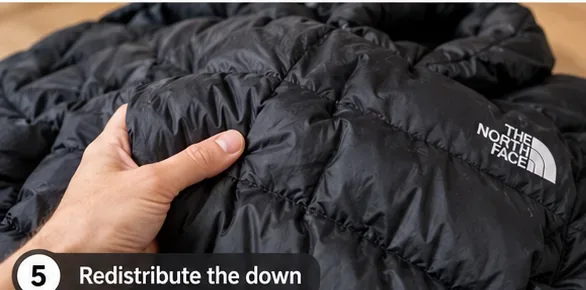
A wet down jacket can look alarmingly flat. That does not automatically mean it is ruined. During drying, pause periodically and gently massage or shake the baffles so the wet down separates and redistributes. A baffle is one of the stitched compartments that keeps insulation from migrating across the whole jacket.
Gently work clumped insulation apart while the jacket dries. The goal is to redistribute the fill without pulling, twisting, or stretching the shell.
Continue until the jacket feels evenly puffy rather than dense in some areas and empty in others. Down that is still damp can clump again, so do not stop merely because the shell fabric feels dry.
Step 7: Let the Jacket Finish Drying Completely
After the main drying stage, inspect the collar, cuffs, underarms, and thick baffles. These areas can stay damp longer. If the care instructions permit air drying, give the jacket plenty of ventilation and turn or reposition it so moisture can escape evenly.
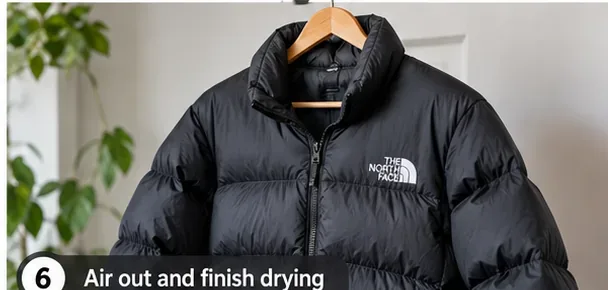
A cleaned puffer finishes drying in a ventilated indoor space. Store the jacket only after the insulation and lining are completely dry.
Do not put a damp puffer into a closet, backpack, or storage bin. Trapped moisture can create odor and can make down clump again.
Step 8: Check Loft, Surface Condition, and Water Beading
Once dry, compare the jacket’s loft across all baffles. If one section is still flat, it may need more low-heat drying or gentle redistribution, provided the care label permits it.
If your jacket has a DWR finish, check how the face fabric behaves after cleaning. DWR is not the same as a waterproof membrane; it is a surface treatment that helps water bead and roll away instead of immediately soaking into the outer fabric. Some current The North Face puffers, including the 1996 Retro Nuptse and THERMOBALL™ Jacket, list a non-PFC DWR finish on their product pages.
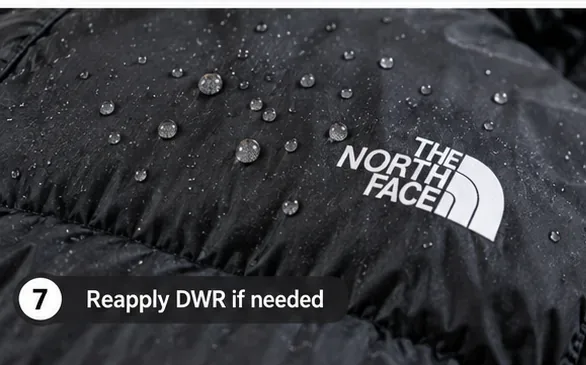
Water beads on the jacket’s face fabric, a sign that a durable water-repellent finish is still functioning at the surface.
If water no longer beads and the care label allows DWR maintenance, follow the manufacturer’s directions for restoring or reapplying the finish. Do not spray on a random treatment simply because the shell looks less shiny after washing.
How to Handle a Synthetic The North Face Puffer
Synthetic puffers are generally less sensitive to clumping than down, but they still need gentle care. The North Face states that synthetic-fill products may be machine washed when the care instructions allow it, and that tumble drying with tennis balls can help restore loft. The exact cycle and temperature still come from the label.
If you own a THERMOBALL™ jacket, remember that its fill is recycled polyester rather than down. A down-specific cleaner is therefore not automatically necessary. Use the cleaner specified for your garment and avoid treating every The North Face puffer as if it were a Nuptse.
What About a Down Nuptse?
The 1996 Retro Nuptse is a down-filled jacket, currently listed by The North Face with 700-fill recycled waterfowl down and a recycled nylon shell with a non-PFC DWR finish. Because it combines down insulation with a treated technical shell, both the insulation and the face fabric matter during cleaning.
For that reason, the care label on your particular Nuptse should be your final authority. If it permits home washing, use a gentle process and give the drying stage enough time to restore the down. If you are uncomfortable managing wet down, The North Face U.S. specifically recommends a professional service that specializes in down products.
Common Mistakes to Avoid
Skipping the label: Two jackets that look similar may use completely different insulation and shell treatments.
Using fabric softener: It can leave residues and interfere with technical finishes.
Using bleach: Chlorine bleach is not recommended in The North Face technical-garment guidance.
Using high heat: More heat can damage fabric or components instead of simply drying the jacket faster.
Stopping while down is still damp: Damp down stays clumped and can develop odor.
Twisting or wringing: Wet insulation and lightweight shell materials should be handled gently.
Assuming every puffer is down: THERMOBALL™ and other synthetic puffers need care matched to their actual fill.
Washing too often: Clean an insulated jacket when it is actually dirty or needs maintenance rather than automatically washing it after every wear.
How to Know You Are Finished
A properly cleaned puffer should be completely dry, evenly lofted, free of obvious detergent residue, and free of damp or musty odor. The baffles should feel consistent instead of containing hard wet clumps. Zippers and fasteners should operate normally, and any DWR-equipped shell should be evaluated according to its care instructions rather than by appearance alone.
Before putting the jacket away, make sure it is dry all the way through. Store it clean and without unnecessary long-term compression.
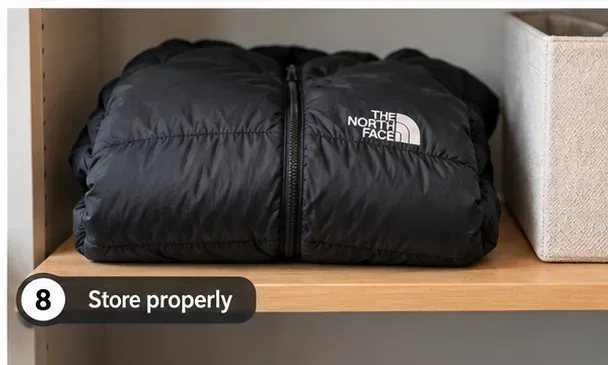
A clean, fully dry puffer rests loosely on an open shelf after washing. Avoid putting the jacket away while damp or tightly compressed.
Quick Decision Guide
If your jacket is...
Start here
Drying priority
Down-filled
Read the care label; consider a down specialist if unsure
Dry completely and restore loft without high heat
Synthetic-filled
Machine wash only if the label allows it
Follow the label; low tumble with balls may help restore loft when permitted
Waterproof or membrane-equipped
Follow the technical-shell instructions as well as insulation guidance
Protect the membrane and DWR from harsh chemicals and excess heat