Home
» How To
»
How to Clean a Range Hood Filter Safely: A Practical Guide for Metal and Charcoal Filters
How to Clean a Range Hood Filter Safely: A Practical Guide for Metal and Charcoal Filters
Current guidance check (September 2026): There has not been a broad, industry-wide change in the basic way washable metal range hood filters are cleaned. Current manufacturer guidance from Whirlpool, Bosch, GE Appliances, and Broan-NuTone still centers on removing the metal grease filter, washing it with warm or hot water and mild detergent, drying it thoroughly, and reinstalling it. What does vary more than many people expect is dishwasher compatibility, cleaning frequency, and whether a charcoal filter can be washed at all. Your model’s owner’s manual should therefore override any generic method.
If your range hood filter looks sticky, darkened with grease, or visibly clogged, cleaning it is usually a straightforward maintenance job. The main thing to get right is identifying the filter type before you put anything in water. Metal mesh and metal baffle grease filters are commonly washable. Carbon or charcoal odor filters used in recirculating hoods are often replaceable rather than washable, although some specific models use washable or reactivatable charcoal filters.
First, identify which filter you have
A grease filter is the metal filter positioned where cooking air first enters the hood. It traps airborne grease before the air reaches the blower or ductwork. Common designs include layered aluminum mesh and stainless-steel baffle filters. These are the filters this cleaning process is primarily for.
A charcoal filter, sometimes called a carbon filter, is used mainly in recirculating range hoods to reduce odors before air is returned to the kitchen. Do not assume it can be washed. Whirlpool’s general vent-hood guidance says its conventional non-vented charcoal filter is not washable, while a separate current Whirlpool support page documents a model-specific charcoal filter that can be washed in a dishwasher and reactivated with heat. That difference is exactly why the manual for your model matters.
Filter type
Typical care
What to verify first
Aluminum mesh grease filter
Usually washable with warm water and mild detergent
Whether dishwasher cleaning is allowed
Stainless-steel baffle filter
Usually washable
Removal method and dishwasher instructions
Charcoal/carbon filter
Often replaced instead of washed
Whether the exact model uses a washable or regenerable version
What you need before cleaning
Mild dish detergent or another cleaner specifically approved by the hood manufacturer
A sink or basin large enough to hold the filter
Warm to hot water, within the limits in your owner’s manual
A soft nylon brush or nonabrasive cleaning brush
A clean towel or drying rack
Optional household gloves if the filter is heavily greasy
Avoid reaching automatically for aggressive cleaners. GE Appliances specifically advises against ammonia or ammonia products on its common metal grease filters. Bosch and Whirlpool also warn against abrasive or chlorine-based products on certain hood surfaces. The safest default is mild detergent unless your manual says otherwise.
How to clean a range hood filter step by step
1. Turn the hood off and let it cool
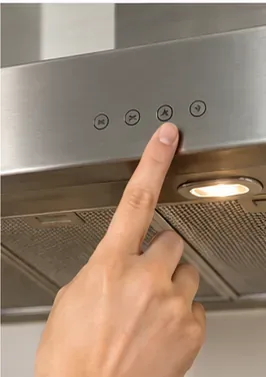
Switch the blower and lights off before touching the filter. If you have just cooked, wait until the hood, lights, cooktop, and surrounding metal are cool enough to handle safely. Whirlpool’s current support guidance explicitly says to make sure the controls are off and the hood is cool before cleaning.
Turn the range hood off before starting, and wait for hot surfaces and lights to cool.
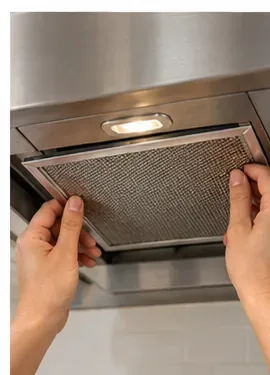
2. Remove the metal grease filter carefully
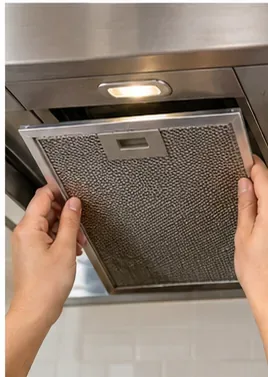
Support the filter with one hand while releasing its tab, latch, spring handle, or retaining clip with the other. Removal mechanisms vary. GE notes that many newer filters use a locking tab, while Whirlpool manuals may use spring-release handles. If the filter does not release easily, stop and check the owner’s manual rather than forcing it.
Support the filter as you release its latch so it does not drop onto the cooktop.
3. Soak the washable metal filter
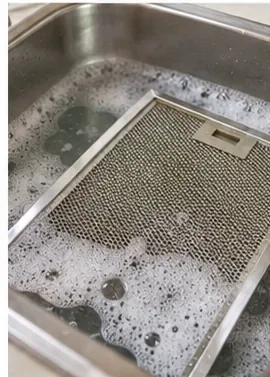
Place the metal grease filter in a sink or basin with warm water and mild detergent. Broan-NuTone recommends soaking its grease filters in warm water with a mild detergent solution for 15 to 20 minutes per side. Bosch gives a shorter 10-minute soak for its filters. Those differences are a reminder that there is no single universal soak time; use the manufacturer’s instructions when available.
Soaking loosens greasy residue before brushing; use the soak time recommended for your model.
4. Brush gently instead of scraping
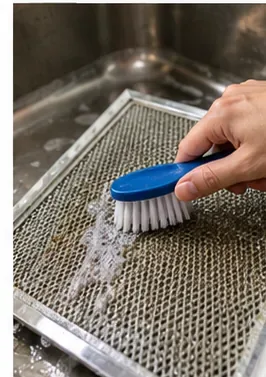
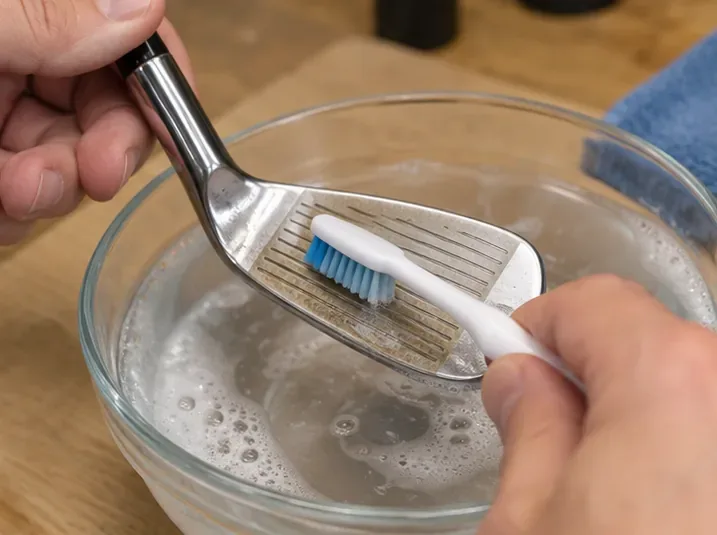
Use a soft cleaning brush to work detergent through the mesh or between baffles. Concentrate on greasy edges and corners, but do not bend thin aluminum mesh or pry at the layers. GE Appliances permits light brushing to remove embedded soil, and Bosch recommends a cleaning brush after soaking. If grease remains after the first pass, another soak is usually gentler than attacking the filter with a harsh abrasive.
Use a soft brush and light pressure so you remove grease without deforming the metal mesh.
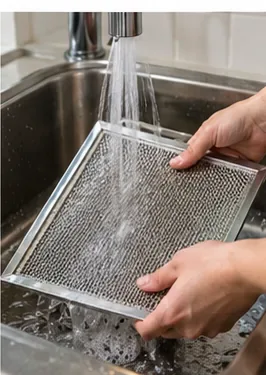
5. Rinse away detergent and loosened grease
Rinse the filter with clean water until visible suds and loosened residue are gone. Hold the filter securely because a wet metal filter can be slippery. Check both faces, the perimeter, and any recessed handle or latch area. If the rinse water still carries obvious grease, repeat the mild-detergent wash rather than jumping to stronger chemicals.
Rinse both sides with clean water until the detergent and loosened residue are removed.
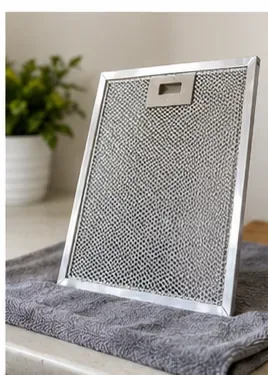
6. Let the filter dry completely
Stand or lay the filter where water can drain freely and allow it to dry fully before reinstalling it. Bosch and GE both specifically tell users to dry metal filters thoroughly before putting them back. Do not reinstall a filter that is still dripping into the hood assembly.
Let the washed filter dry thoroughly before it goes back into the range hood.
7. Reinstall it in the correct orientation
Return the dry filter to the same track, slots, or spring clips it came from. Confirm that the retaining tab or latch fully engages. GE describes sliding the filter into its frame slots and securing the locking tab; Whirlpool models with spring-release handles may use a different sequence. Do not operate the hood with a loose filter.
Reinstall the dry filter in its original track and make sure the latch or spring mechanism is secure.
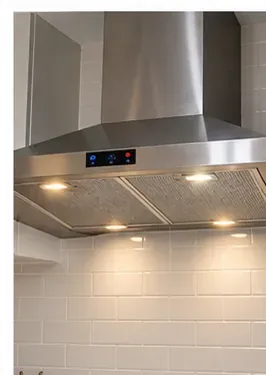
8. Do a quick final check
Once the filter is secure, restore normal operation and check that the hood runs without the filter rattling or shifting. Look underneath to make sure every filter sits flush in its intended position. Cleaning does not fix a bent frame, broken latch, torn mesh, or a filter that no longer fits securely; damaged parts should be replaced with the correct part for the model.
A finished installation should have clean, dry filters seated evenly and securely under the hood.
Can you put a range hood filter in the dishwasher?
Sometimes. Whirlpool states that removable metal grease filters on many of its hoods can be cleaned in the sink or dishwasher. Bosch and GE also allow dishwasher cleaning for common metal filters, while warning that discoloration can occur. Broan-NuTone says some filters may be dishwasher safe and tells owners to confirm in the manual.
That means the correct rule is not “all metal filters are dishwasher safe.” It is “use the dishwasher only when the manufacturer permits it for your exact filter.” Cosmetic darkening or discoloration can occur even when performance is unaffected. If appearance matters, or the manual is unclear, hand washing with mild detergent is the more conservative choice.
How often should you clean a range hood filter?
There is no universal interval that fits every kitchen. Cooking frequency, frying, wok cooking, searing, and the amount of airborne grease all change how quickly a filter loads up. GE Appliances says that for normal day-to-day use, its common metal grease filters should be cleaned about every six months or as needed. Other manufacturers simply say to clean them frequently or based on use.
A practical approach is to inspect the filter periodically and clean it sooner if the metal becomes visibly greasy or sticky. A household that frequently fries food may need substantially more frequent cleaning than one that mostly boils, steams, or reheats food.
What about charcoal or carbon filters?
This is the part where generic advice can be wrong. Bosch currently says the charcoal/carbon filters used in its recirculating ventilation should be replaced every three to four months depending on usage. Whirlpool’s general support article says its conventional non-vented charcoal filter is not washable and may last up to six months with normal use. However, Whirlpool also documents a specific washable charcoal filter that can be cleaned and heat-reactivated, with replacement after approximately three years.
So if your hood recirculates air rather than venting outdoors, find the exact model number and read its filter instructions before washing the charcoal layer. Never copy a cleaning method from a different model just because the filter looks similar.
Common mistakes to avoid
Washing an unidentified charcoal filter. Some are disposable, while a smaller group is designed for washing or regeneration.
Forcing the filter out. A hidden tab or spring handle can bend if you pull in the wrong direction.
Using harsh chemicals by default. GE advises against ammonia on common metal grease filters, and aggressive products may damage finishes or aluminum.
Scrubbing with steel wool or a highly abrasive pad. Gentle brushing is the safer approach for thin mesh and finished metal.
Assuming the dishwasher is always safe. Confirm dishwasher compatibility for your exact filter first.
Reinstalling while wet. Manufacturer guidance consistently calls for thorough drying before replacement.
Ignoring damaged mesh or a broken latch. Cleaning cannot restore a physically damaged filter to its original condition.
When cleaning is not enough
Replace the filter if its frame is bent enough that it no longer seats correctly, the mesh is torn or separating, the latch is broken, or the manufacturer specifies replacement instead of washing. For charcoal filters, replacement intervals can vary widely by design. If you cannot identify the filter type, locate the hood’s model number and use the manufacturer’s parts or support page before ordering a replacement.
Bottom line
For a washable metal range hood filter, the reliable method remains simple: turn the hood off, remove the filter carefully, soak it in warm water with mild detergent, brush gently, rinse, dry completely, and reinstall it securely. The important exceptions are model-specific. Dishwasher use is not universal, cleaning intervals vary with cooking habits, and charcoal filters range from disposable to washable/reactivatable designs.
When in doubt, the exact owner’s manual wins. That extra minute of verification is more useful than a stronger cleaner or a one-size-fits-all rule.