Home
» How To
»
How to Get Rust Off Golf Clubs Without Ruining the Finish
How to Get Rust Off Golf Clubs Without Ruining the Finish
Rust on a golf club can mean two very different things: a removable surface film on a plated iron or steel shaft, or a normal patina on a raw, unplated wedge. The best result is not automatically the shiniest one. A good cleanup removes loose orange corrosion and dirt, keeps grooves clear, preserves the original finish, and leaves the club completely dry. If getting to bare metal would require heavy abrasion, aggressive chemicals, or grinding, the risk of finish damage can outweigh the cosmetic benefit.
The process below starts with the least aggressive method and gives you checkpoints for deciding whether to continue. That matters because golf clubs use different steels, platings, paints, inserts, ferrules, and coatings. Always give model-specific manufacturer guidance priority over a generic rust-removal method.
What a good result should look like
For most plated irons and wedges, success means the face and sole are clean, dry, and free of loose orange residue while the chrome, satin, black, or other finish remains visually intact. Fine staining may remain where the coating has already been worn through. That is different from active, flaky rust.
For a raw carbon-steel wedge, some brown or gray patina may be expected. Callaway states that raw wedge faces can rust over time without affecting playability, while its FAQ for older raw “vintage” wedges describes rust as an expected characteristic of the unplated carbon steel. In that case, your quality target is usually to remove loose contamination and control further corrosion, not force the club back to a mirror finish.
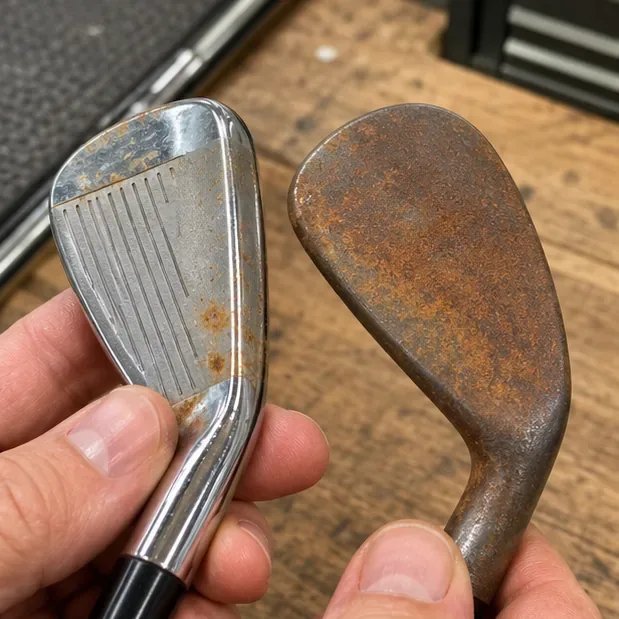
Compare the rust pattern before cleaning. Small isolated spots on a plated iron call for a gentler approach than the widespread patina of a raw wedge.
First, identify the finish before you scrub
Check the club model and finish name if you can. Words such as raw, unplated, vintage, or a manufacturer statement that the face is designed to rust change how you should judge the result. Callaway’s Jaws Raw product information, for example, says the face plating is intentionally removed and that rusting in the scoring area can occur over time.
If the club is chrome plated, painted, black-finished, PVD-coated, or otherwise treated, assume the visible finish is something you want to preserve. Rust at a chip or wear spot may indicate that the protective layer has already been breached. Cleaning can remove corrosion products, but it cannot put missing plating back.
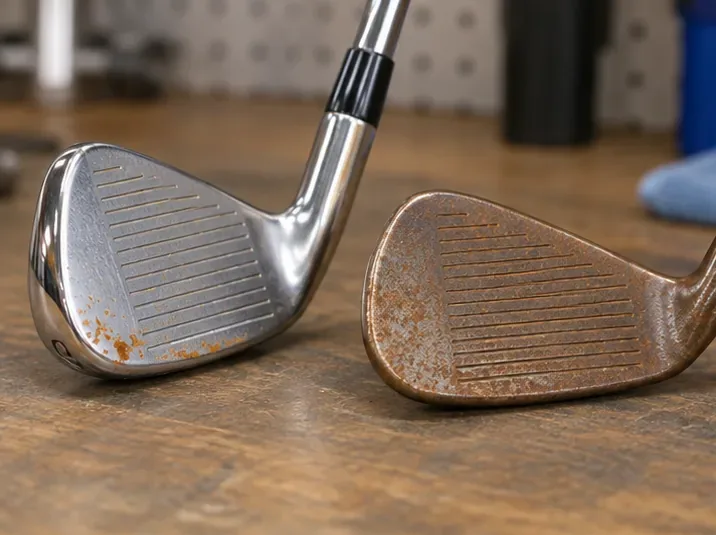
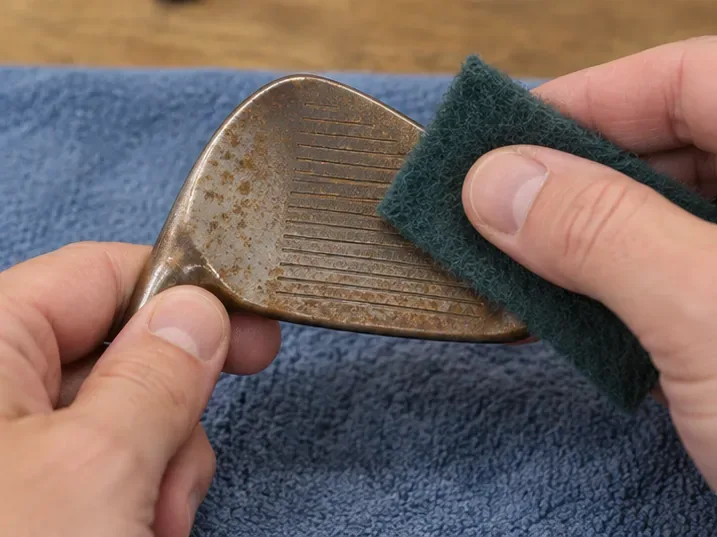
Finish identification matters: the lightly spotted plated club and the heavily oxidized raw-looking wedge should not automatically receive the same treatment.
What you need
Warm water and a small amount of mild dish soap
A soft nylon toothbrush or golf-club groove brush
Two clean microfiber or soft cotton towels
A small nonwoven synthetic scouring pad only if the finish and manufacturer guidance allow it
Good light for inspecting the face, sole, hosel, and shaft
Do not begin with a wire wheel, coarse sandpaper, powered polishing tool, or an acid soak. Those methods can remove or alter finishes faster than the rust itself. For normal cleaning, Titleist’s current care guidance recommends mild soap and water followed by drying with a soft cotton cloth.
How to get rust off golf clubs, step by step
1. Photograph or inspect the rust before cleaning
Look for orange dust, raised scale, pits, flaking chrome, dark staining, and rust around the hosel or shaft. Run a fingernail lightly across the area. A smooth surface with color on top is a better candidate for home cleaning than a rough, cratered surface. If the shaft has deep pits, a crack, or corrosion concentrated at a stress point, skip cosmetic restoration and have the club inspected by a qualified repair shop.
2. Remove dirt before attacking rust
Mix warm water with a small amount of mild soap. Wet the brush, then scrub the face and grooves with light pressure. The goal is to remove soil, grass, sunscreen, and loose oxidation so you can see what corrosion actually remains. Avoid soaking the entire assembled club unless the manufacturer specifically allows it; keeping water away from cavities, inserts, adjustable components, and the grip end reduces the chance of trapped moisture.
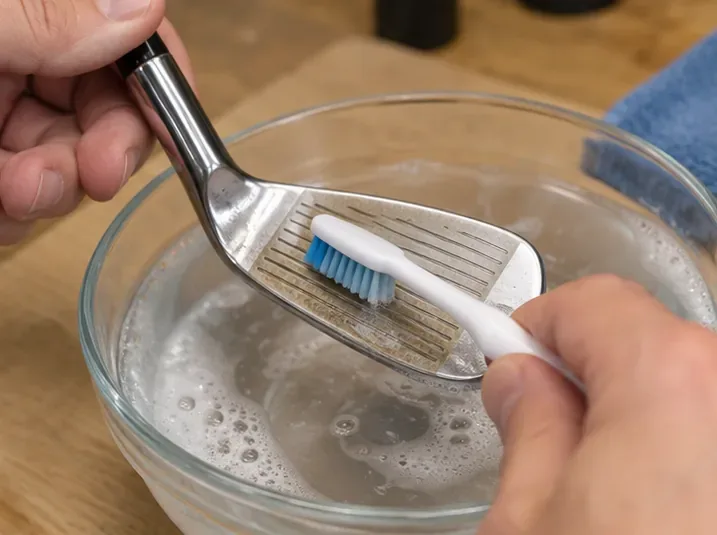
Use a soft nylon brush and mild soapy water first. The clubhead can be cleaned over the bowl without relying on a long soak.
3. Rinse or wipe away soap, then dry immediately
Use a clean damp cloth to remove soap residue, or briefly rinse only where appropriate for the club construction. Then dry the head thoroughly, paying attention to the grooves, hosel, cavity edges, and any seams. Titleist specifically advises that clubs and headcovers be completely dry before storage because wet headcovers can promote rust and corrosion.
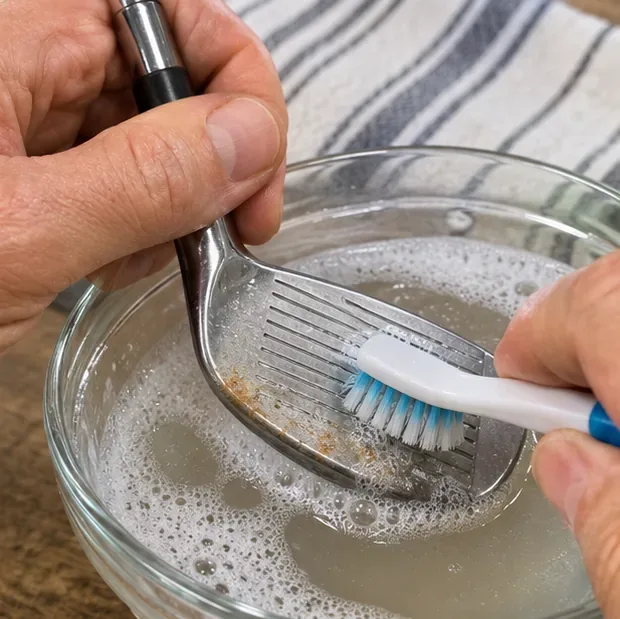
Work the brush along the grooves with controlled pressure; this often removes dirt and loose rust without touching the finish aggressively.Dry immediately after washing. Moisture left in grooves, cavities, or around the hosel can restart corrosion.
4. Recheck the surface before using anything abrasive
Inspect the club in bright light after it is dry. If the orange color is gone and the metal feels smooth, stop. Extra polishing will not improve function and can create a visibly different patch in the finish. If the remaining rust is localized and superficial, decide whether the club is raw/unplated or plated/coated before moving to the next step.
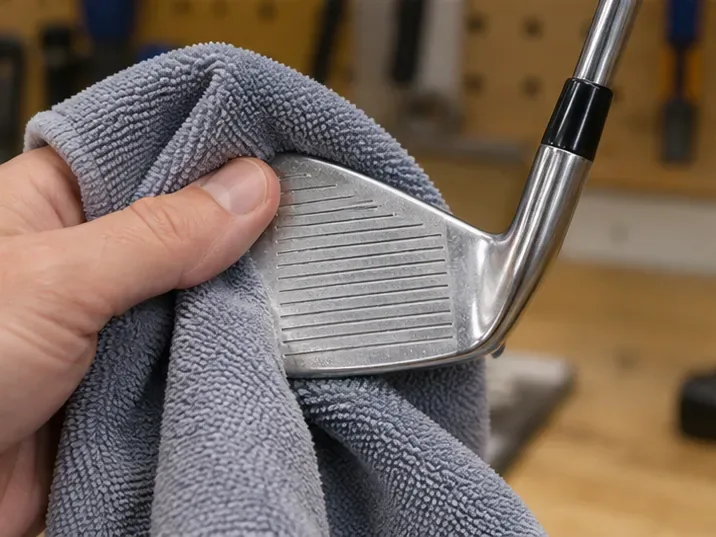
After drying, check the face under good light. If loose orange rust is gone and the finish is intact, the job is complete.
5. On an approved raw or unplated surface, use a synthetic pad gently
For certain raw carbon-steel wedges, manufacturer guidance may permit a synthetic scouring pad. Callaway’s FAQ for its older raw vintage wedge finish specifically recommends a synthetic scouring pad to clean the surface and slow the rusting process. Use short, light strokes and check frequently rather than trying to erase every dark mark in one pass.
This is not universal permission to scour every golf club. A synthetic abrasive can change sheen, create fine scratches, or expose more base metal on plated or decorative finishes. If you do not know the finish, stay with soap, water, a soft brush, and drying until you can verify the manufacturer’s care instructions.
A synthetic scouring pad is appropriate only when the club finish allows it. Use light pressure and inspect often instead of chasing a perfectly bright surface.
6. Treat stubborn exposed steel only with finish-compatible products
If rust remains on exposed, unplated steel, use only a cleaner or corrosion-control product that the club maker allows for that surface. Callaway notes that a lubricant-cleaner can be used to help prevent rust on non-plated surfaces. Apply a small amount to a cloth or pad rather than flooding the assembled club, and keep it away from grips, painted graphics, ferrules, and inserts unless the product instructions say those materials are compatible.
Switch methods when repeated light passes stop improving the result. That usually means you are dealing with staining, pitting, or missing finish rather than removable surface rust. More pressure at that point often changes the surface faster than it improves it.
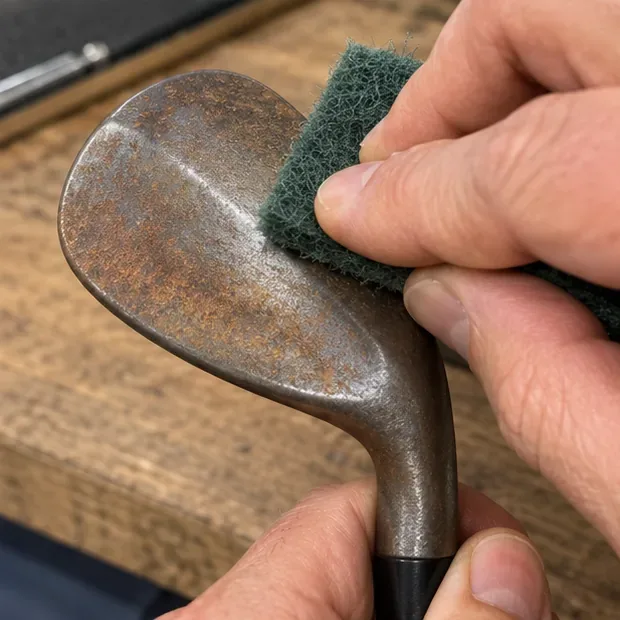
For stubborn oxidation on a suitable unplated surface, work a small area at a time. Stop if the texture or color of the finish begins changing unevenly.
7. Do a final quality check
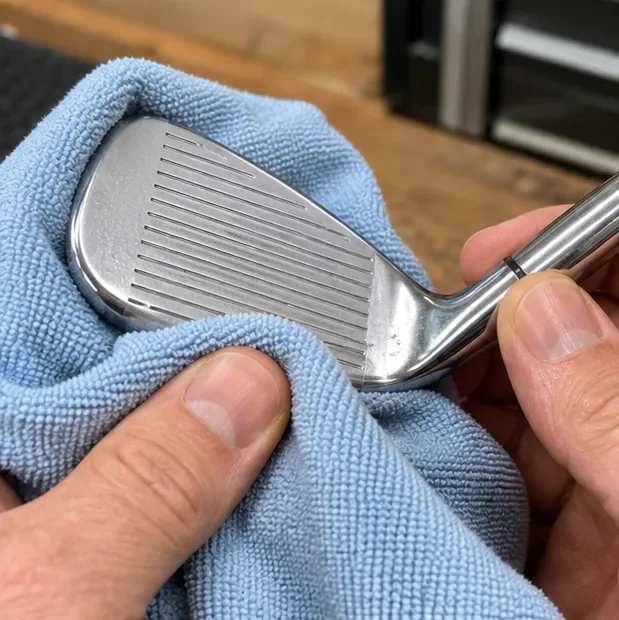
Wipe the club with a clean dry towel and inspect four things: the grooves should be free of packed debris; no loose orange powder should transfer to the towel; the finish should look consistent with the surrounding area; and there should be no moisture around seams, cavities, or the hosel. On a raw wedge, an even brown-gray patina can remain and still count as a successful cleanup.
8. Store the club dry so the result lasts
Let the club air-dry briefly before it goes back into the bag. Never put a damp club into a wet headcover for storage. After a rainy round, remove headcovers, dry clubs individually, and let the bag dry in a ventilated indoor area. For raw carbon-steel surfaces, follow the maker’s instructions if it recommends a light corrosion-protective wipe before long-term storage.
When should you stop and change approach?
What you see
Good next step
Sign to stop DIY cleaning
Light orange film on an otherwise intact plated iron
Mild soap, soft brush, thorough drying
Rust remains inside pits or plating starts lifting
Raw wedge with even brown patina
Clean and dry; use only maker-approved light scouring if desired
You are removing metal or changing the finish unevenly
Rust on a steel shaft
Clean gently and inspect closely
Deep pitting, cracking, a rough ring of corrosion, or rust near a high-stress area
Flaking chrome or exposed base metal
Clean loose corrosion and keep dry
You want the original finish restored; that requires refinishing, not cleaning
Rust near an insert, cavity, adjustable mechanism, or special putter finish
Check model-specific manufacturer instructions
You cannot confirm chemical or abrasive compatibility
What this process cannot fix
Cleaning removes contamination and some surface oxidation; it does not rebuild missing chrome, fill corrosion pits, restore worn groove geometry, or reverse structural damage in a steel shaft. A club can look cleaner and still need professional work. If rust has produced deep pits, sharp flakes, visible cracks, or a weakened shaft, treat that as a repair or replacement question rather than a cosmetic one.
The same caution applies to collectible or specialty putters. Titleist notes that some carbon-steel Scotty Cameron models are particularly susceptible to oxidation and gives finish-specific drying and storage guidance. If the club has value as a collectible, preserving the original finish may matter more than removing every trace of patina.
Should you use vinegar, steel wool, or a rust-remover soak?
They are not the best default choices for an assembled golf club. Acids and dedicated rust removers can be effective on bare metal, but golf clubs may combine plating, paint, badges, adhesives, inserts, ferrules, and hollow or multi-material construction. Steel wool and aggressive abrasives can also change the finish and may leave a visibly polished patch. Start with the manufacturer-supported cleaning method, then escalate only when you know the exact finish and compatibility of the product you plan to use.
If you choose a nonwoven abrasive for a confirmed compatible surface, an ultra-fine hand pad gives more control than an aggressive rust-stripping pad. 3M, for example, describes its Scotch-Brite 7448 ultra-fine hand pad as a metal-conditioning alternative to fine steel wool. That does not make it automatically safe for every golf-club coating, so test a hidden area and defer to the club maker.
How to prevent golf-club rust from coming back
Wipe the clubface and grooves during or immediately after a wet round.
Clean dirt before storage rather than leaving damp soil against the metal.
Dry both the club and the headcover completely.
Do not leave a wet golf bag closed in a car trunk, garage corner, or other humid space.
Inspect raw wedges and carbon-steel putters more often because exposed steel oxidizes readily.
If a plated club repeatedly rusts at the same chip, recognize that the protective finish may already be damaged.
Manufacturer and technical references
Guidance checked September 2026:
Titleist Warranty, Care, and Repair — mild soap and water cleaning, thorough drying, wet-headcover corrosion warning, and carbon-steel putter care.
Callaway Golf FAQs — raw vintage wedge rust behavior, synthetic scouring-pad guidance, and lubricant-cleaner guidance for non-plated surfaces.