Home
» How To
»
How to Clean a Car Air Filter Safely: Know When to Clean vs. Replace
How to Clean a Car Air Filter Safely: Know When to Clean vs. Replace
If you search for how to clean a car air filter, the most important answer comes before the cleaning: first confirm that your filter is actually designed to be cleaned. Many factory engine air filters use disposable paper media and are meant to be replaced when dirty. Reusable aftermarket filters can be washable, but their cleaning method depends on the filter material and manufacturer.
This guide focuses on the engine air filter, the filter inside the airbox under the hood. It is different from the cabin air filter that cleans air entering the passenger compartment. Nissan, for example, documents the engine filter in the air cleaner housing and the cabin microfilter separately. If you meant the cabin filter, use the procedure for that filter instead. See Nissan's official air-filter service overview.
The guidance below was checked against official manufacturer material available on September 13, 2026. Your vehicle's owner's manual and the instructions for the exact filter installed in your car take priority over any generic cleaning method.
The short answer: should you clean or replace the filter?
Filter type
Typical action
What is verified
Disposable paper engine filter
Usually replace rather than wash
Nissan explicitly states that its viscous paper filter element should not be cleaned and reused.
Reusable oiled cotton filter
Clean, rinse, air-dry, then re-oil as directed
K&N publishes a dedicated process using its filter cleaner, low-pressure water, natural drying, and filter oil.
Reusable synthetic dry filter
Clean and rinse as directed; normally no oil
K&N's DRYFLOW instructions use cleaner, low-pressure rinsing, and natural drying without filter oil.
Unknown filter
Do not guess
Cleaning methods vary enough that the exact vehicle/filter instructions matter.
Useful action: Look for a part number or brand on the filter frame, then check the vehicle manual and filter manufacturer's instructions before using water, compressed air, solvents, or oil.
Step 1: Identify the engine air filter and confirm its type
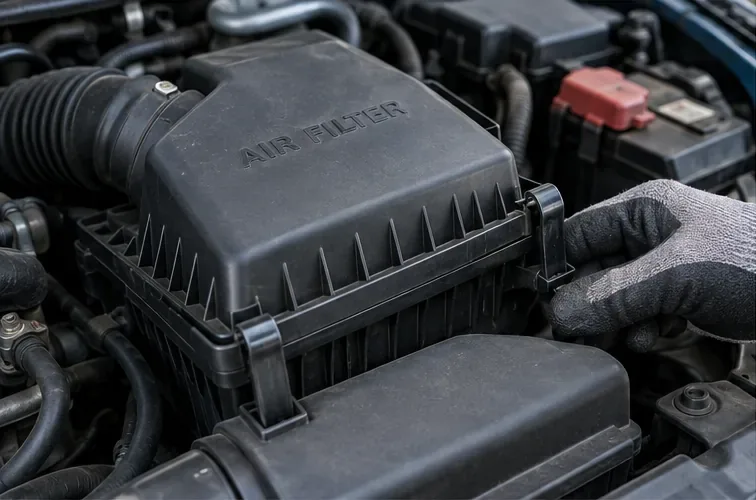
The engine air filter is usually inside a plastic airbox connected to the intake duct. Fasteners may be clips, screws, or another vehicle-specific design.
Park on a level surface, switch the engine off, let hot components cool, and open the hood. The engine air filter is commonly housed in a black plastic airbox connected to a large intake duct. Some covers use clips; others use screws or tabs.
Do not assume every car uses the same access method. Nissan's official do-it-yourself guidance says the exact procedure varies by model and year. Its 2021 Kicks manual, for example, instructs the owner to release retaining clips and rear holders before lifting the housing. The same manual warns against operating the engine with the air cleaner removed. See the 2021 Nissan Kicks Owner's Manual and Maintenance Information.
Useful action: Before opening the airbox, search your owner's manual for “air cleaner,” “engine air filter,” or “air filter replacement” and confirm the correct fasteners and filter orientation.
Step 2: Remove the filter and inspect it before deciding what to do
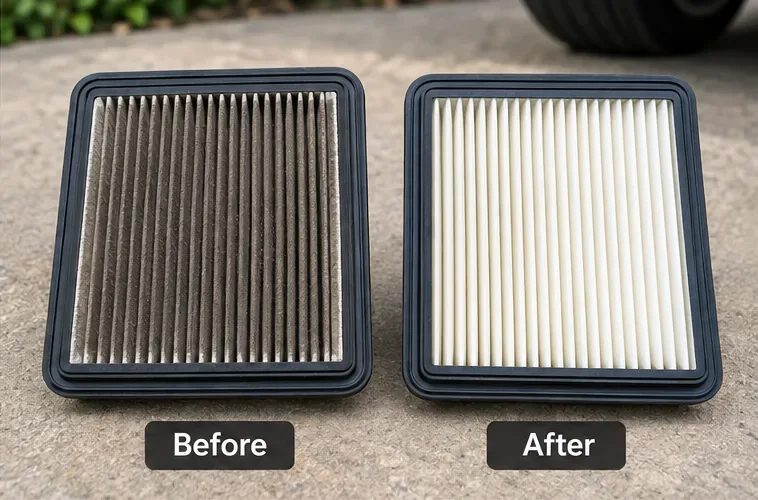
A dirty and a clean pleated filter illustrate the visual difference, but appearance alone does not tell you whether the filter is washable.
Lift the filter out carefully so loose dirt does not fall into the clean side of the intake. Note which side faces up and how the sealing edge sits in the housing. Check for damaged pleats, torn media, a distorted frame, loose seals, oil contamination, or debris packed deep into the material.
If the filter is a disposable paper element and the manual says to replace it, cleaning is not the correct service. Nissan's manual is unusually clear on this point: its viscous paper type element “should not be cleaned and reused.” It also tells owners to wipe the inside of the air cleaner housing and cover with a damp cloth when replacing the filter.
Maintenance intervals are not universal. Nissan's current 2026 Rogue engine-air-filter maintenance guide varies the replacement interval by powertrain and operating conditions. Toyota likewise calls for additional engine-air-filter inspection when driving on dirt or dusty roads in its 2024 Toyota Crown maintenance log.
Useful action: If the filter is damaged, heavily loaded, or identified by the manufacturer as non-reusable, stop here and install the correct replacement instead of trying to restore it.
Step 3: Use only the cleaning method approved for that filter
This is where generic advice becomes risky. Water, compressed air, detergents, brushes, and oil are not interchangeable methods.
If it is a disposable paper filter
Follow the vehicle manual. Some paper filters are replacement-only. Do not wash a replacement-only filter just because the pleats look sturdy. Water can alter paper media, and an apparently clean filter may no longer perform as intended.
If it is a reusable oiled cotton filter
K&N's current official instructions call for removing loose debris, applying the specified cleaner, allowing it to work without drying on the media, rinsing with cool low-pressure water from the clean side out, letting the filter dry naturally, and then applying the specified filter oil evenly. K&N says this is its approved maintenance procedure for its High-Flow oiled cotton filter. See the K&N air-filter cleaning instructions.
If it is a reusable synthetic dry filter
K&N's DRYFLOW instructions use a dedicated synthetic-filter cleaner, a low-pressure rinse from the clean side out, and natural drying before reinstallation. K&N's official FAQ also notes that synthetic filters such as DRYFLOW do not use filter oil.
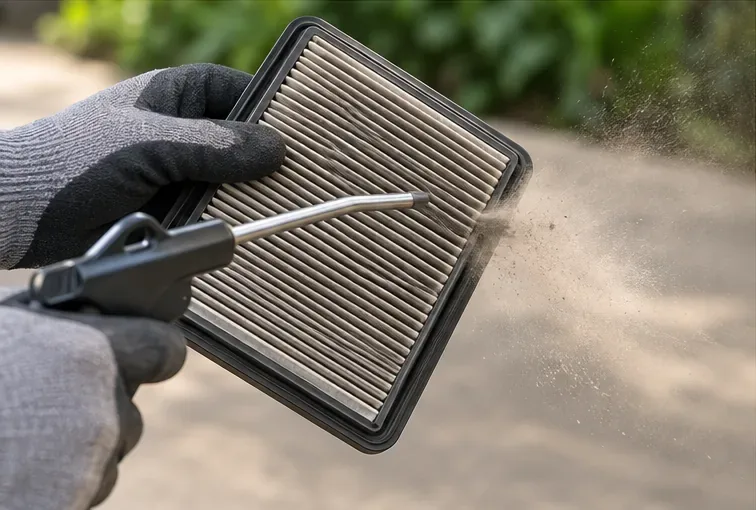
Compressed-air cleaning is filter-specific, not a universal step. Use it only when the instructions for your exact filter explicitly allow it.
Useful action: If you cannot verify that your filter is reusable, do not improvise. Replace it or obtain the manufacturer's service instructions first.
Step 4: Clean the housing, reinstall the correct filter, and seal the airbox
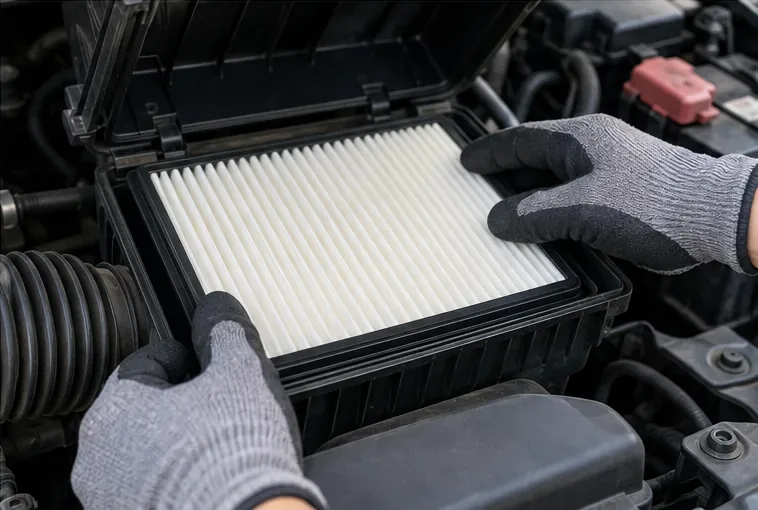
The filter should sit evenly in the airbox with its sealing edge fully seated before the cover is secured.
Before reinstalling, remove loose debris from the airbox without pushing dirt into the intake duct. Nissan's manual recommends wiping the inside of the housing and cover with a damp cloth when replacing its filter.
If you cleaned a reusable filter, make sure it has reached the condition specified by its manufacturer. K&N's oiled cotton instructions require natural drying before oil is applied, while its DRYFLOW guidance says the filter should be dry or only slightly damp before reinstallation. Do not reinstall an oiled filter before the oil has been applied and distributed according to the maker's instructions.
Seat the filter in the same orientation as before, verify that the perimeter seal is flat and continuous, then close the airbox and secure every clip, screw, or tab. Do not run the engine with the filter absent. Nissan warns that an open air cleaner can expose the engine to dirt and can create a safety hazard if the engine backfires.
Useful action: After closing the housing, run a hand around the cover and check every fastener. If the lid rocks, gaps, or refuses to latch, reopen it and reseat the filter rather than forcing the cover.
Common misconception: “Cleaning is always cheaper than replacing”
Verified: Reusable filters can be serviced when their manufacturer provides a cleaning procedure. Also verified: at least some OEM paper filters are explicitly not intended for cleaning and reuse. Those two facts mean “clean instead of replace” is not a universal money-saving rule.
A forced cleaning can create hidden costs if the media, seal, or oiling is wrong. A replacement filter that fits correctly and matches the vehicle specification may be the proper maintenance item, not waste.
Useful action: Compare the part number on your installed filter against its official product page or your owner's manual. Make the clean-versus-replace decision from that information, not from appearance alone.
Common misconception: “A blast of compressed air is safe for every filter”
Not universally true. Filter makers publish different instructions for different media. K&N warns against using compressed air to dry its standard reusable filter because the air can damage fibers, while some specialized heavy-duty filter instructions permit compressed air under specified conditions. Nissan's cited viscous-paper application skips cleaning entirely and calls for replacement.
The important point is not that compressed air is always wrong. It is that the allowable pressure, direction, distance, and even whether air should be used at all are filter-specific.
Useful action: If the manual does not explicitly approve compressed air, leave the air gun on the bench.
Common misconception: “A clean engine air filter always improves gas mileage”
This claim needs qualification. Oak Ridge National Laboratory researchers tested modern fuel-injected gasoline vehicles and found that severely restricted air filters had little or no significant effect on fuel economy under the tested conditions, although acceleration performance suffered. An older carbureted vehicle behaved differently. The later SAE technical paper from the same research program likewise reported insignificant fuel-economy sensitivity in modern tested vehicles but measurable acceleration effects.
That does not make air-filter maintenance optional. The filter protects the engine from contaminants, and excessive restriction can hurt performance. It simply means you should not promise a fuel-economy gain that modern-engine research does not consistently support.
Useful action: Service the filter to protect airflow and filtration according to the maintenance schedule, not as a guaranteed MPG trick.
How often should you check the engine air filter?
There is no trustworthy single mileage number for every car. Filter size, engine design, road dust, construction zones, wildfire ash, off-road use, and the manufacturer's maintenance schedule all affect service needs.
Current manufacturer documentation illustrates that variation. Nissan's 2026 Rogue schedule changes by powertrain and operating condition, and Toyota's maintenance guidance calls for added inspections when driving on dirt or dusty roads. A generic “every 12,000 miles” or “every oil change” rule may therefore be either too early or too late for a specific vehicle.
Useful action: Use the maintenance schedule for your exact model year and powertrain. If you drive regularly on dusty roads, inspect more often when the manufacturer calls for severe-condition service.
When cleaning is not enough
Replace the filter if the media is torn, punctured, deformed, or separating from the frame.
Replace a disposable paper filter when the vehicle manufacturer says it is non-reusable.
Replace or seek professional advice if oil, coolant, or another contaminant has soaked a filter that should normally be dry.
Do not continue driving with an airbox that will not close and seal correctly.
If reduced power, warning lights, or drivability problems remain after proper filter service, do not assume the filter is the only cause.
Useful action: Treat persistent performance problems as a diagnostic issue rather than repeatedly cleaning the same filter.
What if you meant the cabin air filter?
The cabin air filter is part of the heating, ventilation, and air-conditioning system, not the engine intake. It is commonly located behind the glove box or under the cowl, depending on the vehicle. OEM cabin filters are often replaced rather than cleaned, while some aftermarket cabin filters are specifically sold as washable.
Useful action: Search the owner's manual for “cabin air filter” or “in-cabin microfilter.” Do not apply engine-filter oil or engine-filter cleaning chemicals to a cabin filter unless that cabin-filter manufacturer specifically instructs you to do so.
Bottom line
The safest way to clean a car air filter is to begin by confirming that cleaning is allowed. A disposable paper element may need replacement, not washing. A reusable oiled cotton filter may require cleaner, low-pressure rinsing, full natural drying, and re-oiling. A reusable synthetic dry filter may use a similar wash process but no oil. Those differences are not minor details; they are the procedure.
Identify the filter, inspect it, follow the exact approved service method, clean the housing, and reinstall the filter with a complete seal. That approach is more reliable than any universal shortcut.