Home
» How To
»
How to Clean a Patagonia Down Sweater Without Losing Loft
How to Clean a Patagonia Down Sweater Without Losing Loft
A Patagonia Down Sweater can look alarmingly flat when it comes out of the washer, but that does not mean the down is ruined. The critical part is using the right wash method and then drying the insulation completely so the clusters separate and regain loft.
As of September 2026, Patagonia’s current Down Sweater care instructions are straightforward: machine wash cold, do not bleach, tumble dry low, do not iron, do not steam, and for best results dry with two tennis balls. Patagonia’s longer down-care guide also recommends a cleaner made for down, prefers a front-loading washer, and emphasizes thorough rinsing and complete drying. The current sewn-in care label on your own jacket should take priority if it differs from any general guidance.
Quick Reference: The Safe Cleaning Plan
Task
Best starting point
Why it matters
Before washing
Check the sewn-in care label and inspect the shell for tears
Older versions can differ, and a damaged lightweight shell is more vulnerable in a washer
Cleaner
Use a cleaner formulated for down
Patagonia’s down-care guide warns that ordinary detergent may strip natural oils and may not rinse out as cleanly
Wash setting
Cold water; use a front-loading washer when practical
The current Down Sweater page specifies cold machine washing, while Patagonia’s down-care guide prefers front loaders to reduce snagging risk
Drying
Tumble dry low with two clean tennis balls
Low heat protects the garment while the balls help separate wet down clumps
Finish
Keep drying until every baffle is dry and evenly lofted
Down can feel dry outside while moisture remains inside dense clumps
Your Patagonia Down Sweater and its sewn-in care label
A cleaner specifically made for down
A front-loading washing machine if available
A dryer with a reliable low-heat setting
Two clean tennis balls
A clean, dry surface where you can inspect and gently redistribute any remaining clumps
Do not use bleach. The current Patagonia care instructions also say not to iron or steam the Down Sweater. Patagonia’s older down-care guidance does not recommend dry cleaning its products because harsh dry-cleaning chemicals can damage down performance.
How to Clean a Patagonia Down Sweater in 4 Steps
1. Check the Label, Inspect the Shell and Prepare the Jacket
Start with the care label inside your own Down Sweater. This matters because Patagonia has produced Down Sweater variants over many years, and the instructions on the garment are the most specific source for that exact piece.
Look for small holes, open seams or areas where down is escaping. The current Down Sweater includes a repair patch for quick fixes, and Patagonia’s repair guidance notes that lightweight down-jacket fabrics can be vulnerable to sharp objects. If you find an obvious tear, repair it before machine washing rather than hoping the wash cycle will leave it unchanged.
Empty the pockets and make sure nothing hard, sharp or loose is trapped inside. The goal is simply to send a sound garment into the washer, not one that already has a weak point.
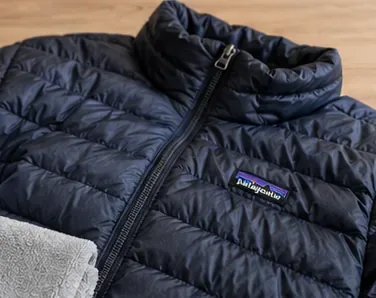
Before washing, inspect the shell, zipper and baffles and check the sewn-in care label for instructions specific to your jacket.
2. Wash Cold with a Down-Specific Cleaner
For the current Down Sweater, Patagonia specifies machine washing in cold water. For detergent, Patagonia’s dedicated down-care guide recommends a cleaner made specifically for down. It explains that regular detergents can remove natural oils from down and may leave residue that interferes with loft.
A front-loading washer is the safer default when you have a choice. Patagonia’s down-care guide prefers front loaders because some top-loading agitators can snag or stress lightweight fabrics. If the only machine available is a top loader, check its design and your care label first; do not force the jacket into an aggressive agitator cycle.
Use only the amount of down cleaner directed by the cleaner manufacturer. More soap is not better. Patagonia specifically warns that excess residue can prevent the insulation from lofting completely. If the jacket still feels soapy after the wash, or if you suspect cleaner remains in the baffles, run an additional rinse or wash cycle without adding more soap.
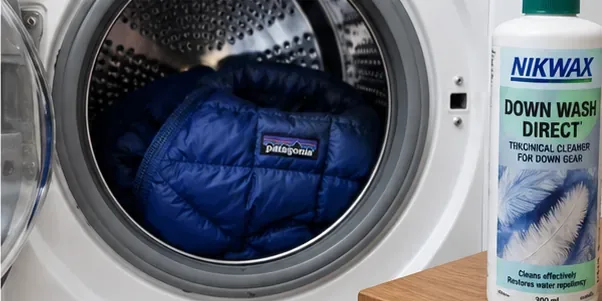
Cold machine washing with a down-specific cleaner follows Patagonia’s current care direction while helping the insulation rinse cleanly.
3. Tumble Dry on Low with Two Clean Tennis Balls
Drying is the part that restores the jacket. The current Patagonia Down Sweater product page explicitly says to tumble dry on low and, for best results, use two tennis balls. Patagonia’s longer down-care guide explains why: wet down forms dense clumps, and the movement of clean tennis balls helps break those clumps apart as the garment tumbles.
Use a genuinely low-heat dryer. High heat can damage a down jacket, and Patagonia cautions that commercial laundromat dryers may run hotter than expected even when the control says “low.” If you are using an unfamiliar dryer, check the jacket periodically rather than leaving it unattended for a long high-temperature run.
Every so often, pause the dryer and feel the baffles. If one area contains a hard or marble-like lump, gently work it apart with your fingers and return the jacket to the dryer. The objective is not to crush the insulation; it is to separate wet clusters so air can reach them.
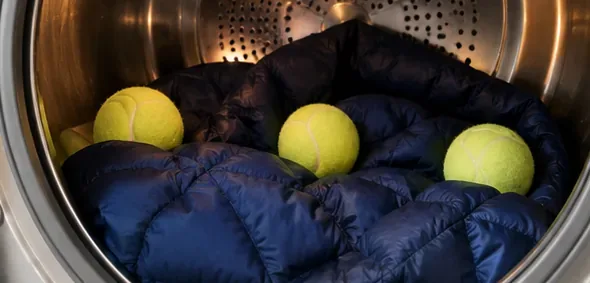
Low-heat tumbling and clean tennis balls help break apart wet down clumps; Patagonia’s current product instructions specify two tennis balls for best results.
The image shows several tennis balls for visual clarity, but follow Patagonia’s current product instruction and use two clean tennis balls unless the care label on your own garment says otherwise.
4. Check for Hidden Dampness and Restore Even Loft
Do not stop simply because the nylon shell feels dry. Patagonia notes that down can appear and feel dry before the interior of the insulation is fully dry. Check multiple baffles with your fingers. A finished jacket should feel light, evenly puffy and free of cool, dense clumps.
If some baffles are still flat or lumpy, that usually means the drying process is not finished. Return the jacket to low heat with the tennis balls, then pause again to gently separate stubborn clumps. Continue until the loft is even.
Only store the Down Sweater after it is completely dry. Patagonia warns that storing wet down while compressed can promote mildew. For normal storage, avoid leaving down tightly stuffed for long periods; give the insulation room to remain lofted.
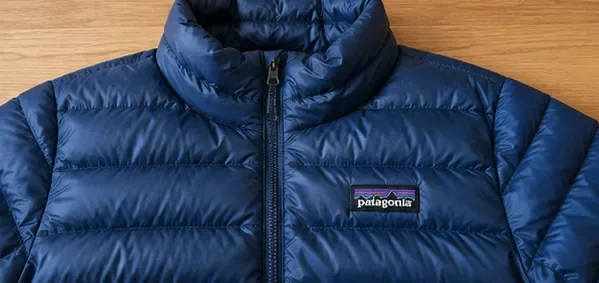
A properly dried Down Sweater should look evenly lofted, with no dense wet clumps hiding inside the baffles.
Current Product Instructions vs. Older Patagonia Advice
One useful detail can otherwise be confusing: Patagonia’s 2011 down-care article mentions a permanent-press cycle, while the current 2026 Down Sweater product page says machine wash cold. For a current Down Sweater, the current product page and the sewn-in label are the better instructions to follow. The older article is still valuable for explaining why down cleaner, front-loading washers, extra rinsing, low heat and tennis balls are useful.
Guidance
Status
What to do
Machine wash cold
Current Down Sweater product instruction
Use this as the default for a current model
Tumble dry low
Current product instruction and older down-care guidance agree
Use low heat and monitor unfamiliar dryers
Two tennis balls
Current product instruction
Use two clean tennis balls for best results
Down-specific cleaner
Patagonia’s detailed down-care guidance
Prefer down wash over ordinary detergent
Front-loading washer
Patagonia’s detailed down-care guidance
Use one when practical, especially to avoid a central agitator
Permanent press
Older 2011 guidance
Do not let this override the current garment label or current product page
Troubleshooting After Washing
The Jacket Is Clean but Looks Flat
Flatness immediately after washing is normal because wet down clumps together. Keep tumble-drying on low, use the two tennis balls, and manually loosen stubborn clumps during pauses.
The Baffles Feel Sticky or Soapy
Residual cleaner can interfere with loft. Patagonia’s down-care guide recommends an additional cycle without soap to ensure cleaner is rinsed away. After that, dry thoroughly again on low.
The Jacket Feels Dry Outside but Has Dense Spots
Dense, cool clumps are a sign to continue drying. Do not pack the jacket yet. Separate the clumps gently and return it to low heat until the insulation is uniformly light and fluffy.
You Do Not Have a Dryer
Patagonia’s older guide says air-drying is possible: lay the jacket flat on a towel in a warm, dry place out of direct sunlight, turn it periodically and keep breaking apart clumps. It can take days, so this is a fallback rather than the easiest method. The current product page still lists tumble drying on low as the standard care instruction.
How Often Should You Wash a Patagonia Down Sweater?
Patagonia’s current Down Sweater product page does not give a universal number of wears between washes, so there is no verified schedule that fits every owner. Dirt, body oils, smoke, spills and how often the jacket is used all change the answer.
A practical rule is to wash when the jacket is genuinely dirty, has absorbed odors or oils, or needs a full refresh—not simply because a calendar says it is time. Each wash should follow the care label and be followed by complete drying.
Final Self-Check
The shell is clean and free of visible soap residue.
No baffle feels cool, heavy or densely clumped.
The jacket has returned to even loft from collar to hem.
The zipper, seams and shell show no new damage.
The garment is completely dry before it is stored or packed.
If all five checks pass, the cleaning process is finished. If the jacket is still flat in isolated areas, keep working on drying and clump separation rather than adding more detergent or heat.