Home
» How To
»
How to Clean a Nespresso Vertuo Machine: A Safe 4-Step Routine
How to Clean a Nespresso Vertuo Machine: A Safe 4-Step Routine
The most important thing to know is that routine cleaning and descaling are not the same job. For everyday or periodic cleaning, a Nespresso Vertuo machine should be rinsed with fresh drinking water, its removable parts should be emptied and washed, and the machine's built-in cleaning cycle should be run with no capsule inside. Descaling is a separate maintenance procedure that uses a descaling solution and a model-specific sequence.
This four-stage routine is a practical fit for many common Vertuo machines, including Vertuo, VertuoPlus, Vertuo Next, and Vertuo Pop models. Nespresso's controls and container-size instructions are not identical across every Vertuo product, so check the exact machine name on the label or support page before pressing buttons. Models with milk systems or newer maintenance controls, such as Vertuo Lattissima, Vertuo Creatista, or Vertuo Up, require additional or different steps.
What you need before cleaning
Prepare fresh drinking water, a clean sink, a soft nonabrasive cloth, and a heat-safe container that is large enough for your model's cleaning cycle. For Vertuo Next and Vertuo Pop, Nespresso's published cleaning guidance calls for a container of at least 34 fl oz (1 L). VertuoPlus materials may specify a smaller minimum for certain procedures, so following the model-specific manual is safer than assuming one volume applies to every machine.
You can use mild, odorless dish detergent on removable parts when the manual permits it. Do not pour dish soap into the water tank for the internal cleaning cycle. The internal rinse is designed to run with fresh water.
Step 1: Rinse the water tank and refill it with fresh water
Remove the water tank and lid. Rinse them thoroughly, then refill the tank with fresh drinking water and reinstall it securely. If the tank feels slimy, has visible residue, or has been sitting with water for several days, wash it first according to the care instructions for your model and rinse away all detergent before reinstalling it.
A properly seated tank matters because poor positioning can cause interrupted flow or a no-water condition. On its U.S. Vertuo Next support page, Nespresso specifically lists checking the water tank position when coffee flow is unusual or water is not moving as expected.
Rinse the removable water tank and lid, then refill with fresh drinking water before starting the machine's cleaning cycle.
Step 2: Empty and wash the removable collection parts
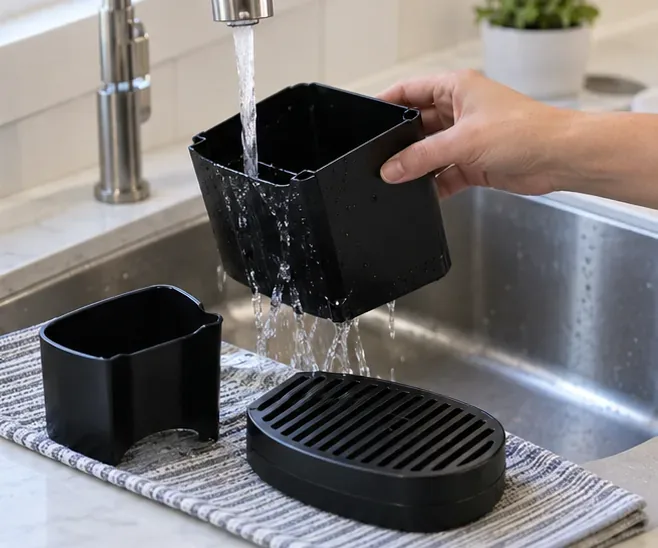
Take out the used-capsule container, drip tray, drip grid, and cup support where removable. Empty any used capsules and standing liquid. Rinse the parts with warm water; if they have oily coffee residue, wash them with a small amount of mild, odorless detergent and rinse thoroughly.
This step is more important than it may look. Coffee oils and small amounts of liquid collect outside the brewing circuit, especially around the capsule bin and drip tray. A machine can finish its internal rinse yet still smell stale if these pieces are not cleaned. Let the parts drain or dry them with a clean towel before putting them back.
Empty and rinse the used-capsule container, drip tray, grid, and cup support so old coffee liquid does not remain around the machine.
Step 3: Eject the capsule, close the head, and place a large container under the outlet
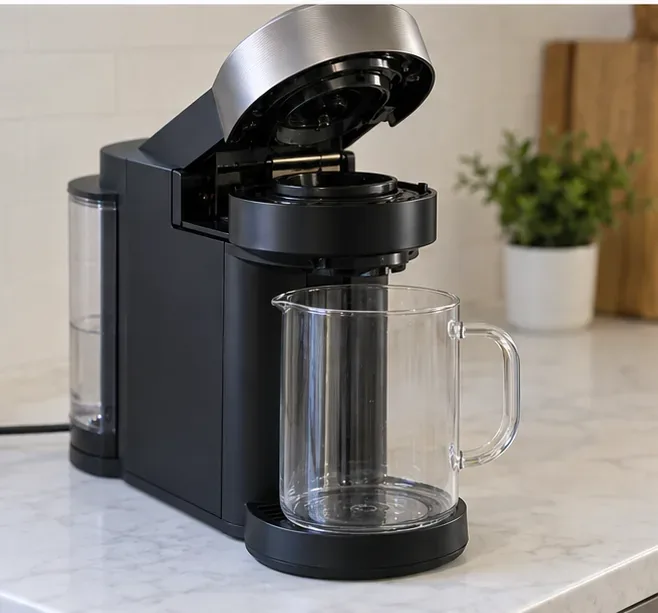
Open the machine head so any used capsule is ejected. Confirm that no capsule remains in the brewing chamber. Close the head and lock it in the normal cleaning position specified for your model. Then put a sufficiently large container under the coffee outlet.
Do not reach deep into the capsule area while the machine is powered. The head contains moving and sharp components. If you need to wipe an accessible surface around the opening, let the machine cool and unplug it first. If a capsule is jammed or the head does not move normally, use the troubleshooting instructions for that exact model rather than forcing it.
Make sure the capsule chamber is empty, then position a large container under the outlet before the water-only cleaning cycle.
Step 4: Run the built-in cleaning cycle, then check the result
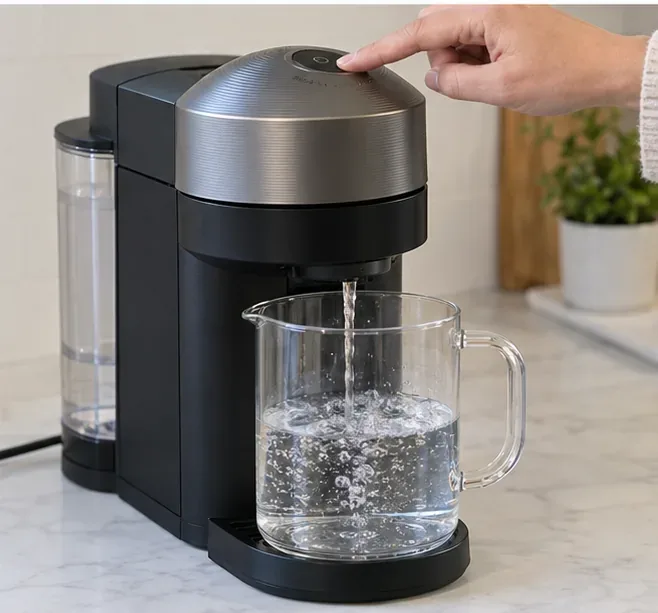
On many Vertuo, VertuoPlus, Vertuo Next, and Vertuo Pop machines, the cleaning cycle starts by pressing the coffee button three times within about two seconds after the machine is ready. The button or status light then blinks while the machine pumps water through the system. Nespresso's official Vertuo Pop and Vertuo Lattissima guidance describes an automatic cleaning process that runs for about five minutes; some VertuoPlus documentation also describes a multi-cycle rinse lasting about five minutes.
Because button behavior can change by model generation, do not rely on the three-press sequence if your machine has a dedicated maintenance button or your manual shows a different procedure. For example, Nespresso's newer Vertuo Up support information describes a maintenance mode with color-coded functions rather than the older three-press-only workflow.
Start the model-approved cleaning cycle and allow the rinse water to discharge into the container until the cycle finishes.
When the cycle ends, discard the rinse water. A good result is not defined by perfectly clear water on the very first seconds of the cycle; a small amount of coffee-colored residue can be normal at the beginning. What matters is that the flow becomes reasonably clear, the machine no longer has stale residue around the removable parts, and there are no obvious grounds or heavy deposits at the outlet.
If the rinse water remains very dirty, you can run another water-only cleaning cycle after checking that the capsule bin and drip area are clean. If coffee flow remains unusually slow, the beverage temperature is lower than usual, or the machine displays a descaling alert, routine cleaning may not solve the problem. That is the point to switch from cleaning to the model's official descaling procedure.
Cleaning versus descaling: how to know which one you need
Situation
Routine cleaning
Descaling
Used capsule bin or drip tray smells stale
Yes
Usually not the first step
Coffee grounds or residue appear in the cup
Run the cleaning procedure
Consider if cleaning does not resolve it
Machine shows its descaling alert
Cleaning alone is not enough
Yes, follow the model-specific guide
Coffee flow is unusually slow or temperature has declined
Clean first if the machine is dirty
May be needed, especially with scale buildup
Machine has been unused for a long period
Run the rinse/cleaning procedure before brewing
Only if the machine also indicates or requires descaling
How often should you clean a Vertuo machine?
There is no single cleaning interval that fits every household because usage, capsule volume, water quality, and how long water sits in the tank all vary. A useful routine is to empty the capsule container and drip tray frequently, keep the water tank fresh, and run the built-in cleaning cycle when you see residue, grounds in the cup, stale odors, irregular flow, or after a long period of non-use.
Descaling should be treated separately. Nespresso's current support information for Vertuo Up says descaling frequency depends on usage and water hardness and gives a general rule of about 300 cups, while also identifying the machine's descaling alert as the more reliable trigger. Other Vertuo models have their own indicators and instructions, so the machine-specific support page should take priority over a generic calendar reminder.
What not to do
Do not run a cleaning cycle with a capsule in the machine.
Do not put dish soap or household cleaner into the water tank for the internal rinse.
Do not force the machine head or reach into moving or sharp parts while the machine is powered.
Do not assume cleaning and descaling are interchangeable. Scale removal uses a separate procedure.
Do not copy button sequences from a different Vertuo model when your machine has different controls or status lights.
If cleaning does not fix the problem
If water leaks, the head cannot close correctly, the machine repeatedly stops, or the light pattern indicates an error, stop repeating the cleaning cycle and consult Nespresso's troubleshooting guidance. On the U.S. Vertuo Next page, Nespresso advises cleaning for issues such as coffee leakage, unusual flow, and grounds in the cup, but it also recommends descaling when necessary and contacting support if problems persist.
Source check: Model notes and maintenance guidance in this article were checked against Nespresso support materials available on September 13, 2026.
Bottom line
For most standard Vertuo machines, successful cleaning comes down to four things: fresh water in a clean tank, clean removable parts, no capsule in the head, and a complete model-approved rinse cycle. If those steps restore clean flow and remove stale residue, routine cleaning has done its job. If the machine still runs slowly, shows a maintenance alert, or behaves abnormally, move to the correct descaling or troubleshooting procedure instead of repeatedly rinsing it.