Home
» How To
»
How to Clean a Microwave Filter: Grease Filter vs. Charcoal Filter
How to Clean a Microwave Filter: Grease Filter vs. Charcoal Filter
A greasy microwave vent filter can make an over-the-range microwave fan seem less effective, but the right fix depends on which filter you have. The most important distinction is simple: a metal grease filter is usually washable, while a charcoal filter used for recirculating air is generally disposable and should be replaced rather than cleaned.
That difference matters because treating every “microwave filter” the same can waste time or damage a filter that was never meant to get wet. Manufacturer guidance also varies by model. Whirlpool and Maytag say many grease filters can go in a dishwasher if the owner’s manual allows it, while Samsung’s support instructions emphasize soaking the grease filter in hot water with mild detergent and rinsing it thoroughly. Charcoal filters, by contrast, are described by these manufacturers as non-washable.
This guide focuses on the user-serviceable vent filters found on over-the-range microwaves. If your microwave does not have a visible grease filter underneath or your manual does not identify a removable filter, do not assume the appliance should be opened. Check the model-specific owner’s manual first.
First, identify which microwave filter you have
Filter type
Where it is commonly found
Can you clean it?
Best choice
Metal grease filter
On the underside of an over-the-range microwave, above the cooktop
Usually yes
Hand wash with mild detergent; use a dishwasher only if the manual permits it
Charcoal filter
Behind the upper vent grille on recirculating models
No, in typical manufacturer guidance
Replace with the correct model-specific filter
Damaged metal filter
Same location as the grease filter
Cleaning may not restore it
Replace if the mesh or frame is bent, broken, or no longer seats correctly
Samsung explains that grease filters sit on the bottom of its over-the-range microwaves, while charcoal filters are used when the microwave recirculates air back into the kitchen. Samsung also notes that models vented outdoors through the top or back may not use the charcoal filter in the same way. See Samsung’s microwave filter maintenance instructions.
Which cleaning method should you choose?
Hand washing: the safest general-purpose default
For most washable metal grease filters, hand washing gives you the most control. Mild dish detergent and hot or warm water loosen cooking grease without requiring aggressive chemicals. You can see where buildup remains and use a soft brush only where needed.
Choose hand washing if: your manual does not clearly say the filter is dishwasher-safe, the filter has a delicate or lightweight frame, or you want the most conservative cross-brand method.
Dishwasher: easier, but only when the manual allows it
Whirlpool and Maytag both state that most grease filters can be cleaned in a dishwasher, but they explicitly recommend checking the owner’s manual. That qualification is important because filter materials and finishes differ among models. If your manual specifically permits dishwasher cleaning, it can be a convenient choice for routine maintenance.
Choose the dishwasher if: your exact model’s manual allows it and convenience matters more than hands-on control. Do not put a charcoal filter in the dishwasher.
Replacement: the correct choice for charcoal filters
A charcoal filter is designed to adsorb odors from recirculated air. Washing it does not restore it to a like-new condition, and major manufacturers describe these filters as non-cleanable. Whirlpool generally recommends replacement about every six months, while Samsung gives a range of roughly six to twelve months and says to replace more often if needed. The correct interval therefore depends on the model and how heavily the vent is used.
Choose replacement if: the filter is charcoal, the metal grease filter is physically damaged, or the correct filter no longer seats securely after cleaning.
How to clean a washable metal microwave grease filter
1. Confirm the filter type and shut the vent system down
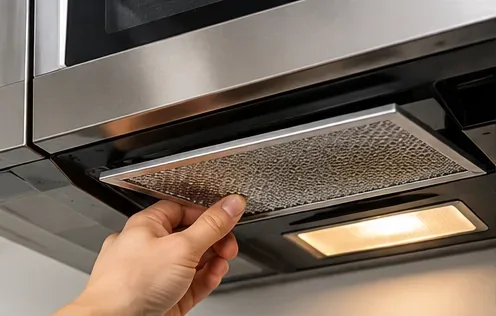
Make sure the vent fan and cooktop light are off and the microwave area is cool. Consult the owner’s manual if the filter location or removal direction is not obvious. Some filters slide sideways before dropping down; others release from a tab or filter case.
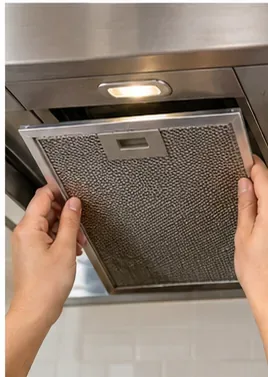
A metal mesh grease filter is removed from the underside of an over-the-range microwave before washing.
If you are accessing a charcoal filter behind a vent grille rather than simply removing a bottom grease filter, manufacturer instructions may require unplugging the microwave or disconnecting power first. Follow the procedure for your exact model rather than copying the screw locations from a different microwave.
2. Soak the grease filter in mild soapy water
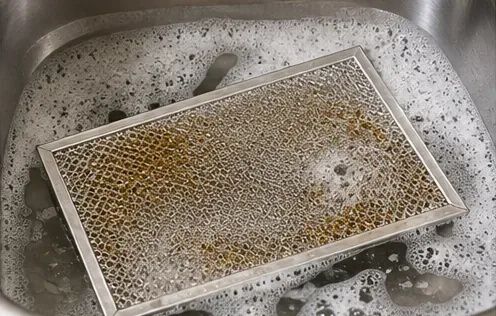
Place the metal grease filter in a sink or basin with hot or warm water and a small amount of mild dish detergent. Allow the detergent time to loosen the oily film. Samsung specifically recommends hot water and mild detergent for its washable grease filters.
Soaking the metal mesh filter in sudsy water helps loosen grease before brushing.
A longer soak can help with heavier buildup, but there is no universal manufacturer-approved soak time across all microwave brands and models. If your manual specifies a time or cleaner, use that instruction.
3. Brush gently instead of attacking the mesh
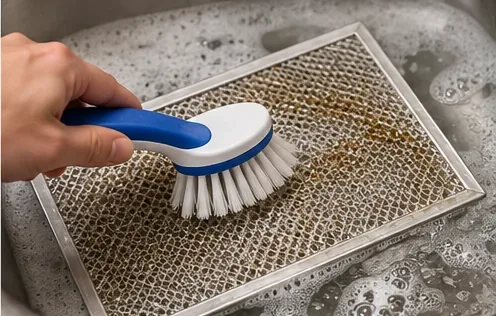
Use a soft-bristled brush or non-abrasive cleaning brush to work detergent through greasy areas. Light pressure is the goal. A microwave grease filter depends on a thin mesh and frame staying intact, so bending or crushing it to remove a stubborn spot is a poor trade-off.
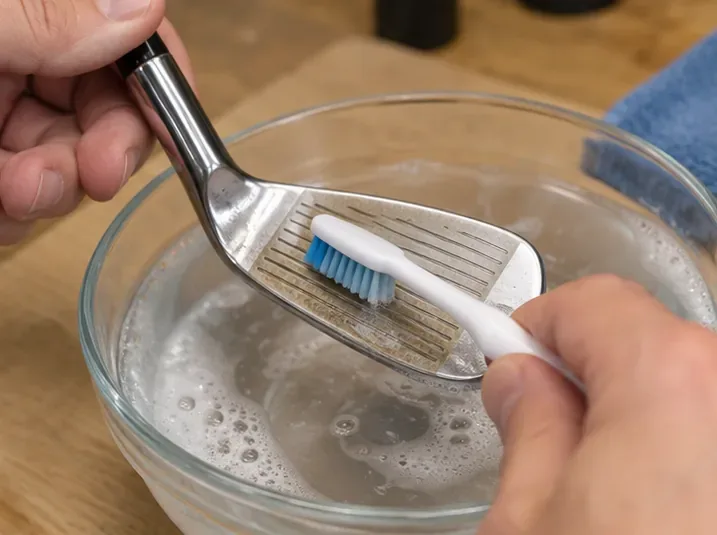
A soft brush can lift embedded residue without forcing or deforming the filter mesh.
There is usually no need to start with harsh household chemicals. Manufacturer instructions from Samsung, Whirlpool, and Maytag center on mild soap or detergent for routine grease-filter cleaning. If ordinary washing no longer restores airflow and the filter is very old or damaged, replacement can be more sensible than increasingly aggressive cleaning.
4. Rinse thoroughly and let the filter dry completely
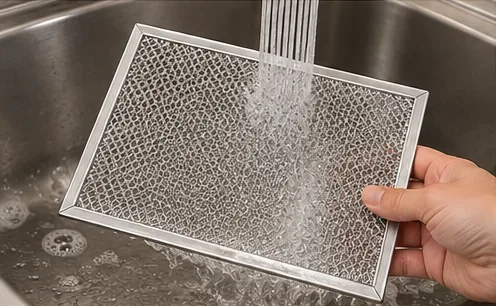
Rinse away detergent and loosened grease with clean water. Shake off excess water carefully, then allow the filter to dry completely before reinstalling it. Whirlpool says the filter can be air-dried or patted dry with a clean cloth; Samsung likewise instructs users to rinse well and shake the filter dry.
The cleaned grease filter is rinsed thoroughly so soap and loosened grease do not remain in the mesh.
5. Reinstall it and verify the result
Return the completely dry filter to the same orientation and slot it came from. It should sit flat and secure without forcing. If the model has a filter reminder, reset it only after the maintenance is actually complete and according to the owner’s manual.
Then run the vent fan briefly. You are looking for normal airflow, no unusual rattling, and a filter that stays firmly in place. Cleaning should leave the mesh visibly less greasy and free of loose residue. A stained filter does not necessarily have to look brand-new to work, but it should not feel heavily oily or remain clogged with debris.
What about the charcoal filter?
Do not soak, scrub, rinse, or dishwash a charcoal microwave filter unless your specific manufacturer explicitly says that your exact filter is washable. The mainstream guidance checked for this article treats charcoal filters as replaceable consumables.
On many over-the-range microwaves, the charcoal filter sits behind the upper vent grille rather than underneath the unit. Access can involve screws, a vent panel, or a dedicated filter door. GE Appliances emphasizes that charcoal filters are model-specific and that the owner’s manual or installation instructions should be used to identify the correct replacement. See GE Appliances’ charcoal filter replacement guidance.
This is one place where buying a generic filter based only on dimensions can be a bad shortcut. A replacement may need the correct shape, frame, airflow orientation, and fit for that model.
How often should you clean or replace microwave filters?
There is no single schedule that fits every appliance. Whirlpool and Maytag commonly recommend cleaning grease filters monthly or when a filter indicator prompts you. Samsung’s guidance varies by filter configuration: some models call for monthly cleaning, while others may specify a longer interval. For charcoal filters, common official intervals range from about six months to twelve months depending on brand, model, and use.
A practical rule is to treat the owner’s manual as the primary schedule and shorten the interval if you frequently fry, sear, or cook foods that generate heavy grease and smoke. Waiting for the filter to become visibly saturated can mean reduced vent performance long before you clean it.
Quick comparison: which option fits your situation?
Your situation
Recommended action
Why
Washable metal filter with normal grease
Hand wash with mild detergent
Broadly supported by manufacturer guidance and easy to control
Metal filter and manual says dishwasher-safe
Dishwasher is reasonable
Less hands-on work, but compatibility is model-specific
Charcoal filter in a recirculating microwave
Replace
Major manufacturers identify it as non-washable
Filter is bent, torn, or will not stay seated
Replace
Cleaning cannot repair damaged structure
You cannot identify the filter type
Check the model number and owner’s manual first
Avoids washing a disposable filter or dismantling the wrong panel
Final self-check
The filter is the washable metal grease type, not a charcoal filter.
The mesh is free of loose debris and no longer heavily greasy to the touch.
No detergent remains trapped in the mesh.
The filter is completely dry before installation.
The frame is flat, intact, and seated securely.
The vent runs without a new rattle or vibration.
If airflow still seems weak, you have checked whether a separate charcoal filter also needs replacement and whether the model’s vent path requires further service.
If those checks pass, the filter maintenance is complete. The main trade-off is not between a “strong” cleaner and a “weak” one; it is between using the method your filter was designed for and using a method that may be incompatible. For most people, mild hand washing is the safest default for a washable grease filter, dishwasher cleaning is a model-dependent convenience, and charcoal-filter replacement is the correct maintenance path.
Manufacturer guidance reviewed in September 2026. Always follow the owner’s manual for your exact microwave model when it differs from general guidance.