Home
» How To
»
How to Clean a Hairbrush After Lice: A Safe, Practical Guide
How to Clean a Hairbrush After Lice: A Safe, Practical Guide
Finding head lice often creates a second question immediately after treatment begins: what should you do with the brush that was used on the affected hair? The useful answer is simpler than many home-remedy lists make it sound. Current CDC guidance says to soak combs and brushes used by a person with head lice in hot water at least 130°F (54°C) for 5–10 minutes. You do not need to spray the brush with a household pesticide or invent a stronger chemical treatment.
To make the process concrete, this guide follows a clearly hypothetical example. Imagine that Maya discovers live head lice in her school-age child's hair and realizes the child used a basic plastic paddle brush that morning. Maya wants to clean that brush without turning the entire bathroom into a decontamination project. The example is only an illustration, not a report of a real household or a test result.
The short answer: use a 130°F hot-water soak for 5–10 minutes
For a comb or brush that can safely be immersed, the CDC's specific lice-control instruction is to soak it in hot water at a temperature of at least 130°F (54°C) for 5–10 minutes. That temperature-and-time combination is the key step. Soap can be useful for removing oil, styling-product residue, and ordinary dirt, but soap is not what the CDC identifies as the required lice-control measure for brushes.
Before doing anything, check whether the brush is actually suitable for immersion. A simple plastic or metal comb is usually straightforward. A wooden brush, natural-bristle brush, cushioned brush with glued parts, or powered styling brush may have care instructions that prohibit soaking. If the manufacturer's instructions say not to immerse it, do not sacrifice the brush just to follow a method it was not built to tolerate. In that situation, replacement is often the simpler option because it avoids improvising with unverified chemicals.
A hypothetical example: Maya's four-step cleanup
Step 1: Remove trapped hair before the hot-water treatment
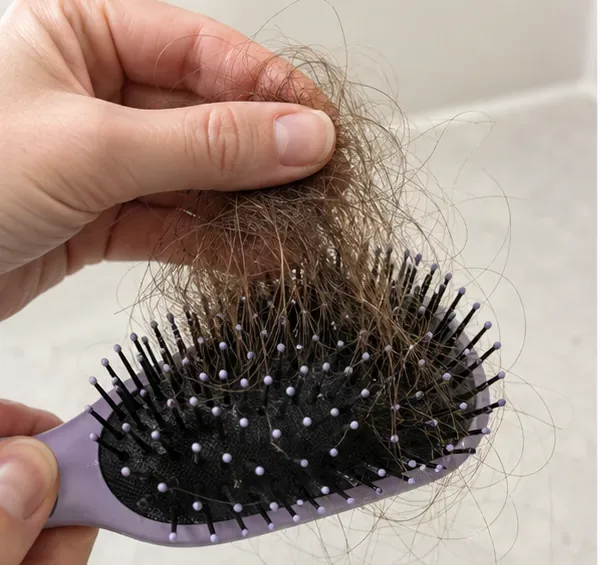
In our hypothetical example, Maya first sets the used brush aside so no one else picks it up. She removes the hair tangled around the bristles and base. This is useful because nits are attached to hair shafts, and a clump of shed hair can make the brush harder to inspect and clean. Fingers, a disposable tissue, tweezers, or the narrow end of a comb can help lift the hair away without damaging the brush.
Remove trapped hair and visible debris first so the brush can be fully exposed to the hot-water treatment.
Do not confuse this with treating the infestation itself. Cleaning the brush is an additional control measure. The person with active head lice still needs an appropriate lice treatment, and close contacts should be checked as the CDC recommends.
Step 2: Soak the brush in water at least 130°F for 5–10 minutes
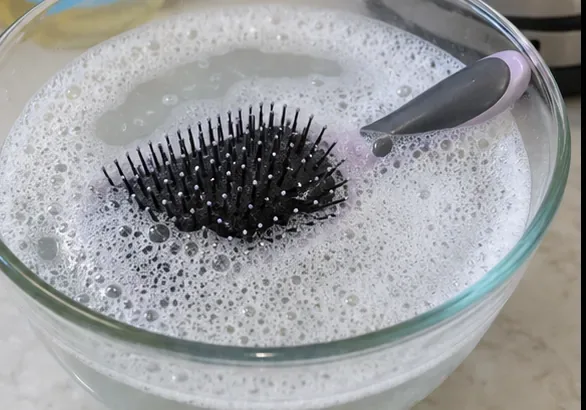
Maya's brush is a basic plastic brush that can be immersed, so she prepares a heat-safe bowl with water at or above 130°F (54°C). A kitchen thermometer is a practical way to confirm the temperature instead of guessing. She submerges the brush and keeps it in the water for at least 5 minutes and no more than needed to complete the CDC's 5–10 minute window.
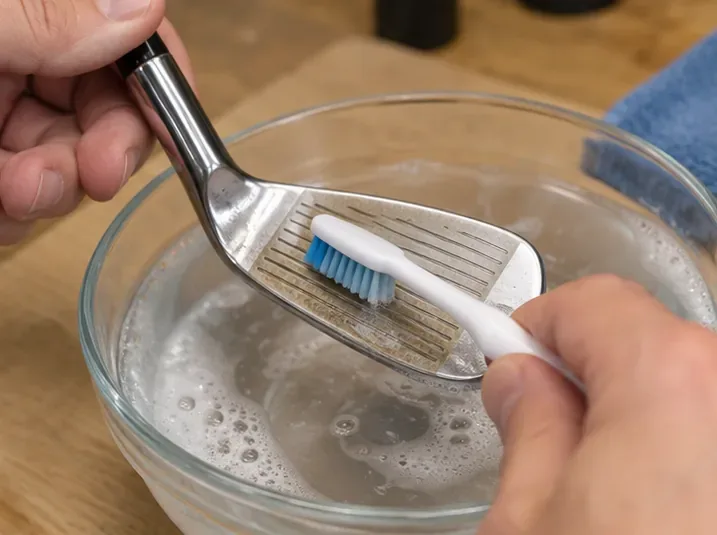
A plastic brush shown submerged for the hot-water step. The CDC lice-control requirement is water at least 130°F (54°C) for 5–10 minutes; detergent is not the essential part of this step.
There is no benefit in turning this into a boiling-water procedure. Water at 130°F is already hot enough to burn skin, so handle the container carefully, keep children away, and use tools or heat-resistant gloves if needed. The CDC calls for at least 130°F, not boiling water.
Step 3: If the brush is still dirty, wash and rinse it for ordinary cleanliness
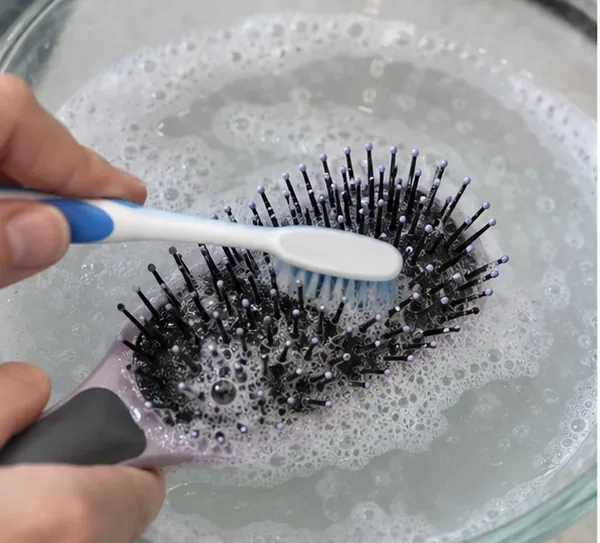
After the required soak, Maya notices some styling residue near the bristle base. She gently scrubs that residue with a small cleaning brush and rinses the paddle brush. This is a housekeeping step, not a substitute for the 130°F soak. If the brush was already visibly clean after soaking, extensive scrubbing would add little.
After the CDC hot-water soak, gentle scrubbing can remove ordinary hair product residue and debris if the brush still looks dirty.
If your brush's manufacturer recommends a particular cleaner, follow that care guidance. Avoid assuming that vinegar, bleach, rubbing alcohol, essential oils, or household insecticide sprays are necessary. The current CDC brush-cleaning guidance specifies hot water; it does not require those additives. Strong chemicals can also discolor finishes, weaken adhesives, or leave residues on a tool that will later touch the scalp.
Step 4: Let the brush dry completely and keep it personal
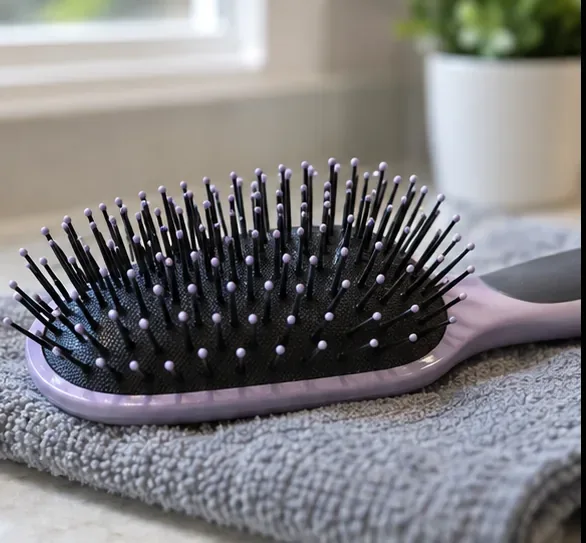
Maya places the cleaned brush bristle-side down or on its side on a clean towel and lets it dry fully before returning it to the bathroom drawer. Once dry, it goes back to the child rather than into a shared family brush basket.
Let the cleaned brush air-dry completely, then keep it for one person's use instead of sharing it among household members.
The CDC specifically advises people not to share combs, brushes, or towels during head-lice prevention and control. That matters more than repeatedly disinfecting every grooming tool in the house.
What if the brush cannot be soaked?
This is where the type of brush changes the decision. The CDC instruction is easy to apply to an inexpensive plastic comb or simple washable brush, but not every grooming tool is designed for hot-water immersion.
Brush type
Practical choice
Main tradeoff
Simple plastic or metal comb/brush
Use the CDC hot-water soak if the maker permits immersion.
Easy to treat, but hot water can still deform some plastics.
Check the manufacturer's care instructions first; replace it if safe immersion is doubtful.
Keeping the brush may risk swelling, adhesive failure, or finish damage.
Electric, heated, or battery-powered styling brush
Do not immerse unless the manufacturer explicitly says it is washable that way; replacement may be simpler.
Water exposure can damage electronics and create a safety issue.
Low-cost brush with unclear materials
Replacement is a reasonable option if you cannot verify that it can tolerate the CDC method.
Costs more than cleaning but avoids uncertain material damage.
The goal is not to prove that every brush needs to be thrown away. It is to avoid replacing a clear, evidence-based hot-water method with a harsher but unverified chemical workaround merely because a particular brush is difficult to soak.
Do you need to clean every brush in the house?
No. Focus on combs and brushes actually used by the person with head lice, and stop sharing them. The CDC notes that head lice spread most commonly through direct head-to-head contact. Spread through shared objects such as combs and brushes can occur, but it is less common. The CDC also says the risk of getting lice from a louse that has fallen onto carpet or furniture is very small.
In Maya's hypothetical household, that means she treats the child's brush and comb, checks whether any sibling shared those tools, and avoids a frantic purge of every unopened hairbrush in the bathroom cabinet. That is a more proportionate response to the documented transmission routes.
Should you use lice spray, bug spray, or a fogger on the brush?
No. The CDC specifically warns against fumigant sprays and fogs for head-lice control because they are unnecessary and can be toxic if inhaled or absorbed through the skin. A brush that will later touch the scalp is a particularly poor place to improvise with pesticide residues.
If the brush can be immersed, use the hot-water method. If it cannot, consult the brush manufacturer's care instructions and consider replacement rather than escalating to stronger chemicals.
What about the rest of the household cleanup?
The brush is only one small part of lice management. CDC guidance says to machine wash and dry clothing, bedding, and other washable items used by the infested person during the two days before treatment, using hot water and high-heat drying. Items that cannot be washed or dry-cleaned can be sealed in a plastic bag for two weeks. Floors and furniture can be vacuumed, particularly where the affected person sat or lay, but the CDC emphasizes that spending a great deal of time and money on housecleaning is not necessary.
That context helps keep the brush question in perspective. Cleaning the right personal items is sensible; attempting to sterilize the entire home is not the main route to successful head-lice control.
When cleaning the brush is not enough
If live lice are still being found on the person's scalp after treatment, the problem is not solved by repeatedly cleaning the brush. Follow the medication directions carefully and review the CDC's treatment guidance. Some lice medicines require a second treatment because they kill live lice but not unhatched eggs. If the treatment seems ineffective, contact a healthcare professional before repeatedly applying the same product.
Also remember that diagnosis can be mistaken. The CDC says finding a live nymph or adult louse is the best way to diagnose an active infestation; dandruff, dirt, and hair-product residue can be confused with nits. If you are unsure whether lice are actually present, a healthcare professional can help confirm the diagnosis.
Bottom line
For a washable hairbrush used by someone with head lice, the evidence-based core is straightforward: remove trapped hair, soak the brush in water at least 130°F (54°C) for 5–10 minutes, clean away ordinary residue if needed, and let it dry before reuse. Do not share the brush, and do not substitute pesticide sprays or foggers for the CDC method.
If the brush cannot safely tolerate hot-water immersion, the best choice depends on its construction and care instructions. For an inexpensive or hard-to-clean brush, replacing it may be more practical than experimenting with unverified chemicals. Most importantly, treat the person with active head lice according to appropriate medical guidance; cleaning the hairbrush helps reduce one possible route of re-exposure, but it is not the treatment itself.