Updated: November 26, 2026, 18:58 CET (Milan, Italy, UTC+01:00; 17:58 UTC). Post-session review.
Italy’s FTSE MIB rose 2.36% on Thursday, November 26, 2026, closing at approximately 48,362 points as banks, technology companies and industrial stocks recovered. Easing concerns about proposed US tariffs on European goods helped drive a wider European relief rally, while company-specific developments supported some of Milan’s biggest gainers.
The rally was broad, but it occurred during the US Thanksgiving holiday, when reduced trading activity made it harder to judge the durability of the rebound. Friday’s session will provide another test of whether improved sentiment can survive renewed US market participation.
Destaques
The FTSE MIB advanced about 1,113 points from the previous close.
Stellantis and Prysmian stood out, while semiconductor shares and banks also recovered.
Prysmian and Saipem confirmed substantial project developments on November 25.
Friday’s outlook depends on tariff headlines, bank and technology sentiment, and the abbreviated US trading session.
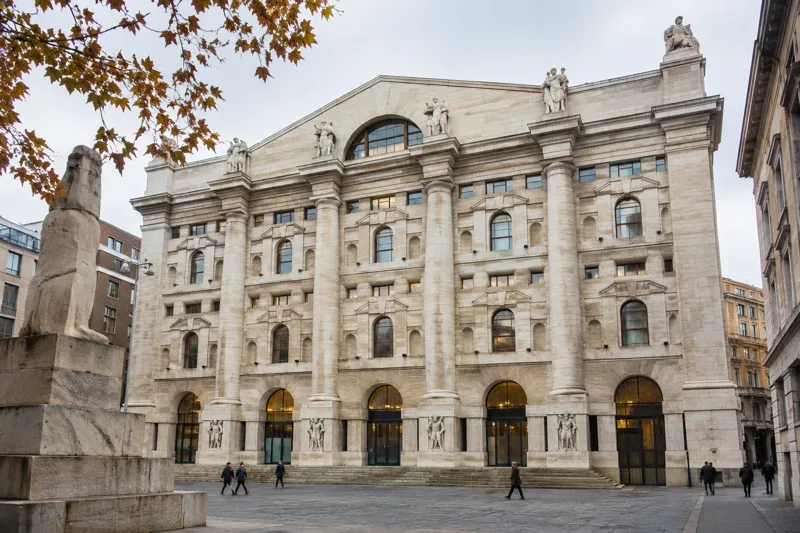
AI-generated illustration of Milan’s financial district; not a photograph of the November 26 trading session.
How much did the FTSE MIB rise on November 26?
The closing level and percentage gain were corroborated by Quotidiano Nazionale and SoldiOnline’s session review. The supplied delayed market feed recorded 48,362.35 points, compared with 47,249.00 in the preceding session. The quote was timestamped at 17:35:29 CET in Milan (16:35:29 UTC), after the scheduled 17:30 CET (16:30 UTC) end of continuous trading. The independently reported closing figure is rounded to a whole index point.
Session measure
Value
FTSE MIB close (rounded)
48,362
Previous close (rounded)
47,249
Daily change
+2.36%
Reported intraday range
48,058–48,558
Italian equity trading turnover
€2.31 billion
The gain was not confined to Italy’s headline benchmark. The FTSE Italia All-Share rose 2.31%, the Mid Cap index gained 2.03%, and the STAR index advanced 2.22%, according to the local closing review. This broader participation is consistent with a market-wide recovery rather than an isolated move in a single heavily weighted stock. These are selected benchmarks, not a comprehensive inventory of Italian securities.
Why did Italian stocks rally today?
Less severe US tariff expectations and a European rebound
According to Reuters’ European market report, Washington’s trade representative signaled an intention to limit proposed duties where lower rates had already been agreed or were being negotiated. For the European Union, attention centered on the previously agreed 15% rate. That reduced fears of an even larger tariff burden on exporters, although it did not establish that all trade disputes were resolved or that future implementation was certain.
Automakers and industrial exporters are especially sensitive to assumptions about cross-border trade. Lower expected trade friction can improve estimates for margins and demand without any immediate change in factory output. This was a plausible explanation for Thursday’s broader rebound after Wednesday’s losses, not a quantified attribution of every FTSE MIB point.
What lifted Stellantis, Prysmian and chip stocks?
Stellantis led the named gainers with an 8.82% advance. ANSA’s closing report associated the move with a JPMorgan automotive-sector research report. The underlying report was not independently available for review, so its precise recommendations and forecasts should not be treated as verified here.
Prysmian climbed 6.57%. In Prysmian’s November 25 announcement, the cable manufacturer confirmed authorization to begin seven electricity-interconnection projects linking Greek islands to the national grid. Their combined potential value is up to €910 million under an existing June 2026 framework. The notice adds the projects to its backlog; it is not equivalent to immediate revenue or profit. The confirmation provides a tangible company-specific development alongside the broader improvement in risk appetite.
STMicroelectronics gained 4.58% and Technoprobe rose 4.31%, reflecting renewed interest in technology shares. Semiconductor stocks are particularly exposed to changing expectations about AI infrastructure spending, financing costs and future demand. The rebound does not by itself establish that recent concerns about AI valuations have disappeared.
Why did banks and energy shares contribute?
Banco BPM rose 2.81%, while Intesa Sanpaolo gained 2.46% and UniCredit added a more modest 0.87%, as ANSA reported. The recovery in lenders matters because financial companies are prominent in Italy’s large-cap benchmark. A calmer risk environment can support bank valuations, although changes in interest rates can have competing effects on lending margins, funding costs and credit quality.
Saipem advanced 4.64% after announcing two offshore awards from Aramco worth approximately $650 million. Saipem’s contract announcement confirms the contracts under an existing long-term commercial agreement. The awards are distinct from a forecast of earnings for the quarter. Energy producer Eni also gained 1.83% as oil prices strengthened, though higher energy costs can create risks for Italy’s economy more generally.
What does the Thanksgiving trading lull mean?
Italian equity turnover fell from €3.39 billion on Wednesday to €2.31 billion on Thursday. The US cash equity markets were closed for Thanksgiving, limiting normal transatlantic price discovery. A move with lower turnover can still be meaningful, but fewer participants can amplify changes in prices in either direction. The breadth of Milan’s rally is encouraging evidence of participation within Italy; the lower turnover is a reason to be cautious about declaring a lasting reversal.
FTSE MIB outlook for Friday, November 27, 2026
The next session is Friday. The ECB weekly calendar lists the October Consumer Expectations Survey at 10:00 CET in Frankfurt and Milan (09:00 UTC). Inflation expectations can influence perceptions of future monetary policy. The NYSE holiday calendar and Nasdaq holiday schedule also confirm an early US close at 1:00 p.m. EST in New York (UTC−05:00; 18:00 UTC or 19:00 CET in Milan).
Scenario
Conditions that would support it
Bullish
Trade-policy reassurance persists, banks and chipmakers retain their gains, and renewed US participation supports European risk appetite.
Base case
Mixed signals and holiday-thinned liquidity produce a consolidation after Thursday’s unusually strong rise.
Bearish
New tariff threats, higher sovereign borrowing costs, weaker technology sentiment or profit-taking reverse part of the rebound.
These are conditional possibilities, not price targets or probabilities. An important distinction for Friday is whether the recovery remains visible across banks, technology and industrial shares or narrows to just a few stocks. The Italian-German government bond yield spread and US equity trading after the holiday will also help contextualize changes in risk appetite. This article is a market explanation, not an investment recommendation.
European tariff concerns eased, banks and technology shares rebounded, and company-specific news supported industrial stocks such as Prysmian and Saipem.
What was the FTSE MIB closing level?
It finished at approximately 48,362 points, up 2.36% from the preceding session.
Will the FTSE MIB rise again on November 27?
That cannot be established in advance. Friday’s ECB survey, trade headlines, bond-market conditions and shortened US session are relevant factors.