Source check: Nov. 26, 2026, 6:27 p.m. CET (UTC+1; 5:27 p.m. UTC), the timestamp on the latest same-day report reviewed. The session itself ended at 5:30 p.m. CET (4:30 p.m. UTC); the supplied delayed quote was timestamped 4:35:30 p.m. UTC.
Spain’s IBEX 35 jumped 2.26% on Thursday, Nov. 26, to 19,057.9 points, recovering the previous session’s 2.00% loss and finishing just below 19,100. Banks were a central force in the advance, while the broader European market rallied as investors reassessed U.S. tariff risks and digested new European Central Bank information. The move was a sharp rebound, but one session does not establish that the recent volatility has ended.
Destaques: IBEX 35 closed at 19,057.9, up 422.1 points (2.26%) on the day.
Spanish bank shares led the index’s rebound, with Santander up about 4.1% and Bankinter 2.6%, according to Cinco Días.
U.S. tariff headlines and the ECB’s October meeting account helped set a more supportive tone for European shares.
The next session’s watch list includes Spain’s November flash CPI and retail-sales releases, both scheduled for Friday morning.
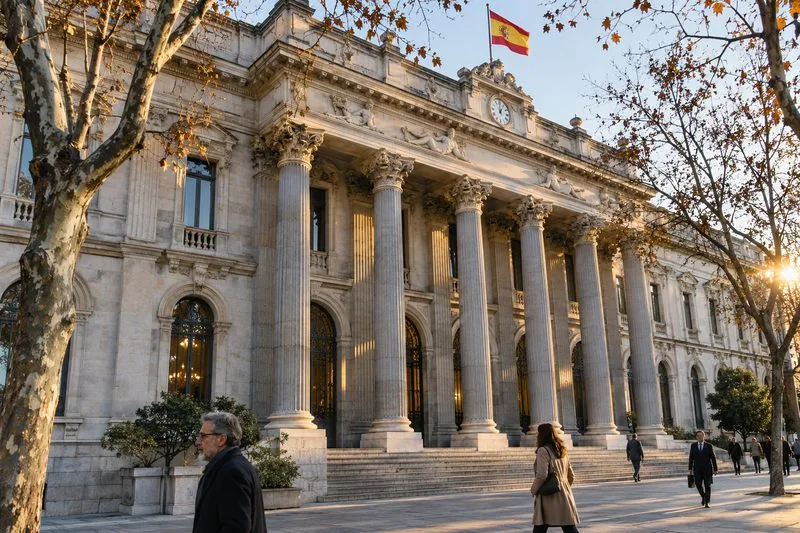
Madrid’s stock exchange district. The image is an illustrative editorial image, not a photograph of trading on Nov. 26.
What happened to the IBEX 35 on Nov. 26?
The index rose 422.1 points to 19,057.9, a 2.26% gain, according to the session figures supplied for this article and corroborated by Spain’s EFE news agency. EFE reported that all 35 IBEX constituents finished higher. That breadth matters: the move was not just a one-stock jump, although sector weights and large companies can still magnify the effect of particular groups on a capitalization-weighted index.
The session followed declines of 2.00% on Wednesday and 0.86% on Tuesday, based on the preceding closes reported by EFE. Cinco Días described Thursday’s rise as the index’s strongest advance since the U.S. midterm elections. Europe’s gains were broad rather than Spain-specific: Reuters reported a 1.8% rise in the STOXX 600, while EFE said the IBEX recovered the 19,000-point level. The United States cash market was closed for Thanksgiving, leaving European investors without a live Wall Street session to confirm the rebound.
Spain’s financial sector has substantial influence on the IBEX, so the strength in bank shares helped the index outperform many European peers. Cinco Días reported gains of roughly 4.1% for Banco Santander and 2.6% for Bankinter. It framed the move as investors returning to banks after recent profit-taking and repricing. That is a market interpretation, not a proven single cause: no exchange-wide statement can identify why every investor bought shares.
Reuters also reported that European bank shares rose 2.4% in the morning, making them the largest sectoral boost to the STOXX 600 at that point. The European-wide bank rally supports the view that Thursday’s Spanish advance was part of a broader risk-on move, amplified in Madrid by the index’s bank exposure.
Tariff fears eased, but the policy risk remained
Investors welcomed signs that planned U.S. duties might be capped at levels already agreed in trade deals. Reuters identified that reassessment as a key support for European shares. The underlying U.S. Trade Representative announcement, however, described proposed actions, not a completed settlement: it said the agency was considering a 15% tariff rate on EU goods, net of most-favored-nation and existing Section 301 rates, with certain exemptions. That proposal leaves trade policy uncertain; Thursday’s rally reflected a less alarming reading of the news, not removal of the risk. Read the USTR’s Nov. 25 announcement.
ECB minutes and leadership news added context
The ECB published its account of the Oct. 28–29 policy meeting on Nov. 26. The account discussed stronger energy-price pressures and inflation concerns, alongside market attention to fiscal conditions and debt-financed AI investment. The publication was a scheduled event, not a surprise change in the ECB’s policy rate. Its implications for banks and rate-sensitive stocks are mixed: a higher-rate outlook can support lenders’ income expectations, but it can also raise borrowing costs and pressure economic activity.
Euro-area governments also agreed to recommend former Bank of Spain governor Pablo Hernández de Cos as the next ECB president. Reuters reported that formal appointment steps remained ahead in December. This was a leadership recommendation, not an immediate change to ECB policy. Investors may have viewed the news as reducing uncertainty around succession, but it should not be treated as the sole cause of the day’s gains. See the ECB’s meeting account and Reuters’ report on the recommendation.
What could move the IBEX 35 in the next session?
Friday, Nov. 27 is the next scheduled Spanish trading session. The official BME calendar does not list that date among 2026 non-trading days. Spain’s National Statistics Institute (INE) scheduled the November flash CPI and October retail-trade indexes for Friday, with its weekly calendar specifying a 9:00 a.m. publication time. That is 8:00 a.m. UTC (CET is UTC+1 on this date). The CPI can influence expectations for household purchasing power, interest rates and bond yields; retail data may add information about domestic demand. Neither release guarantees a particular share-market response.
Bull scenario: If inflation and retail data are read as manageable, and the broader European rebound holds when U.S. markets reopen after Thanksgiving, buyers could extend Thursday’s recovery. Banks and other cyclical shares would remain important to the IBEX’s direction.
Base scenario: The index may consolidate after its 2.26% jump. Thursday’s move retraced much, but not all, of the preceding declines; with U.S. trading absent on Thursday and likely thinner holiday-week liquidity, investors may wait for Friday’s data and renewed U.S. price discovery.
Bear scenario: A hotter-than-expected inflation reading, renewed tariff concerns, higher bond yields, or another decline in global technology shares could revive selling. These are risks to monitor, not forecasts. No verified information supports a specific next-session price target or guaranteed direction.
It gained 2.26%, or 422.1 points, to close at 19,057.9.
What was the main reason the IBEX 35 went up?
The clearest documented drivers were a broad European rebound, strength in banks, and reduced immediate concern about U.S. tariff levels. ECB news also shaped sentiment; no single cause explains every trade.
What should investors watch next?
Friday’s Spanish flash CPI and retail-trade figures, U.S. market reopening after Thanksgiving, and changes in tariff and interest-rate expectations. This article is market information, not investment advice.