Information checked: November 27, 2026, at 4:55 p.m. Korea Standard Time (KST, UTC+09:00), equivalent to 07:55 UTC. The regular Seoul market session ended at 3:30 p.m. KST (06:30 UTC).
South Korea’s KOSPI jumped 4.34% on Friday, November 27, closing at 4,915.68. A return of foreign buying, a sharp rebound in heavyweight semiconductor shares, and expectations of stronger government market support helped drive the recovery. The move came after a turbulent stretch for stocks tied to artificial intelligence, not after a reduction in Korean interest rates.
The main question for Monday is whether demand will persist once traders have seen the shortened U.S. Friday session and any developments in Korea’s market stabilization plans. Friday’s gains were substantial, but the available evidence does not establish that a new round of stabilization fund purchases has already begun.
Destaques
KOSPI: 4,915.68, up 204.47 points from Thursday’s close of 4,711.21.
Foreign investors bought a net roughly 1.13 trillion won of main-market shares.
Samsung Electronics gained 4.55%, SK hynix rose 5.41%, and the KOSDAQ jumped 8.13%.
Market support discussions and the U.S. semiconductor sector are key variables for the next Korean trading session.
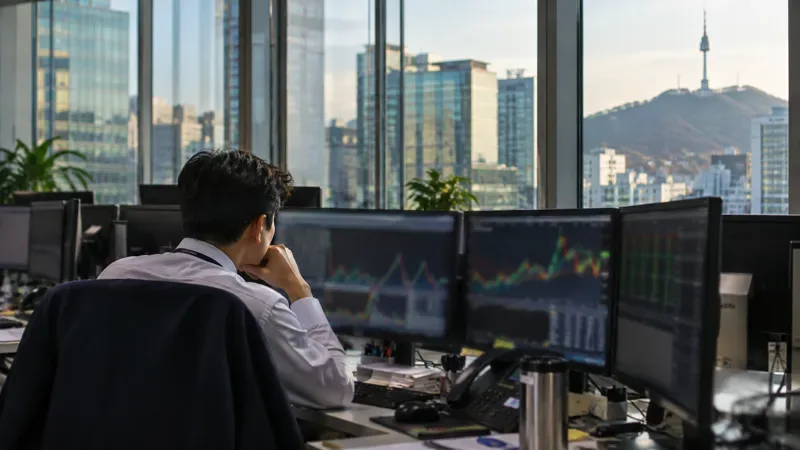
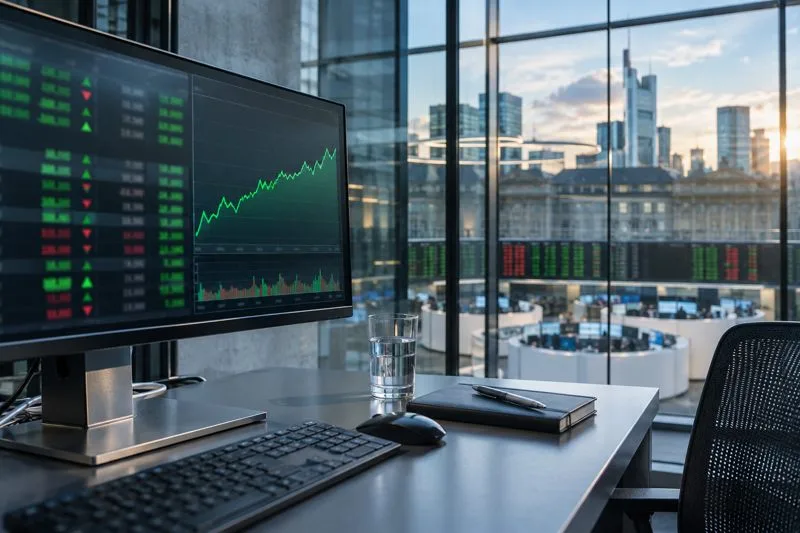
AI-generated illustration of a Seoul trading desk; not a photograph of the November 27 market session.
What happened to the KOSPI on November 27?
Friday’s rally gathered momentum after an initially hesitant start. The benchmark opened at 4,728.80, slipped as low as 4,682.43 and later reached 4,922.94, according to The Korea Economic Daily’s market recap. It finished close to that intraday high. The previous closing figure also appears in the Ministry of Finance and Economy’s economic indicators for November 26. The independently reported closing level agrees with the supplied delayed Yahoo Finance observation, which was timestamped 15:30:40 KST (06:30:40 UTC).
Market indicator
November 27 close
Daily change
KOSPI
4,915.68
+4.34%
KOSDAQ
708.99
+8.13%
Samsung Electronics
KRW 179,100
+4.55%
SK hynix
KRW 1,110,000
+5.41%
These are selected Korean market indicators, not a complete inventory of listed securities. The KOSPI and KOSDAQ are measured in index points, whereas the individual share prices are in Korean won. The gains in both indexes show that the recovery was not confined to the main benchmark.
Why is the KOSPI up today?
Foreign buying returned alongside institutional demand
According to Newspim’s closing report, overseas investors purchased a net approximately 1.126 trillion won of main-market shares and institutions bought about 239 billion won. The reported foreign inflow was the clearest observable change in demand. A foreign investor buying more stocks than they sell provides a direct source of demand, although aggregate trading statistics cannot establish the motive behind each order. Whether those flows persist after the weekend will help distinguish a durable recovery from a temporary repositioning.
Semiconductor shares rebounded after AI-related volatility
Samsung Electronics and SK hynix are particularly important because of their large representation in the capitalization-weighted KOSPI. A recovery in their shares can lift the benchmark even when smaller companies move differently. Their gains on Friday are consistent with renewed interest in semiconductor exposure after a selloff linked to uncertainty about AI investment. But no precise contribution to the index or newly confirmed chip earnings catalyst was established in the available closing reports. A price rebound is not by itself proof that concerns about future AI spending have disappeared.
The Financial Services Commission’s November 23 statement describes preparations to make the stock market stabilization fund available if needed, together with closer monitoring of unlawful short selling. A separate FSC’s English-language buyback announcement confirms that restrictions on daily listed-company share buyback orders were relaxed from November 24, 2026, through February 23, 2027.
These steps can affect sentiment by reducing fears of disorderly selling or allowing companies more flexibility to repurchase shares. However, the possibility of expanding a fund, a decision to activate it, and actual purchases are three separate developments. The evidence supports expectations of intervention as a catalyst, not a claim that government money accounted for Friday’s increase.
Why did stocks rally despite a Bank of Korea rate hike?
The Bank of Korea’s November 26 policy decision confirms a quarter-percentage-point increase in the base rate from 3.00% to 3.25% on Thursday. The central bank cited strengthening economic activity, persistent inflation and financial stability concerns. Higher rates can increase borrowing costs and reduce the present value of future corporate earnings. Friday’s rise therefore should not be interpreted as a monetary easing rally.
In the short term, equity prices can recover even when monetary policy tightens, especially when investors have already reduced exposure and then reassess the risk of further losses. The won also strengthened to 1,337.9 per U.S. dollar at the Seoul equity close, compared with 1,342.7 at the preceding session, according to Yonhap’s closing market report. A firmer currency may ease currency-related uncertainty for overseas investors, but exchange rates and equity flows influence each other; neither establishes a one-way causal relationship.
What could happen in the next KOSPI session?
The next regular session is expected on Monday, November 30, 2026. Two developments matter before and during that session. First, the NYSE holiday calendar schedules an early close on November 27 at 1 p.m. New York Eastern Standard Time (EST, UTC−05:00), or 18:00 UTC and 3 a.m. KST on Saturday, November 28. Moves in U.S. chip shares during that abbreviated session could shape sentiment in Seoul, although holiday liquidity may make the signals less representative of normal trading.
Second, Seoul Economic Daily’s November 26 reporting reported that a fund committee meeting was planned for Sunday, November 29, followed by a regulator-led meeting on Monday to consider market stability and potential fund expansion. The timing and outcomes remain subject to change. A concrete commitment would carry different implications from a discussion without an implementation timetable.
Conditional bull, base and bear scenarios
Bull case: If foreign demand continues, U.S. chip stocks hold up and officials provide credible details about market support, Friday’s recovery could extend.
Base case: If policy discussions remain preliminary and overseas technology shares are mixed, the benchmark could consolidate as traders reassess the unusually large Friday move.
Bear case: If semiconductor shares weaken abroad, foreign flows reverse or anticipated support disappoints, profit-taking could undo part of the rebound. The recent rate increase could compound concerns about financing costs.
These are conditional scenarios, not forecasts with assigned probabilities or price targets. Relevant confirmation signals include the next session’s net foreign purchases, relative performance of the major chipmakers, market breadth and the won’s direction. A single opening move may not tell the same story as the end-of-day data. This article explains market developments and does not provide investment advice.
FAQ
How much did the KOSPI rise on November 27, 2026?
It rose 4.34%, or 204.47 points, to 4,915.68 at the regular session close.
Did Korea activate its stock market stabilization fund on Friday?
Preparations and possible expansion were reported. The sources reviewed did not confirm that the fund made purchases during Friday’s session.
When is the next KOSPI trading session?
The next regular session is expected Monday, November 30, subject to any exceptional exchange notice.