Why Is ASML Down Today? MATCH Act Fears Weigh on Shares — November 25, 2026
ASML fell 5.8% to €1,131.60 on November 25 as concern over proposed U.S. chip-equipment export controls revived China-sales risks. Here’s what may matter next.
Verified and updated: November 25, 2026, 18:33 CET (UTC+01:00), Amsterdam.
ASML shares on Euronext Amsterdam closed November 25 at €1,131.60, down 5.8% from the previous close of €1,201.20, according to the supplied delayed Yahoo Finance session data. Renewed concern about the proposed U.S. MATCH Act and possible tighter restrictions on semiconductor equipment sales to China was the main reported pressure on the chip-equipment maker. The legislation is a proposal, not an enacted restriction, so the immediate issue for investors is the risk that it could become policy.
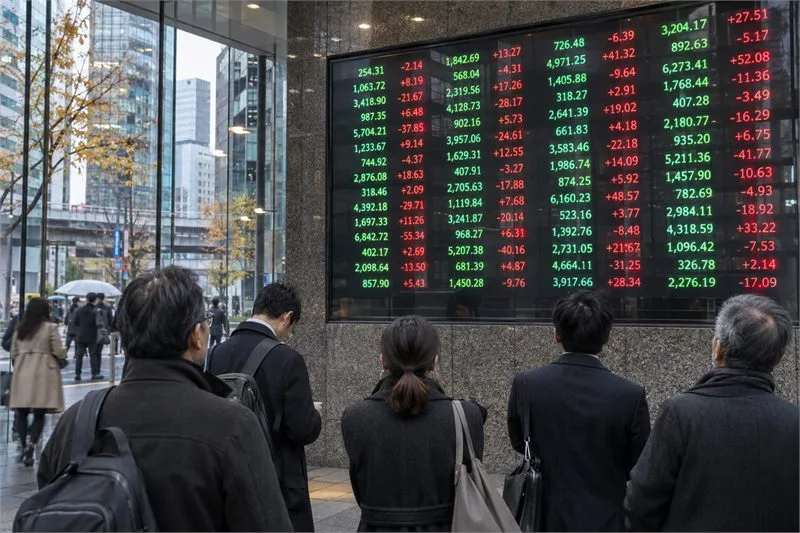
The drop came amid broader weakness in technology shares. Euronext’s Amsterdam market page showed the AEX down 0.74% at 15:55 CET, a smaller decline than ASML’s reported session move. The stock-specific concern therefore appears to have compounded a softer market backdrop. The price move and reported news are observable; attributing the full decline to any single cause remains an interpretation.
The MATCH Act would seek to align U.S. allies’ controls on semiconductor manufacturing equipment with U.S. restrictions. The bill text describes export restrictions and multilateral alignment; the Senate version was introduced and referred to committee. That process does not by itself make the proposed measures effective. Investors may nevertheless price in the possibility that restrictions could expand or that negotiations with allies could create uncertainty for suppliers and customers.
Reuters reporting carried by the London Stock Exchange’s news service said the Netherlands was working to prevent the U.S. legislation from passing in a form that could further restrict ASML’s China business. The report also said Congress was considering attaching the MATCH Act to the annual National Defense Authorization Act. That makes legislative developments and Dutch-U.S. discussions relevant watch points, but does not establish that a final measure will pass or what its final scope would be.
China exposure is one reason the debate matters. ASML’s third-quarter 2026 release forecast full-year net sales of €44 billion to €45 billion and a gross margin around 56%. Those company figures provide the operating baseline, but they do not quantify the effect of a hypothetical new restriction. Any impact would depend on the final rules, their implementation, customer demand, and whether existing service or shipment permissions were affected.
The sources checked for this update did not show a new ASML earnings release or company announcement on November 25 explaining the share-price fall. ASML’s most recent cited quarterly outlook was published on October 14. That does not rule out other market factors, but it means the day’s movement should not be described as a reaction to a newly announced guidance cut on the evidence available here.
Nor does the larger percentage drop alone prove a single catalyst. The reported legislative concern coincided with weakness across technology shares, and a broad risk-off move can amplify stock-specific worries. The MATCH Act story offers a plausible explanation for why ASML could underperform the AEX; it is not proof that every seller acted for that reason.
The next regular Euronext Amsterdam session is Thursday, November 26. The scenarios below are conditional, not price targets or predictions.
For the next session, the clearest indicators to monitor are official updates on the defense bill and the MATCH Act, statements from Dutch and U.S. officials, and moves in other semiconductor-equipment stocks. No scenario guarantees a direction. This is a market explainer, not investment advice.
Session price and percentage change use the supplied Yahoo Finance delayed data for ASML.AS, compared with the immediately preceding valid close. Market context comes from Euronext Amsterdam. The proposal’s status and scope were checked against the U.S. Senate MATCH Act bill text; company outlook figures come from ASML’s Q3 2026 results release. The Netherlands policy report was carried by LSE.co.uk, citing Reuters. Prices from delayed feeds and third-party reports can differ by timing and methodology.
ASML.AS fell 5.8% to €1,131.60, based on the supplied delayed session data.
No. The cited MATCH Act text is proposed legislation; it has not, on the sources checked for this update, become an enacted restriction.
Watch for official legislative developments, statements from the Netherlands and United States, and the direction of semiconductor-sector shares. These factors could move sentiment either way.
ASML fell 5.8% to €1,131.60 on November 25 as concern over proposed U.S. chip-equipment export controls revived China-sales risks. Here’s what may matter next.
The Nikkei 225 fell 2.78% to 57,011.62 on November 25 as global AI and semiconductor stocks sold off. Here are the verified drivers and conditional scenarios for the next Tokyo session.
Why did China markets fall on November 25, 2026? Analysis of the Shenzhen Component's 3.24% drop and Shanghai Composite's 2.03% slide, key catalysts, and next-session outlook.
KOSPI plummeted 6.16% and Samsung Electronics dropped 9.87% on November 25, 2026. Explore verified catalysts, global semiconductor downgrades, and next-session outlook.
Natural gas rebounded while silver slid on Nov. 24. See the verified contract moves, weather and rate drivers, rollover caveat, and next-session catalysts.
Nvidia (NVDA) dropped 5.86% to $155.38 on November 24, 2026. Explore the primary catalysts behind the pullback, fundamental valuation, and next-session outlook.
Sanofi rose 9.76% on Nov. 24 after announcing a $41 billion Insmed acquisition. Here are the confirmed deal terms, risks and conditional outlook for the next session.
ASML.AS closed lower on Nov. 24 as the chip rally faded and export-control risks lingered. See the verified close, confirmed catalysts, and conditional outlook for Nov. 25.
Why is Nvidia up today? Analysis of NVDA's 31.48% surge on November 23, 2026, examining core catalysts, verified market data, and the next-session outlook.
The KOSPI jumped 6.32% and Samsung Electronics gained 6.70% on Nov. 24 as a Wall Street technology rally lifted Korean chip stocks. Here are the confirmed drivers and conditional scenarios for the next session.