Why Is ASML Down Today? MATCH Act Fears Weigh on Shares — November 25, 2026
ASML fell 5.8% to €1,131.60 on November 25 as concern over proposed U.S. chip-equipment export controls revived China-sales risks. Here’s what may matter next.
Updated: November 24, 2026, 08:18 UTC (09:18 CET, Berlin).
South Korea’s KOSPI surged 6.32% on Tuesday, November 24, closing at 5,006.03 after a two-session sell-off. Samsung Electronics rose 6.70% to 189,400 won. The immediate catalyst was a sharp overnight rebound in U.S. technology shares after Nvidia’s board reinstated Jensen Huang as CEO, easing a source of uncertainty around the AI chipmaker and its broader ecosystem. The rally pushed the KOSPI back above 5,000 and was strong enough to prompt a Korea Exchange trading safeguard.
This was a broad, technology-led rebound, but it does not by itself prove that recent volatility has ended. The next session’s direction will depend on whether global chip shares and demand for Korean equities remain firm.
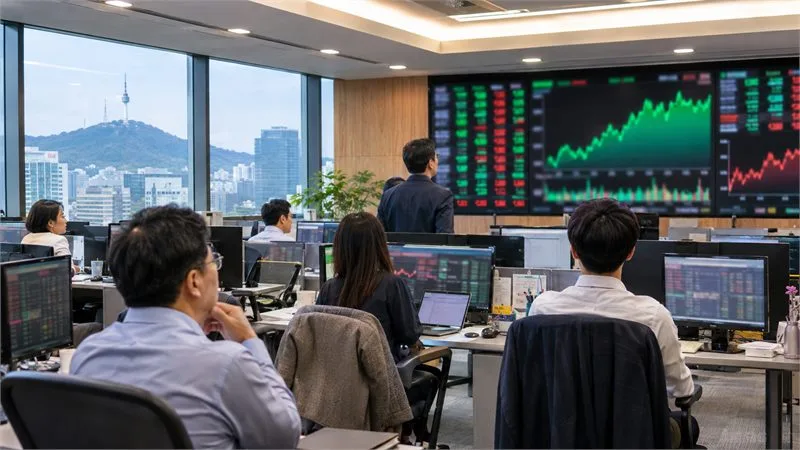
The benchmark index added 297.49 points, finishing at 5,006.03 after reaching as high as 5,065.74, according to Yonhap’s report on the close. That was its first finish above 5,000 in three sessions. Samsung Electronics gained 6.70% to 189,400 won, while chip rival SK hynix advanced 6.73% to about 1.16 million won.
Buying was not limited to the two chipmakers. Yonhap reported 795 advancing stocks against 94 decliners. Foreign investors bought a net 725.6 billion won of shares and institutions bought 869 billion won, while individual investors sold a net 2 trillion won. The exchange activated a buy-side sidecar at 9:06 a.m. Seoul time, suspending program buy orders in KOSPI-listed shares for five minutes. Yonhap said the trigger is reached when KOSPI 200 futures rise at least 5% and hold that level for a minute.
The clearest confirmed driver was a global technology rebound that began on Wall Street. Nvidia shares and other AI-linked stocks rallied after Nvidia’s board reinstated Huang, following uncertainty about the company’s leadership. The Nasdaq Composite rose 6.51% and the Dow Jones Industrial Average gained 3.01% overnight, Yonhap reported. The Associated Press also linked the Asian chip-stock gains to Wall Street’s rebound and Nvidia’s leadership news.
That move mattered in Seoul because Samsung Electronics and SK hynix are large semiconductor companies whose shares can respond sharply to changes in expectations for AI investment and chip demand. The board decision appears to have relieved one immediate concern for investors; it did not establish that every risk facing the AI sector has disappeared. The KOSPI’s 6.32% gain was also a recovery after a sharp preceding decline, so some buying may have reflected investors returning after losses. That is a possible market interpretation, not a separately confirmed cause.
Bull case: If U.S. technology shares hold their gains and investors continue buying Korean chipmakers, the KOSPI could see follow-through demand. A sustained advance would require support beyond a single overnight news catalyst.
Base case: After a 6.32% jump, traders may take profits or trade unevenly as they assess whether the rebound can last. Samsung Electronics’ and SK hynix’s price action, along with foreign and institutional flows, may offer useful signals, but no single indicator guarantees the index’s direction.
Bear case: If risk appetite fades, AI-sector concerns return, or global chip shares weaken, Tuesday’s gains could give back part of the rebound. The recent sell-off is a reminder that sentiment can reverse quickly.
These scenarios are conditional, not price targets or predictions. The November 24 close and related trading figures above are reported market data; the possible next-session paths are analysis. This article is informational and is not investment advice.
A Wall Street technology rally after Nvidia’s board reinstated Jensen Huang as CEO helped lift Korean semiconductor stocks and the broader index.
Samsung Electronics gained 6.70% to close at 189,400 won, according to Yonhap.
No. The next move depends on whether global technology shares and demand for Korean equities remain strong; a single rebound cannot confirm a lasting trend.
ASML fell 5.8% to €1,131.60 on November 25 as concern over proposed U.S. chip-equipment export controls revived China-sales risks. Here’s what may matter next.
The Nikkei 225 fell 2.78% to 57,011.62 on November 25 as global AI and semiconductor stocks sold off. Here are the verified drivers and conditional scenarios for the next Tokyo session.
Why did China markets fall on November 25, 2026? Analysis of the Shenzhen Component's 3.24% drop and Shanghai Composite's 2.03% slide, key catalysts, and next-session outlook.
KOSPI plummeted 6.16% and Samsung Electronics dropped 9.87% on November 25, 2026. Explore verified catalysts, global semiconductor downgrades, and next-session outlook.
Natural gas rebounded while silver slid on Nov. 24. See the verified contract moves, weather and rate drivers, rollover caveat, and next-session catalysts.
Nvidia (NVDA) dropped 5.86% to $155.38 on November 24, 2026. Explore the primary catalysts behind the pullback, fundamental valuation, and next-session outlook.
Sanofi rose 9.76% on Nov. 24 after announcing a $41 billion Insmed acquisition. Here are the confirmed deal terms, risks and conditional outlook for the next session.
ASML.AS closed lower on Nov. 24 as the chip rally faded and export-control risks lingered. See the verified close, confirmed catalysts, and conditional outlook for Nov. 25.
Why is Nvidia up today? Analysis of NVDA's 31.48% surge on November 23, 2026, examining core catalysts, verified market data, and the next-session outlook.
The KOSPI jumped 6.32% and Samsung Electronics gained 6.70% on Nov. 24 as a Wall Street technology rally lifted Korean chip stocks. Here are the confirmed drivers and conditional scenarios for the next session.