Why Is ASML Down Today? MATCH Act Fears Weigh on Shares — November 25, 2026
ASML fell 5.8% to €1,131.60 on November 25 as concern over proposed U.S. chip-equipment export controls revived China-sales risks. Here’s what may matter next.
Updated November 25, 2026, at 6:33 p.m. Japan Standard Time (UTC+09:00; 09:33 UTC).
The Nikkei 225 closed Wednesday, November 25, at 57,011.62, down 1,633.01 points, or 2.78%, from the previous close of 58,644.63. The decline followed renewed selling in artificial intelligence and semiconductor shares across global markets, with losses in major Japanese technology-related stocks adding pressure to the index. The move erased much of the prior session’s sharp rebound.
The clearest verified near-term catalyst was the reversal in U.S. AI-linked stocks and a broader retreat in Asian chip shares. Separately, the prospect of additional U.S. tariffs and fresh Japanese services inflation added uncertainty, but the available reporting does not establish either as the direct cause of the Nikkei’s full-day decline.
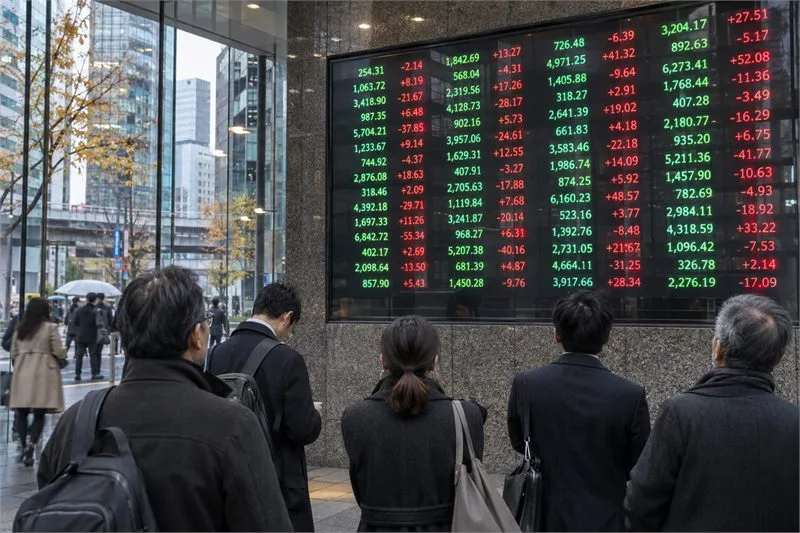
The benchmark fell from 58,644.63 to 57,011.62. Those figures imply a loss of 1,633.01 points, or 2.78%, in the supplied delayed market data. The Associated Press also reported the Nikkei down 2.8% at 57,011.62, corroborating the closing level and rounded percentage. This was a completed Tokyo trading session, not a live intraday quote.
The fall came after a sharp rise in the previous session, making the reversal especially visible. But a large index move alone does not explain its cause. The day’s reporting tied weakness to the tech-led pullback in global markets: U.S. shares connected to artificial intelligence had retreated, while several Asian markets with substantial technology exposure fell as well.
U.S. technology shares weakened on Tuesday, November 24, after a short-lived rebound in AI-related names faded. The S&P 500 fell 0.5% and the Nasdaq Composite lost 1.5%, while the Dow Jones Industrial Average rose. The AP reported Nvidia down 5.9% and described investor concerns about whether AI-related investment can generate enough profit to justify its cost. Those U.S. moves provide market context for the pressure that followed in Asia; they do not by themselves prove the cause of every Japanese stock’s movement.
The same report said the Nikkei declined alongside sharp losses in regional technology shares. SoftBank Group fell 14.8% and Kioxia dropped 14.2%, according to the AP. Their declines illustrate the intensity of selling in prominent AI and semiconductor-linked names, though the Nikkei’s performance reflects all of its constituents and index weighting, not a single company.
Investors were also weighing the possibility that the U.S. administration would announce plans for higher tariffs on China and other trading partners. That possibility can cloud expectations for exporters and supply chains, but it was reported as an expected policy development, not a confirmed tariff decision or a quantified cause of the Nikkei’s decline.
The Bank of Japan released October’s Services Producer Price Index on November 25. Its all-items measure rose 4.2% year over year; the measure excluding international transportation rose 3.2%. The data add to the background for monetary-policy expectations. There is no verified evidence here that this release alone drove Wednesday’s equity losses.
The next regular Tokyo session is Thursday, November 26. Its direction is uncertain, and the following scenarios are conditional rather than forecasts:
For the next session, watch global semiconductor performance, U.S. market signals, the yen, Japanese interest-rate expectations, and concrete updates on trade policy. These are monitoring points, not guarantees of direction. The index close and market reaction are reported facts; the scenarios above are conditional analysis. This article is an informational market explainer, not investment advice.
Closing level and comparison: Yahoo Finance Nikkei 225 quote. Session context and reported company moves: Associated Press coverage of Asian markets and AI shares. October services inflation: Bank of Japan Services Producer Price Index release.
It closed at 57,011.62, down 1,633.01 points, or 2.78%, from the previous close.
The session coincided with renewed selling in global AI and semiconductor shares, including notable declines in SoftBank Group and Kioxia.
No. The next session’s direction is uncertain and depends in part on global technology shares, currency moves, rates, and trade-policy developments.
ASML fell 5.8% to €1,131.60 on November 25 as concern over proposed U.S. chip-equipment export controls revived China-sales risks. Here’s what may matter next.
The Nikkei 225 fell 2.78% to 57,011.62 on November 25 as global AI and semiconductor stocks sold off. Here are the verified drivers and conditional scenarios for the next Tokyo session.
Why did China markets fall on November 25, 2026? Analysis of the Shenzhen Component's 3.24% drop and Shanghai Composite's 2.03% slide, key catalysts, and next-session outlook.
KOSPI plummeted 6.16% and Samsung Electronics dropped 9.87% on November 25, 2026. Explore verified catalysts, global semiconductor downgrades, and next-session outlook.
Natural gas rebounded while silver slid on Nov. 24. See the verified contract moves, weather and rate drivers, rollover caveat, and next-session catalysts.
Nvidia (NVDA) dropped 5.86% to $155.38 on November 24, 2026. Explore the primary catalysts behind the pullback, fundamental valuation, and next-session outlook.
Sanofi rose 9.76% on Nov. 24 after announcing a $41 billion Insmed acquisition. Here are the confirmed deal terms, risks and conditional outlook for the next session.
ASML.AS closed lower on Nov. 24 as the chip rally faded and export-control risks lingered. See the verified close, confirmed catalysts, and conditional outlook for Nov. 25.
Why is Nvidia up today? Analysis of NVDA's 31.48% surge on November 23, 2026, examining core catalysts, verified market data, and the next-session outlook.
The KOSPI jumped 6.32% and Samsung Electronics gained 6.70% on Nov. 24 as a Wall Street technology rally lifted Korean chip stocks. Here are the confirmed drivers and conditional scenarios for the next session.