Home
» New Trends
»
Where to Watch the 2026 US Open Finals Live: A Beginner’s Schedule and Streaming Guide
Where to Watch the 2026 US Open Finals Live: A Beginner’s Schedule and Streaming Guide
If this is your first US Open finals weekend, start with two facts. The women’s singles final is Aryna Sabalenka vs. Elena Rybakina on Saturday, September 12, 2026 at 4:00 p.m. ET / 1:00 p.m. PT, live in the United States on ESPN. The men’s singles final is Alexander Zverev vs. Ben Shelton on Sunday, September 13 at 2:00 p.m. ET / 11:00 a.m. PT, live on ABC. ESPN Deportes carries both finals in Spanish.
ET means Eastern Time, the time zone used in New York, where the US Open is played. PT means Pacific Time. If you live elsewhere, convert from the official New York start time rather than assuming your local television listing uses ET. The USTA marks broadcast times as subject to change, so check the official 2026 US Open U.S. TV schedule again before first serve.
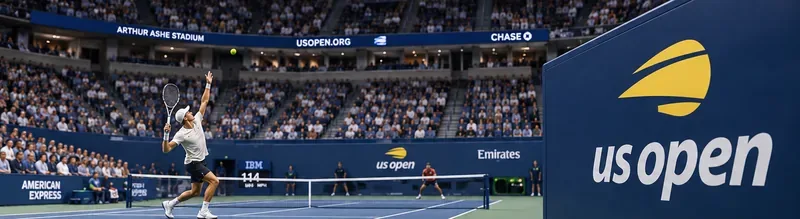
A packed blue hard-court stadium during a major tennis match. For finals weekend, the practical first step is to match the correct day and U.S. network to the championship you want to watch.
What Should a First-Time Viewer Know Before Finals Weekend?
The US Open is one of tennis’s four Grand Slam tournaments—the sport’s four most prestigious annual events. The singles tournament begins with a 128-player draw, and the last two players in each draw meet in the final. Women play best-of-three-set singles matches; men play best-of-five sets at the majors, so the Sunday final can last considerably longer.
Both singles finals take place at Arthur Ashe Stadium in Queens, New York. You do not need to understand every tennis statistic to follow them. The most useful things to know are the start time, where the match is being shown, and the basic storyline for each finalist.
Final
Date
Start
U.S. English TV
Spanish TV
Women: Aryna Sabalenka vs. Elena Rybakina
Saturday, Sept. 12
4:00 p.m. ET / 1:00 p.m. PT
ESPN
ESPN Deportes
Men: Alexander Zverev vs. Ben Shelton
Sunday, Sept. 13
2:00 p.m. ET / 11:00 a.m. PT
ABC
ESPN Deportes
The official schedule also lists a men’s final preview show on ABC beginning at 1:00 p.m. ET Sunday, one hour before the championship. If you want player interviews, analysis and context before the match, that is the easiest point to start watching. The complete event calendar is available on the official US Open tournament schedule.
What Do You Need to Prepare Before You Watch?
You only need three things: the correct channel or streaming entitlement, a compatible device, and a reliable internet connection if you are streaming. Do these checks before the match rather than during the opening game.
If you already receive ESPN and ABC: confirm that both channels are in your TV package. Saturday and Sunday use different English-language networks.
If you plan to use the ESPN app: sign in ahead of time and make sure your subscription or TV-provider entitlement is active.
If you watch through a smart TV or streaming box: update the ESPN app and test playback with another live event.
If you are outside the U.S.: find the authorized broadcaster for your country instead of trying to follow a U.S.-only recommendation.
How Do You Watch Without Cable?
In 2026, ESPN sells two direct subscription tiers, and the names matter. ESPN Unlimited includes ESPN, ESPN Deportes, ESPN on ABC, ESPN2, ESPN+ and the company’s other listed networks and services. Because the women’s final is on ESPN and the men’s final is on ABC, Unlimited is the direct ESPN plan that matches both confirmed U.S. broadcasts.
As of ESPN Fan Support’s August 25, 2026 pricing update, ESPN Unlimited is listed at $31.99 per month or $319.99 per year. Prices and promotions can change, so verify the checkout screen before subscribing. The plan’s current network list is on the official ESPN Unlimited support page, and ESPN publishes current pricing on its official plans and prices page.
What about ESPN Select or ESPN+?
This is a common beginner trap. ESPN says ESPN Select includes ESPN+ content only, while Unlimited adds the linear ESPN networks and ESPN on ABC. In other words, seeing “tennis” in the ESPN+ library does not automatically mean a Select subscription carries the ESPN television feed for Saturday or the ABC feed for Sunday.
If you already have Select, open the ESPN app and check the specific final before match time. Do not buy or keep a plan based only on the old assumption that “ESPN+” and “ESPN” are interchangeable. ESPN explains the distinction on its official Select-versus-Unlimited page.
Could your TV provider already include ESPN Unlimited?
Possibly. ESPN says customers of several supported pay-TV providers may already receive an ESPN Unlimited entitlement and simply need to activate it. The current list includes services such as Hulu + Live TV, DIRECTV, Fubo, Spectrum, Xfinity, Cox, Verizon FiOS, U-verse and YouTube TV, among others. If you already pay for one of these services, check your account before paying ESPN separately.
How Do You Watch Outside the United States?
Broadcast rights are sold by territory, so the U.S. instructions above are not universal. The official US Open partner directory lists the authorized networks by country. Examples for 2026 include Sky Sports in the United Kingdom and Ireland, Nine/Stan Sport in Australia, TSN and RDS in Canada, WOWOW in Japan, JioStar in India and neighboring South Asian markets, and Eclat SPOTV across several Southeast Asian territories including Vietnam, Singapore, Thailand, Malaysia, Indonesia and the Philippines.
Use the official US Open international broadcast-partner directory as the final authority for your location. Avoid subscribing to a service simply because an article says it carries the US Open in another country; sports rights are often geographically restricted.
How Should You Set Up Your Device?
The goal is simple: eliminate account and connection problems before the players walk onto court.
Sign in early. Open the channel or ESPN app at least 15 to 30 minutes before the scheduled start.
Confirm the correct feed. Saturday should identify the women’s singles championship; Sunday should identify the men’s singles championship.
Use a stable connection. If Wi-Fi is unreliable near your TV, move closer to the router, reduce other heavy downloads, or use Ethernet if your device supports it.
Disable unnecessary VPN routing. Sports services use territorial rights, and a VPN location can cause authentication or blackout confusion even when you have a valid subscription.
Keep the official schedule handy. Tennis start times can be affected by ceremonies, weather or earlier programming.
Who Is Playing in the Women’s Final?
Aryna Sabalenka, the No. 1 seed, faces Elena Rybakina, the No. 2 seed. A seed is a tournament ranking used to place leading players in different parts of the draw so the highest seeds cannot meet in the earliest rounds.
Sabalenka is the two-time defending US Open champion and is trying to win the women’s title for a third consecutive year. Rybakina reached her first US Open final after defeating Coco Gauff in three sets. The official US Open preview says this is their 18th meeting, with Sabalenka leading the overall series 10–7, while their hard-court record is tied 7–7.
For a new viewer, watch the first two shots of each point. Both are powerful servers and aggressive baseline players. The US Open describes them as strong at plus-one tennis: using a big serve to create a weak return, then attacking immediately with the next groundstroke. The official women’s final breakdown provides the current matchup statistics.
Who Is Playing in the Men’s Final?
The men’s championship is now set: Alexander Zverev vs. Ben Shelton. Zverev reached Sunday’s final by defeating Karen Khachanov 6–3, 7–6, 7–6. Shelton then defeated fellow American Frances Tiafoe in four sets, 4–6, 6–3, 6–3, 7–5, to earn his first Grand Slam singles final.
Zverev is the top seed and the reigning Roland Garros champion. Shelton, the No. 8 seed, arrived in the final after an especially difficult path that included a five-set quarterfinal victory over defending US Open champion Carlos Alcaraz.
If you are learning how to watch tactically, start with the serve. Shelton is a left-hander with one of the tournament’s most explosive serves, so notice how Zverev positions himself to return. On the other side, Zverev uses his height and reach to produce a heavy first serve and prefers controlled baseline exchanges. You do not need advanced analytics to see the contrast: watch who gets more neutral rallies after the return and who is forced to defend immediately.
The official US Open men’s singles draw is the safest place to confirm the latest bracket and final listing.
What Mistakes Should First-Time Viewers Avoid?
Mixing up ESPN and ABC
The women’s final is on ESPN; the men’s final is on ABC. Do not assume the same channel carries both days.
Assuming ESPN+ means full ESPN access
ESPN Select contains ESPN+ content, while ESPN Unlimited includes the linear ESPN networks and ESPN on ABC. Check your actual plan, not just the app installed on your device.
Converting the time incorrectly
The USTA lists schedules in Eastern Time. New York is the reference point. If you are not in that zone, convert from ET once and put the local time in your calendar.
Waiting until first serve to sign in
Password resets, provider activation and device updates are much less stressful 30 minutes early than during the opening game.
Using an unofficial international stream
Availability differs by country. Start from the US Open’s official broadcaster list so you know which service actually owns local rights.
Beginner’s Finals-Weekend Checklist
Saturday: Sabalenka vs. Rybakina, 4:00 p.m. ET, ESPN.
Sunday: Zverev vs. Shelton, 2:00 p.m. ET, ABC.
ESPN Deportes carries both finals in Spanish.
If streaming directly in the U.S., verify that your plan includes ESPN and ESPN on ABC; ESPN Unlimited does.
If you already have a supported TV package, check whether ESPN Unlimited activation is included before paying again.
If you are abroad, use the official US Open country-by-country broadcast directory.
Sign in and test playback 15–30 minutes before the match.
Recheck the official schedule on match day in case the start time changes.
Bottom Line
You do not need to be a longtime tennis fan to enjoy US Open finals weekend. Prepare the correct channel, learn the local start time and know one or two storylines before play begins. On Saturday, the central story is Sabalenka’s attempt at a third straight New York title against Rybakina, the No. 2 seed. On Sunday, Zverev meets first-time major finalist Shelton.
For U.S. viewers, remember the one detail most likely to cause confusion: ESPN on Saturday, ABC on Sunday. Once that is set, the rest is straightforward—test your stream, arrive a little early and let the match explain itself point by point.