Home
» New Trends
»
Where to Study Smart Medical Device Engineering: 6 Biomedical Programs to Compare
Where to Study Smart Medical Device Engineering: 6 Biomedical Programs to Compare
“Smart medical device engineering” is not usually the name printed on a college diploma. In practice, it sits at the intersection of biomedical engineering, electronics, sensing, embedded or connected software, signal processing, biomechanics, human factors, clinical design, and regulated product development. That makes choosing a school less about finding one perfect ranking and more about finding a program whose curriculum matches the kind of device you want to build.
This guide highlights six U.S. programs that are especially worth comparing because their official curricula or design programs show clear links to medical devices, bioinstrumentation, clinical translation, wearable or implantable technology, or product development. It is not a universal ranking: the strongest choice for a wearable-sensor engineer may be different from the best choice for someone who wants to lead a clinical-device startup.
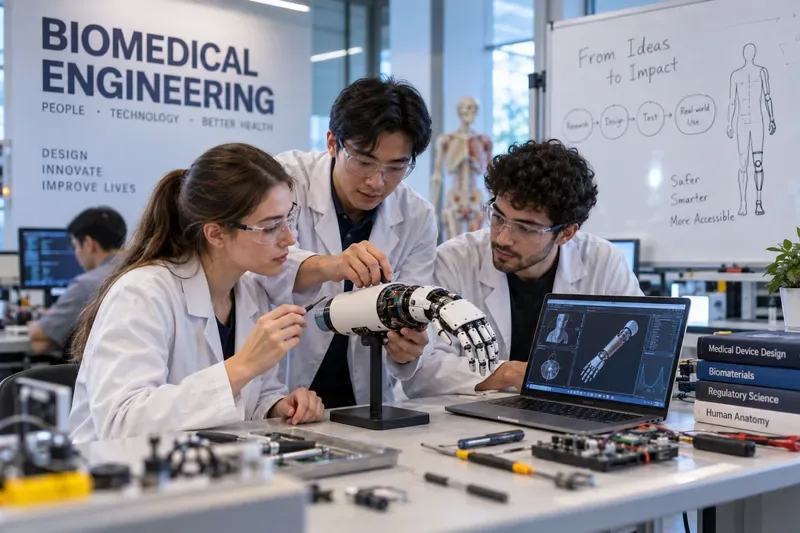
Students work on a robotic prosthetic-hand prototype in a biomedical engineering lab. Programs that combine physiology, electronics, software, prototyping, testing, and clinical design are particularly relevant to smart medical device development.
What should you look for before choosing a biomedical engineering program?
Start with the curriculum rather than the school name. ABET's 2026-2027 criteria for bioengineering and biomedical engineering programs require experience in applying engineering and biological science, solving biomedical problems, designing or realizing biomedical devices or systems, and making measurements on living systems. That is a useful baseline, but smart devices typically demand more than the baseline. See the current ABET engineering program criteria.
For a connected, software-enabled, or sensor-rich medical device, look for opportunities in several of these areas:
bioinstrumentation, sensors, circuits, and data acquisition;
embedded programming, computation, controls, or signal processing;
wearable, implantable, imaging, rehabilitation, or neural engineering;
hands-on prototyping with verification and validation;
clinical observation or projects with hospitals and clinicians;
human factors, risk analysis, quality systems, and regulatory strategy;
cybersecurity and connected-device software;
capstone work that produces a tested prototype rather than only a report.
The regulatory side is increasingly important. The FDA's Quality Management System Regulation became effective on February 2, 2026 and incorporates ISO 13485:2016 into the U.S. medical-device quality framework. The FDA also issued updated medical-device cybersecurity guidance in February 2026 for devices with cybersecurity risk. That means a student aiming at modern connected devices should value programs that expose students to requirements, documentation, verification, risk, software, and security—not only mechanical prototyping. See the FDA QMSR overview and the FDA's February 2026 medical-device cybersecurity guidance.
Which programs are especially strong for medical device design?
Program
Why it stands out for smart devices
Best fit for
Johns Hopkins University
Imaging & Medical Devices focus area, structured design requirements, longitudinal healthcare design teams
Clinical device design and translational projects
University of Michigan
Dedicated Medical Device Development track plus Imaging & Bioelectrics and Neural Engineering options
Students who want an explicit undergraduate device-development pathway
Georgia Tech / Emory
Clinical capstone, design history file, verification and validation, hospital relationships
Hands-on product development linked to real clinical needs
Stanford University
Bioengineering plus Biomedical Computation, early medical-device innovation coursework, Biodesign ecosystem
Health-tech innovation, computation, and entrepreneurship
Northwestern University
Required medical-device design with regulatory content plus bioelectronics for wearable and implantable systems
Wearables, implants, and structured product-development training
UC San Diego
Bioinstrumentation, design project sequence, strong device-oriented B.S. and professional M.Eng. option
Instrumentation-heavy devices and industry-oriented graduate study
1. Johns Hopkins: Is it a good choice for clinical device innovation?
Yes, especially if you want device design tied closely to medicine. Johns Hopkins Biomedical Engineering offers an undergraduate focus area in Imaging & Medical Devices. The current B.S. requirements include eight credits of design, with options that include year-long health-tech design teams and biomedical engineering instrumentation. The curriculum also requires foundational programming in Python or Java. See the official Johns Hopkins BME degree requirements.
The more distinctive feature is the design environment. Johns Hopkins says its BME design programs include more than 50 teams and 300 students each year across undergraduate and graduate offerings. Its undergraduate design teams work with clinical and industry mentors and cover not only prototyping but also regulatory frameworks, intellectual property, and business planning. See the Johns Hopkins BME Design program and Undergraduate Design Team details.
Choose Hopkins if: you want strong exposure to healthcare problems and multidisciplinary design and can take advantage of the medical-device, instrumentation, imaging, or neuroengineering options.
2. University of Michigan: Do you want a clearly labeled medical-device track?
Michigan is one of the clearest undergraduate options for that goal. Its BME major currently offers nine academic tracks, including Medical Device Development, Biomedical Imaging & Bioelectrics, and Neural Engineering. The Medical Device Development track is explicitly described as covering the end-to-end process of inventing, designing, and testing devices for clinical practice. See the University of Michigan BME undergraduate program and its current curriculum overview.
Michigan's design program also emphasizes real clients, professional mentorship, intellectual property, commercialization, budgeting, and design work connected to medical-device companies and clinical partners. That can matter if your objective is to leave school with a portfolio showing how you handled a real requirement, tradeoff, prototype, or stakeholder need. See the Michigan BME Design Program.
Choose Michigan if: you want a broad BME foundation but also want to declare a device-oriented direction without constructing the entire specialization from unrelated electives.
3. Georgia Tech and Emory: How much real product-development practice can you get?
A lot of the value here is in the clinical capstone structure. The Wallace H. Coulter Department of Biomedical Engineering is jointly offered by Georgia Tech and Emory University. Its undergraduate program emphasizes engineering, biology, computing, design, and clinical relevance. The two-semester capstone takes students from unmet clinical needs toward biomedical solutions and prototypes. See the official Georgia Tech/Emory BME undergraduate overview.
The department's Design Garden describes a capstone process that includes stakeholder interviews, design inputs, market assessment, verification and validation, intellectual-property analysis, a functional prototype, and a design history file. Students can also receive clinical access to Emory University Hospital and Grady Hospital, according to the program. See the official BME Design Garden.
For smart-device students, the standard four-year plan is also useful to inspect: it includes circuits and electronics as well as an instrumentation and electronics laboratory in the senior year, while depth electives can broaden the technical profile. See the Georgia Tech BME four-year plan.
Choose Georgia Tech/Emory if: you care about disciplined design process, clinical access, and building an engineering portfolio around real healthcare problems.
4. Stanford: Is it better for engineering or for health-tech innovation?
It can support both, but the distinction matters. Stanford's undergraduate Bioengineering B.S. builds a foundation in science, engineering, programming, and computational tools, while the department also offers a separate B.S. in Biomedical Computation. The Bioengineering program explicitly lists medical devices and medical imaging among possible career destinations. See the Stanford Bioengineering B.S..
For device innovation, Stanford's broader ecosystem is especially relevant. The Stanford Mussallem Center for Biodesign offers a project-based Medical Device Innovation course for freshmen and sophomores covering clinical needs, stakeholder interviews, ideation, prototyping, intellectual property, FDA regulation, reimbursement, and startup financing. See the official Medical Device Innovation course page.
For applicants who already hold advanced degrees or have substantial professional experience, Stanford's 10-month Biodesign Innovation Fellowship is a separate, later-career option focused on identifying health needs, inventing technologies, and preparing them for implementation. It is not an undergraduate substitute, so prospective students should distinguish it from the B.S. program. See the Stanford Biodesign Innovation Fellowship.
Choose Stanford if: you want to combine bioengineering or biomedical computation with an unusually strong health-technology innovation environment.
5. Northwestern: What if your interest is wearables, implants, or bioelectronics?
Northwestern deserves a close look for that combination. Its B.S. in Biomedical Engineering emphasizes quantitative problem solving and design, and the 2026-2027 curriculum includes a substantial engineering core plus BME major requirements. The program is ABET-accredited. See the Northwestern BME curriculum.
The required senior Biomedical Engineering Design course is particularly relevant to medical-device development: it uses open-ended team projects in the medical-device arena and covers reliability, safety, ethics, economics, FDA regulation, patents, requirements definition, verification and validation, and documentation. The follow-on design course continues into prototyping, testing, and risk mitigation. See the Northwestern Biomedical Engineering Design course.
Students interested in smart wearables and implants should also inspect Northwestern's Bioelectronics course, which covers sensors, stimulators, and device design for wearable and implantable bio-integrated electronics. See the official Bioelectronics course description.
Choose Northwestern if: your target is a sensor-rich wearable or implantable product and you want both device physics and structured product-development experience.
6. UC San Diego: Is it strong for bioinstrumentation and industry-focused device work?
Yes. UC San Diego's B.S. in Bioengineering explicitly says it prepares students for careers in the biomedical-device industry. The program covers biomechanics, biotransport, bioinstrumentation, bioelectricity, biosystems, biomaterials, and physiology. See the UC San Diego Bioengineering B.S..
The 2026-2027 course schedule includes Principles of Bioinstrumentation Design and a multi-part Bioengineering Design Project sequence, along with programming, modeling, controls, physiology, and laboratory work. Course availability can change, so applicants should always compare the current catalog with the year they expect to enroll. See the official UC San Diego undergraduate course offerings.
For graduate students who want a professional rather than research-centered path, UC San Diego also offers a Master of Engineering with a Medical Device Engineering specialization. The university describes it as preparation for design and project-engineering careers involving device design, development, manufacturing, and management. See the UC San Diego M.Eng. Medical Device specialization.
Choose UC San Diego if: you want a technically broad device foundation with visible strength in instrumentation and a clearly defined professional graduate route.
Should you study biomedical engineering, electrical engineering, or computer engineering?
If your main goal is to design the physiological interface, clinical workflow, biomaterials, biomechanics, or system-level medical product, biomedical engineering is a natural home. If your goal is primarily firmware, wireless communications, low-power electronics, ASICs, real-time embedded systems, or security, an electrical or computer engineering degree with biomedical electives may give you greater technical depth.
A strong smart-device team usually needs both. The practical question is therefore not “Which major sounds closest to medical devices?” but “Which major gives me the deepest skills in the part of the device I want to own?” A student who wants to develop a wearable ECG algorithm might prioritize signals, embedded computing, statistics, and physiology. Someone building an implantable electrode may prioritize bioelectronics, materials, biocompatibility, sensing, and neural engineering. A future systems engineer may need a broader mix of BME, requirements, risk, testing, and regulatory work.
What should you ask during a campus visit or admissions call?
Can undergraduates take a real bioinstrumentation or embedded-systems course, not only a survey class?
Does the capstone produce a physical or software-enabled prototype that is tested against defined requirements?
Do students work directly with clinicians, patients, hospital staff, or medical-device companies?
Are verification, validation, risk management, human factors, and regulatory documentation taught in the design sequence?
Can BME students take meaningful electrical engineering, computer engineering, machine learning, or cybersecurity electives without delaying graduation?
Are there labs working on wearable, implantable, imaging, rehabilitation, neural, robotic, or connected medical systems?
How easy is it for undergraduates to join those labs?
Are internships or co-ops integrated into the degree plan?
Can you see recent capstone projects and determine what students actually designed, fabricated, programmed, and tested?
Which program is the best fit for you?
There is no single best biomedical engineering program for every smart medical-device career. Johns Hopkins is compelling for clinically connected design and translational projects. Michigan stands out for its explicit Medical Device Development track. Georgia Tech/Emory is attractive for a capstone process closely modeled on real product development. Stanford is especially strong when bioengineering is combined with computation and the Biodesign ecosystem. Northwestern is a notable option for medical-device design plus wearable and implantable bioelectronics. UC San Diego offers strong bioinstrumentation foundations and a direct professional graduate specialization in medical-device engineering.
The best shortlist is the one that matches your intended technical role. Before applying, download each program's current degree plan and mark the courses that build your target stack: physiology, circuits, sensors, programming, signals, controls, device design, testing, human factors, cybersecurity, and regulatory systems. If a school is prestigious but forces you to assemble most of that stack outside the major, compare it carefully with a program where those experiences are built into the degree.
Program information and regulatory references in this article were checked on September 12, 2026. Curricula, course availability, admissions policies, accreditation status, and fellowship requirements can change, so verify the current university catalog and official program pages before applying.