Home
» New Trends
»
Where to Study Elder Care Management and Smart Healthcare Tech
Where to Study Elder Care Management and Smart Healthcare Tech
One of the hardest parts of planning a career in elder care is that the degree names do not line up neatly with the jobs. A student may want to manage senior living services, improve home-based care with sensors and telehealth, evaluate AI tools for older adults, or lead digital transformation in a health system. Yet those goals are often split across separate programs in gerontology, health administration, health informatics, engineering, and digital health.
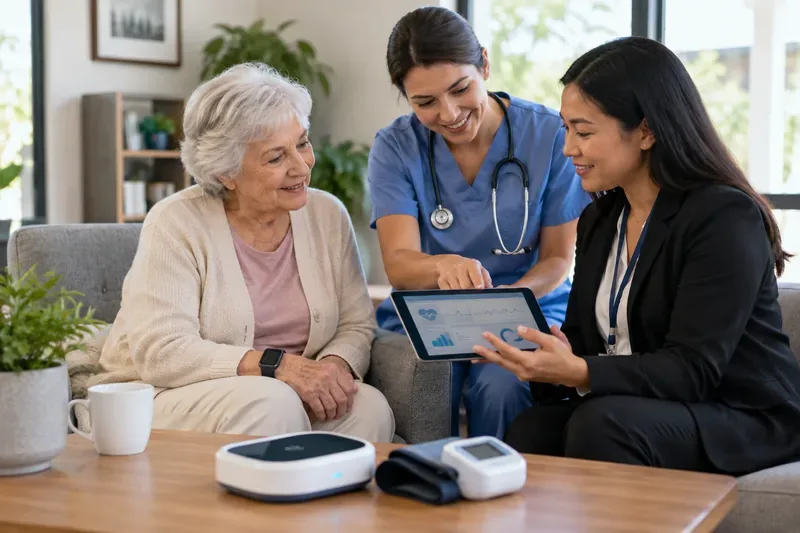
An older adult, a nurse, and a care-management professional review digital health information together, illustrating the overlap between person-centered elder care and healthcare technology.
The practical solution is not to search for one perfect degree title. Start by deciding which side of the problem you want to own: aging-services operations, technology and product development, or the bridge between them. That distinction matters because modern elder care increasingly depends on both coordinated services and digital infrastructure. The World Health Organization’s UN Decade of Healthy Ageing emphasizes person-centered integrated care and long-term care, while WHO’s Global Strategy on Digital Health 2020–2027 focuses on strengthening health systems through digital transformation.
Why this study choice is more complicated than it looks
Elder care management and smart healthcare technology solve related problems, but they use different professional languages. Aging-services programs usually emphasize care delivery, policy, finance, workforce management, ethics, housing, long-term services and supports, and the needs of older adults. Health informatics and digital-health programs tend to emphasize data, information systems, interoperability, implementation, analytics, user requirements, privacy, and emerging technologies.
That creates a common mismatch. A strong gerontology degree may teach you how to run services for older adults but offer only limited technical depth. A strong informatics program may teach you how to design or deploy healthcare systems without requiring much study of aging, disability, caregiving, or long-term care. The best choice depends on which gap you need your degree to close.
Start with the easiest decision: choose the job before the degree
Before comparing universities, write down the type of work you want to do three to five years after graduation. Most goals fit one of these three paths:
Aging-services leadership: managing senior living, home care, community services, care coordination, long-term care, or public aging programs.
Smart healthcare technology: working in health informatics, digital health, healthcare AI, data systems, product management, implementation, or clinical technology.
Hybrid AgeTech leadership: selecting, designing, implementing, or evaluating technology specifically for older adults, caregivers, senior living organizations, or home-based care.
If you are still unsure, the hybrid path is a useful test: ask whether you want to be primarily accountable for the care organization or primarily accountable for the technology. That answer usually narrows the field quickly.
A direct hybrid option: USC Master of Science in Applied Technology and Aging
For students who explicitly want aging plus technology in the same degree, the USC Master of Science in Applied Technology and Aging is one of the clearest matches currently available. USC describes the program as preparation for applying technology to challenges faced by an aging population. The 32-unit program is available online or on campus, and USC lists a typical completion time of 12–18 months full time or 18–36 months part time.
The curriculum is notable because it does not simply add one technology elective to a general gerontology degree. Required coursework includes gerontechnology, novel technologies in aging and assisted living, adaptive age-friendly environments and injury prevention, plus a field practicum. That makes it especially relevant for people interested in AgeTech product strategy, senior-living innovation, assistive technology, remote support, or technology-enabled independence.
As of September 12, 2026, USC lists October 15, 2026 as the Spring 2027 deadline and March 15, 2027 as the Fall 2027 deadline, with rolling consideration after the priority deadline. Applicants should confirm those dates again before submitting because admissions schedules can change.
If you want to lead elder-care organizations first: USC or UMass Boston
USC Master of Arts in Aging Services Management
The USC Master of Arts in Aging Services Management is a better fit when your main goal is to manage services, programs, products, or organizations for older adults. It is also a 32-unit program offered online or on campus. Its curriculum combines gerontology with business topics such as marketing, finance, operations, legal and regulatory issues, and leadership.
This is not a technical computing degree, but it can still support an innovation-oriented career. USC includes technology-related study within its aging-services ecosystem, and the degree is designed for leaders working across areas that include technology, care, housing, policy, and social services. Choose this route if you expect to manage a senior-care organization or business and need to understand technology well enough to evaluate and deploy it rather than build the underlying systems yourself.
UMass Boston MS in Gerontology: Management of Aging Services
The UMass Boston MS in Gerontology: Management of Aging Services is a strong online option for working professionals. The current 36-credit curriculum covers aging policy, service delivery, organization and financing of aging services, human resources, research methods for managers, and a capstone project. Students can also choose a Technology and Aging elective.
The strength here is operational depth. If you want to become an executive director, program director, aging-services administrator, care-coordination leader, or policy professional, the program is closely aligned with those responsibilities. The tradeoff is that one technology elective does not provide the same technical concentration as a health-informatics or AgeTech degree. A student targeting smart healthcare should therefore use the capstone, electives, and workplace projects to build a technology-focused portfolio.
If you want smart healthcare technology first: study health informatics or digital health
University of Michigan Master of Health Informatics
The University of Michigan Master of Health Informatics is a two-year, interdisciplinary program offered jointly through the School of Information, School of Public Health, and Medical School. Its 45-credit curriculum covers health systems, policy, emerging technologies, behavioral and organizational science, and a hands-on capstone. Michigan also notes options to focus on areas such as Big Data and AI in Health Care or Management and Leadership in Health Informatics.
This route makes sense if you want to work on clinical information systems, data-driven care, healthcare AI, implementation, or digital transformation and then specialize in aging through internships, research, or the capstone. It is less direct for students whose primary goal is senior-living administration or long-term-care operations. As of September 2026, Michigan lists Fall 2027 as the next term, with a January 15 priority application deadline and May 1 final deadline.
Karolinska Institutet and Stockholm University Joint Master’s in Health Informatics
The 2026–2027 course structure includes healthcare organization and management, computer applications in healthcare and biomedicine, requirements engineering and evaluation, standardization, data science, information security, project management, current research, and a degree project. That combination is useful for people who want a technically grounded role in smart healthcare. To make it elder-care specific, your thesis or project should focus on areas such as remote monitoring, dementia support, medication management, fall prevention, care coordination, or age-friendly interface design.
UCL Digital Health and Entrepreneurship MSc
The UCL Digital Health and Entrepreneurship MSc is most relevant for students who want to build, evaluate, commercialize, or lead digital-health products. UCL’s 2026/27 page describes a one-calendar-year full-time option as well as part-time and modular study. The program combines health, digital innovation, and entrepreneurship rather than focusing specifically on aging.
This can be a good route for a future AgeTech founder or product leader, but the specialization is your responsibility. Prospective students should use older adults as the target population for projects, seek placements in aging or long-term-care settings, and verify the 2027/28 admissions page because the 2026/27 application window has already closed.
Quick comparison: which program fits which goal?
Program
Strongest focus
Best fit
Main tradeoff
USC MS Applied Technology and Aging
Aging + technology
AgeTech, assistive tech, senior-living innovation
Less depth in software engineering or advanced data science than a computing-heavy degree
USC MA Aging Services Management
Management + gerontology
Leadership in aging services, senior care, housing, programs
Technology is not the core technical discipline
UMass Boston MS Management of Aging Services
Operations, policy, long-term services
Working professionals moving into elder-care leadership
Technology depth depends heavily on electives and capstone choices
University of Michigan MHI
Health informatics, data, implementation
Healthcare AI, information systems, digital transformation
Not specifically centered on older adults
Karolinska/Stockholm Joint Master’s in Health Informatics
Health IT, data, standards, systems
Technical and interdisciplinary smart-healthcare roles
Requires you to create your own aging specialization
The harder but often better solution: build your own hybrid specialization
If no single program perfectly matches your goal, you can create the combination intentionally. The key is to avoid collecting unrelated electives. Your coursework, field experience, and final project should all point toward one coherent problem in aging.
For example, a health-informatics student could focus on medication adherence for older adults, remote monitoring after hospital discharge, caregiver data-sharing, or usability of patient portals for people with sensory or cognitive limitations. An aging-services student could focus on technology procurement, implementation of telehealth in senior housing, workforce adoption of digital documentation, evaluation of fall-detection systems, or governance of AI-assisted care tools.
A strong hybrid plan should expose you to five areas: aging and functional ability; health or long-term-care operations; data and digital systems; human-centered design and accessibility; and implementation, ethics, privacy, or regulation. You do not need every topic in the program title, but you should be able to show where each competency appears in your coursework or applied work.
What to check before you apply
Program pages change, so do not choose based only on a university’s reputation or an old ranking. Open the current curriculum and verify the actual courses you would take. Look for a practicum, internship, capstone, thesis, or client project where you can work on a real healthcare or aging problem. Check whether faculty research overlaps with your intended area, whether online students receive equivalent project opportunities, and whether the degree is designed for your background.
Also check professional requirements in the country or state where you plan to work. A degree in gerontology or health informatics does not automatically qualify someone for every licensed nursing-home-administrator, clinical, or regulated healthcare role. Licensure and certification requirements can be jurisdiction-specific.
Self-check: did you choose the right program?
Before paying an application fee, you should be able to answer all of these questions clearly:
What job title or responsibility am I targeting after graduation?
Do I need deeper expertise in aging-services operations or in digital technology?
Does the required curriculum—not just the elective list—cover my biggest skill gap?
Can I complete a project, practicum, or thesis involving older adults or elder-care organizations?
Will I graduate with evidence of applied work, not only classroom knowledge?
Have I checked the current 2026–2027 or 2027–2028 program page, deadlines, delivery format, and admissions requirements?
If you can answer yes to those questions and explain how the program connects your target population, your target job, and your target technical or management skills, you are probably evaluating the right kind of degree. If you cannot, change the program shortlist before you change your career goal. The strongest path is the one that makes your future role more concrete—not the one with the broadest collection of fashionable healthcare and technology terms.