Home
» New Trends
»
Where to Study Cross-Border Digital Supply Chain Management: A Practical Program Guide
Where to Study Cross-Border Digital Supply Chain Management: A Practical Program Guide
If you want to work where global trade meets data, automation, procurement, and logistics, do not search only for a degree with the exact phrase “cross-border digital supply chain management.” As of September 2026, that phrase is better treated as a skill combination than a standardized degree title. The strongest programs usually sit in one of three camps: analytically rigorous supply chain programs, globally oriented logistics programs, or operations degrees with serious digital and data content.
The practical goal is to find a program that covers enough of four areas: cross-border logistics and sourcing, quantitative decision-making, digital systems and analytics, and real-world international exposure. The right balance depends on the job you want after graduation.
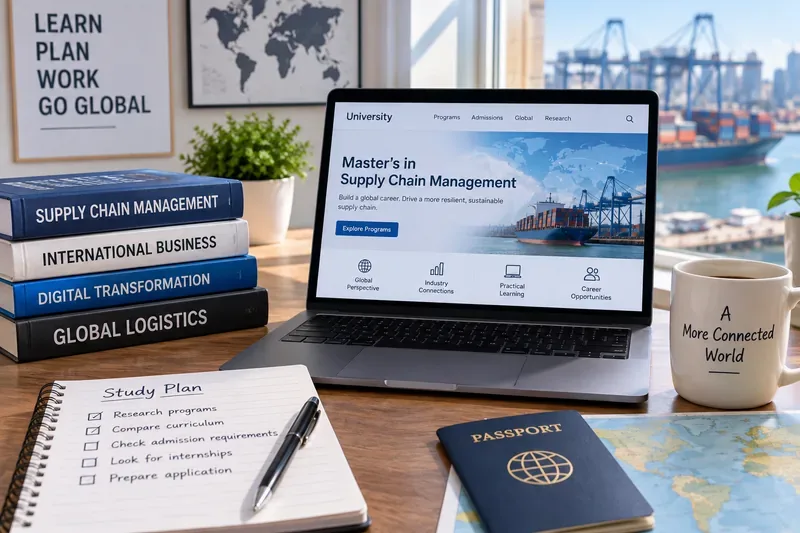
A study workspace combines supply chain, international business, digital transformation, and global logistics materials—the mix of subjects worth looking for when comparing cross-border supply chain programs.
First, understand what “cross-border digital supply chain” actually means
A cross-border supply chain moves goods, information, money, and risk across national borders. The “digital” part refers to the technologies and data practices used to plan, monitor, coordinate, and improve that flow. In a modern curriculum, this can include forecasting, optimization, business analytics, enterprise systems, cloud platforms, traceability technologies, automation, artificial intelligence, digital procurement, and data governance.
That is broader than logistics alone. A freight-focused degree may teach transportation very well but say little about analytics. A business analytics degree may teach Python and machine learning but barely address sourcing, trade routes, inventory, ports, supplier relationships, or customs exposure. Your task is to find the overlap that matches your intended career.
Decide which job family you are preparing for
Before comparing universities, pick the type of problem you want to solve. This prevents a common mistake: choosing a famous program whose strengths do not match the work you actually want to do.
May devote less time to customs, sourcing contracts, or trade compliance
Global logistics and distribution
Transportation, ports, warehousing, international logistics, resilience, network design
Digital content can be lighter unless analytics modules are explicit
Procurement and global sourcing
Supplier management, sourcing, contracts, digital procurement, cost analysis, risk
May be less technical than a quantitatively focused SCM degree
Digital transformation of supply chains
ERP, cloud infrastructure, AI, robotics, blockchain/traceability, cybersecurity, data architecture
Technology coverage can be broad rather than deep
Cross-border operations leadership
Global operations, international business, supply chain strategy, analytics, projects with companies
Often broad; you may need to add specialist trade-compliance training separately
Programs worth comparing in 2026
The programs below are not ranked from best to worst. They solve different needs. All details should be rechecked before applying because modules, fees, deadlines, and entry rules can change by intake.
MIT SCALE: strongest fit for quantitatively ambitious supply chain professionals
The MIT Global SCALE Network is a useful benchmark if you want a technically demanding supply chain education with international reach. Its master's curricula include analytical methods, logistics systems, database analysis or information systems, finance, economics, leadership, and a research project. Students across SCALE centers also participate in SCALE Connect at MIT, which adds a multinational network component.
This route is especially attractive for people targeting supply chain analytics, network design, planning, consulting, or technology-enabled operations. The trade-off is intensity and selectivity. MIT's residential pathway is designed for applicants with quantitative preparation and relevant experience, while the blended route requires the MITx MicroMasters credential. If you are coming directly from a non-quantitative undergraduate degree with little work experience, it may not be the easiest first step.
University of Warwick: strong for digital transformation plus global supply networks
Warwick's MSc in Supply Chain and Logistics Management is one of the clearest options for applicants who specifically want digital themes inside a conventional supply chain degree. The 2026 course description names cloud-based supply chain infrastructure, blockchain-based product traceability and information security, robotics, and artificial intelligence in logistics and warehousing. It also emphasizes resilience, sustainability, data analytics, procurement, production scheduling, and distribution planning.
This makes Warwick a good fit if you want a one-year UK master's that connects operations with digitization rather than treating technology as a separate specialization. The limitation is that “cross-border” is still broader than customs and trade law. If your goal is sanctions screening, customs classification, VAT, or trade-control compliance, verify whether electives or external credentials cover those areas.
Kühne Logistics University: strong for global logistics immersion in Europe or Southeast Asia
Kühne Logistics University offers its MSc in Global Logistics and Supply Chain Management through Hamburg and Saigon. The Saigon program explicitly combines international business perspectives with sustainability and digitalization, uses case studies, projects, simulations, and company visits, and offers an optional semester in Hamburg. That structure can be particularly useful if you want exposure to Southeast Asian manufacturing and trade flows while keeping a European logistics connection.
KLU is a good fit for students who want logistics and supply chain to be the center of the degree rather than one concentration inside a broader business program. The trade-off is that its digital component should still be inspected at module level if you want heavy programming, machine learning, or advanced optimization.
National University of Singapore: strong for Asia-facing digital supply chains
NUS describes its MSc in Supply Chain Management as a multidisciplinary program for planning, designing, and managing modern supply chains in Asia with a global context. It specifically highlights the digitalized global economy, business analytics, and industrial systems engineering and management.
That combination makes NUS a compelling choice if your intended career is tied to Southeast Asia, regional headquarters, electronics, maritime trade, e-commerce, or multinational operations. It gives you a useful geographic advantage: Singapore is deeply connected to regional logistics and global commerce. The main question to check is how much direct customs, trade finance, procurement, or regulatory content appears in the exact modules available for your intake.
Hong Kong Polytechnic University: strong for sourcing, procurement, and applied digital skills
PolyU's MSc in Global Supply Chain Management is especially relevant if you see cross-border supply chains through the lens of sourcing and procurement. Its curriculum includes International Logistics Systems, Supply Chain Management, Global Sourcing and Supply, and options such as Digital Procurement Management and Analytics. The program structure also lists Coding for Management with Python and Business Analytics among available subjects.
This is a practical combination for careers that sit between supplier management, international logistics, procurement technology, and analytics. Hong Kong also offers a natural cross-border business setting. The trade-off is that students seeking mathematically intensive optimization or machine-learning depth may prefer a more analytics-heavy program.
Rotterdam School of Management: strong for European logistics, decision analytics, and industry exposure
RSM's MSc Supply Chain Management combines decision analytics, purchasing and supply management, distribution networks, sustainability, and industry exposure. The setting matters: Rotterdam places students close to one of Europe's most important logistics and port ecosystems, and the program emphasizes company visits, consultancy work, and thesis research connected with practice.
Choose RSM if you want European supply chain strategy and analytics with strong logistics context. If advanced digital architecture, coding, automation, or AI is your primary goal, compare the exact elective mix with programs that explicitly name those technologies.
HKUST MSc in Global Operations: useful if you want a broader operations-and-analytics route
HKUST's MSc in Global Operations is broader than a pure supply chain degree, but that can be an advantage for students aiming at operations leadership. The program includes Global Supply Chain Management and Business Modeling and Optimization, while electives have included big data analytics, ERP and enterprise systems management, logistics management, digital business, and simulation for risk and operations analysis. The program also emphasizes digital innovation and global operational strategy.
This is a good fit if you want flexibility across supply chain, operations, analytics, and transformation roles. It is less ideal if you want your transcript to be narrowly branded around logistics or procurement.
You do not need to be a programmer or customs specialist before starting, but you will get more value from these programs if you arrive with a basic analytical and commercial foundation.
Quantitative basics: refresh statistics, probability, algebra, and spreadsheet modeling. More technical programs may expect calculus or stronger quantitative coursework.
Data skills: become comfortable with Excel first, then learn basic SQL and either Python or R. You do not need advanced machine learning to begin.
Supply chain fundamentals: understand inventory, forecasting, procurement, transportation, warehousing, and the difference between push and pull systems.
International trade vocabulary: learn what Incoterms, customs classification, duties, country of origin, trade finance, sanctions, and export controls mean. A degree may not teach all of them in depth.
Business communication: cross-border supply chains require explaining quantitative decisions to procurement, finance, suppliers, regulators, and executives across cultures.
How to compare programs without being distracted by marketing
Download the actual curriculum for each intake and mark every course against four columns: global trade/logistics, quantitative methods, digital systems, and experiential learning. A program that looks “digital” because its website mentions AI may still offer only one technology elective. Likewise, a “global” degree can be international in student mix without teaching global sourcing or trade processes.
Then ask three practical questions. First, are the digital subjects compulsory or optional? Second, are company projects, internships, labs, simulations, or field visits built into the degree? Third, does the program teach enough of the region where you want to work? A student targeting ASEAN manufacturing has different needs from someone targeting EU distribution or North American supply chain analytics.
Common mistakes to avoid
Choosing by university name alone
A strong university can still have a program that is too broad for your goal. Compare modules, assessment methods, faculty expertise, and industry projects before prestige.
Assuming digital supply chain means software engineering
Most supply chain master's degrees teach technology as a management and decision tool, not as deep software development. If you want to build optimization engines, data platforms, or AI systems, you may need additional computer science, data engineering, or operations research coursework.
Ignoring trade compliance
Cross-border work can involve customs, sanctions, export controls, product regulations, tax, documentation, and data-transfer rules. Many excellent supply chain degrees do not cover all of these. If compliance is central to your intended role, plan a second credential or specialist training rather than assuming the master's includes it.
Overlooking geography
Location can be part of the curriculum. Rotterdam, Hamburg, Singapore, Hong Kong, and major manufacturing centers expose students to different trade lanes, industries, and regulatory environments. Choose a region that supports the network you want to build.
A practical way to make your shortlist
For a quantitatively strong applicant with professional experience, MIT SCALE is a natural benchmark. For a one-year program with unusually explicit digital-transformation content, Warwick deserves close attention. For logistics-centered study in Europe or Southeast Asia, KLU offers a distinctive geographic choice. For Asia-facing digital supply chains, NUS is a strong fit. For sourcing and digital procurement, PolyU stands out. For European port and decision-analytics exposure, RSM is compelling. For broader global operations with analytics flexibility, HKUST can make more sense than a narrowly branded supply chain degree.
The best program is therefore not the one with the longest technology list. It is the one that gives you the right combination of trade context, quantitative depth, digital fluency, and industry exposure for the role and region you actually want.
Source check
Program information in this article was checked against official university and program pages available on September 13, 2026. Curricula, tuition, deadlines, and entry requirements can change by intake, so verify the latest version directly with each university before applying.