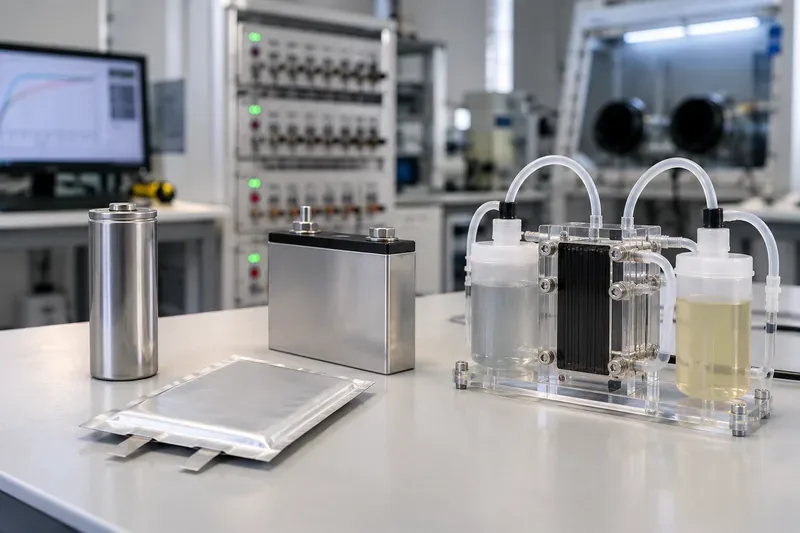
Students searching for a degree in “carbon capture engineering” quickly run into a naming problem: the field is real, but the degree title is not standardized. Carbon capture, utilization and storage (CCUS) sits across chemical engineering, environmental engineering, petroleum and geosystems engineering, materials science, energy systems, and geoscience. As a result, the strongest choice is usually not the school with the most impressive label. It is the program that gives you the technical depth, project access, and research exposure needed for the part of the carbon-management chain you actually want to work on.
Verified in September 2026: the programs and research routes below were checked against official university pages and U.S. government technical resources. Program availability, faculty projects, fees, and lab access can change, so applicants should re-check the linked university pages before submitting an application.
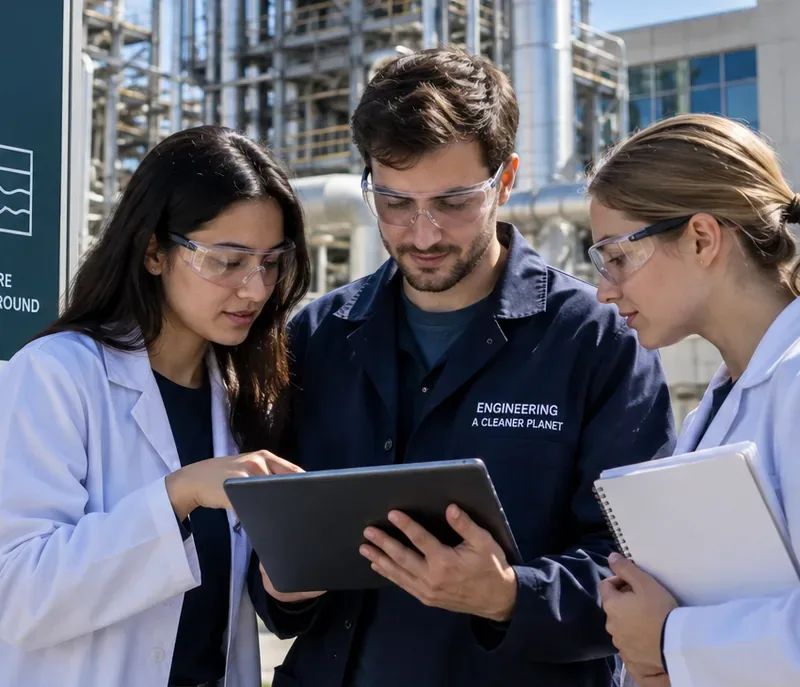
Three engineering students review technical material beside industrial process equipment, illustrating the multidisciplinary, hands-on environment that can support carbon capture training.
What should a good carbon capture program help you do?
A useful program should leave you able to solve engineering problems, not simply recognize climate terminology. The U.S. National Energy Technology Laboratory identifies CCUS workforce needs that span process and chemical engineering, mechanical systems, geoscience, reservoir engineering, environmental assessment, instrumentation, data analytics, regulatory knowledge, and project management. See the NETL CCUS workforce resource.
For a capture-focused career, the strongest technical signals are coursework or research in separations, thermodynamics, heat and mass transfer, process control, solvents, sorbents, membranes, and process integration. For storage-focused work, look for reservoir engineering, multiphase flow, geomechanics, well design, site characterization, monitoring, reporting and verification. For systems or environmental roles, add life-cycle assessment, techno-economics, environmental impacts, policy, permitting, and uncertainty analysis.
Action: before comparing universities, write down the two job functions you most want to perform—for example, “design post-combustion capture processes” and “run process simulations,” or “model CO2 injection” and “support Class VI permitting.” Use those functions as your filter.
How to judge program quality before you apply
At the undergraduate level, a rigorous engineering foundation matters more than having “carbon capture” in the degree name. In the United States, the 2026–2027 ABET engineering criteria show why: chemical engineering programs emphasize material and energy balances, thermodynamics, fluid mechanics, heat and mass transfer, reaction engineering, process control, and separations, while environmental engineering programs add fate and transport, laboratory work, environmental systems design, life-cycle thinking, and regulation.
At the graduate level, specialization becomes more important. A good match usually has at least three of the following: dedicated CCUS courses, faculty currently publishing in your target area, a thesis or substantial project option, access to pilot or laboratory facilities, industry-connected projects, computational modeling, and exposure to economics or regulation.
Action: open the current course catalog and faculty research pages. If you cannot identify at least three relevant courses and two potential faculty or project groups, treat the program as a weak fit regardless of its overall reputation.
Strong programs and pathways to consider
| University and route |
What is verified |
Best fit |
Important limitation to check |
| Colorado School of Mines — M.S. in Carbon Capture, Utilization and Storage |
Fully online, non-thesis CCUS master's with 30 graduate credits, a capstone, and electives spanning geological storage, non-geologic capture and utilization, CO2 reaction kinetics, biological capture, and Class VI well design and permitting. |
Working professionals or students who want a direct, full-value-chain CCUS credential. |
Online, non-thesis delivery may not suit applicants who need intensive laboratory research. |
| Imperial College London — Chemical Engineering MEng or Advanced Chemical Engineering MSc |
Carbon capture appears in chemical engineering teaching and research; Imperial operates a four-story carbon capture pilot plant, and its advanced chemical engineering MSc lists carbon capture-related study among its sustainability options. |
Capture-process engineering, plant operations, controls, and chemical engineering fundamentals. |
Do not assume every MSc student gets the same hands-on pilot-plant access; confirm access for your chosen module or project. |
| University of Edinburgh — MSc GeoEnergy and carbon-capture research |
The GeoEnergy MSc includes carbon capture and storage, while the School of Engineering's carbon capture group works on adsorption, membranes, modeling, process integration, and related separation technologies. |
Students interested in linking geoscience, storage, capture materials, and energy transition work. |
The degree is broader than a capture-only engineering program. |
| University of Texas at Austin — Petroleum and Geosystems Engineering M.S./Ph.D. |
Graduate research explicitly includes carbon capture and storage; UT Chemical Engineering also reports major carbon-capture and sequestration research and a dedicated test facility. |
Subsurface storage, reservoir and geosystems research, or interdisciplinary CCS research. |
CCS activity spans departments, so verify which labs and advisers are accessible through your specific degree. |
| Carnegie Mellon University — Chemical Engineering M.S., M.S. Applied Study, or MChE |
Master's programs emphasize numerical methods, computational fluid mechanics, process simulation, and optimization; departmental research includes carbon capture, utilization and sequestration within energy and decarbonization work. |
Process systems, optimization, computational design, membranes, and research-oriented chemical engineering. |
A general chemical engineering master's does not guarantee a carbon-capture project; adviser and project selection matter. |
| University of Wyoming — Chemical Engineering M.S. plus CCUS ecosystem |
The Chemical Engineering M.S. lists faculty expertise in carbon capture, utilization and storage; the university also offers a CCUS undergraduate certificate and operates major energy and carbon-storage research programs. |
Applied energy research, capture/storage exposure, and students who want access to a state with active CCUS field projects. |
The dedicated CCUS certificate is undergraduate; graduate students should verify how their M.S. research will connect to CCUS centers and projects. |
| Heriot-Watt University — CCS research-degree route |
Heriot-Watt lists full-time and part-time CCS research centered on subsurface CO2 behavior, core flooding, pore-scale work, field data, and reservoir simulation. |
Doctoral or research-intensive students focused on geological storage and subsurface engineering. |
This is a research route rather than a standardized taught master's in “carbon capture engineering.” |
Colorado School of Mines: the clearest direct CCUS degree
Among the programs checked, Colorado School of Mines has the most explicit degree title for students who want a dedicated CCUS credential. The current M.S. in Carbon Capture, Utilization and Storage is fully online and non-thesis. The university catalog lists a 30-credit structure with core work in climate and sustainability, the political economy of the energy transition, and a CCUS capstone, plus electives including geological CCUS, non-geologic capture and utilization, CO2 reaction kinetics, biological carbon capture, and Class VI well design and permitting. The official Mines catalog provides the current requirements.
This route is particularly strong for someone who already works in engineering, geoscience, energy, or policy and needs structured coverage of the full carbon chain. The trade-off is that a non-thesis online degree is not the same as a laboratory-intensive research master's.
Action: choose Mines if breadth, flexibility, and a direct CCUS credential matter most. Choose a thesis-heavy alternative if your next goal is a Ph.D. or experimental R&D role.
Imperial College London: strong for capture-process engineering and pilot-scale learning
Imperial's advantage is the combination of core chemical engineering and unusually visible carbon-capture infrastructure. Its Carbon Capture Pilot Plant spans four floors and is used for student and researcher training in process operations and controls. Imperial's Advanced Chemical Engineering MSc options include sustainability teaching with carbon capture and clean-fuels content, while the undergraduate MEng also uses the pilot plant in chemical engineering training.
The quality signal here is not the degree label; it is exposure to real process-engineering concepts at pilot scale. That is valuable for students who want to understand how separation chemistry, instrumentation, control, and plant design interact.
Action: before applying, ask the department exactly which modules, projects, or research groups would let you use or work with data from the pilot plant. Facility presence alone does not guarantee personal access.
University of Edinburgh: good for GeoEnergy, storage, membranes, and adsorption
The University of Edinburgh's MSc GeoEnergy explicitly includes carbon capture and storage within a broader geoenergy curriculum. Separately, the School of Engineering's carbon capture research group works on adsorption, membranes, molecular modeling, process modeling, and process integration.
This makes Edinburgh especially interesting if you do not want to choose between “capture” and “storage” too early. However, a broad GeoEnergy degree may provide less process-design depth than a chemical engineering master's if your goal is to design solvent regeneration systems or separation trains.
Action: compare your desired role with the dissertation topics and optional courses. If you want capture chemistry, prioritize a supervisor in the engineering carbon-capture group; if you want subsurface storage, prioritize the GeoEnergy and geoscience route.
UT Austin: a research ecosystem for subsurface CCS and capture
The University of Texas at Austin does not present a single graduate degree titled “carbon capture engineering,” but it has substantial CCS work across departments. The Hildebrand Department of Petroleum and Geosystems Engineering graduate program explicitly identifies carbon capture and storage among its graduate research areas. UT Chemical Engineering also describes a major carbon capture and sequestration research program and a test facility for carbon-emissions technologies.
This is a strong example of why applicants should evaluate the research ecosystem rather than only the degree name. It may be particularly compelling for students interested in reservoir behavior, injection, storage integrity, transport, or cross-disciplinary carbon management.
Action: identify a prospective adviser before applying and ask whether your degree home gives you practical access to the cross-department facilities or collaborations you care about.
Carnegie Mellon: strong for computational process systems and optimization
Carnegie Mellon's Chemical Engineering master's programs emphasize numerical methods, computational fluid mechanics, process simulation, and optimization. Its energy, decarbonization and sustainability research includes carbon capture, utilization and sequestration, alongside industrial decarbonization and low-carbon process design.
That makes CMU a strong fit for students who want to model capture systems, optimize energy penalties, compare process configurations, or connect materials and process design. The limitation is specialization: the master's degree itself is broader than CCUS.
Action: review current faculty projects before applying. If you cannot identify a faculty member working on capture, separation, decarbonization, or related process systems, do not assume the general computational strength will automatically produce a CCS-focused experience.
University of Wyoming: useful for applied energy and storage context
The University of Wyoming's Chemical Engineering M.S. lists expertise in carbon capture, utilization and storage, while the School of Energy Resources supports applied carbon research. Undergraduates can also pursue the university's CCUS certificate. The university's carbon-storage work includes field-scale characterization and CarbonSAFE projects, which can be relevant for students interested in the practical transition from laboratory concepts to deployment.
Action: graduate applicants should ask which current M.S. advisers are tied to the carbon-storage or carbon-management centers and whether funded thesis opportunities are available in the year they plan to enroll.
Heriot-Watt University: a research route for geological storage specialists
Heriot-Watt's Carbon Capture and Storage research program focuses heavily on subsurface CO2 behavior, field data, core flooding, pore-scale visualization, and reservoir simulation. This is better understood as a research-degree pathway than as a standard taught master's with a fixed CCUS curriculum.
Action: consider this route if your goal is doctoral-level subsurface research. If you need a broad taught program or a fast professional credential, compare it with Mines or a taught GeoEnergy/chemical engineering master's instead.
Which degree background is best for carbon capture?
There is no single correct major. Chemical engineering is usually the most direct route to capture-process design because the field depends on separations, thermodynamics, mass transfer, process control, and reaction engineering. Petroleum, geosystems, geological, and reservoir engineering are often stronger for transport, injection, storage, and monitoring. Environmental engineering is valuable for emissions, environmental impacts, life-cycle thinking, regulation, and systems design. Materials science can be ideal for sorbents, membranes, catalysts, and porous materials.
The technology landscape also changes. DOE/NETL's Point Source Carbon Capture program currently covers solvents, sorbents, membranes, hybrid systems, and other advanced concepts. That breadth means a student trained deeply in one engineering discipline can still move into CCUS through research, internships, or graduate specialization.
Action: if you are choosing a bachelor's degree, prioritize a rigorous engineering discipline with strong fundamentals and then add carbon-focused research or electives. If you already hold an engineering degree, graduate specialization can be a faster route.
When should you change your program-search strategy?
- If you want capture-process design but the curriculum is mostly policy or geology: move toward chemical engineering, process systems, or separations.
- If you want geological storage but the program has no reservoir, geomechanics, or subsurface modeling: move toward geosystems, petroleum, geoenergy, or geological engineering.
- If you want experimental R&D but the degree is fully online and non-thesis: look for a thesis master's or Ph.D. with active laboratories.
- If you want industry deployment but all work is early-stage materials science: look for pilot plants, process design, techno-economics, permitting, and industry projects.
- If the school lists impressive facilities but cannot explain student access: do not count those facilities as part of your decision until access is confirmed.
Action: treat these as stop signs. A famous school with the wrong training mix can be a worse career fit than a less famous program with the right adviser, project, and facilities.
A practical application checklist
- Can you name the CCUS role you want: capture, transport, utilization, storage, MRV, environmental analysis, or systems integration?
- Does the curriculum teach the engineering fundamentals needed for that role?
- Are at least two faculty members currently active in your target area?
- Can students complete a thesis, capstone, independent project, or substantial design project related to CCUS?
- Are relevant pilot plants, laboratories, field projects, or computational tools actually accessible to students in your degree?
- Does the program expose you to safety, regulation, economics, and environmental impacts—not only technical theory?
- Can you point to a realistic path to an internship, research assistantship, or industry project, while recognizing that placement is rarely guaranteed?
If you can answer “yes” to most of these questions, the program is likely giving you more than a climate-themed credential: it is giving you a usable engineering pathway.
The bottom line
For a direct professional CCUS degree, Colorado School of Mines is unusually explicit. For pilot-scale chemical engineering and capture-process training, Imperial is a strong option. For GeoEnergy and a bridge between capture and storage, Edinburgh is compelling. UT Austin stands out as a cross-department research ecosystem, particularly for subsurface CCS. Carnegie Mellon is especially attractive for computational process systems and optimization. Wyoming offers applied energy and storage context, while Heriot-Watt is a strong research route for subsurface specialists.
None of these is automatically “best” for every student. The best program is the one that produces the outcome you need: technical depth in your chosen part of CCUS, evidence of real project work, access to the right people and facilities, and a credible next step into industry or research.
Final action: shortlist three programs, then email each one the same four questions: Which current courses map to my target role? Which faculty are taking students? What facilities or datasets can students actually use? What kind of CCUS project can I complete before graduating? The quality and specificity of those answers can tell you more than a generic ranking.