Home
» New Trends
»
Where to Study Brain-Computer Interface Engineering: 8 Best-Fit Degree Programs for 2026–2027
Where to Study Brain-Computer Interface Engineering: 8 Best-Fit Degree Programs for 2026–2027
Brain-computer interface (BCI) engineering is moving from a niche research topic toward a more visible academic pathway. A notable 2026 change is Carnegie Mellon University’s launch of a new M.S. in Neural Technologies, with dedicated tracks in neural interfaces and in neural computation and AI. That matters because students can now find programs that explicitly connect neuroscience, signal processing, machine learning, robotics, and neural devices rather than assembling those pieces entirely on their own. See the university’s January 2026 program announcement and current M.S. in Neural Technologies curriculum.
There is still no single “best BCI degree” for everyone. BCI engineering is interdisciplinary, and universities organize it under names such as neural engineering, neurotechnology, biomedical engineering, electrical engineering, neural computation, or neuroscience and neurotechnology. The right program is the one that produces the skills and research evidence you need for your intended role.
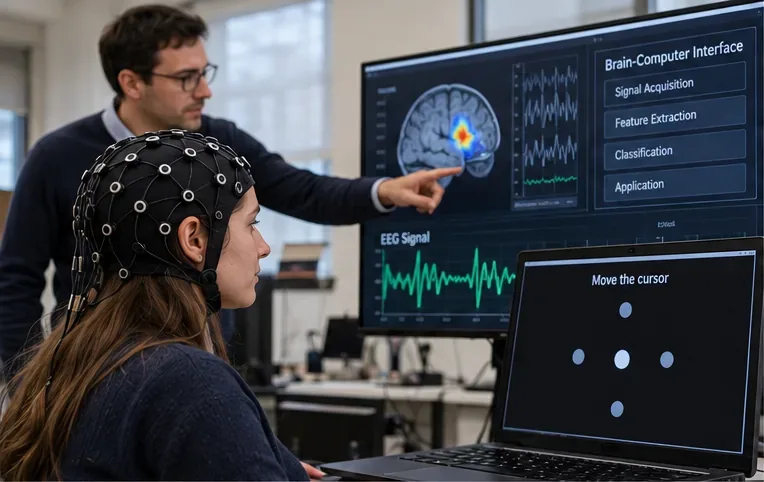
A student wearing an EEG cap works with brain-signal displays in a neuroengineering lab, illustrating the combination of neural sensing, signal analysis, software, and human testing that strong BCI programs try to integrate.
What a Strong BCI Program Should Help You Produce
Before comparing universities, define the outcome you want. A good BCI education should leave you with more than a transcript. By graduation, you should be able to show evidence that you can work across several parts of a neural-interface system.
Neural signal competence: understand signals such as EEG, ECoG, intracortical recordings, EMG, or related biosignals, including noise, artifacts, referencing, filtering, and sampling.
Signal-processing and machine-learning skills: extract features, build decoding or classification models, evaluate them correctly, and understand where model performance can fail.
Neuroscience literacy: connect algorithms to the physiology and behavior that generated the data.
Engineering implementation: work with sensors, amplifiers, embedded systems, real-time pipelines, robotics, stimulation, or human-computer interaction when your target role requires it.
Research evidence: complete a thesis, capstone, substantial lab project, publication, conference poster, or well-documented portfolio that uses real neural or physiological data.
Safety, ethics, and translation: understand human-subject research, neuroethics, medical-device constraints, and the difference between a laboratory demonstration and a clinically usable system.
If a program looks impressive but offers no practical route to these outcomes, its name should carry less weight in your decision.
Best-Fit BCI and Neuroengineering Degree Programs
The programs below are a fit-based shortlist, not a universal ranking. Each is strong for a different reason, and all details should be rechecked on the official program page before applying because curricula, project availability, and admissions dates can change.
Program
Level and location
Best fit
Main trade-off
Carnegie Mellon University – M.S. in Neural Technologies
Master’s; Pittsburgh, U.S.
Direct BCI, neural interfaces, AI, robotics, and research
New program, so long-term alumni outcomes are still developing
Imperial College London – MRes Neurotechnology
Master’s; London, U.K.
Research-intensive neurotechnology and preparation for a PhD
Less suitable if you want a primarily coursework- or product-management-focused degree
Johns Hopkins University – MSE Biomedical Engineering, Neuroengineering
Master’s; Baltimore, U.S.
Clinical translation, neural interfaces, implants, and research
BCI is a focus area inside a broader BME degree, not the degree title
ETH Zurich / University of Zurich – M.Sc. Neural Systems and Computation
Master’s; Zurich, Switzerland
Neural computation, theory, neurotechnology, and flexible research
Students seeking heavy device prototyping should inspect project and lab options carefully
Duke University – BME Master’s with Neural Engineering concentration
MS or MEng; Durham, U.S.
Neural devices, stimulation, signal acquisition, and industry preparation
You must deliberately build a BCI-focused course and project plan within a broader BME degree
University of Michigan – MS/MSE Bioelectrics and Neural Engineering
Master’s; Ann Arbor, U.S.
Neural recording, stimulation, bioelectrics, and medical devices
Broader neural engineering may be a better description than BCI-only training
Georgia Tech – M.S. Biomedical Engineering, Neuroengineering
Master’s; Atlanta, U.S.
Broad neural engineering with thesis and non-thesis options
The BCI path depends substantially on elective and lab selection
University of Washington – BSECE Neurotechnology Pathway
Bachelor’s; Seattle, U.S.
One of the clearest undergraduate engineering routes into BCI
A bachelor’s pathway is excellent preparation, but advanced research roles may still require graduate study
1. Carnegie Mellon University: M.S. in Neural Technologies
Best for: students who want one of the most explicit current graduate pathways into BCI engineering.
Carnegie Mellon’s M.S. in Neural Technologies is jointly offered by the Neuroscience Institute and Biomedical Engineering. Its two core tracks are Neural Interfaces, Robotics & Engineering and Neural Computation & AI. The official curriculum includes Introduction to Neural Engineering and Brain-Computer Interface: Principles & Applications, along with options spanning robotics, sensors, neuromorphic computing, neural data analysis, and AI.
The program offers research, applied-study, and accelerated versions. The research route is the better match for students targeting a PhD or research-intensive career; the applied route is more attractive if you want capstone and internship experience. The accelerated option is restricted to eligible Carnegie Mellon undergraduates. Review the official MiNT degree page for current track and admissions details.
Quality signal: you should be able to leave with a thesis, applied project, or demonstrable neural-interface portfolio rather than only lecture-based exposure. Limitation: because the program was introduced in 2026, applicants cannot yet judge it using a long history of graduate placements.
2. Imperial College London: MRes Neurotechnology
Best for: students who want a research-heavy bridge into neurotechnology or doctoral work.
Imperial’s MRes Neurotechnology combines neuroscience, research data analysis, neural engineering, and a substantial research project. Current program information lists Brain Machine Interfaces among the optional modules and describes a nine-month research project for full-time students. The university also requires applicants to identify and contact a potential supervisor because research is central to the degree.
For the October 2027 start, Imperial states that applications open on September 30, 2026. Check the official MRes Neurotechnology page for the latest module availability, supervisor list, and application rounds.
Quality signal: a strong outcome is a technically substantial dissertation with methods you could defend in a PhD interview. Switch approach if: you mainly want short-term product, business, or software-industry training and do not want most of your year centered on research.
3. Johns Hopkins University: MSE in Biomedical Engineering, Neuroengineering Focus
Best for: clinically connected neuroengineering, neural implants, and translation toward medicine.
Johns Hopkins offers Neuroengineering as a focus area within its Biomedical Engineering master’s program. Suggested courses include Models of the Neuron, Neural Implants and Interfaces, and machine-learning electives. The program describes brain-computer interfaces as an exemplar neuroengineering discipline and offers both a one-year course-based path and a second-year thesis route.
Quality signal: access to a lab, thesis, neural-interface project, or clinically relevant device work. Switch approach if: your goal is mostly noninvasive consumer BCI software and you do not plan to use Hopkins’ medical and translational environment.
4. ETH Zurich and University of Zurich: M.Sc. Neural Systems and Computation
Best for: computational neuroscience, neural decoding, theoretical foundations, and research flexibility.
The joint Neural Systems and Computation master’s program is taught in English and is listed as 90 ECTS over 1.5 years. Students build an individualized curriculum with a mentor, drawing from systems neuroscience, neural computation and theoretical neuroscience, and neurotechnologies and neuromorphic engineering. Short projects and a master’s thesis are built into the degree.
Quality signal: you can connect mathematical models and neural data to a serious research project. Switch approach if: you discover that your real interest is implant electronics, embedded hardware, or medical-device development and your chosen curriculum is becoming too theoretical.
5. Duke University: BME Master’s with Neural Engineering Concentration
Best for: neural devices, stimulation, signal acquisition, and a choice between research-oriented and industry-oriented master’s routes.
Duke allows BME master’s students to select a Neural Engineering concentration. Sample courses include Biopotential Amplifiers and Implant Device, Neuronal Control of Movement, Connectomic Neuromodulation, and Introduction to Neural Engineering. Duke also offers a 12-credit Neural Engineering certificate for master’s students. The MS supports thesis or non-thesis study, while the MEng adds business preparation and an industry internship.
Quality signal: your course plan should form a coherent neural-engineering stack rather than a collection of unrelated electives. If you want research, make sure you secure a lab or independent-study project early.
6. University of Michigan: MS/MSE in Bioelectrics and Neural Engineering
Best for: students interested in recording and stimulating the nervous system, bioelectrical modeling, and restorative medical devices.
Michigan’s Biomedical Engineering master’s degrees include a Bioelectrics and Neural Engineering concentration. The department describes core training around computational bioelectrical fields and techniques for modeling neurons and stimulating or recording from individual neurons and neural populations. Its research area also includes brain-machine interfaces.
Quality signal: you should graduate able to reason about both neural physiology and the electrical interface used to measure or modulate it. Limitation: this is intentionally broader than BCI, which is an advantage for neural-device careers but may require extra computational electives for a decoding-heavy path.
7. Georgia Tech: M.S. in Biomedical Engineering with Neuroengineering Specialization
Best for: students who want a broad engineering program with a formal neuroengineering specialization and a choice between thesis and non-thesis study.
Georgia Tech’s M.S. in Biomedical Engineering lists Neuroengineering as a specialization. The program is 30 credit hours and offers thesis and non-thesis tracks. The institute’s neuroengineering research includes machine-learning-powered BCI, neuromodulation, neural prosthetics, and closed-loop stimulation.
Quality signal: choose electives and a lab that converge on one technical problem—such as neural decoding, closed-loop stimulation, or neural interfaces—rather than treating “neuroengineering” as a generic label.
8. University of Washington: BSECE Neurotechnology Pathway
Best for: undergraduates who want to enter BCI from electrical and computer engineering.
The University of Washington’s BSECE Neurotechnology pathway is unusually explicit at the bachelor’s level. The pathway describes devices and algorithms that interact with the brain, spinal cord, and peripheral nervous system. Suggested courses include Introduction to Neural Engineering, where students process real brain signals, and Neural Computation and Engineering Laboratory, which includes neural recording, stimulation, amplifier development, and real-time decoding methods.
Quality signal: by graduation, you should have an engineering foundation strong enough to build and debug a signal-acquisition or real-time neural-decoding system. Limitation: a bachelor’s degree can open entry-level device and software roles, but research leadership in advanced neural interfaces often benefits from a master’s or PhD.
How to Judge Program Quality Before You Enroll
1. Check Whether Students Actually Touch Real Neural Data
A course called “neurotechnology” can still be mostly conceptual. Look for EEG, intracortical, ECoG, EMG, imaging, stimulation, or other physiological data in labs and projects. Ask whether students implement preprocessing, artifact handling, decoding, validation, and real-time control rather than only reading papers.
2. Look for a Complete Technical Stack
A strong BCI curriculum should combine at least three layers: neuroscience, quantitative signal analysis, and engineering or software implementation. If one layer is missing, you should have a practical way to add it through electives, a minor, cross-registration, or lab work.
3. Evaluate Lab Access, Not Just Faculty Names
A university may have famous BCI researchers without guaranteeing master’s students meaningful access to their labs. Before enrolling, determine whether master’s students can join research groups, whether projects are assigned competitively, and whether your intended supervisor expects you to arrive with specific programming or hardware skills.
4. Prefer Programs That Produce a Defensible Project
The strongest outcome is something you can explain in detail: the problem, data, hardware, model, metrics, failure modes, and next experiment. A thesis is one route, but an industry capstone, open-source pipeline, neural-device prototype, or substantial independent study can also demonstrate competence.
5. Match the Program to the BCI Layer You Want to Build
BCI engineering includes several different careers. Neural-device engineers need circuits, electrodes, embedded systems, and safety. Neural-decoding engineers need statistics, signal processing, machine learning, and real-time software. Clinical neurotechnology roles benefit from physiology, medical-device development, and clinical collaboration. Human-computer interaction roles may emphasize usability, accessibility, experiment design, and noninvasive sensing.
When You Should Change Your Study Plan
If your degree is too neuroscience-heavy: add signal processing, machine learning, programming, embedded systems, or control courses.
If your degree is too software-heavy: add neurophysiology, electrophysiology, neural engineering, and human-subject research experience.
If you cannot access a lab: seek an independent project, research internship, or a program where supervised research is structurally built into the degree.
If your goal shifts to invasive BCI research: prioritize programs with implant, electrophysiology, neurosurgery, or translational-device groups and consider a PhD route.
If your goal shifts to noninvasive consumer or accessibility BCI: a strong ECE, computer science, HCI, or machine-learning degree plus EEG research may be more efficient than a highly clinical program.
Which Degree Level Makes the Most Sense?
Bachelor’s: build fundamentals first. Electrical engineering, computer engineering, biomedical engineering, computer science, or applied mathematics can all work if you add neuroscience and neural-signal experience. UW’s Neurotechnology Pathway is a particularly direct undergraduate example.
Master’s: best when you already have a technical foundation and want to specialize, build a portfolio, transition into neurotechnology, or prepare for doctoral work. CMU, Imperial, Johns Hopkins, ETH/UZH, Duke, Michigan, and Georgia Tech all provide credible but different versions of this path.
PhD: usually the strongest choice for people who want to lead research on new neural interfaces, invasive systems, decoding methods, stimulation paradigms, or clinical translation. At the doctoral level, supervisor and lab fit normally matter more than the exact degree title.
Final Recommendation
If you want the most explicitly BCI-oriented new graduate pathway, Carnegie Mellon’s M.S. in Neural Technologies deserves close attention. If you want a research-intensive route into a PhD, Imperial’s MRes Neurotechnology is especially well structured around a long project. If clinical translation is central to your goals, Johns Hopkins is a strong fit. If your strengths are mathematical and computational, ETH/UZH is compelling. For neural devices and stimulation, Duke and Michigan offer strong engineering depth. Georgia Tech is attractive for broad neuroengineering with research flexibility, while the University of Washington provides one of the clearest undergraduate ECE pathways into neurotechnology.
The most useful way to choose is not to ask, “Which school has the strongest brand?” Ask, “Which program will let me graduate with the exact technical evidence I need?” A good answer should name the courses, lab, project, data, hardware or software stack, and mentor that will get you there. If you cannot identify those before enrolling, keep comparing programs.