Home
» New Trends
»
Where Should You Study Urban Air Traffic Management (UTM)? A 2026 Guide to the Best-Fit Programs
Where Should You Study Urban Air Traffic Management (UTM)? A 2026 Guide to the Best-Fit Programs
If you want to work on the digital systems that coordinate drones, air taxis, and other low-altitude aircraft, the best place to study depends less on finding a degree with “UTM” in its title and more on choosing the right combination of air traffic management, autonomy, systems engineering, regulation, optimization, and unmanned-aircraft operations.
That distinction matters because the terminology is easy to blur. In current U.S. aviation usage, UTM most commonly means Unmanned Aircraft System Traffic Management, not “Urban Air Traffic Management.” The Federal Aviation Administration’s UTM program describes a collaborative, highly automated ecosystem for managing drone operations at low altitude, separate from but complementary to conventional air traffic services. NASA uses the same UTM meaning in its UAS Traffic Management research. Urban Air Mobility, by contrast, is normally abbreviated UAM, while Advanced Air Mobility is AAM.
Useful action: when searching universities, use all four terms—UTM, U-space, UAM, and AAM—plus “air traffic management,” “autonomous systems,” and “air transportation systems.” Searching only for “urban air traffic management” will miss many of the strongest options.
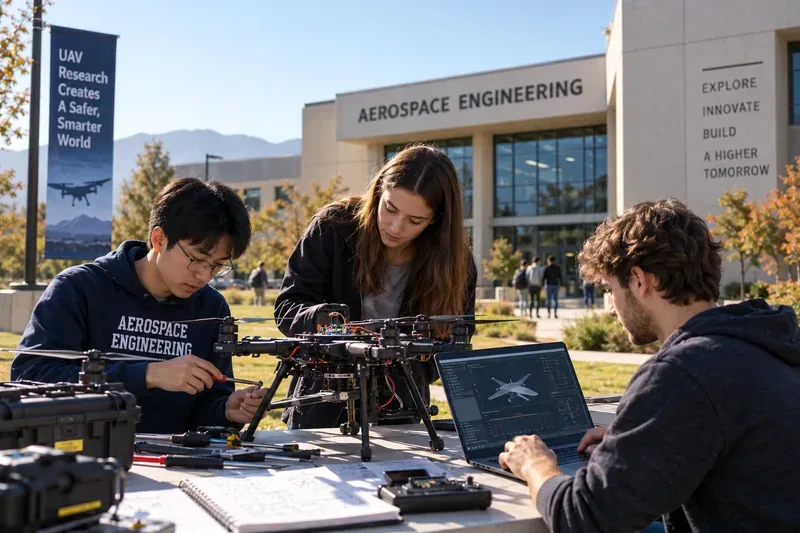
Researchers compare low-altitude flight paths and city airspace constraints, reflecting the mix of traffic management, autonomy, data, and operations skills used in UTM work.
First, decide which part of UTM you actually want to build
UTM is not a single job. The FAA’s current concept includes functions such as flight planning, authorization, surveillance, and conflict management, with much of the coordination happening through automated digital services and APIs rather than voice instructions from a controller. In Europe, the closest regulatory framework is EASA’s U-space, where designated airspace relies on services such as flight authorization and geo-awareness.
Verified: modern UTM work spans software, communications, surveillance, airspace design, safety, regulation, human factors, and operations. Context-dependent: the best degree depends on whether you want to become a software engineer, ATM systems analyst, regulator, safety specialist, UAS operator, or researcher. Useful action: write down the role you want five years after graduation, then compare curricula against that role rather than comparing university brands alone.
Best current study options by career goal
Study option
Best fit
What is verified for 2026
Main limitation
Linköping University, Sweden
Direct UAM/UTM coursework
A current course titled “Urban Air Mobility and Unmanned Traffic Management” appears in relevant programs
It is a course within broader programs, not a standalone UTM degree
ENAC, France
ATM, air-navigation operations, regulation
Advanced Master includes an ATM option; ENAC also lists UTM training for ANSP professionals
Some professional UTM training is in French and may target working aviation staff
Embry-Riddle, United States
UAS operations, autonomy, online study
M.S. in Uncrewed and Autonomous Systems is active and covers integration of drones and advanced/urban air mobility platforms
UTM is part of a broader uncrewed-systems curriculum rather than the sole focus
George Mason University, United States
Systems modeling, optimization, ATM analysis
M.S. Systems Engineering has an Advanced Transportation Systems concentration with ATC and air-transport modeling coursework
Strong on system-level ATM, less specialized in low-altitude UTM operations
TU Delft, Netherlands
Research, transport optimization, aerospace systems
Current Aerospace Engineering MSc structure and active UAM/ATM research are verifiable
A dedicated UTM degree or required UTM course was not verified
Cranfield University, United Kingdom
AAM research if a supervisor/project matches
Active AAM and airspace research remains, but the dedicated Advanced Air Mobility Systems MSc page now says the course is no longer available
Do not apply assuming the former AAM MSc still admits students
1. Linköping University: the clearest verified classroom match
For a student who specifically wants UAM and UTM in the formal curriculum, Linköping University is unusually direct. Its official 2026 study information lists TNFL12: Urban Air Mobility and Unmanned Traffic Management. The course covers unmanned-systems infrastructure, international rules and regulations, risk factors, concepts of operations, and algorithms and geometric methods for UTM/UAM. It is included in programs such as the Master of Science in Communications, Transport and Infrastructure.
Verified: the course exists in the 2026 curriculum and its learning outcomes explicitly mention UTM/UAM. Context-dependent: this is especially attractive if you like optimization, transport planning, programming, and logistics rather than aircraft design alone. Useful action: compare the full degree plan—not just TNFL12—with your background in math and programming, because the course assumes those foundations.
2. ENAC: strongest fit for air-navigation and regulatory operations
France’s École Nationale de l’Aviation Civile (ENAC) is a strong choice for students who see UTM as an extension of air navigation rather than primarily as a robotics problem. Its Advanced Master in Air Navigation System Engineering and Operations includes an Air Traffic Management option covering ATM operations, airspace design, safety, and advanced ATM topics.
ENAC also lists a current professional course, UTM for ANSP, updated in June 2026. That training focuses on the drone ecosystem, European and French regulation, and the frameworks governing drone use of airspace.
Verified: ENAC has both deep ATM education and current UTM-specific professional training. Context-dependent: the professional course is aimed at executives, managers, technicians, authorities, airports, airlines, and air navigation service providers, and its listed language is French. Useful action: if you want to work for an ANSP, regulator, U-space service provider, or airport, ask ENAC admissions which degree modules and projects currently connect most directly to U-space and UTM.
3. Embry-Riddle: best for a UAS and autonomy-centered route
Embry-Riddle Aeronautical University’s current M.S. in Uncrewed and Autonomous Systems is offered online and explicitly includes drones, autonomous systems, and advanced and urban air mobility platforms. Students can choose specializations including small uncrewed aircraft systems, research, or technical development and support.
This makes Embry-Riddle a practical fit if your intended UTM role sits close to operators, autonomy, vehicle integration, or UAS program management. It is less obviously a pure ATM-systems degree than ENAC or George Mason.
Verified: the degree is active and its official description explicitly addresses adoption and integration of uncrewed and autonomous systems. Context-dependent: online delivery can be a major advantage for working professionals, while students seeking a laboratory-heavy airspace-optimization research path may prefer a campus-based research program. Useful action: inspect the current elective list and faculty research before applying, and make sure you can build a project around airspace integration, deconfliction, UTM services, or AAM operations.
4. George Mason University: best for quantitative air-transport systems
George Mason University offers a different route: study UTM as a complex networked transportation system. Its current M.S. in Systems Engineering includes an Advanced Transportation Systems concentration with courses such as Introduction to Air Traffic Control and Air Transportation Systems Modeling. The university’s transportation and aerospace research also explicitly includes urban air mobility and autonomous drone systems.
Verified: the 2026–2027 catalog lists the concentration and its air-transport coursework. Context-dependent: this route is especially relevant if you want to model capacity, congestion, safety, policy, optimization, or decision support rather than design flight hardware. Useful action: ask potential advisors whether your capstone or thesis can focus on low-altitude airspace, UAM demand/capacity, conflict management, or UTM architecture.
5. TU Delft: a research-heavy route rather than a branded UTM degree
TU Delft is worth considering if you want a rigorous aerospace research environment and are comfortable shaping your own UTM specialization through electives, research groups, and a thesis. Its Aerospace Engineering MSc remains active for 2026–2027, and recent university research covers air traffic management, urban air mobility optimization, vertiport placement, safety risk, and eVTOL sequencing.
Verified: the university has active ATM/UAM research and a current Aerospace Engineering MSc structure. Not verified: I did not find a current official TU Delft page showing a dedicated UTM degree or a compulsory course specifically named UTM. Useful action: contact the relevant aerospace operations faculty before applying and confirm that a UTM/UAM thesis topic and suitable supervisor will be available during your study period.
6. Cranfield: a good example of why old program lists can mislead you
Cranfield University has substantial advanced-air-mobility expertise, including current work on airspace digital twins, autonomy, communications, and UTM testbeds. However, there is an important current-status issue: the university’s official Advanced Air Mobility Systems MSc page now states that the course is no longer available and points prospective students toward other options.
This is exactly why an older brochure, blog post, or search snippet should not be treated as proof that a degree is currently open for admission.
Verified: Cranfield still has active AAM research, but the dedicated MSc page says the program is no longer available. Context-dependent: Cranfield may still be an excellent place for a related MSc, PhD, or research project if you secure the right supervisor. Useful action: ask admissions for the current replacement pathway and get written confirmation of the 2026–2027 program title before paying an application fee or deposit.
Should you choose a university, or professional U-space training?
If you already work in aviation, a full degree may be unnecessary. EUROCONTROL’s Aviation Learning Centre currently offers UAS-focused training material covering ATM integration, U-space actors and services, UAS/ATM interfaces, risk assessment, and U-space regulation. Its current UAS – ATM Integration course outline is a good example of the professional topics employers may expect in Europe.
Verified: current EUROCONTROL training covers U-space and UAS/ATM integration. Context-dependent: short professional courses can update an existing aviation career, but they do not replace the mathematical, software, research, or engineering depth of a master’s degree. Useful action: if you already have an aerospace, computer science, electrical engineering, operations research, or ATM background, compare the cost and time of a short course against the specific skill gap you need to close.
What should a strong UTM curriculum contain?
Regardless of university name, a serious UTM study plan should expose you to several of the following areas:
Air traffic management, airspace design, and concepts of operations
Optimization, operations research, simulation, and traffic-flow modeling
UAS regulations, U-space or FAA UTM frameworks, and safety assessment
Communications, navigation, surveillance, remote identification, and data exchange
Software systems, APIs, distributed architectures, cybersecurity, and cloud services
Autonomy, detect-and-avoid, trajectory planning, and conflict management
Human factors, system safety, public policy, noise, and community constraints
A thesis, capstone, internship, or research project tied to real airspace operations
Useful action: score each program from 0 to 2 on those eight areas: 0 for absent, 1 for available as an elective or research topic, and 2 for required or strongly embedded. A program with the right technical mix is usually a better UTM preparation than a program with attractive AAM branding but little systems or airspace content.
How I would choose among these options
If you want the most directly verified UAM/UTM classroom content, start with Linköping University. If your target is European air navigation, regulation, or U-space implementation, put ENAC high on the list. If you need an online UAS/autonomy pathway while working, Embry-Riddle is the clearest fit. For quantitative air-transport modeling and systems engineering in the United States, George Mason is especially relevant. If you want a research-intensive route and are prepared to shape your own thesis topic, TU Delft is compelling.
I would not choose solely by a school’s reputation or by whether “urban air mobility” appears in a marketing headline. UTM is an integration discipline. The strongest preparation is usually a combination of airspace operations, software, safety, optimization, regulation, and real research or operational exposure.
Useful action: before applying, send the same three questions to each program: “Which current courses cover UTM/U-space or low-altitude airspace integration?”, “Which faculty supervised a UTM/UAM project in the last two years?”, and “Can my thesis or capstone use real or simulated traffic-management data?” The answers will tell you more than a generic program brochure.
What remains uncertain
Program availability, tuition, scholarship rules, visa requirements, course language, and individual electives can change by intake. I verified the program and course information above against official university or aviation-authority sources available on September 13, 2026, but I did not independently verify every institution’s tuition or every future semester’s timetable. Cranfield’s program change shows why that matters.
Useful action: treat the links above as the starting point, then confirm the exact intake, curriculum, tuition, and supervisor availability on the institution’s current admissions page before making a financial decision.