Home
» New Trends
»
Where Should You Study Embodied AI? Top Universities and Programs for Robotics and Physical Intelligence
Where Should You Study Embodied AI? Top Universities and Programs for Robotics and Physical Intelligence
Updated September 2026. If you want to study embodied AI, the first thing to know is that very few universities offer a degree actually called “Embodied AI.” The field usually lives at the intersection of robotics, machine learning, perception, control, planning, manipulation, and human-robot interaction.
That means the best program is not necessarily the school with the most famous AI department. You need a place where intelligent models are connected to physical systems and tested on real robots. Stanford’s 2026 Emerging Technology Review describes embodied AI as AI integrated into robots or other physical devices that can sense and act in the physical world. That definition is a useful filter when comparing programs: the closer the curriculum and research are to perception-action loops on real hardware, the closer they are to embodied AI.
For a direct research-focused master’s, Carnegie Mellon’s MS in Robotics is one of the clearest fits because its core explicitly includes robot embodiment and interaction with the environment. For a new, compact taught option centered on autonomous physical systems, Oxford’s MSc in Autonomous Robotics is unusually direct. If your priority is world-models, robot learning, dexterous manipulation, or frontier embodied intelligence research, MIT, Stanford, and UC Berkeley are exceptionally strong research ecosystems, although students typically enter through broader graduate programs rather than a degree named Embodied AI.
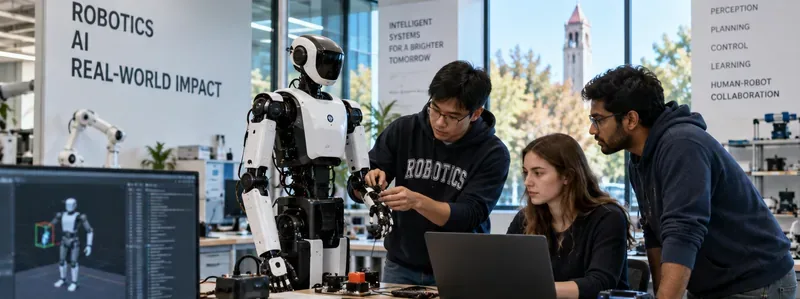
Students work on a humanoid robot in a university robotics lab, illustrating the hands-on combination of perception, planning, control, learning, and hardware that defines embodied AI education.
Quick Comparison: Best Places to Study Embodied AI
University
Program or route
Best for
Format
Carnegie Mellon University
MS in Robotics
Research robotics, robot learning, perception-action systems
24-month thesis-based master’s
University of Oxford
MSc in Autonomous Robotics
Integrated autonomous systems and hands-on robotics
11-month taught master’s
University of Pennsylvania
Robotics MSE
AI + perception + control + robot design
10-course-unit interdisciplinary master’s
ETH Zurich
MSc Robotics, Systems and Control
Control, perception, planning, systems engineering
90 ECTS / 1.5 years
EPFL
MSc Robotics
Hands-on intelligent robots and hardware/software integration
120 ECTS master’s
UCL
MSc Robotics and Artificial Intelligence
One-year applied robotics + AI
1 calendar year
MIT
Graduate study + CSAIL Embodied Intelligence research
Frontier embodied intelligence and physical AI research
Research ecosystem rather than a standalone Embodied AI degree
Research ecosystem rather than a dedicated Embodied AI degree
What Makes a Program Strong for Embodied AI?
Embodied AI is not just “AI plus a robot.” A useful program should teach or support the full loop between sensing and action. Before applying, look for evidence that students can work across several of these areas:
Perception: computer vision, tactile sensing, 3D perception, multimodal sensing.
State estimation: localization, mapping, sensor fusion, uncertainty estimation.
Planning and reasoning: task planning, motion planning, decision making, world models.
Control: feedback control, optimal control, model predictive control, whole-body control.
Robot learning: imitation learning, reinforcement learning, visuomotor policies, foundation models for robotics.
Real-world deployment: projects where models run on physical robots rather than only in simulation.
A program can still be excellent if it is stronger in some areas than others. The key is matching that profile to your goal. Someone building manipulation policies for humanoids needs a different environment from someone studying mobile autonomy, soft robots, or human-robot interaction.
1. Carnegie Mellon University: Best Direct Research Master’s for Embodied Robotics
Carnegie Mellon’s Robotics Institute is one of the most straightforward choices if you want a degree whose structure already resembles embodied AI research. The MS in Robotics is a 24-month research master’s that combines coursework with supervised research and a thesis.
The current curriculum is especially relevant: CMU organizes its core around Sensing and Perception, Thinking about Actions, Robot Embodiment, and Environment Interaction. The program also requires substantial supervised research. That balance makes it a good fit for students who want to connect learning algorithms with physical robots instead of specializing only in software.
CMU’s official MSR curriculum states that the degree normally takes two full years and culminates in a master’s thesis and public thesis talk.
Choose CMU if: you want a research-heavy route toward a PhD or R&D role in robot learning, perception, manipulation, field robotics, haptics, or human-robot interaction.
Potential downside: this is not a lightweight professional master’s. Research commitment is central, and the program explicitly says funding is not guaranteed.
2. University of Oxford: Best New One-Year Program for Integrated Autonomous Robotics
Oxford’s MSc in Autonomous Robotics is one of the most directly aligned taught degrees now available. For 2026–27 entry, Oxford lists an expected length of 11 months.
The curriculum combines programming, perception, systems engineering, autonomous robotic systems, and machine learning for robotics. Students also complete a hands-on robotics group project and an individual dissertation. Oxford states that students have opportunities to work with physical platforms including quadrupeds and robotic arms.
The program is particularly attractive if you want a compact degree that still includes real hardware, integrated autonomous systems, and research exposure. It also sits near the Oxford Robotics Institute, whose work spans machine learning, AI, computer vision, perception, planning, grasping, driving, inspection, flying, and embodied intelligence.
Choose Oxford if: you want an intensive one-year program with a clear robotics identity and hands-on systems work.
Application note: as of September 12, 2026, applications for 2026–27 are closed. Oxford says the site is expected to update for 2027–28 applications in mid-September, so prospective applicants should check the official page rather than rely on last year’s dates.
3. University of Pennsylvania: Best Structured Balance of AI, Control, Perception, and Robot Design
Penn’s Robotics MSE is administered through the GRASP Laboratory and jointly supported by computer science, electrical and systems engineering, and mechanical engineering.
For students entering in fall 2026 and later, the degree requires 10 course units. The curriculum forces breadth: students choose foundational coursework from three of four areas—artificial intelligence, robot design, control, and perception—before adding technical electives.
That structure is useful for embodied AI because it makes it difficult to build a degree around machine learning alone. You can combine learning in robotics with advanced robotics, model predictive control, machine perception, computer vision, or mechatronic design.
Choose Penn if: you want a master’s with strong flexibility but still want the curriculum to keep you connected to physical robotics fundamentals.
4. ETH Zurich: Best for Embodied AI with Strong Control and Systems Foundations
The program combines mechanical engineering, electrical engineering, and computer science. Its official curriculum covers robot design, modeling and control, optimization, perception, navigation and path planning, embedded and distributed computing, and AI. A semester project, industrial internship, and master’s thesis create multiple opportunities to connect theory with real systems.
Choose ETH if: you want physically grounded intelligence with serious depth in dynamics, control, optimization, and systems—not only learning-based robotics.
Best fit: students interested in legged robots, drones, mobile robotics, manipulation, control, or research where model-based and learning-based methods meet.
5. EPFL: Best for Hands-On Intelligent Robotics Across Multiple Embodiments
EPFL’s MSc in Robotics is a 120-ECTS program covering intelligent mobile robots, wearable robots, robotic manipulators, autonomous robots, and brain-interfaced robots.
Its strongest fit with embodied AI comes from the combination of electromechanical systems and advanced AI plus substantial hands-on work. EPFL says both core and optional classes include practical exercises on real systems, while semester projects, interdisciplinary projects, and the final thesis can be completed in robotics laboratories or industry.
The 2026–27 study plan includes courses such as mobile robotics, manipulation, machine learning, model predictive control, robotics practicals, and robotics projects.
Choose EPFL if: you want to build, prototype, validate, and control physical robotic systems rather than treat robotics as a purely computational specialization.
Admissions condition: applicants are expected to bring skills in at least two of computer science, electrical/electronic engineering, and mechanical engineering. That makes EPFL particularly suitable for candidates with a genuinely interdisciplinary engineering background.
6. UCL: Best One-Year Applied Robotics + AI Option in London
The 2026–27 compulsory modules include Modelling and Motion Planning, Estimation and Control, Computer Vision and Sensing, Machine Learning for Robotics, Robot Vision and Navigation, and a final project. Optional topics include aerial robotics, soft robotics, legged systems, and robotic sensing, manipulation, and interaction.
UCL also states that students work with mobile robots, manipulators, robotic sensors, and systems for autonomous navigation and interaction. Its UCL East facilities include an Intelligent Robotics Lab, manufacturing tools, electronics facilities, and motion capture.
Choose UCL if: you want a one-year professional/research bridge with a balanced mix of control, perception, machine learning, and hands-on robotics.
Cost note: UCL lists 2026–27 tuition at £21,500 for UK students and £42,700 for overseas students. Because tuition can change by intake, verify the current figure before applying.
7. MIT: Best for Frontier Embodied Intelligence Research
MIT is a different type of recommendation. Rather than a single master’s degree branded around embodied AI, its strength comes from the research ecosystem inside CSAIL and connected engineering departments.
The CSAIL Embodied Intelligence Community of Research explicitly focuses on intelligent behavior in the physical world and brings together perception, sensing, language, learning, and planning to build physical agents.
The community includes researchers working on robot locomotion, manipulation, task-and-motion planning, human-robot collaboration, robust autonomy, vision, world models, and physical intelligence. MIT also launched a five-year CSAIL-Pegatron initiative running from 2026 to 2031 focused on physically intelligent robots, including tactile sensing, adaptive manipulation, multimodal perception, and AI-driven control.
Choose MIT if: your priority is frontier research and you are comfortable applying through broader graduate pathways, then aligning with a faculty group or lab.
Do not choose MIT expecting: a neatly packaged “MSc Embodied AI” curriculum comparable to Oxford or UCL. The value here is advisor and research-group fit.
8. Stanford University: Best for Robot Learning and Real-World Interaction Research
Stanford also works best as a research ecosystem rather than as a single named Embodied AI degree. Its Robotics Center brings together researchers across computer science, mechanical engineering, electrical engineering, aeronautics, medicine, and other departments.
The Robotics and Embodied Artificial Intelligence (REAL) Lab is especially relevant: it develops algorithms that enable intelligent systems to learn from interaction with the physical world to perform complex tasks and assist people.
Current 2026 REAL research includes bimanual mobile manipulation, continual robot learning, multisensory visuomotor adaptation, dexterous manipulation, compliant control, whole-body mobile manipulation, and learning from human demonstrations.
Choose Stanford if: you want to work on robot learning, manipulation, human-centered robotics, interactive autonomy, or learning-based control and can target the right faculty/lab through a broader Stanford graduate degree.
9. UC Berkeley: Best for Robot Learning, Reinforcement Learning, and Embodied Dexterity
Berkeley is another case where the research environment is stronger than any single degree title. The Robotic AI & Learning Lab (RAIL) focuses on learning algorithms, robotics, and computer vision with the goal of producing flexible and adaptable robot behavior.
Berkeley also has the Embodied Dexterity Group, which develops robot hands, grippers, tactile perception, exoskeletons, and bio-inspired manipulation strategies for unstructured environments. Berkeley research groups also explicitly describe work in embodied AI, loco-manipulation, multimodal reasoning, generalist robot policies, and real-world deployment.
Choose Berkeley if: you are most interested in robot learning, reinforcement learning, manipulation, dexterity, tactile intelligence, or foundation-model-style approaches to physical agents.
How to Choose Between a Direct Program and a Research Ecosystem
Your goal
Better route
Examples
You want a defined curriculum and predictable graduation path
Direct robotics/autonomy master’s
CMU, Oxford, Penn, ETH, EPFL, UCL
You want to publish frontier embodied-AI research
Research-driven graduate route centered on advisor fit
MIT, Stanford, Berkeley, CMU
You want strong control and physical modeling
Systems/control-heavy robotics degree
ETH, Penn, Oxford
You want learning-heavy manipulation or robot foundation models
Lab-driven ecosystem with modern robot-learning research
Stanford, Berkeley, MIT, CMU
You want broad hands-on hardware experience
Program with compulsory labs/projects and access to multiple platforms
EPFL, Oxford, UCL, CMU
You need a one-year master’s
Compact taught program
Oxford, UCL
Application Checklist for Embodied AI Programs
Before applying, check the following instead of relying on a university’s general AI reputation:
Can you identify at least two faculty members whose current work matches your interests?
Does the curriculum include both learning and physical-system fundamentals such as control, estimation, or robot design?
Can master’s students actually join research labs, or are most lab positions effectively reserved for PhD students?
Will you work with physical robots, manipulators, mobile platforms, humanoids, drones, or tactile sensors?
Does the program teach ROS or comparable robotics software infrastructure where relevant?
Are there courses in manipulation, locomotion, perception, planning, control, and robot learning—not just general machine learning?
Is there a thesis, capstone, or substantial independent research project?
Can you access sufficient compute for modern vision-language-action or reinforcement-learning experiments?
Does the lab have the hardware needed for the research you want to do?
Are tuition, program length, visa conditions, and cost of living realistic for your budget?
What Background Should You Build Before Applying?
The strongest embodied-AI applicants usually combine mathematical, software, and physical-system skills. You do not need to be equally strong in everything, but gaps become obvious once models have to control hardware.
A useful preparation stack includes:
Linear algebra, calculus, probability, and optimization.
Python and ideally C++.
Machine learning and deep learning.
Computer vision.
Feedback control and dynamical systems.
Robotics kinematics and dynamics.
State estimation and sensor fusion.
ROS/ROS 2, simulation, and Linux.
At least one real hardware project where sensors, actuators, calibration, latency, and failure modes matter.
If you come from computer science, add control, dynamics, and hardware. If you come from mechanical or electrical engineering, add modern deep learning and large-scale software skills. That cross-training is often more valuable for embodied AI than taking another purely theoretical AI course.
Bottom Line
If you want a direct degree pathway, start your shortlist with Carnegie Mellon, Oxford, Penn, ETH Zurich, EPFL, and UCL. Among them, CMU is particularly compelling for research-oriented robotics; Oxford and UCL are attractive for intensive one-year study; ETH is excellent for systems and control; EPFL is strong for hands-on intelligent robotics; and Penn provides unusually balanced foundations across AI, robot design, control, and perception.
If you want frontier embodied-AI research, MIT, Stanford, and UC Berkeley deserve serious attention even though the degree itself may be called computer science, EECS, mechanical engineering, or robotics rather than Embodied AI. In those environments, the decisive factor is the lab and advisor—not the label printed on the diploma.
The most useful question is therefore not “Which university ranks highest in AI?” It is: Where can I repeatedly close the loop from perception to reasoning to physical action on real systems, under faculty whose current research matches the kind of embodied intelligence I want to build?