Home
» New Trends
»
The Rise of Embodied AI: Bridging the Gap Between Code and Physical Reality
The Rise of Embodied AI: Bridging the Gap Between Code and Physical Reality
Embodied AI is changing the central question in robotics. Instead of asking, “Can software recognize this object?” or “Can a robot repeat this motion?”, researchers are increasingly asking whether one system can perceive a changing scene, understand a human goal, choose a useful action, execute it through a physical body, detect failure, and try again.
That shift sounds incremental, but it changes nearly every design decision. A language model can be wrong and produce a bad sentence. A physical agent can drop a glass, collide with a person, damage equipment, or simply fail because friction, lighting, object geometry, sensor noise, and timing differ from its training data. The most important embodied AI choices are therefore not about picking a single “best” model. They are about deciding where intelligence should live, how much autonomy is appropriate, what kind of data is worth collecting, and which parts of the control stack should remain conventional and deterministic.
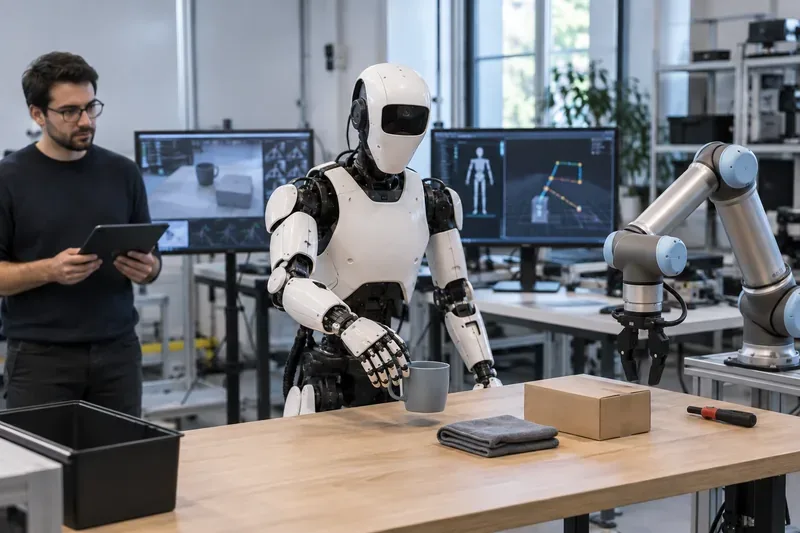
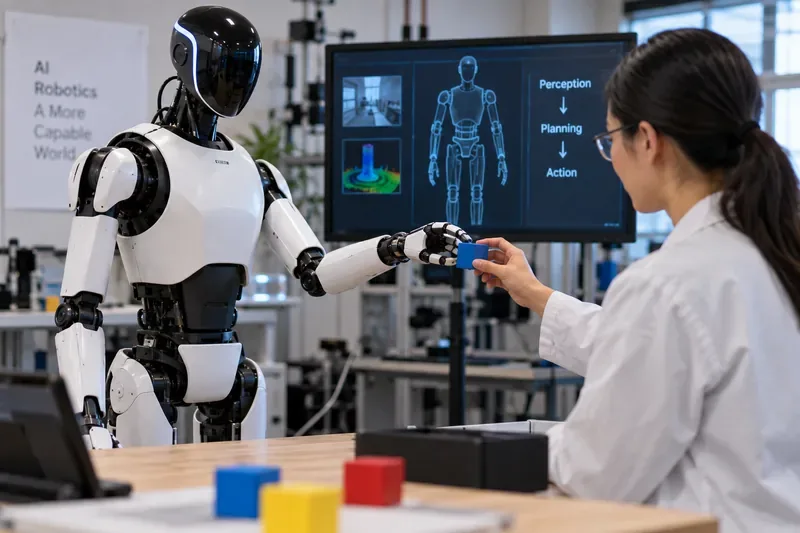
A robotics lab scene illustrates the core embodied-AI loop: sensing the environment, interpreting a task, producing motion, and observing the physical result.
What makes embodied AI different from ordinary software AI?
Embodied AI connects perception and reasoning to actions that change the physical world. A typical system may combine cameras, force or touch sensing, proprioception, language instructions, a high-level planner, a vision-language-action model, low-level motion control, and hardware safety layers. The defining feature is the closed loop: the system observes, acts, observes the consequence, and adapts.
Progress has accelerated because robotics is borrowing ideas that helped foundation models scale in language and vision. In 2023, the Open X-Embodiment collaboration pooled data from 22 robot types, more than 500 skills, and over one million episodes, showing that cross-robot training could improve transfer rather than requiring an entirely separate learning system for every machine. Google DeepMind’s original project description is available in its Open X-Embodiment and RT-X research overview.
By 2025 and 2026, several groups were pushing the idea further. NVIDIA released GR00T N1 as an open-weight humanoid foundation model trained from a mixture that includes robot trajectories, human video, simulation, and synthetic data, according to the official GR00T N1 research page. Physical Intelligence’s π0.5 work explored open-world generalization by co-training on heterogeneous robot and multimodal data; its paper reports multi-stage tasks in previously unseen homes and is available from the original π0.5 paper. Figure, meanwhile, described Helix 02 in January 2026 as a unified neural system for full-body humanoid control; because this is a company-published result rather than an independent benchmark, its claims are best read in that context through the Helix 02 technical announcement.
The first major choice: end-to-end control or a layered architecture?
One of the clearest tradeoffs is whether a learned model should control the robot from perception all the way to motor output, or whether the system should split the job between high-level reasoning and lower-level controllers.
Approach
Strengths
Tradeoffs
Best fit
End-to-end vision-language-action policy
Can learn direct mappings from observations and instructions to actions; may reduce task-specific hand engineering
Harder to interpret, validate, and constrain; often data-hungry; unexpected physical states can expose brittle behavior
Research on general manipulation, adaptable household tasks, settings where broad behavior matters more than strict determinism
Hierarchical reasoning plus low-level control
Separates planning from fast motor execution; easier to insert safety checks, motion planners, or specialized controllers
More system integration; interfaces between layers can introduce latency or mismatched assumptions
Industrial, collaborative, or safety-sensitive environments where predictable motion and explicit safeguards are important
Conventional automation with selective AI modules
High repeatability, easier validation, mature safety engineering
Less flexible when objects, instructions, or layouts vary
High-volume repetitive tasks where variability is low and uptime matters more than generality
Google DeepMind’s 2026 robotics stack makes this separation explicit. Gemini Robotics 2 is described as a vision-language-action model for motor control, while Gemini Robotics ER 2 performs higher-level embodied reasoning and multi-step planning. The company also offers an on-device variant optimized for local execution. See the July 30, 2026 Gemini Robotics 2 release and the Gemini Robotics ER 2 model card.
Recommendation: if a robot operates around people, expensive assets, or hard safety constraints, a layered design is usually the more defensible starting point because it provides more places to enforce limits. If the main objective is research on generalization, an end-to-end policy may expose capabilities that hand-built pipelines miss, but it should still sit behind independent physical safeguards.
Cloud intelligence or on-device inference?
Embodied systems are unusually sensitive to latency. A cloud model can offer more compute and can be updated centrally, but network delay and outages are physical-world problems when a robot must react quickly. On-device inference reduces round-trip latency and can keep camera or sensor data local, but it constrains model size, power consumption, memory, and thermal design.
Google’s July 2026 Gemini Robotics On-Device 2 model card is useful because it states both the benefit and the limit: the model is designed for efficient local robotic manipulation, while its known limitations include weaker generalization to out-of-distribution tasks and difficulty with high-degree-of-freedom robots. That is a practical reminder that “smaller and local” is not automatically equivalent to “same intelligence with lower latency.”
Recommendation: use local inference for reflex-like or timing-sensitive control, privacy-sensitive sensing, and operations that must continue without a network. Use remote or larger models for slower planning, semantic interpretation, fleet learning, or tasks where added reasoning quality is worth the latency. A hybrid architecture often makes more sense than forcing every function into one location.
Generalist model or task specialist?
Generalist robot foundation models promise transfer: learn from many tasks and embodiments, then adapt to a new robot or job with less data. That is attractive when environments change frequently. But generality is not free. A narrow specialist can still be preferable when the same operation repeats millions of times and failure cost is high.
Physical Intelligence’s π0 work illustrates the distinction. Its earlier research argued that broad pretraining improves recovery and transfer, while high-quality post-training helps specialize difficult tasks. The π0.5 paper extends the idea toward new environments. The important engineering lesson is not that every application needs a huge generalist policy. It is that pretraining and specialization can be combined instead of treated as opposites.
Recommendation: choose a generalist base when task variety, object variety, or redeployment speed dominates. Choose a specialized policy or conventional automation when the environment is tightly controlled, the task is stable, and qualification cost matters more than adaptability.
Real-world data, simulation, or synthetic data?
Robot learning has a data problem that text models do not: useful physical interaction data is expensive. Real trajectories require hardware, operators, maintenance, space, safety procedures, and time. Simulation can generate experience faster and more safely, but simulated physics and perception do not perfectly match reality. Synthetic data can increase diversity, yet the value of that diversity depends on how closely it covers the conditions the deployed system will actually encounter.
NVIDIA’s GR00T N1 research describes a training mixture spanning real robot trajectories, simulation, synthetic data, and human video. Open X-Embodiment demonstrated another route: pooling real datasets across institutions and robot forms. These approaches are complementary rather than mutually exclusive.
Recommendation: use simulation to cover dangerous, rare, or combinatorial situations; use real data to calibrate the reality gap and validate final behavior; use synthetic variation to expand visual and task diversity. The strongest data strategy is usually a portfolio, followed by evaluation on physical hardware that was not used to produce the training examples.
Humanoid body or purpose-built robot?
The rise of embodied AI is often visually represented by humanoids, but embodiment does not require a human-shaped body. A mobile manipulator, warehouse arm, quadruped, drone, or autonomous vehicle can all be embodied AI systems if perception and learned reasoning close the loop with physical action.
Humanoids have an obvious advantage: homes and workplaces are designed around human reach, stairs, doors, shelves, and tools. A human-compatible form could reduce the need to redesign the environment. The downside is complexity. Whole-body balance, dexterous hands, energy use, actuator reliability, and safety create a much harder control problem than a fixed arm bolted to a workstation.
Figure’s Helix 02 and Google DeepMind’s 2026 whole-body robotics work show why humanoid control is now a frontier research area. At the same time, Google’s own robotics lineup spans bi-arm systems and full humanoids, which reinforces the practical point that there is no requirement to use a humanoid body just because the intelligence layer is general.
Recommendation: select morphology from the work environment. If the task is “move standardized cartons between two fixed points,” a purpose-built arm or mobile manipulator can be cheaper and easier to certify. If the task is “operate in spaces designed for people and use many human tools,” humanoid morphology becomes more compelling despite the added engineering burden.
Open platform or proprietary stack?
Open models and reference platforms can lower experimentation cost, improve reproducibility, and let teams inspect or modify parts of the stack. Proprietary systems can deliver tighter hardware-software integration and may arrive with stronger product support, but they can limit portability and visibility into training or control internals.
NVIDIA positions Isaac GR00T as an open development platform and GR00T N1 as open-weight. Google DeepMind’s latest Gemini Robotics models have model cards and selected access paths, while commercial humanoid vendors such as Figure tightly integrate their own hardware and models. These are different product strategies, not directly interchangeable research results.
Recommendation: academic labs and platform teams that need to modify training, datasets, or controllers should favor open interfaces and reproducible tooling. Deployment teams that care more about support, integration speed, and a single accountable vendor may reasonably prefer a vertically integrated system, provided they can still obtain the validation evidence they need.
Safety is not a model feature; it is a system architecture
The most consequential difference between embodied AI and a chatbot is that failures can create physical hazards. A safe deployment therefore needs more than a model that has been prompted to “be careful.” It needs layered controls: semantic restrictions, collision avoidance, force limits, emergency stops, safe operating zones, hardware interlocks, operator procedures, monitoring, and clear conditions for handing control back to a human.
Google DeepMind’s robotics safety materials explicitly recommend a layered approach and warn against using its robotics models for safety-critical applications such as healthcare or transportation without appropriate safeguards. Its public framework separates semantic, physical, and operational safety; see the official robotics safety framework. This is consistent with a broader engineering principle: learned behavior should not be the only barrier between a model error and a physical accident.
How should organizations evaluate embodied AI before adopting it?
A useful evaluation should be based on operational criteria rather than a demo reel. Start with task success rate across repeated trials, but do not stop there. Measure recovery after disturbances, time to complete the task, human interventions, collision or near-collision events, grasp failures, energy consumption, network dependence, and performance on objects or layouts excluded from training.
Then separate three questions that are often mixed together. First, can the model perform the task under known conditions? Second, can it generalize when the scene changes? Third, can the entire robot system fail safely when the model is wrong? A system may score well on one dimension and poorly on another.
Vendor demonstrations are useful evidence that a capability exists under some conditions, but they are not a substitute for independent testing in the intended environment. Claims such as multi-minute autonomous household tasks or full-body humanoid control should be treated as promising technical milestones, while reliability, maintenance burden, throughput, and safety in broad production use remain application-specific questions that require deployment data.
What the rise of embodied AI actually means
Embodied AI is not simply “putting an LLM in a robot.” The more important development is the convergence of multimodal foundation models, cross-robot datasets, learned action policies, fast local inference, simulation, and conventional robotics control. Together, they are making it possible to move from robots that follow fixed scripts toward machines that can interpret goals and adapt to physical variation.
The winning architecture will differ by use case. Research labs may prioritize broad generalization and open models. Factories may prioritize deterministic motion, uptime, and validation. Home robots may require human-compatible hardware, natural-language interaction, privacy-aware on-device processing, and unusually strong recovery behavior. Hazardous environments may justify greater autonomy but demand stricter supervisory controls.
The practical question is therefore not whether embodied AI will replace traditional robotics. It is where learned intelligence creates enough flexibility to justify its uncertainty. Teams that answer that question with measurable criteria—latency, success rate, recovery, safety, data cost, portability, and maintenance—will be better positioned than teams that choose a robot or model based on generality alone.