Home
» New Trends
»
The Evolution of Autonomous Vehicles: How Safety, Edge Computing, and AI Are Converging
The Evolution of Autonomous Vehicles: How Safety, Edge Computing, and AI Are Converging
Autonomous vehicles are not evolving along a single technology curve. The most important progress is happening where three disciplines meet: safety engineering, edge computing, and artificial intelligence. Better neural networks matter, but a vehicle cannot safely outsource a split-second braking decision to the cloud, and a powerful onboard computer does not make a driving system trustworthy unless its limits are defined, tested, monitored, and handled safely.
To make those ideas concrete, consider a hypothetical example used throughout this article. MetroLoop Mobility is fictional: imagine that it operates a Level 4 robotaxi service inside a clearly defined downtown operating area. The vehicles can drive themselves only when required road, weather, mapping, and system conditions are satisfied. One evening, a MetroLoop car approaches road construction just as light rain begins, a cyclist moves near the lane boundary, and cellular service briefly degrades. Nothing in this example is a reported real-world test or company result. It is simply a practical way to examine what a modern autonomous driving system must do.
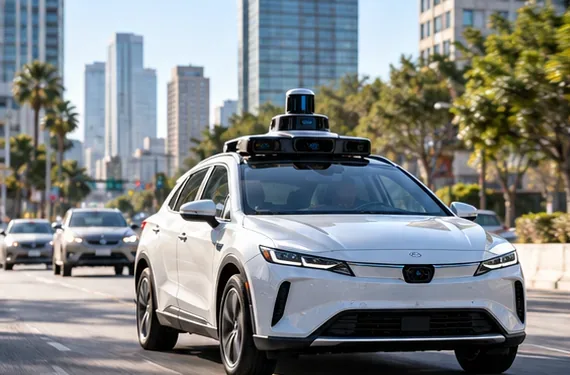
A sensor-equipped autonomous vehicle travels through urban traffic, illustrating how perception hardware and onboard computing must operate together in real time.
Autonomy has evolved from driver assistance to bounded automated driving
The first thing to understand is that “self-driving” is often used too loosely. The SAE J3016 driving automation framework distinguishes six levels, from Level 0 through Level 5. At Levels 0, 1, and 2, the human remains responsible for driving and supervision. Levels 3, 4, and 5 move the sustained driving task to an Automated Driving System, or ADS, under increasingly broad conditions.
This distinction is not just terminology. The National Highway Traffic Safety Administration likewise separates Level 2 advanced driver assistance systems from Levels 3–5 automated driving systems. That matters because the safety case, human role, failure handling, and regulatory expectations are different.
In the MetroLoop example, the service is Level 4, not Level 5. Its autonomy is tied to an operational design domain, commonly shortened to ODD. An ODD defines the conditions in which the automated system is intended to operate: for example, particular road types, geographic areas, weather ranges, traffic conditions, speeds, or times of day. A mature Level 4 system does not need to pretend it can drive everywhere. It needs to know where its competence begins and ends, and it needs a safe response when conditions move outside that boundary.
The safety problem has become broader than preventing hardware failure
Traditional automotive safety engineering remains essential, but autonomous driving adds new kinds of risk. A sensor can be electrically healthy while an AI model still misinterprets an unusual object. A compute module can be functioning exactly as designed while the perception stack becomes uncertain in glare, heavy rain, construction, or an unfamiliar traffic pattern.
That is why modern AV safety draws on several complementary frameworks rather than one checklist:
Safety layer
What it addresses
Why it matters for autonomy
Functional safety
Hazards caused by faults in electrical and electronic systems
Helps manage failures in sensors, compute, power, communications, and control hardware. The current published ISO 26262 series remains a core reference for road-vehicle functional safety.
Safety of the Intended Functionality (SOTIF)
Hazards that can occur even when components have not failed
ISO 21448:2022 specifically addresses functional insufficiencies and performance limitations in systems that depend on complex sensing and processing.
AI safety assurance
Safety risks created by insufficiencies, systematic errors, or hardware errors involving AI elements
ISO/PAS 8800:2024, published in December 2024, provides a road-vehicle framework focused on safety-related systems that use AI.
Cybersecurity
Threats to connected vehicle systems across their lifecycle
ISO/SAE 21434:2021 addresses automotive cybersecurity engineering from concept through operation and maintenance.
Return to MetroLoop in the rain. The relevant question is not simply, “Did the camera work?” The vehicle may need to determine whether camera contrast has degraded, whether radar and lidar agree on the cyclist’s position, whether the construction geometry still fits the ODD, and whether confidence is sufficient to continue. If not, the correct behavior may be to slow down, increase spacing, change route, pull over, or transition to another predefined minimal-risk condition.
This is a major change in how autonomous vehicle safety is understood. Safety is not a claim that the AI will never be wrong. It is a system property that combines fault detection, uncertainty handling, redundancy, safe fallback, operational limits, validation, monitoring, and post-deployment learning.
Edge computing moved the critical decision loop into the vehicle
Edge computing means processing data close to where it is produced instead of sending every task to a remote cloud data center. The concept is broader than vehicles; NIST research on fog and edge computing describes edge architectures as an extension of cloud computing designed in part to support applications with stringent latency requirements.
For autonomous driving, the implications are direct. Cameras, radar, lidar, inertial sensors, wheel-speed sensors, and other inputs can produce a continuous stream of data. Perception, localization, prediction, planning, and vehicle control must continue even if a mobile connection becomes slow or disappears. A cloud round trip is therefore unsuitable as a dependency for immediate collision avoidance or steering control.
Modern automotive compute platforms reflect that architecture. For example, current NVIDIA in-vehicle computing documentation describes onboard systems built to combine cameras, radar, lidar, and high-performance AI processing. The important architectural point is not any one vendor's chip specification. It is that the safety-critical inference loop is increasingly centralized into powerful automotive-grade computers inside the vehicle.
The cloud still matters. A fleet can use remote infrastructure for model training, simulation, large-scale log analysis, map generation, software distribution, fleet health monitoring, and aggregated learning from unusual scenarios. But the practical design is hybrid:
Cloud or data center: computationally heavy offline training, simulation, fleet analytics, map processing, software delivery, and long-horizon optimization.
Connectivity: useful for updates and coordination, but not treated as a guaranteed prerequisite for basic safe control.
In the MetroLoop scenario, the cellular outage should therefore be inconvenient rather than catastrophic. The vehicle still needs enough onboard capability to detect the cyclist, interpret the construction zone, plan a safe trajectory, and stop if necessary. Cloud connectivity may affect dispatch or fresh fleet information, but it should not be the only path to a braking decision.
AI integration is shifting from isolated perception models to system-level intelligence
Earlier autonomous driving stacks were often described as a sequence of separate modules: detect objects, estimate their motion, localize the vehicle, predict what other road users may do, generate candidate trajectories, select a path, and control steering and braking. That modular design is still widely useful because engineers can inspect boundaries and test components independently.
At the same time, machine learning has expanded across more of the stack. Neural networks now support tasks such as object detection, semantic understanding, lane and free-space estimation, motion forecasting, occupancy modeling, driver or cabin monitoring, and sometimes more integrated planning. The emerging direction is not necessarily “one giant model controls everything.” In safety-critical vehicles, hybrid architectures can combine learned models with deterministic checks, constraints, redundant estimators, conventional control, and runtime safety monitors.
This integration creates a new engineering challenge: an AI model may perform extremely well on average while still failing on rare combinations of conditions. ISO/PAS 8800 is significant because it treats AI safety as an assurance problem rather than assuming that aggregate machine-learning accuracy alone proves a vehicle is safe.
For MetroLoop, suppose the perception model identifies the cyclist correctly but the construction layout is unusual. A robust stack should not rely on a single classification score. It can fuse multiple sensors, compare independent signals, estimate uncertainty, check planned trajectories against physical constraints, and invoke a conservative fallback when evidence conflicts.
Sensor fusion remains important even as AI gets stronger
An autonomous vehicle does not experience the road through one perfect sensor. Cameras provide rich visual information but can be challenged by glare, darkness, contamination, or weather. Radar is useful for measuring range and relative motion and can behave differently from cameras in poor visibility. Lidar can provide detailed geometric distance information, although implementations differ in range, cost, resolution, and environmental performance. Vehicle-motion sensors add another independent view of what the car itself is doing.
Sensor fusion is the process of combining those different signals so that the system can build a more robust estimate of its surroundings than any single sensor may provide. The goal is not merely to add more hardware. Redundancy is useful only when the system understands disagreements, detects degraded inputs, and can still reach a safe state.
This is one reason AV evolution is increasingly about integration. Sensors, AI models, vehicle networks, compute accelerators, safety controllers, maps, cybersecurity, and fleet software are becoming parts of one engineered safety system.
Real-world safety needs better evidence than raw crash counts
As autonomous vehicles move from prototypes into commercial service, the safety question becomes measurable: how often do harmful events occur, under what conditions, and compared with what baseline?
NHTSA's Standing General Order on crash reporting requires identified manufacturers and operators to report qualifying crashes involving ADS and Level 2 ADAS. The order was first issued in 2021 and amended in 2021, 2023, and 2025. NHTSA's current public data page notes that the latest displayed incident data extend through July 15, 2026.
Those data are valuable, but NHTSA also warns about limitations. Reporting requirements differ between ADS and Level 2 systems; reports can be duplicated; classifications can be corrected; and exposure differs across companies and locations. Therefore, simply ranking developers by the number of reported crashes would be misleading.
Good safety comparisons need appropriate denominators and matched driving conditions. They should consider miles driven, road type, geography, speed, weather, operating hours, human-crash underreporting, injury severity, and whether the autonomous system operates in the same environments as the human benchmark.
A useful current example is Waymo's publicly documented research program. Its Safety Impact dashboard reports rider-only mileage and crash-rate comparisons using location-adjusted human benchmarks, while a peer-reviewed insurance-claims study developed a method for comparing the Waymo Driver with human driving exposure. These are important pieces of evidence, but they are still evidence about a particular system operating in particular ODDs. They should not be generalized into a claim that every autonomous vehicle is safer than every human driver.
Regulation is beginning to shift toward performance and deployment frameworks
The regulatory environment is also evolving. In the United States, NHTSA announced in July 2026 that it was accelerating work on AV performance standards and granted a temporary exemption allowing limited commercial deployment of purpose-built Zoox robotaxis under an oversight structure. The original announcement is available from NHTSA.
On September 3, 2026, the U.S. Department of Transportation also announced a new Automated Vehicles National Strategy. Whatever future rulemakings ultimately require, the direction is notable: regulators are increasingly confronting vehicles that may not be designed around a continuously present human driver or even traditional manual controls.
International work is evolving too. In June 2026, UNECE published the latest version of a proposal for a UN regulation covering Automated Driving Systems. That proposal should not be confused with a universally adopted final rule, but it shows how regulators are moving from narrow automated functions toward broader ADS approval concepts.
What a mature autonomous vehicle stack looks like
The most useful way to understand the current evolution is to view the vehicle as a layered system rather than a single AI product.
Layer
Main job
Typical safety question
Sensing
Capture visual, geometric, motion, and vehicle-state data
Are the sensors healthy, clean enough, calibrated, and sufficiently redundant?
Perception and localization
Estimate objects, road structure, free space, and vehicle position
How certain is the world model, and how does the system detect degraded perception?
Prediction and planning
Estimate likely behavior of other road users and select a safe trajectory
Does the plan remain safe under uncertainty and plausible alternative behaviors?
Control
Translate the planned motion into steering, braking, and acceleration
Can the vehicle track the plan safely despite actuator or surface variation?
Safety supervision
Monitor faults, assumptions, ODD status, and fallback behavior
What happens when the primary stack becomes uncertain or unavailable?
Connectivity and fleet operations
Support updates, dispatch, monitoring, maps, and fleet learning
Can the vehicle remain safe when connectivity is delayed or absent?
Returning to MetroLoop: how the pieces work together
Now revisit the fictional rainy construction encounter. The cameras see cones, temporary markings, a work vehicle, and the cyclist. Radar contributes motion and range information. Lidar contributes geometric structure. The onboard computer fuses those streams and updates the local scene continuously.
The AI system predicts several plausible cyclist paths instead of assuming one perfect future. The planner reduces speed and preserves extra lateral space. A runtime safety monitor checks whether the planned trajectory violates vehicle-dynamics or clearance constraints. Meanwhile, the vehicle recognizes that the construction layout is close to the boundary of its supported conditions.
Then the cellular connection drops. Because the critical driving loop is running at the edge, local perception and control continue. The fleet service may temporarily lose fresh cloud information, but the car does not lose the ability to brake. If confidence falls below the system's safe threshold, the vehicle follows its predefined fallback behavior rather than improvising beyond the ODD.
This hypothetical trip illustrates the central lesson of AV evolution: autonomy is becoming less about demonstrating that a car can drive and more about demonstrating that the entire system can recognize uncertainty, remain resilient when parts of the environment or infrastructure degrade, and reach a safe outcome when its assumptions are no longer valid.
What remains unresolved
Significant technical and policy uncertainty remains. Long-tail road situations are difficult because rare combinations of weather, infrastructure, human behavior, and sensor degradation may be underrepresented in training data. Simulation can increase coverage but does not perfectly reproduce reality. Real-world testing provides valuable evidence but cannot expose every possible hazardous combination before deployment.
Scaling from a constrained city ODD to broader regions also changes the problem. Snow, rural roads, temporary traffic control, emergency scenes, unusual vehicles, inconsistent signage, and different driving cultures can all add distribution shift. A system that is demonstrably safe in one operational domain is not automatically proven safe in another.
AI also creates lifecycle questions. Models can change after software updates, and new field data may reveal previously unknown weaknesses. That makes version control, regression testing, safety monitoring, cybersecurity, traceability, and update governance part of the safety case—not merely software operations.
The next phase of autonomy is integration, not a single breakthrough
The evolution of autonomous vehicles is often described as a race toward smarter AI. That is only part of the story. The more consequential shift is toward integrated systems in which AI, sensors, automotive-grade edge computing, functional safety, SOTIF, cybersecurity, operational limits, real-world measurement, and regulatory oversight reinforce one another.
For a hypothetical fleet like MetroLoop, success would not be defined by whether the vehicle handled one impressive construction-zone encounter. The meaningful question would be whether the system can repeatedly operate within a known ODD, identify when conditions are no longer trustworthy, preserve safe local control without depending on perfect connectivity, learn from fleet evidence, and support claims with transparent data.
That is where autonomous vehicles are heading in 2026: away from the idea of a car that simply “drives itself,” and toward a continuously validated safety system whose intelligence is distributed across sensors, onboard compute, software, fleet infrastructure, and carefully defined operating boundaries.