Home
» New Trends
»
Smart Automation in Industry 4.0: A Practical Framework for Maximum Efficiency with Minimal Intervention
Smart Automation in Industry 4.0: A Practical Framework for Maximum Efficiency with Minimal Intervention
Updated September 2026. Smart automation in Industry 4.0 is not about removing people from the factory. It is about designing production systems that can sense conditions, make routine decisions, coordinate equipment, and recover from ordinary variation without waiting for constant human input—while keeping people firmly in control of safety, quality, policy, and unusual exceptions.
The practical goal is therefore minimal unnecessary intervention, not zero intervention. A well-designed smart factory lets deterministic controls handle what is predictable, uses analytics and AI where they add value, and escalates to operators when uncertainty, risk, or business judgment exceeds defined limits.
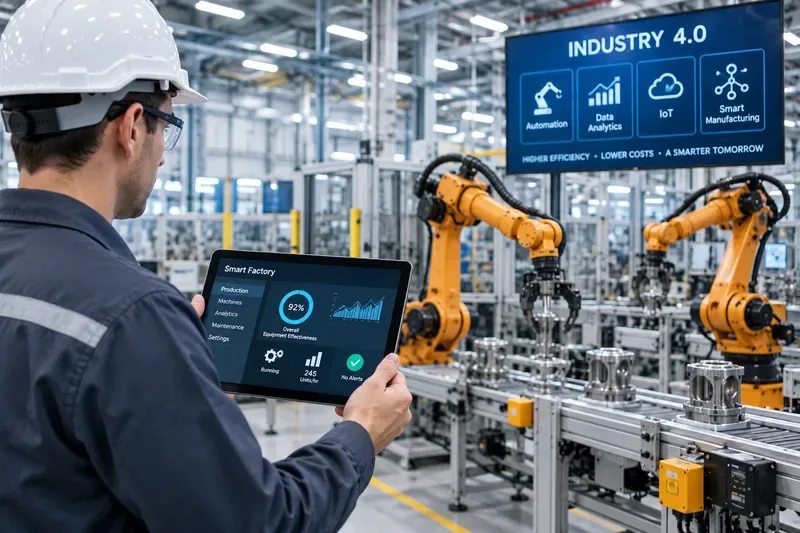
A factory engineer monitors robotic production equipment and a production dashboard, illustrating the combination of automation, operational data, and human oversight in an Industry 4.0 environment.
Quick Reference: What Should Be Automated, and What Should Stay Human-Controlled?
Area
Good candidates for automation
Human authority should remain clear for
Useful measures
Machine control
Sequencing, interlocks, motion, repeatable setpoint control
Energy per good unit, peak demand, idle consumption
Start with the Right Definition of Smart Automation
NIST describes smart manufacturing as a cyber-physical environment in which sensors, controls, production software, analytics, and enterprise systems exchange information to improve how manufacturing systems are designed and operated. Its Smart Manufacturing Systems Design and Analysis Program emphasizes standards, protocols, measurement science, real-time control, and analytics across the enterprise.
That distinction matters. Buying robots, adding sensors, or sending machine data to the cloud does not automatically create a smart factory. Smart automation requires a closed information loop:
Observe the process with trustworthy data.
Interpret current state and relevant context.
Decide whether action is required.
Act through a controlled, authorized mechanism.
Verify the result.
Escalate when the result falls outside expected bounds.
When any link in that chain is weak, adding more autonomy can simply make mistakes happen faster.
A Practical Industry 4.0 Architecture
1. Keep deterministic control close to the physical process
Programmable logic controllers (PLCs), distributed control systems (DCS), robot controllers, drives, safety controllers, and embedded devices should continue to handle functions that require predictable response times and proven control logic. Hard real-time control and safety behavior should not depend on a distant analytics service or an internet connection.
This is one of the most important design rules for minimal-intervention automation: advanced intelligence may optimize the process, but the basic process must remain stable and safe without it.
2. Build a reliable data layer before adding AI
Analytics cannot compensate for missing timestamps, inconsistent tag names, faulty sensors, undocumented units, or machines that report state differently. Before deploying predictive models, establish:
Asset and tag naming conventions.
Reliable timestamps and time synchronization.
Units, engineering ranges, and quality flags.
Asset hierarchy and production context.
Historical storage for process, alarm, maintenance, and quality events.
3. Use open information models to reduce custom integration
One reason smart-manufacturing projects become expensive is the number of proprietary interfaces between machines, historians, SCADA systems, MES/MOM platforms, and business applications.
OPC Unified Architecture (OPC UA) provides a platform-independent framework for information modeling and secure information exchange across industrial systems. The OPC Foundation describes OPC UA as applicable from sensors and control systems through MES, ERP, IIoT, and cloud-connected environments. As of September 2026, the current OPC UA Part 1 release listed by the Foundation is version 1.05.06, published in late 2025; individual specification parts may have later revisions.
The practical benefit is not merely connectivity. Semantic models help systems understand what a value represents, not just where to read it.
4. Separate plant operations from enterprise planning, but integrate them deliberately
The ISA-95 series, also associated with IEC 62264, provides a technology-independent reference for integrating manufacturing-control activities with business systems. ISA currently lists ANSI/ISA-95.00.01-2025 for Part 1, Models and Terminology.
In practical terms, the model helps clarify responsibilities:
Machines and control systems execute physical operations.
SCADA and supervisory systems monitor and coordinate processes.
MES/MOM manages production execution, quality, traceability, and work context.
ERP and planning systems manage business planning, logistics, orders, and finance.
Modern architectures may be more distributed than a strict hierarchy, but clear ownership between these functions still prevents conflicting commands and duplicated logic.
5. Put edge computing where response time, resilience, or bandwidth matters
Edge systems are useful when analytics must continue during a WAN outage, when high-rate sensor data is expensive to transmit continuously, or when a model must respond near the machine. Typical edge workloads include vision inference, vibration analysis, local buffering, protocol conversion, and bounded optimization.
Cloud platforms are better suited to cross-site analysis, fleet-level model training, long-term storage, centralized governance, and compute-intensive workloads that are not part of a safety-critical control loop.
A hybrid design usually works better than trying to force every workload into either the plant floor or the cloud.
Where AI Adds Real Value
The 2026 NIST smart-manufacturing roadmap highlights industrial big-data analytics, advanced sensing and perception, autonomous systems, digital twins, robotics, supply-chain optimization, and sustainable manufacturing as major areas for AI and machine learning. Those capabilities are most useful when they are attached to a clearly defined operational decision.
Predictive and condition-based maintenance
Models can combine vibration, temperature, current, pressure, operating hours, and historical failure data to identify abnormal behavior. The automation should not merely produce an anomaly score. It should connect the finding to an operational workflow: inspect, schedule maintenance, reduce load, or escalate.
The most important metric is not how many anomalies the model finds. It is how many useful warnings it produces early enough for the maintenance team to act without creating excessive false alarms.
Machine vision and automated quality screening
Vision systems can inspect parts continuously and consistently, especially for repeatable visual defects. But automated rejection should be validated against the economic and quality consequences of false positives and false negatives. Difficult or novel cases can be routed to human review rather than forcing the model to make an unsupported decision.
Adaptive process optimization
AI can recommend or adjust process parameters when relationships are nonlinear or too complex for simple rules. A safe implementation constrains the model to validated operating envelopes. The optimization layer should not be able to bypass equipment interlocks or safety systems.
Production scheduling and material orchestration
Scheduling engines can react to machine availability, material shortages, labor constraints, changeovers, and due dates faster than manual planning. The useful design pattern is automated rescheduling for routine disturbances with human approval for major customer, cost, or policy tradeoffs.
Digital twins
A digital twin can combine a digital representation of an asset or process with current operational data to support simulation, diagnostics, commissioning, and optimization. The value comes from a maintained connection to the real system and validated models—not from a visually impressive 3D representation alone.
Use an Automation Ladder Instead of Jumping Directly to Autonomy
The following ladder is a practical engineering framework, not a formal industry standard. It helps teams increase autonomy only after the previous level is stable.
Level
System behavior
Human role
Observe
Collects data and visualizes state
Interprets and acts
Recommend
Detects conditions and suggests an action
Reviews and executes
Approve
Prepares the action automatically
Approves or rejects
Closed-loop within guardrails
Acts automatically inside validated limits
Monitors exceptions and can override
Coordinated autonomy
Multiple systems optimize together across equipment or production areas
Sets policy, constraints, goals, and exception handling
Do not promote a use case to a higher level simply because the model performs well in a lab. Production autonomy also requires safe failure behavior, access control, monitoring, change management, rollback, and an accountable owner.
Cybersecurity Must Scale with Automation
Every new sensor gateway, remote-maintenance path, API, edge computer, and cloud integration expands the operational technology attack surface. Increased autonomy also increases the potential impact of an incorrect or malicious command.
NIST's SP 800-82 Rev. 3, Guide to Operational Technology Security provides guidance for securing OT while accounting for its distinctive safety, reliability, and performance requirements. The ISA/IEC 62443 series provides lifecycle-oriented cybersecurity requirements for industrial automation and control systems.
At minimum, a smart-automation program should include:
An accurate inventory of assets, software, connections, and data flows.
Network segmentation and controlled pathways between OT and IT environments.
Strong identity, authentication, and least-privilege access.
Managed certificates and credentials for machine-to-machine communication.
Controlled remote access with logging and explicit authorization.
Backup, restore, and recovery procedures tested against real operational needs.
Patch and vulnerability processes adapted to production constraints.
Independent emergency-stop, interlock, and safe-state mechanisms where required.
Audit logs for automated decisions, model versions, configuration changes, and overrides.
How to Govern AI Without Slowing the Factory Down
Industrial AI needs governance because operating conditions change. Sensors are replaced, tooling wears, products change, suppliers change materials, and maintenance alters machine behavior. A model that worked well six months ago can drift even if the software itself has not changed.
NIST's AI Risk Management Framework remains a useful voluntary reference for managing AI risks. As of September 2026, NIST states that AI RMF 1.0 is being revised. For industrial deployments, the most practical principles are straightforward: validate performance in the real context of use, make responsibility explicit, monitor the model after deployment, and keep human override available where consequences are significant.
For each model, record:
The decision it influences.
The input data and expected ranges.
Training and validation data periods.
Known failure modes.
Thresholds and confidence rules.
Who owns the model operationally.
What triggers retraining, rollback, or retirement.
Metrics That Show Whether Automation Is Actually Working
Do not evaluate smart automation only by counting connected machines or deployed models. Compare outcomes against a representative pre-automation baseline and track both operational performance and automation quality.
Objective
Example metrics
Throughput
Good units per hour, cycle time, constraint utilization
Reliability
Availability, unplanned downtime, MTBF, MTTR
Quality
First-pass yield, scrap, rework, defect escapes
Flow
WIP, queue time, material shortages, schedule adherence
Energy
Energy per good unit, idle consumption, peak demand
Human workload
Interventions per shift, manual data-entry time, alarm load
Intervention rate is especially useful. If a supposedly autonomous process still requires frequent operator correction, the problem is often poor process stability, weak data, unclear exception logic, or overly aggressive automation—not insufficient staffing.
Common Failure Patterns
Automating a broken process
If the process is unstable, poorly documented, or highly dependent on tribal knowledge, automation tends to encode that instability. Standardize the work and identify failure modes first.
Collecting everything without defining decisions
A large historian is not a strategy. Start with the decision you want to improve, then identify the minimum trustworthy data needed to support it.
Putting AI directly in the control path too early
Begin with advisory mode. Measure prediction quality, operator acceptance, and edge cases. Move to automatic action only after the response has safe bounds and a reliable fallback.
Ignoring ownership across OT, IT, engineering, and operations
Smart automation crosses organizational boundaries. Every automated decision needs an owner who understands both the process consequence and the supporting technology.
Optimizing one machine while hurting the line
A machine can improve its local utilization while increasing downstream queues, energy use, or changeover losses. Optimize against system-level objectives, not isolated equipment metrics.
Implementation Checklist
Before increasing autonomy, confirm the following:
The process is stable enough to automate and its normal operating envelope is documented.
Safety functions and emergency behavior do not depend on experimental analytics.
Critical sensors are reliable, calibrated where required, and time-synchronized.
Machine and process data have defined meaning, units, and quality indicators.
The automation has a clear owner and a documented manual fallback.
Operators can understand why an alarm, recommendation, or automatic action occurred.
Network and identity controls are appropriate for OT risk.
Model and configuration changes are versioned and auditable.
Performance is measured against a real baseline rather than a vendor demo.
Exceptions are routed to the right person instead of being silently ignored.
If the answers are weak for safety, fallback, data quality, ownership, or cybersecurity, the correct next step is usually not more autonomy. It is strengthening the foundation.
What “Minimal Intervention” Should Look Like in Practice
A mature Industry 4.0 system is quiet when everything is normal. Operators do not spend their shifts acknowledging low-value alarms, entering the same data into multiple systems, or manually coordinating equipment that can coordinate itself.
Instead, people define goals and limits, automation executes predictable work, analytics anticipate problems, and the system escalates only when judgment is genuinely required. The best outcome is not a factory with no people. It is a factory where human attention is reserved for safety, improvement, innovation, and exceptions that deserve human expertise.
That is the practical meaning of smart automation: less routine intervention, more reliable decisions, and autonomy that remains observable, governable, and reversible.