Home
» New Trends
»
Navigating Global Supply Chain Disruptions with Digital Twin Technology
Navigating Global Supply Chain Disruptions with Digital Twin Technology
Global supply chains are entering another period in which resilience depends as much on trusted data and decision speed as on physical capacity. On September 9, 2026, the U.S. National Institute of Standards and Technology (NIST) finalized a new manufacturing supply-chain traceability meta-framework designed to organize, link, and verify provenance data across different industries and regions. That update matters because a digital twin is only as useful as the data it can trust. A few weeks earlier, the World Trade Organization reported that world merchandise trade had remained resilient in the first quarter of 2026, while warning that disruptions around the Strait of Hormuz were likely to show up more fully in later trade data.
For supply chain leaders, the practical lesson is not that every disruption can be predicted. It is that organizations need a continuously updated view of suppliers, inventory, production, transport, and demand, plus a way to test alternatives before acting. That is where digital twin technology becomes useful.
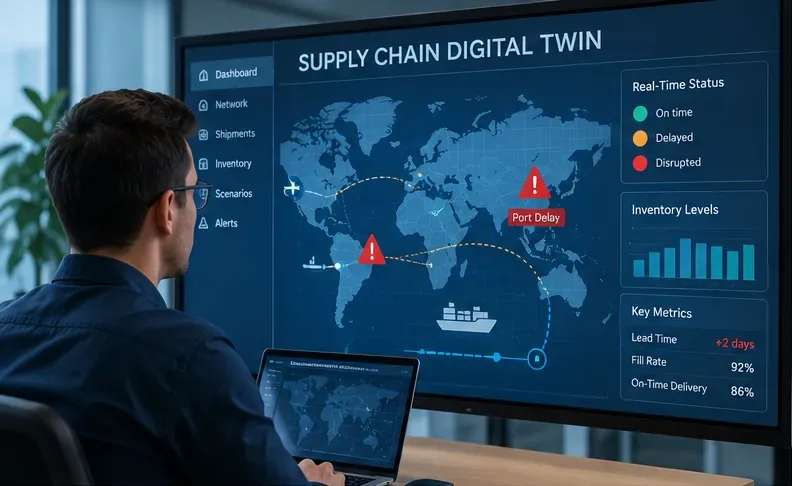
A logistics operator reviews a conceptual supply chain digital twin that combines route visibility, inventory status, and disruption alerts in one operational view.
What a Supply Chain Digital Twin Actually Is
NIST describes digital twins as synchronized virtual models that can help users represent, diagnose, predict, and optimize real-world systems. In a supply chain context, the “real-world system” is not just a factory. It can include suppliers, manufacturing sites, distribution centers, transport lanes, ports, inventory positions, customer demand, and selected external risk signals.
A digital twin is therefore more than a dashboard. A dashboard shows what has happened or what is happening. A useful twin also links that data to models that can estimate what may happen next and evaluate possible responses. The exact level of synchronization varies by implementation; not every twin operates in true real time, and not every business needs that level of latency.
NIST’s ongoing Digital Twins for Advanced Manufacturing work emphasizes the ability to observe, diagnose, predict, and optimize operations, while also stressing interoperability, validation, and trustworthy use. The important action for a supply chain team is to define the decision the twin must improve before choosing the technology stack.
Why the 2026 Traceability Update Matters
The newly finalized NIST IR 8536 supply-chain traceability meta-framework is not itself a digital twin platform. It addresses a different but complementary problem: how organizations can organize, link, query, and verify traceability information across fragmented ecosystems.
NIST’s framework uses common structural patterns, interoperable interfaces, and cryptographically verifiable links to create a time-ordered provenance chain without requiring every participant to place all data in one central repository. It also emphasizes selective disclosure, allowing organizations to share necessary traceability information while protecting sensitive intellectual property.
For a digital twin, that is valuable because scenario analysis becomes unreliable when component identity, supplier provenance, shipment status, or event history is incomplete or contradictory. The action to take is straightforward: treat data lineage and traceability as part of the twin architecture, not as a cleanup project to be added later.
Where Digital Twins Help During a Disruption
Disruption
What the twin can evaluate
What still requires human judgment
Port closure or shipping delay
Alternative ports, transport modes, route lead times, inventory depletion dates, and customer impact
Commercial priorities, carrier commitments, customs constraints, and risk tolerance
Supplier interruption
Which products depend on the supplier, alternate-source capacity, safety-stock exposure, and recovery scenarios
Supplier qualification, contract terms, quality risk, and strategic sourcing decisions
Demand surge
Capacity constraints, inventory reallocation, backlog risk, and production sequencing alternatives
Which customers or markets receive priority and how service promises change
Cold-chain or quality excursion
Affected lots, transit history, temperature-linked exposure, and replacement options
Regulatory disposition, quality release, and product-specific safety decisions
A March 2026 NIST paper on supply-chain digital twin deployments in biopharmaceuticals identified global supply risks, traceability, decentralized production, complex cold-chain logistics, and supply-demand uncertainty as important areas where digital twins may provide value. Those examples are industry-specific, but the underlying pattern is broadly useful: connect operational data to a model, then test response options against real constraints.
Use the Twin as a Scenario Engine, Not an Oracle
One common misconception is that a digital twin predicts the future with certainty. It does not. It produces estimates based on the data, assumptions, and models available at that moment. A rerouting simulation may calculate a shorter lead time, for example, but the answer can still be wrong if port dwell time, carrier capacity, customs clearance, or supplier readiness is stale or missing.
NIST’s July 2026 Digital Twins Workshops Summary Report highlights persistent challenges in interoperability, verification, validation, uncertainty quantification, cybersecurity, and workforce readiness. These are not secondary concerns. They determine whether a twin can support an operational decision responsibly.
The practical action is to show uncertainty instead of hiding it. Scenario outputs should distinguish known inputs from estimates, include confidence ranges where possible, and record which assumptions drove the recommendation. A twin that says “Route B is likely to preserve service if port dwell time stays below four days” is more useful than one that simply labels Route B “optimal.”
Build the Data Foundation Before Adding Sophisticated AI
The highest-value supply chain twin is rarely the one with the most complicated machine-learning model. It is the one that consistently represents the network well enough to support decisions. That foundation usually includes several layers:
Network topology: suppliers, sites, lanes, ports, warehouses, products, bills of material, and customer destinations.
Operational state: purchase orders, production status, inventory, shipments, estimated arrivals, capacity, backlog, and demand.
Identity and traceability: consistent identifiers for products, lots, components, locations, and trading partners.
Event history: what happened, when it happened, where it happened, and which object or shipment was affected.
Models and constraints: lead-time distributions, capacity limits, replenishment rules, substitution logic, costs, and service targets.
Decision workflow: who reviews an alert, who can approve a reroute, when a supplier change requires qualification, and how actions are recorded.
If these layers are weak, adding generative AI or advanced optimization may make the interface more impressive without making the decision more reliable. Start by fixing the data paths that matter to one high-value disruption scenario.
How to Roll Out a Digital Twin Without Boiling the Ocean
Start with one painful decision
Choose a recurring decision where delay is expensive: responding to a late inbound shipment, allocating constrained inventory, recovering from a supplier outage, or deciding whether to expedite freight. Define the current decision time, required data, and business outcome.
Model only the part of the network required for that decision
A global enterprise does not need to represent every supplier and lane on day one. A focused twin for one product family or region can prove whether the data, model, and workflow create value. Expand only after the initial model has been validated.
Compare simulations with actual outcomes
Validation is essential. If the twin predicts a six-day recovery and the real network takes ten, determine why. Was the carrier data late? Was production capacity overstated? Did customs processing change? Each mismatch is an opportunity to improve the model rather than conceal the error.
Connect recommendations to an accountable workflow
A twin should not end at a visualization. An alert should lead to a defined decision process: evaluate scenarios, identify affected orders, obtain approvals, communicate with partners, execute the response, and record the result. That record becomes training data for future improvement.
Metrics That Show Whether the Twin Is Improving Resilience
Technology metrics such as data refresh rate and model latency matter, but business outcomes matter more. Useful measures include:
time from disruption signal to confirmed impact assessment;
time from impact assessment to an approved response;
forecast error for arrival, recovery, or inventory-depletion estimates;
service level or fill-rate loss during disruptions;
expedite cost and premium-freight spend;
inventory stranded by a disruption;
recovery time after a supplier, plant, or transport interruption;
percentage of critical events with complete traceability data.
The goal is not to prove that a digital twin exists. It is to prove that decisions become faster, more consistent, and more resilient.
What the Technology Cannot Fix by Itself
A digital twin cannot create supplier cooperation, repair a missing contract, qualify an alternate source, or guarantee transportation capacity. It also cannot eliminate geopolitical, weather, cyber, or regulatory risk. The WTO’s July 31, 2026 update noted that global goods trade remained resilient in the first quarter of 2026 even as Middle East conflict disrupted shipments, while warning that the full effect of disruptions in the Strait of Hormuz was likely to appear in later data. That is a useful reminder that physical events can move faster than official statistics.
What a well-designed twin can do is shorten the gap between signal and action. It can expose which orders, components, sites, and customers are at risk; compare feasible alternatives; and make assumptions visible to the people responsible for the decision.
The Most Important Design Principle: Trust Before Automation
The newest NIST work on supply-chain traceability and digital twins points in the same direction: interoperability, provenance, validation, and security are prerequisites for trustworthy automation. A supply chain twin should become a shared decision model of the network, not an opaque optimization engine that only specialists understand.
Organizations navigating global supply chain disruptions should therefore begin with a narrow, measurable use case, build verifiable data connections around it, validate the model against real outcomes, and expand gradually. Once that foundation is credible, digital twin technology can move from an attractive visualization to a practical resilience tool—one that helps teams understand disruption faster, test options before committing resources, and coordinate a response with fewer surprises.