Home
» New Trends
»
Last-Mile Sky Delivery: How Low-Altitude Networks Are Scaling E-Commerce
Last-Mile Sky Delivery: How Low-Altitude Networks Are Scaling E-Commerce
Drone delivery is becoming easier to understand once you stop thinking of the drone as the whole system. The aircraft is only the visible part. What actually scales e-commerce is a low-altitude delivery network: nearby inventory, automated dispatch, approved airspace access, digital traffic-management services, reliable aircraft, safe drop-off points, and a commerce platform that decides which orders are suitable for flight.
As of September 14, 2026, this is no longer limited to small demonstrations. Walmart reported more than one million drone deliveries in May 2026, while Wing says its commercial network has passed one million home deliveries and is expanding with Walmart toward nearly 20 U.S. metro areas. Amazon says Prime Air plans to serve nearly 500 U.S. cities and towns by the end of 2026 and has launched its first service outside the United States in Darlington, England. These are company-reported milestones and plans, so they should be read as evidence of commercial expansion rather than proof that drone delivery is already universal. See Walmart's May 2026 delivery milestone, Wing's June 2026 network update, and Amazon's 2026 Prime Air expansion announcement.
Start with the vocabulary: what is a low-altitude delivery network?
A UAS, or unmanned aircraft system, is the drone plus the equipment and systems needed to operate it. BVLOS means beyond visual line of sight: the aircraft flies beyond the distance at which a human pilot can continuously see it with unaided vision. BVLOS matters because a delivery network cannot economically cover a large service area if every flight must be watched end to end by a person standing nearby.
UTM, or UAS Traffic Management, is the digital coordination layer intended to help multiple drone operators share low-altitude airspace. The U.S. Federal Aviation Administration describes UTM as a collaborative ecosystem for flight planning, authorization, surveillance, and conflict management, especially for BVLOS operations. It is separate from, but complementary to, conventional air traffic control. Read the FAA's UTM overview.
Europe uses the term U-space for a regulated set of services in designated airspace. EASA lists four mandatory services in U-space airspace: flight authorization, geo-awareness, network identification, and traffic information. Importantly, U-space is not simply “all airspace below a certain height”; Member States designate specific U-space areas following an airspace risk assessment. See EASA's U-space framework and the current consolidated EU regulation.
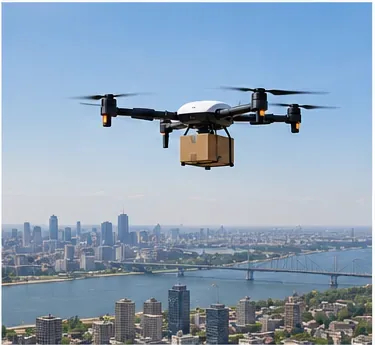
A parcel-carrying delivery drone flies above an urban corridor. In a real service, the aircraft is only one layer of a larger network that also includes inventory, dispatch, airspace services, and a safe delivery point.
Why the network matters more than the aircraft
A fast drone does not automatically create a fast delivery service. The order must start close enough to the customer, fit the aircraft's payload and dimensions, pass weather and address checks, receive the necessary flight authorization, and have a safe place to be delivered. If any one of those conditions fails, the order needs another fulfillment method.
That is why the strongest drone-delivery deployments increasingly look like an extension of an existing e-commerce network rather than a separate aviation product. Walmart's current customer guidance, for example, checks the exact address and basket for eligibility and notes that weather and vendor rules affect availability. The eligible order can then appear as another fulfillment choice at checkout. Walmart also says current vendor-dependent basket limits are typically in the range of 2–8 pounds. See its drone delivery help page.
Network layer
What it does
What usually limits scale
Inventory node
Keeps eligible goods close to customers
SKU availability, picking speed, local demand
Order eligibility
Checks weight, size, address, weather, and service rules
Too many baskets falling back to ground delivery
Launch and recovery
Loads, checks, charges, and dispatches aircraft
Station throughput, battery turnaround, staffing
Airspace services
Handles constraints, authorizations, identity, and traffic coordination
People, pets, trees, wires, small yards, inaccessible properties
Commerce platform
Presents delivery options, tracking, cancellation, support, and refunds
Poor integration with the normal checkout and support journey
What has changed by 2026?
1. Commercial volume is beginning to matter
Walmart's May 2026 update says it had completed more than one million drone deliveries, with service then operating from 66 stores across four states and five metro markets. Wing separately announced a planned network of more than 270 Walmart locations in 2027 and, in June 2026, named seven additional metro areas for expansion. Those numbers do not mean every household in those metros is eligible, but they show a shift from isolated launch sites toward repeatable multi-node networks.
2. Drone delivery is being embedded in normal e-commerce
The customer experience is becoming less exotic. Amazon says Prime Air is integrated into its existing shopping flow, while Walmart exposes drone delivery through its web and app experience when an address and basket qualify. This matters because a delivery mode scales more easily when customers do not need a separate ordering system, separate account, or unfamiliar support process.
3. Shared low-altitude traffic management is moving into operations
The FAA says its UTM Operational Evaluation has begun supporting BVLOS operations through accepted strategic-deconfliction services, and that operators and service providers exchange flight intent through highly automated systems and APIs rather than relying primarily on voice coordination. The FAA also notes that the Dallas-area authorizations for Wing and Zipline use UTM technology to keep commercial BVLOS operations safely separated in shared airspace.
4. Regulation is still a gating factor
In the United States, the FAA's Part 107 guidance updated July 6, 2026 still states that small-drone pilots generally must keep the aircraft within sight unless operating under another approved pathway. Package delivery at airline-like scale therefore relies on more specific authority, including Part 135 air-carrier certification and applicable exemptions or operating approvals. The FAA currently lists seven Part 135 UAS package-delivery operators. See the FAA's Part 135 package-delivery page and Part 107 operating requirements.
The FAA proposed a broader BVLOS rule in August 2025, and its 2026 Drone Normalization Strategy identifies a BVLOS final rule as a 2026 milestone. A business planning a launch should verify the current Federal Register and FAA status instead of treating a proposal as effective law. The same caution applies internationally: local civil-aviation rules, privacy rules, environmental review, security restrictions, and municipal requirements can all affect a service area.
What a retailer or logistics operator needs before launch
Choose the right orders, not every order
Drone delivery works best when the item is small enough for the aircraft, needed quickly, stocked near the customer, and expensive enough—or urgent enough—to justify a premium fulfillment path. A large weekly grocery basket, furniture, bulk pet food, and low-urgency parcels may remain better suited to vans or consolidated ground routes. The network should identify the subset of orders where flight creates a clear customer or operational advantage.
Build service cells around inventory
A service cell is the geographic area a launch site can reliably reach under the aircraft's range, reserve-energy, weather, and regulatory constraints. Scaling then becomes a network-design problem: add nodes where there is enough eligible demand, overlap them carefully, and keep high-frequency products close to launch points. Store-based retail has an advantage because existing stores can serve as local inventory nodes; dedicated e-commerce networks may use micro-fulfillment centers or purpose-built drone hubs.
Make eligibility automatic
Customers should not have to understand aviation rules. The platform should automatically determine whether an order is flyable by checking the item, weight, dimensions, delivery address, operating hours, current weather, aircraft availability, airspace constraints, and safe drop point. If the answer is no, the checkout should cleanly fall back to another delivery method.
Treat airspace data as production infrastructure
For a few flights, manual coordination may be manageable. For hundreds or thousands of flights, the system needs machine-readable constraints, flight intent, authorization, tracking, and deconfliction. Remote identification is one part of that stack. The FAA defines Remote ID as the ability of a drone in flight to broadcast identification and location information; drones that are required to be registered generally must comply with the rule. See the FAA's Remote ID guidance.
Design ground operations with the same care as flight
A fleet can be technologically sophisticated and still bottleneck at the store. Package staging, loading, preflight checks, battery charging, maintenance, weather holds, exception handling, and recovery all consume time and space. The launch site needs enough throughput to prevent aircraft from waiting on packages—or employees from waiting on aircraft.
A practical path from pilot to network
Phase 1: Prove one useful customer promise
Start with a narrow use case such as urgently needed household essentials, convenience goods, pharmacy items where regulations permit, or small forgotten grocery items. Measure not just flight time but total order-to-door time, completion rate, customer repeat use, cancellations, and fallback rate.
Phase 2: Prove the service cell
Map the actual deliverable area, not just a circle based on maximum aircraft range. Remove addresses that cannot support safe delivery, restricted areas, locations with persistent obstacles, and zones that repeatedly fail due to weather or airspace constraints. A smaller reliable service area is more valuable than a larger theoretical one.
Phase 3: Integrate with normal fulfillment
The drone path should share inventory, payment, order management, customer support, returns, and notifications with existing channels. When flight is unavailable, the order should move to pickup, courier, or ground delivery without forcing the customer to start over.
Phase 4: Add network-level coordination
As nearby operators and service cells overlap, strategic deconfliction and conformance monitoring become more important. This is where UTM or U-space services begin to turn a collection of individual flights into managed low-altitude infrastructure.
Phase 5: Scale by density and utilization
More aircraft alone do not guarantee better economics. Useful scale comes from higher order density around each node, more eligible baskets, better fleet utilization, shorter turnaround, robust weather recovery, and fewer manual interventions. The business objective is not “maximum flights”; it is dependable fulfillment at a cost and service level customers will use repeatedly.
Common mistakes to avoid
Assuming BVLOS is automatically legal: approval pathways differ by country and operation. Verify the rule and authorization that applies to the specific service.
Designing around maximum aircraft range: usable range is constrained by reserves, weather, obstacles, airspace, and the return or contingency plan.
Promising every SKU by drone: payload, dimensions, packaging, and handling rules make eligibility selective.
Running drone delivery as a separate app: extra accounts and fragmented customer support add friction that can erase the convenience advantage.
Ignoring the ground node: slow picking, loading, charging, or maintenance can eliminate the speed gained in the air.
Treating weather as an exception: wind, precipitation, temperature, visibility, and severe weather are ordinary planning inputs, not rare edge cases.
Optimizing only for speed: completion rate, safety, noise, privacy, customer trust, and unit cost matter just as much as minutes saved.
Claiming environmental benefits without measurement: a lightweight electric flight may replace some car trips, but lifecycle impact depends on the energy source, packaging, aircraft utilization, failed deliveries, and which ground trip is actually displaced.
Why “global” scaling will still be regional
The technology stack can be replicated internationally, but the airspace system is not one global network. ICAO is working toward common UTM principles because inconsistent national approaches can create safety, security, reliability, and economic problems. ICAO's framework envisions regulators and air navigation organizations providing real-time constraints and flight-intent information directly or through UTM service providers, with operators managing flights within those constraints. See ICAO's UTM guidance.
That points to a likely model for global e-commerce: common aircraft and software platforms, but locally authorized service cells connected to national or regional digital airspace systems. The United States may emphasize FAA-approved UTM services and operator authorizations; the European Union uses designated U-space with mandatory service providers; other countries will combine their own licensing, airspace, privacy, security, and infrastructure rules.
What to watch next
Three signals will show whether low-altitude delivery is moving from a fast niche to a standard e-commerce layer. First, watch the percentage of normal online baskets that become drone-eligible, not just the number of aircraft. Second, watch whether multiple operators can safely share the same low-altitude airspace through interoperable digital services. Third, watch whether retailers can open new service cells using a repeatable playbook instead of treating every city as a custom aviation project.
The important shift is already visible: last-mile sky delivery is becoming a network problem rather than a drone problem. The winners will not necessarily be the operators with the fastest aircraft. They will be the systems that connect nearby inventory, automated airspace coordination, reliable ground operations, customer-friendly checkout, and safe delivery into one repeatable service. That is what turns a low-altitude flight into scalable e-commerce infrastructure.