Home
» New Trends
»
How Embodied AI Is Reshaping Next-Generation Humanoid Robotics in 2026
How Embodied AI Is Reshaping Next-Generation Humanoid Robotics in 2026
The most important change in humanoid robotics in 2026 is not that robots suddenly became “human-level.†It is that the AI stack is becoming more integrated: perception, language, spatial reasoning, locomotion, dexterous manipulation, progress tracking, and recovery are increasingly being trained to work together instead of being engineered as isolated modules.
A useful example arrived on July 30, 2026, when Google DeepMind introduced Gemini Robotics 2. The company described a vision-language-action system that can control an entire humanoid body—from walking and crouching to reaching and manipulating objects—and paired it with a higher-level embodied reasoning model for multi-step tasks. DeepMind also published task-level results rather than claiming universal competence: on one Apollo humanoid setup, reported success rates were 68.4% for picking an object from a table, 45.7% from the floor, and 76.3% from a shelf. Those numbers are promising, but they also make the current limitation visible: capability is improving faster than reliability.
For readers evaluating the field, that distinction matters. The right question is no longer “Can a humanoid do this once?†It is “Can it do the task repeatedly, in changing conditions, recover when something goes wrong, and remain safe around people?†That is the standard that separates a compelling demonstration from a system that is approaching useful deployment. See the Google DeepMind Gemini Robotics 2 announcement and reported benchmarks.
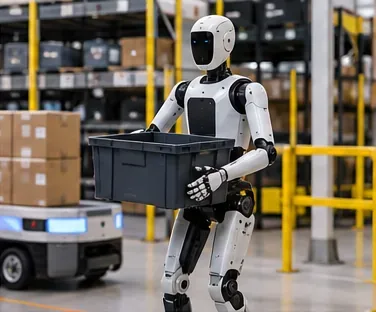
A humanoid robot carries a tote through a warehouse-style workspace, illustrating the kind of closed-loop perception, balance, navigation, and manipulation that embodied AI must coordinate in real environments.
What Embodied AI Actually Changes
Embodied AI is artificial intelligence that must perceive and act through a physical body. For a humanoid, that body imposes constraints that a text model does not face: gravity, friction, latency, limited battery power, joint limits, uncertain contact, moving people, occluded objects, and the possibility of causing physical harm.
Earlier robot systems often divided these problems into carefully engineered modules. A perception stack detected objects, a planner chose a path, a controller executed a motion, and each task was tuned for a narrow environment. Modern embodied AI increasingly uses foundation models—especially vision-language-action, or VLA, models—to connect visual observations and language instructions directly to actions, while higher-level models reason about goals and task progress.
Google DeepMind’s 2025 Gemini Robotics work explicitly added physical actions as an output modality to a multimodal model, while its embodied-reasoning model focused on spatial understanding and could connect to conventional low-level controllers. That separation is important: learned intelligence can broaden what the robot understands, while deterministic or certified control layers can still enforce collision, force, and stability constraints. The original architecture is described in Google DeepMind’s Gemini Robotics technical overview.
What “Good†Looks Like: Measure Outcomes, Not Demo Appeal
There is no single benchmark that proves a humanoid is generally intelligent. The most informative evaluation combines several signals. A strong system should not merely succeed once; it should degrade gracefully when the environment changes and make its failures visible.
Quality signal
What a strong result looks like
Warning sign
Task success
High repeatability across many trials, not one selected run
A polished video without trial counts or failure cases
Generalization
The same policy handles new objects, layouts, or instructions with limited adaptation
Every new task requires a fresh policy or tightly staged environment
Long-horizon reliability
The robot completes multi-minute sequences without compounding small errors
Performance is shown only on isolated pick-and-place actions
Recovery
The robot notices a miss, drop, obstruction, or changed scene and replans
One early mistake forces a full reset
Whole-body coordination
Walking, reaching, balancing, and hand control work as one closed loop
Manipulation succeeds only while the robot is fixed in place
Latency
Perception and action remain responsive enough for safe closed-loop control
Long pauses make the robot unable to react to people or moving objects
Safety behavior
The system respects force, proximity, stability, and uncertainty constraints and can ask for help
Safety depends only on the generative model “understanding†what is dangerous
A practical action for anyone comparing humanoid systems is to ask for distributions, not highlights: success rate over repeated trials, what changed between train and test conditions, average task time, intervention frequency, and the most common failure modes. If those answers are unavailable, treat the result as an existence proof rather than evidence of deployment readiness.
Why Foundation Models Are a Bigger Deal for Humanoids Than for Fixed Robots
Humanoid robots have a potentially useful advantage: their cameras, hands, arms, torso, and locomotion resemble the viewpoint and action space found in human environments. That makes human demonstrations, internet video, teleoperation, simulation, and cross-robot datasets potentially valuable training sources.
The Open X-Embodiment project helped establish this direction by aggregating data from 22 robot embodiments and demonstrating that a generalist policy could benefit from experience collected on other robots. Its original dataset covered 527 skills and more than 160,000 tasks. The important idea was not that one model solved robotics, but that robot learning could begin to scale through shared, heterogeneous experience rather than one policy per task and per machine. The paper is available from the Open X-Embodiment research publication.
NVIDIA has pushed a similar scaling strategy for humanoids through Isaac GR00T. In 2026, GR00T N1.7 combined vision-language reasoning with action generation and an end-to-end development workflow spanning data collection, simulation, post-training, evaluation, and deployment. NVIDIA reports that the model was pretrained on tens of thousands of hours of real and simulated data and supports commercial use under an open license. The practical significance is that a robotics team can start from a general model and specialize it instead of training every behavior from scratch. See NVIDIA’s GR00T end-to-end humanoid policy workflow.
The 2026 Step Forward: Whole-Body Intelligence
For years, many impressive robot-learning results focused on tabletop manipulation because it isolates one of the hardest problems: getting hands and arms to interact with unpredictable objects. Humanoids must add locomotion and balance without sacrificing manipulation quality.
Gemini Robotics 2 is notable because DeepMind reports a move from upper-body tasks to full-body control on Apptronik’s Apollo platform. In the company’s examples, the model can interpret a goal, walk to an object, bend or crouch when necessary, grasp it, move to another location, and place it. The associated embodied-reasoning model tracks multi-step tasks over several minutes and can self-correct when a step fails.
That is the direction to watch. A humanoid becomes more useful when locomotion is not a separate pre-programmed “taxi†that moves the hands from one station to another, but part of the same task representation. The quality test is whether the robot can preserve task intent while its viewpoint, balance state, reachable workspace, and contact conditions continuously change.
Dexterity Is Becoming a Data Problem—and Still a Hardware Problem
Modern embodied AI can learn contact-rich behaviors that would be difficult to describe with hand-written rules. Figure, for example, has reported that its Helix family can use one learned VLA architecture across logistics, laundry, and household manipulation. In May 2026, Figure published a demonstration in which two Helix-02 humanoids reset a bedroom together using a learned policy, including opening doors, hanging clothing, moving furniture, placing objects, and making a bed.
That is an interesting systems result, but it should be interpreted correctly: it is a company-reported demonstration, not an independent cross-platform benchmark. The useful takeaway is that data can teach one architecture qualitatively different behaviors without redesigning the core model. The result and its claimed conditions are documented in Figure’s Helix-02 bedroom-tidy report.
At the same time, better models cannot compensate indefinitely for poor sensors or weak actuators. Fine manipulation depends on camera placement, tactile or force feedback, finger range of motion, backlash, torque control, and mechanical robustness. Figure’s later hardware work, for example, explicitly redesigned sensing and hands around its learned controller. This is a broader lesson: if a humanoid repeatedly fails at contact, grasp stability, or small-object manipulation, the right fix may be hardware, calibration, or sensing—not a larger model.
Simulation and Synthetic Data Are Closing the Data Gap
Physical data is expensive. Human teleoperation takes time, robots wear out, and rare edge cases are difficult to collect safely. Embodied AI teams are therefore building data “flywheels†that mix real demonstrations with simulation, synthetic trajectories, video, and automatic relabeling.
NVIDIA’s Isaac GR00T platform explicitly combines real captured data, simulated data, and internet-scale video, while its 2026 reference humanoid design couples onboard compute with open models and a common development stack. That approach matters because teams can evaluate policies in simulation before spending hardware time on every experiment. The company’s reference platform is described in the NVIDIA Isaac GR00T reference humanoid announcement.
Simulation does not eliminate reality. Friction, deformable materials, sensor noise, contact timing, actuator heating, and human motion can differ sharply from a simulator. A good workflow uses simulation to expand coverage and accelerate iteration, then measures the sim-to-real gap explicitly. If a policy scores well virtually but needs frequent resets on hardware, more simulation alone is unlikely to solve the problem.
On-Device AI Matters More Than It Sounds
Robots operate in real time. A cloud round trip may be acceptable for high-level planning, but fast visuomotor control often benefits from local inference because the robot must respond immediately to slips, moving people, and changing contact.
Google DeepMind’s 2025 Gemini Robotics On-Device work focused on running a VLA locally and adapting it to new robot embodiments with relatively small amounts of data. By 2026, DeepMind described on-device models as part of a broader whole-body stack. The practical metric is not simply model size; it is end-to-end control latency under real compute, thermal, and power limits. The underlying direction is documented in Gemini Robotics On-Device.
Safety Has to Be Layered, Not Prompted
Embodied AI raises the cost of mistakes because a robot can apply force in the physical world. A robust architecture therefore separates responsibilities. High-level AI can interpret goals, identify hazards, and decide when to stop or ask for help. Lower-level controllers can independently enforce joint limits, collision avoidance, force limits, dynamic stability, emergency stops, and restricted zones.
DeepMind’s 2026 Robotics 2 release describes this layered approach and introduces an agentic safety benchmark that tests whether a reasoning model rejects unsafe tool calls and recognizes when human intervention is needed. That is useful progress, but benchmark success should not be confused with safety certification. Real deployments still require application-specific risk assessment, validated hardware limits, operational procedures, and testing under the actual environment.
A simple rule is helpful: if a safety-critical function can be enforced deterministically at the control or hardware level, do not rely on a generative model as the only barrier.
When a Single End-to-End Model Is the Wrong Choice
End-to-end learning is attractive because it can reduce brittle hand-coded interfaces. It is not always the best architecture. If a robot is failing long tasks, has unpredictable latency, or operates in a tightly regulated environment, a hierarchical system may be easier to debug and validate.
Use hierarchical planning when the task lasts minutes and requires checkpoints, progress estimation, or recovery.
Keep low-level safety controllers separate when forces, collisions, or stability have hard constraints.
Move inference on-device when network latency or connectivity undermines closed-loop response.
Add structured perception or task state when a pure VLA repeatedly loses track of inventory, counts, or exact process state.
Improve sensing or mechanics when errors are caused by occlusion, weak tactile feedback, backlash, or insufficient actuator control.
Use human-in-the-loop escalation when uncertainty is high and the cost of a wrong physical action is unacceptable.
The right architecture is the one that produces the required reliability and observability, not the one with the fewest modules.
What Embodied AI Has Not Solved Yet
Several limitations remain easy to underestimate.
Reliability still trails capability
A robot may demonstrate a difficult behavior yet remain unsuitable for continuous operation. DeepMind’s own 2026 whole-body results show meaningful but far-from-perfect success rates on basic pickup locations. A warehouse, factory, hospital, or home needs a system that can handle hours of operation, not only individual task attempts.
Benchmarks are difficult to compare
Different organizations use different robots, hands, cameras, object sets, layouts, success criteria, and levels of human intervention. A 90% result on one setup cannot be assumed to outperform a 75% result on another. The most useful comparisons keep hardware and evaluation conditions fixed.
Long-horizon errors compound
If a robot is 95% reliable at each of 20 dependent steps, the chance of completing the full chain without any error can be much lower than the per-step number suggests. Recovery and progress tracking are therefore as important as raw action accuracy.
Physical economics matter
Embodied AI does not remove the need for durable hardware, batteries, maintenance, safe actuators, spare parts, and acceptable cycle time. A system can be technically impressive and still be uneconomic for a specific job.
Generalization is not the same as unrestricted autonomy
A model that adapts to new objects or layouts is more general than a scripted robot. That does not mean it can safely handle arbitrary instructions in arbitrary environments. Deployment envelopes still need to be defined and tested.
A Better Way to Judge the Humanoid-Robotics “Revolutionâ€
The strongest evidence of progress will not be a robot that performs the most spectacular one-off task. It will be a robot that can learn a new task with less data, transfer skills to a different environment, execute for longer without intervention, recover from ordinary mistakes, and stay within safety constraints while doing so.
By that standard, embodied AI is already changing the engineering path for humanoid robotics. Cross-embodiment datasets are making general pretraining practical. VLA models are connecting language and vision to action. Whole-body models are combining locomotion with manipulation. On-device inference is reducing dependence on cloud latency. Synthetic data and simulation are expanding training coverage. Higher-level embodied reasoning is improving task decomposition, progress tracking, and recovery.
But the field is still in the transition from “possible†to “dependable.†That is why the most useful 2026 updates are the ones that expose measured success rates, longer task horizons, transfer conditions, safety behavior, and failure recovery—not just more fluent demonstrations.
For anyone deciding whether next-generation humanoids are ready for a real workflow, the final question should be operational: Does the system meet the required success rate, cycle time, recovery rate, intervention rate, and safety envelope in the environment where it will actually work? If not, the right move is not necessarily to abandon embodied AI. It may be to narrow the task, add supervision, change the architecture, collect better data, or improve the robot body until the measured outcome is good enough.