Home
» New Trends
»
How Advanced Battery Technology Is Reducing Electric Vehicle Range Anxiety
How Advanced Battery Technology Is Reducing Electric Vehicle Range Anxiety
The biggest change in electric vehicles is not a single miracle battery. It is the combination of more energy-dense cells, faster charging, better thermal management, smarter battery controls, and more efficient vehicle design. Together, those improvements are making range anxiety less about whether an EV can complete an ordinary day and more about whether a driver can recharge quickly and predictably on an unusual long trip.
That distinction matters. A battery that adds 50 miles of rated range can help, but so can a battery that accepts energy much faster, maintains performance in cold weather, or uses less energy per mile. For many buyers, the best EV is therefore not the one with the largest battery. It is the one whose range, charging curve, thermal system, and charging access fit the way they actually drive.
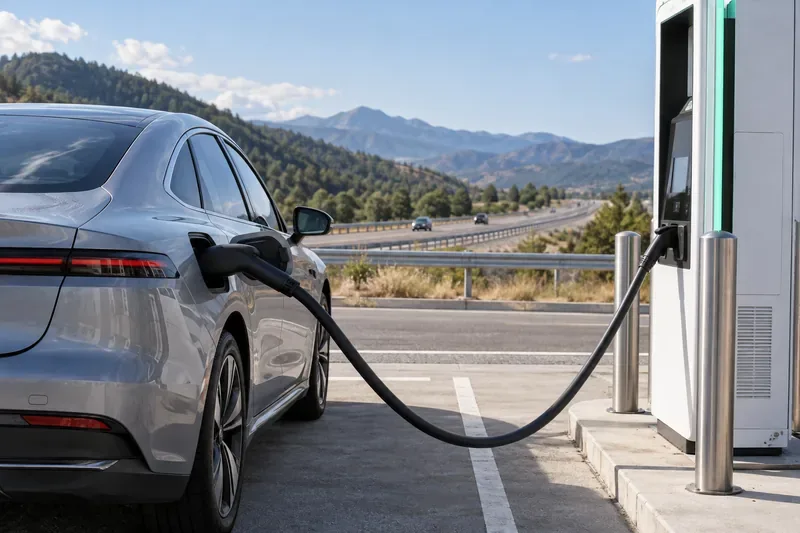
A modern electric sedan charges at a highway fast-charging stop, illustrating how battery capability and charging speed work together to reduce long-trip range concerns.
Range anxiety is increasingly a system problem, not just a battery-size problem
The U.S. Environmental Protection Agency notes that most current EV models can travel more than 200 miles on a full charge, while more than 98% of U.S. on-road passenger trips measured in the 2022 National Household Travel Survey were shorter than 75 miles. That does not mean every EV works for every household, but it helps explain why everyday range is already adequate for many drivers. See the EPA's Electric Vehicle Myths page for the underlying context.
The harder use case is usually a long highway trip, especially in winter, with few charging choices or a tight schedule. Advanced battery technology is attacking that problem from several directions at once.
Technology
How it reduces range anxiety
Important limit
Higher-energy-density cells
Stores more usable energy without simply making the pack much larger and heavier
Higher energy density must still meet cost, safety, durability, and thermal requirements
800-volt electrical architectures
Can support very high charging power with lower current for a given power level
The charger, battery temperature, state of charge, and vehicle charging curve still determine real speed
Battery preconditioning and thermal management
Keeps cells closer to the temperature range where they can deliver and accept power efficiently
Cold weather, cabin heating, speed, wind, and load can still reduce range
Smarter battery management systems
More precisely controls charging, cell balancing, temperature, and usable state-of-charge windows
Software cannot overcome the physical limits of the cells or an underpowered charger
Silicon-rich and lithium-metal anodes
Potentially store substantially more lithium than conventional graphite-based designs
Expansion, cycle life, manufacturing, and interface stability remain engineering challenges
Solid-state batteries
Could raise energy density while enabling new safety and packaging approaches
Still not a mainstream production solution for mass-market EVs as of September 2026
Higher-density batteries are already translating into longer production-EV range
The most direct way to extend range is to carry more usable energy for the same or similar pack mass and volume. Automakers are doing this through incremental improvements in cathodes, anodes, cell packaging, pack integration, and vehicle efficiency rather than waiting for an entirely new chemistry.
A useful production example is the 2026 Lucid Air lineup. Lucid says the Air Touring uses higher-density battery cells and reaches an EPA-estimated 431 miles, while the Air Grand Touring is rated at up to 512 miles. Those figures are manufacturer-reported EPA estimates, not a promise that every driver will achieve them, but they show how far current lithium-ion technology and vehicle efficiency can be pushed. The details are in Lucid's 2026 Air announcement.
For a buyer who regularly drives 250 to 350 highway miles between reliable charging opportunities, this kind of range can materially change trip planning. For someone whose normal day is 30 miles and who charges at home, however, paying for the largest available battery may provide little practical benefit.
Faster charging can matter more than another 50 miles of rated range
Long-distance EV travel becomes much easier when a charging stop starts to resemble a normal rest break rather than a long wait. This is where high-voltage battery and power-electronics architectures matter.
Hyundai's current IONIQ 5 documentation states that, when connected to an appropriate 800-volt ultra-rapid charger, the vehicle can recharge from 10% to 80% in about 18 minutes. Hyundai also warns that real charging time depends on charger capability, battery temperature, electricity supply, accessory use, and environmental conditions. Those conditions are important; a headline peak-kilowatt number does not describe the entire charging session. See the 2026 Hyundai IONIQ 5 specification sheet.
The U.S. Department of Energy's Alternative Fuels Data Center says DC fast charging can add roughly 100 to 200 or more miles of range in 30 minutes depending on the vehicle, battery, charger, and conditions, with installed DC fast-charging equipment reaching power levels as high as 500 kW. Its EV charging equipment overview is a useful reference when comparing charging claims.
For road-trip buyers, the better question is therefore not simply, “What is the maximum charging power?” Ask how long the vehicle takes from roughly 10% to 80%, whether it can precondition the battery before a charging stop, and how consistently it holds useful charging power through that window.
Thermal management protects both range and charging performance
Lithium-ion batteries are sensitive to temperature. In cold conditions, electrochemical reactions slow and the car may also consume significant energy heating the battery and cabin. In very hot conditions, the vehicle may spend energy cooling the pack and may limit power to protect it.
The EPA explicitly cautions that cold weather, accessory use, and high-speed driving can significantly reduce EV range. Its range testing methodology also accounts for factors such as air conditioning, cold temperatures, aggressive driving, and higher speeds. See the EPA's EV range testing explanation.
Modern thermal systems address the problem by actively heating or cooling the pack and, on many vehicles, preconditioning it before a fast-charging stop. The Department of Energy recommends preconditioning while the vehicle is plugged in when possible because grid energy can warm the cabin and battery before departure instead of consuming stored driving energy. DOE also notes that a heat pump can improve cabin-heating efficiency in many conditions. See DOE's winter EV guidance.
This matters most for drivers in cold regions. If winter highway travel is a normal requirement, a heat pump, route-aware battery preconditioning, and a healthy range buffer may be more useful than choosing between two EVs whose official range differs by only a few miles.
Silicon-rich anodes could increase energy storage, but the engineering trade-offs are real
Conventional lithium-ion cells commonly use graphite-dominant anodes. Silicon is attractive because it can theoretically store far more lithium than graphite for a given mass. The challenge is that silicon expands and contracts substantially during cycling, which can damage particles and the interfaces around them.
DOE research has highlighted both sides of that trade-off: silicon has very high theoretical capacity, but repeated swelling can degrade the electrode. That is why current progress tends to involve carefully engineered silicon-containing materials, binders, structures, and electrolyte strategies rather than simply replacing all graphite with bulk silicon. A useful technical starting point is the Department of Energy's silicon-anode research summary.
For consumers, the practical takeaway is simple: silicon-rich batteries can contribute to future range gains, but a purchase decision should be based on the tested vehicle available today, not the theoretical capacity of a material in a laboratory.
Solid-state batteries are promising, but they should not be treated as a showroom standard yet
Solid-state batteries replace the conventional liquid electrolyte with a solid electrolyte and are being developed with high-energy anodes such as lithium metal. The attraction is significant: higher energy density, different thermal and safety characteristics, and potentially smaller or lighter packs for a given amount of energy.
There has been meaningful progress. In September 2025, Mercedes-Benz reported that a lightly modified EQS development car using a lithium-metal solid-state battery traveled 1,205 kilometers (about 749 miles) from Stuttgart to Malmö without recharging and arrived with 137 kilometers of indicated range remaining. Mercedes described the vehicle as a test car and said it was targeting production integration of technologies like this by the end of the decade. Read the Mercedes-Benz solid-state demonstration report.
That result is encouraging, but it is not an EPA range rating, a mass-production specification, or evidence that solid-state batteries have already solved EV range for ordinary buyers. Toyota has separately published a roadmap aiming for commercial use of its first solid-state battery around 2027–2028, while acknowledging that manufacturing and durability have been central development issues. See Toyota's advanced battery roadmap. Timelines like these are development targets and can change.
Battery technology cannot solve unreliable or unavailable charging by itself
Even an EV with very long range can create anxiety if the driver cannot trust the next charger. The Department of Energy has described range anxiety as partly a charging-infrastructure problem, and the National Renewable Energy Laboratory's ChargeX work focuses specifically on improving the public charging experience and automatically recovering from failed charging-session starts.
That is why the next phase of EV confidence depends on both batteries and infrastructure: reliable stations, enough stalls, straightforward payment, compatible connectors, accurate route planning, and chargers that can actually deliver useful power. NREL's ChargeX reliability update explains one part of that effort.
How to decide whether today's battery technology is enough for you
Start with your hardest normal trip rather than your average commute. Then compare vehicles using a small set of practical measures:
Official range: Use EPA estimates in the United States as a standardized comparison point, not as a guaranteed real-world distance.
Winter and highway margin: Add a buffer if you regularly drive at high speed, in cold weather, with heavy loads, or through steep terrain.
10–80% charging time: This is often more useful on road trips than the maximum advertised charging power.
Battery preconditioning: Confirm whether the car can warm or cool the battery automatically before DC fast charging.
Efficiency: A more efficient EV can travel farther with a smaller battery, reducing weight and the amount of energy that must be replaced at each stop.
Charging access: Check the actual networks and power levels along routes you use, not just national charger counts.
Example: a 300-mile family road trip
Suppose two EVs both start at home with a full battery. Vehicle A has a 330-mile EPA range but a modest fast-charging curve. Vehicle B has a 290-mile rating but can precondition its battery and sustain much faster charging through the middle of the pack. In mild weather, Vehicle A might complete the route without stopping. In winter, both may need a stop. If Vehicle B can reliably add the required energy during a 15- to 20-minute break while Vehicle A needs much longer, Vehicle B may feel less range-limited despite its lower official range.
The answer changes again if there is no dependable fast charger on that route. In that case, the extra battery capacity in Vehicle A may be more valuable. This is why range technology has to be evaluated in context rather than by one headline number.
The bottom line
Advanced battery technology is steadily reducing EV range anxiety, but the progress is coming from a portfolio of improvements rather than one breakthrough. Higher-density lithium-ion cells are already delivering longer ranges. High-voltage architectures and better thermal control are shortening useful charging stops. Smarter battery management helps protect performance and durability. Silicon-rich anodes and solid-state cells offer additional upside, but their most ambitious benefits are still moving from development programs toward large-scale production.
For buyers in 2026, the most useful question is not, “Has range anxiety been solved?” It is, “Does this specific EV provide enough real-world range, fast enough charging, and reliable enough charging access for my hardest regular trip?” For a growing number of drivers, the answer is already yes. For people who tow, drive long distances in severe weather, or travel through sparse charging corridors, battery advances are helping quickly—but route-specific planning and infrastructure still matter.